• About Us
    • What Is Street Harassment?
    • Why Stopping Street Harassment Matters
    • Meet the Team
      • Board of Directors
      • Past Board Members
    • In The Media
  • Our Work
    • National Street Harassment Hotline
    • International Anti-Street Harassment Week
    • Blog Correspondents
      • Past SSH Correspondents
    • Safe Public Spaces Mentoring Program
    • Publications
    • National Studies
    • Campaigns against Companies
    • Washington, D.C. Activism
  • Our Books
  • Donate
  • Store

Stop Street Harassment

Making Public Spaces Safe and Welcoming

  • Facebook
  • Instagram
  • Pinterest
  • Tumblr
  • Twitter
  • YouTube
  • Home
  • Blog
    • Harassment Stories
    • Blog Correspondents
    • Street Respect Stories
  • Help & Advice
    • National Street Harassment Hotline
    • Dealing With Harassers
      • Assertive Responses
      • Reporting Harassers
      • Bystander Responses
      • Creative Responses
    • What to Do Before or After Harassment
    • Street Harassment and the Law
  • Resources
    • Definitions
    • Statistics
    • Articles & Books
    • Anti-Harassment Groups & Campaigns
    • Male Allies
      • Educating Boys & Men
      • How to Talk to Women
      • Bystander Tips
    • Video Clips
    • Images & Flyers
  • Take Community Action
  • Contact

Reporting Street Harassment to the Police: A Success Story

December 10, 2013 By SSHIntern

For many women, and some men, street harassment may be such a normal occurrence that they don’t even think of reporting it to police. Similarly, it’s not uncommon to be reluctant to report even serious incidents for fear that officers won’t take the report seriously, that they will engage in victim blaming, or that you will be subject to further harassment. (Unfortunately, this can be the case and we encourage you to file a complaint if this happens to you).

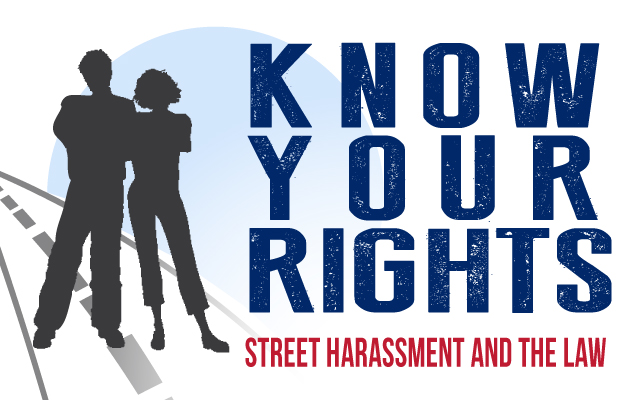
But Stop Street Harassment’s newest resource, Know Your Rights: Street Harassment and the Law, reveals that many common street harassment behaviors are in fact illegal across the U.S., giving you grounds to report an incident and seek help.

In preparation for the launch of our toolkit, I spoke to Officer Harris of the University of Washington Police Department about an incident of street harassment that he recently responded to.

The University of Washington Incident

The incident began as too many do: a female student was out for an evening run near the University of Washington campus when a man allegedly jumped out from around a corner, grabbed her by the arm, and said, “How are you doing tonight?”

As anyone who has experienced street harassment knows, a harasser’s language may be benign in itself but it usually comes with an intimidating interaction.

The student responded with a few choice words and crossed the street. (While SSH doesn’t recommend profanity or insults, an assertive response can help prevent sexual assault and/or feelings of disempowerment.)

After making sure the man hadn’t followed her – although he did leer in her direction – the young woman returned home and called University Police. Harris responded to the call, checked the area where the incident took place, and the young woman identified the man in question. He was arrested and charged with assault.

While it would be better if street harassment didn’t happen at all, the situation Harris described is ideal in terms of the young woman’s safety and the police response. I asked Officer Harris if he felt there was any room for discretion in determining whether or not to arrest the offender.

“No,” he said, “she was afraid for her safety and her well-being.” Given that it was after dark and “the guy grabbed her and really scared her,” he added, “I think most police officers would have taken that very seriously.”

Unfortunately, we know that not all officers see street harassment so clearly. But Officer Harris presented the perspective we hope all police officers will have and the standard that you should hold your community police to.

“Even if somebody made rude comments,” Harris said, “or made somebody feel unsafe, even if it wasn’t a crime yet, we would still go and talk to them.” Officer Harris stressed that no one should feel “unqualified” to call the police because what happened to her or him did not escalate to physical assault. It is appropriate, he told me, for an officer to have a “knock-it-off” conversation with someone even before an incident becomes criminal.

“A lot of very serious incidents start off as ‘it’s not that serious, it’s not a big deal.’ … But we’ll be glad to go investigate and keep things from escalating.”

In a society that says street harassment is a “compliment,” or “no big deal,” Harris’ perspective may sound too good to be true. But in fact, it may be a sign that advocacy efforts do work.

Notably, Victim’s Advocate Natalie Dolci provides the University of Washington officers with a variety of training and support to best address sexual assault, stalking, and gender-based violence.

I asked Harris what his main takeaways were from the training he has received and what advice he might have for other officers.

* He shared that he learned what a lasting impact sexual assault and sexual abuse can have on a person, and stressed that it’s important for officers to take every case very seriously.

* He included street harassment in that sentiment, noting that officers have a role to play in preventing street harassment from “becoming a habit” or escalating.

* He also added that his department works to have a positive relationship with the community and looks “for directions from the community on what problems they have or what they need help with.

Reach out to your department,” he said, “and let them know what you need.”

Have you reported street harassment to the police? What happened? What did officers in your community do well, or what would you like them to do differently? Leave your stories and ideas in the comments, and check out our new Know Your Rights toolkit to learn about the laws in your state.

Talia Hagerty has been a Stop Street Harassment intern since June 2013. She also is a peace economics consultant working on a variety of projects that ensure the equitable economic participation of all. She holds a B.A. in Economics from Eckerd College and an M.S. in Global Affairs with a concentration in Peacebuilding from New York University. Talia blogs about peacebuilding, human rights, economic development, and witty responses to street harassment. Follow her on Twitter: @taliahagerty.

Share

Filed Under: male perspective, Resources, Stories, street harassment

I Know My Rights

December 2, 2013 By SSHIntern

I work in a branch of psychological research that emphasizes: structural change, policy influence, and empowerment of marginalized groups as they exist within their communities. These are the tools and theories that have guided my work, and similarly, what attracted me to Stop Street Harassment. But what happens when structural change isn’t enough? What happens when the policies change but the culture doesn’t? I had an experience the other day that reminded me of my work—and reminded me that even when the policy and legislature are clear, I have to continue to work to change the culture.

The other day on my way home, having just dedicated hours to working on a section of the “Know Your Rights Toolkit,” I ended up in the transit center for about 30 minutes.

In a mere 30 minutes, mid-day, I was harassed, threatened, and berated by over half a dozen men. I had one man invade my personal space from behind and then simulate beating me with a crutch when I moved away in disgust. I had another pace back and forth staring at me as I was reading alone against a wall. I had one scream at me to smile in a voice that actually sounded annoyed. I was angry and exhausted and for the rest of the day—I actually felt a bit helpless. I knew my rights—and I did nothing. Even more, I was disappointed in the dozens of men who stared on, watched others treat me this way, yet said or did nothing.

When I finally got home, and was able to relax and calm down, I reminded myself that the toolkit was not intended to make victims feel guilty for not reporting—it was created so that we know our rights. And I do.

In the following days, I talked to a mutual acquaintance who is a police officer stationed in the transit center about keeping an eye on the harassment and let him know which areas were the most problematic. I took solace and satisfaction in knowing that my city offers online reporting, and that I can snap a camera phone picture of the particularly heinous offenders in the future. I felt proud of the way I chose to handle those particular harassers in that moment, and I felt grateful for my safety. The experience not only served as a reminder of the challenges in my work, but also reminded me that however I choose to respond that day, is the right way, and that the same remains true for all of you. I hope you all find the toolkit informative and possibly empowering when it releases on December 10. You can join our Tweet chat at 1 p.m. EST that day.

Rickelle Mason is Stop Street Harassment’s fall 2013 intern. She is an undergraduate senior at the University of North Carolina at Charlotte. With a major in Psychology and a minor in Women’s and Gender Studies, she has a passion for feminist psychology, and using community-based participatory research to dismantle gender-based violence. She has worked for several years in the university’s Community Psychology Research Lab, which was recently the recipient of the “Outstanding Training in Community Psychology” International Award.

Share

Filed Under: SSH programs, Stories, street harassment

Bringing Peacebuilding Home: My Summer with Stop Street Harassment

October 11, 2013 By SSHIntern

Cross-posted with permission from SSH’s Intern Talia Hagerty’s personal blog

Once again, I inadvertently took the summer off of Theory of Change. That isn’t because I took any time off of social change – I just had to get outside. Summer in New York City has been beautiful, and Fall is looking the same. (It’s 80 and sunny today!) But with the warm weather has come something else that’s gotten a lot a play around the web the past few months – street harassment. Since June, I’ve been working for the organization Stop Street Harassment (SSH) on one of the human rights and peacebuilding issue that plagues my community.

What is street harassment? You know it when you see it: it’s gender-based harassment in public spaces and it looks and sounds like, “Hey, baby!”, “Nice ass!”, “MMmmhhmmm…”, and “Give me a smile!” (Newsflash: I’m not here to give you anything, mister.) Unfortunately, these not-compliments are only the beginning – street harassment is most often verbal (like, every time I walk outside in Brooklyn) but can also include groping or indecent exposure, and can quickly escalate to sexual assault.

And why is it a human rights issue? Because women and the LGBTQ individuals targeted by street harassment never know when a seemingly innocuous comment will escalate into something much more serious. It’s a subtle form of violence that impacts women psychologically, limits our mobility, and leads us to live in fear. And sadly, what we’re afraid of – being followed, attacked, or raped – happens all the time.

For me, street harassment started when I was young teenager. There’s a lot of landscaping work that goes on in the Floridian paradise where I grew up, and those guys were the worst – always yelling and whistling from yards or the back of their trucks. People said to ignore it, but I was just a kid and it made me feel gross. Earlier this summer I wrote for the SSH blog about the first time street harassment made me really afraid – and made me think of using violence in my own defense – in my neighborhood in Brooklyn.

I immediately made a plan. I was carrying my cell phone and wallet in one hand and my dinner and an umbrella in the other. If anyone – a sexual harasser or otherwise – wanted to take my wallet, it would have been easy. I’ve heard so many stories, and had so many men overreact when I told them to stop harassing me, that I knew, if he was following me, how this would play out. If this man wanted to intimidate me, the easiest thing for him to do would be to grab my wallet and phone and push me to the ground. He would walk away with some cash, an iPhone, and a renewed sense of his violent power.

So what are we doing about it? SSH founder Holly Kearl brought me on in June to build Know Your Rights Guide for dealing with street harassment in the 50 U.S. States. As far as I know, most people don’t report street harassment to the police, even when the harasser is doing something clearly illegal. Of course, yelling “Hey, baby!” isn’t illegal – and it shouldn’t be. But you can always call 911 if you think you’re being followed, and every state we’ve surveyed so far has laws that protect you from indecent exposure, groping, and other forms of assault. We’re collecting the relevant laws for each state and major city, and we aim to have the Guide online later this fall so that you can know your rights.

If this sounds familiar, because street harassment is part of your life, or if you’re a guy and didn’t know what your friends/sister/partner/mother/daughter might be going through, get involved and help out our effort. If you see street harassment, especially you men, intervene to stop it. There are plenty of creative, nonviolent and deescalating ways to do so. Share your stories – of street harassment and street respect – on the SSH blog. Follow us on Twitter and Facebook to keep up with our work and find the Guide when it goes live. And if you really want to make an impact, donate. It’s tax deductible, and it keeps activists like me housed, fed, and working for safer streets.

Share

Filed Under: SSH programs, Stories, street harassment

“It’s OK, we weren’t talking to you – just about you.”

June 21, 2013 By SSHIntern

A daytime shot of the intersection where this happened in Bay Ridge, Brooklyn. Photo credit: Anthony Lanzilote for AM New York.

I live in a safe neighborhood.

Of course, as a woman, that’s not an unqualified statement. What I mean is, I’ve only felt a relatively normal amount of fear when I walk alone or come home late. I don’t mean safe as in, I’m not worried about being harassed, followed, or worse. I mean, I’m not as worried about being harassed and followed as I would be in some other neighborhoods.

But last night I didn’t feel safe – I felt scared.

I went to pick up take-out for my boyfriend and me. I was presumptuous enough to do this alone. As I crossed the street kitty-corner from my block, two older men entered the cross walk as well. I did have that fleeting thought – it’s only a split second, hardly articulated, but spelled out it would read, “Please don’t say anything… not tonight…”

And then I heard, “Mira.” Spanish for, “Look.” Men in New York don’t usually expect me to speak Spanish. But I understood that one of them was telling the other to look at me, and when I turned he was a foot away from me, looking me up and down, and nearly drooling. (I know, I know, so flattering.)

I couldn’t help it. This was not a moment to “just ignore it” – he was too close. I said very clearly and directly to this man, “Please stop looking at me. It makes me uncomfortable.”

He replied, “It’s ok, I was just talking to my friend.”

It’s ok, we weren’t talking to you – just about you. This street doesn’t belong to you.

The other light was green and I needed to get away. I crossed the other street quickly, in front of the last few lighted shops before my dark apartment building. But when I was halfway up the block, I saw the man who had originally pointed me out crossing diagonally through the middle of the street and heading straight toward me. I started to panic. Was he coming after me? Was he going to say something? Would he try to hurt me? Would anyone help? This is New York…

I immediately made a plan. I was carrying my cell phone and wallet in one hand and my dinner and an umbrella in the other. If anyone – a sexual harasser or otherwise – wanted to take my wallet, it would have been easy. I’ve heard so many stories, and had so many men overreact when I told them to stop harassing me, that I knew, if he was following me, how this would play out. If this man wanted to intimidate me, the easiest thing for him to do would be to grab my wallet and phone and push me to the ground. He would walk away with some cash, an iPhone, and a renewed sense of his violent power.

I put the take-out bag handle over my left wrist and with the same hand held my phone and wallet against my stomach. In my right hand, I gripped the handle of my folded umbrella, ready to defend myself.

Perhaps I should note here – I’m a peace activist. I’m a practitioner of nonviolence, and everything I do personally and professionally is aimed at reducing the amount of violence in this world. But here I was, outside my own home in my “safe” neighborhood, mentally preparing myself to hit a man with my umbrella as hard as I could to defend myself.

I was thinking it through – he had fallen in step behind me, so if I heard him get close or saw his shadow too near me, I would have to turn around. I couldn’t let him get between me and my front door or I’d never get home safely. If he put his hands on me I’d get one good whack to bat him off and I’ve have to instantly run. If I didn’t run as fast as I could and get inside that door, there would be no fending off this man twice my height. And if he happened to be walking behind me because he lived in my building of 125 units where no one talks to their neighbors, well, then, there was no hope for me.

I got inside and up four flights of stairs as fast as I could, and he didn’t try to follow me. But my boyfriend and I were both scared and angry for several minutes even after I’d dead bolted our door.

Most of the time these men don’t follow me. Compared to the stories I’ve heard, I’ve been very lucky. But this isn’t the first time this has happened, and I know it won’t be the last. Every time a man harasses me, and especially when I dare to speak back, I have to plan my self defense, my escape route, the bystander I’ll look to, and what I’ll yell. I’ve practiced, “I don’t know you! Stop it!” lest anyone think this a “domestic dispute” that they shouldn’t get involved in.

This is the city, and the world, we live in. I can march against rape, injustice, police violence, and the war, but when I go out at night… I’d better have that umbrella.

Talia Hagerty is peace economics activist and Stop Street Harassment’s 2013 summer intern. Follow her on twitter – @taliahagerty – or read her blog about making the world better at www.theoryofchange.wordpress.com.


Share

Filed Under: Stories, street harassment Tagged With: brooklyn, following, New York City, safe streets, street harassment

« Previous Page

Share Your Story

Share your street harassment story for the blog. Donate Now

From the Blog

  • #MeToo 2024 Study Released Today
  • Join International Anti-Street Harassment Week 2022
  • Giving Tuesday – Fund the Hotline
  • Thank You – International Anti-Street Harassment Week 2021
  • Share Your Story – Safecity and Catcalls Collaboration

Buy the Book

  • Contact
  • Events
  • Join Us
  • Donate
  • Facebook
  • Instagram
  • Pinterest
  • Tumblr
  • Twitter
  • YouTube

Copyright © 2026 Stop Street Harassment · Website Design by Sarah Marie Lacy