• About Us
    • What Is Street Harassment?
    • Why Stopping Street Harassment Matters
    • Meet the Team
      • Board of Directors
      • Past Board Members
    • In The Media
  • Our Work
    • National Street Harassment Hotline
    • International Anti-Street Harassment Week
    • Blog Correspondents
      • Past SSH Correspondents
    • Safe Public Spaces Mentoring Program
    • Publications
    • National Studies
    • Campaigns against Companies
    • Washington, D.C. Activism
  • Our Books
  • Donate
  • Store

Stop Street Harassment

Making Public Spaces Safe and Welcoming

  • Facebook
  • Instagram
  • Pinterest
  • Tumblr
  • Twitter
  • YouTube
  • Home
  • Blog
    • Harassment Stories
    • Blog Correspondents
    • Street Respect Stories
  • Help & Advice
    • National Street Harassment Hotline
    • Dealing With Harassers
      • Assertive Responses
      • Reporting Harassers
      • Bystander Responses
      • Creative Responses
    • What to Do Before or After Harassment
    • Street Harassment and the Law
  • Resources
    • Definitions
    • Statistics
    • Articles & Books
    • Anti-Harassment Groups & Campaigns
    • Male Allies
      • Educating Boys & Men
      • How to Talk to Women
      • Bystander Tips
    • Video Clips
    • Images & Flyers
  • Take Community Action
  • Contact

“This is becoming a real problem and is affecting my anxiety”

August 15, 2016 By Contributor

It was a summer evening in Elmont, New York. It was about 7:30 p.m. and I had gone down the block from my house to grab a few snacks. I was wearing black sneakers, grey leggings and a white t-shirt. After shopping at my local Rite Aid, I was walking home through the parking lot. An older man who was walking near me stopped and began leering at me and saying, “Ohhh, look at all that sweetness.”

I turned around to look at him and I shook my head indicating that it was not appropriate for him to be leering at me. I began walking off. Next thing I know, a car pulls up alongside me, the man was now in the driver’s seat with another man in the passenger seat. He rolls down the window and says…

“Hey don’t be like that, I was complimenting you – I was telling you how sweet all of you is.”

I usually will walk away from this, but today I had had enough. I stopped and said, “Excuse me?”

He then began to repeat himself before I jumped in and begin telling him how inappropriate his words were. I told him that no matter what he said it is not okay for him to make a woman in the street feel incredibly uncomfortable. I told him how disrespected I felt and that he has no right to leer at me in that manner.

“Look at what you’re wearing,” he said. “I can say whatever I want because you’re dressed like that.”

I became furious! I was speechless. I wish I had been able to film what he had said in that moment. I continued ranting about how disgraceful that was until I found myself walking away in a fury. Then another car nearby slowed down and two men shouted, “Baby, what is wrong? Is he trying to get your number?” as they laughed and jeered.

I felt so completely miserable. I was nothing but a source of entertainment, a sexualized object with no value, no voice. It astonishes me that I cannot walk to my local store without being harassed like that.

I experience daily catcalling and harassment, but it has come to a point where this is becoming a real problem and is affecting my anxiety. I cannot continue to feel unsafe in public places.

– KA

Location: Elmont, New York

Need support? Call the toll-free National Street Harassment hotline: 855-897-5910

Share your street harassment story for the blog.
See the book 50 Stories about Stopping Street Harassers for idea
s.

Share

Filed Under: Stories, street harassment

“Street harassment isn’t normal and shouldn’t happen!”

August 13, 2016 By Contributor

I was walking down the street with my little sister and mother in front of me and a group of teenage boys passed next to me walking in the opposite direction. They were making noises to attract my attention but I looked down and actually, I didn’t even noticed their presence until one of the boys almost rubbed himself against me when passing and stroked my cheek. I was shocked and angry. I didn’t even know how to react.

That wasn’t my first time experiencing street harassment. I am quite used of it. I’ve already been stalked, followed, called names, but that was the first time someone had actually touched me without my consent. Normally I don’t pay attention to those behaviors but this time it was different. I realized that this wasn’t normal. Like my body isn’t a public area and these kinds of thing shouldn’t happen. I shouldn’t go out and worry about street harassment. Because street harassment isn’t normal and shouldn’t happen!!

I was really shocked and angry as I said, but this made me realize that people shouldn’t be afraid to talk about things like street harassment or whatever makes them uncomfortable!! That we should also stand for our rights and help create a world where we could walk wherever we want without suffering from street harassment!

So in the end I’m glad I’ve realized all this and I hope this story will help others to express themselves.

Optional: What’s one way you think we can make public places safer for everyone?

I think we should continue to raise awareness and encourage women and men to speak their mind.

– Khooshalee

Location: Port-Louis/Port-Louis/Mauritius

Need support? Call the toll-free National Street Harassment hotline: 855-897-5910

Share your street harassment story for the blog.
See the book 50 Stories about Stopping Street Harassers for idea
s.

Share

Filed Under: Stories, street harassment

You Can’t Keep Women Runners Safe By Only Talking to Women

August 12, 2016 By HKearl

Cross-posted from Huffington Post

Three young women were killed while running alone in Michigan, Massachusetts and New York across the past two weeks. Each case is under investigation with no clear motives or suspects. Police believe they are unconnected cases.

But there are connections. In each tragedy, the victim was female and she was alone in a country that is unsafe for women. It’s quite likely that another connection is that their killers were male. Women are most often killed by men; just as men are most often killed by men.

In the regions where the attacks happened, some women feel nervous about going running alone, so more of them are joining running groups and changing their running routes. There’s been an increased interest in safety phone apps and a spike in sales for “booby trap bras,” a product that was developed by a female runner after she was attacked.

I empathize with these women runners’ concern.

I am 33 years old and I have been a long distance runner for 20 years. I ran my first marathon when I was 14. When I was 13, I attended a week-long cross country camp. The camp was for both girls and boys, ages 13 to 18, and we were together for all of our runs, clinics and social activities. But one morning, the boys went outside to for a fun activity while the girls stayed inside and listened to the male coach’s wife talk to us about safety.

She told us how she used to run the same route at the same time of day and a man she sometimes passed began to take notice. One day, he physically attacked her. She was able to escape. She told us we could be at risk if we ran alone, if we wore headphones, and if we ran at the same times along the same routes. Her story scared me. What I took to heart the most from her talk was to never become predictable. I have never run the same route at the same time two days in a row if I am running alone.

Aside from when I ran on school teams in high school and college, I have largely chosen to run alone. I am often the only woman I see running alone, especially on bike trails and wood paths. I actually feel the safest in the woods or on a mountain path compared with running by roads.

Across the more than 30,000 miles that I have run, hundreds of men I do not know have verbally harassed me from their moving vehicles and from sidewalks as I pass by. Men have harassed me in many other situations too, but as I am alone the most while running, that is when I have faced the most harassment.

My experience is not unusual. A 2014 national study found that 65% of American women had experienced verbal or physical harassment by men they do not know. This included a national statistic of 1 in 4 women having been sexually touched and 1 in 5 having been followed.

The first time a man followed me in his car, I was 14 years old and on a mid-morning summer run near my house in California. I was able to dart down side streets and lose him. When I was 22 years old, a man chased me through a park in Virginia one evening during my run after work. I have never been more terrified. I’m grateful I could will my legs to move fast and I outran him.

All women runners have been warned about the potential dangers of men harming us when we run alone. We read stories like these recent ones and we know there are risks. But for most of us, it’s a risk we continue to take because the benefits of running, including alone, outweigh those risks. And that’s how I hope it can be; that we keep on running, that we claim these public spaces as our own, because that’s how it should be. We belong and we should have that right.

Looking back at the running summer camp I attended, I am frustrated that the discussion was only for the girls. While both women and men are at risk of being hurt and even killed by careless drivers, predatory attackers primarily target girls and women. And those predatory attackers are primarily boys and men, yet the premise of the discussion — and of so many discussions and articles since — was to teach us girls that it was our responsibility to stay safe, rather than the boys’ responsibility to work with us to create a world where we could be safe. To their credit, I have yet to be harassed by a male runner, but I still think they should be part of this conversation.

Overall, I want to see more accountability placed on boys and men. Yes, #NotAllMen attack and kill women, in fact a very, very small portion do. But quite a lot of men verbally harass women, demean them, and make sexist slurs and jokes. Those behaviors create a world in which women are valued less and they provide a context for attacks to happen. Women cannot truly be safe on the trails or in any other public space until those behaviors end.


Share

Filed Under: News stories Tagged With: killed, runners, safety

Survivor Activists Call on Campuses to #JustSaySorry

August 11, 2016 By Correspondent

By LB Klein, former SSH Blog Correspondent

Kamilah Willingham, via her Twitter page

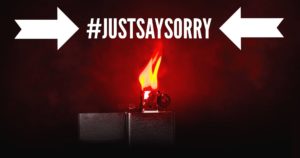
There is a joyful moment during which applicants to institutions of higher education turn into admitted students. This moment is perhaps best captured by students sporting newly-acquired campus swag such as a sweatshirt in official colors with the campus name emblazoned on the front or a t-shirt with a mascot. However, for survivors of sexual assault on many campuses who felt their schools did not support them, these coveted items quickly become a tangible reminder of a dream promised and nightmare delivered. To capture the hollowness of institutional betrayal, Wagatwe Wanjuki and Kamilah Willingham, two prominent Black feminist survivor activists and founders of Survivors Eradicating Rape Culture, are literally setting these items on fire.

Willingham and Wanjuki are burning their once-prized possessions and asking for other survivors to do the same until their alma maters do what they see as the bare minimum: acknowledge their experiences by apologizing. Through this #JustSaySorry campaign Survivors Eradicating Rape Culture is asking for “public acknowledgements of past failures” to “restore a sense of trust in the school’s intention and ability to approach campus gendered violence with integrity.” They argue that this action is simple but would have a huge impact on survivors who often feel their campuses see them as numbers in a crime statistics report and not treasured students or alumni who deserve restoration.

saysorryA few years have passed since Wanjuki and Wilingham were sexually assaulted while students at Tufts University and Harvard Law School respectively, they discuss the long-range impact of institutional betrayal. In a recent article she penned for The Establishment, Willingham mentions the “PTSD and a six-figure student debt amount” that linger, while her pride in her Harvard Law School attendance have faded. Much like movements to address street harassment, #JustSaySorry uses a grassroots and community approach to ask institutions to move beyond the often clinical official statements often issued by college and universities. #JustSaySorry is calling for acknowledgment of survivors as people and to consider the human impact of sexual violence and its aftermath when handled poorly.
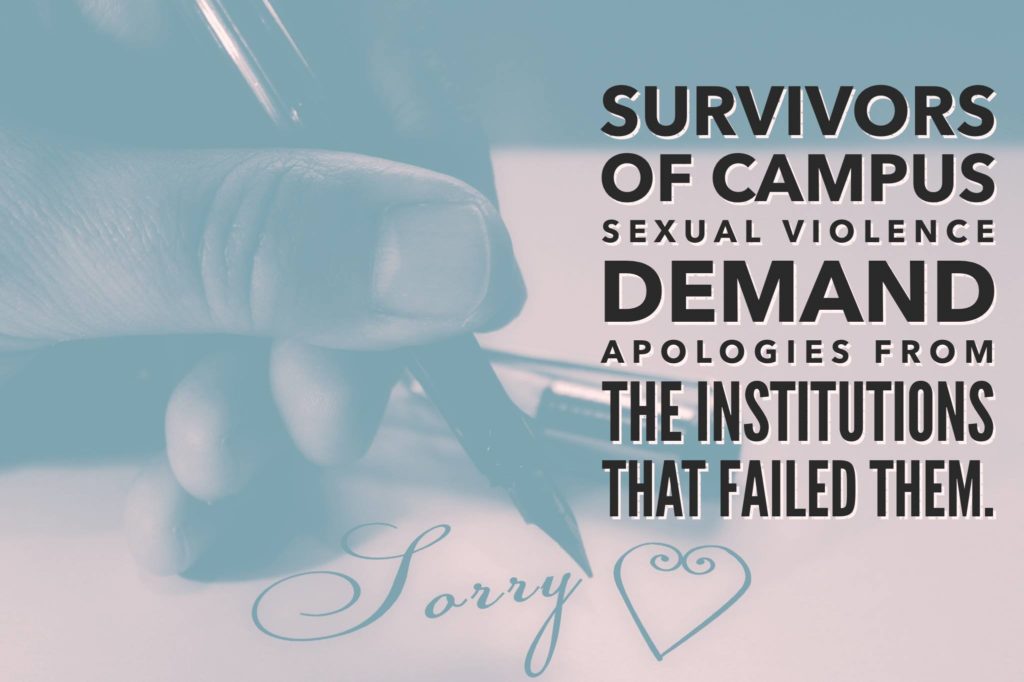
Survivors Eradicating Rape Culture and the #JustSaySorry campaign come at a time during which there is increased attention to the issue of sexual violence on campuses, but the road to accountability can be a long and fruitless one for survivors. No matter how well we enhance our university systems (and we should) we are in need of more than just more laws and more policies. Our processes for holding institutions accountable for the harm they have caused survivors frequently mirror the failings of systems of perpetrator accountability.

survivorWanjuki and Willingham are reminding us through their deeply personal and cathartic actions that genuine apologizing is a rare, critical, and distressingly radical act for administrators and institutions. Survivors Ending Rape Culture is calling on survivors to send them items from alma maters who failed them or to post videos or photos of themselves withholding their donations to their institutions.
Anyone can show solidarity for their work by using the hashtag #JustSaySorry to call out institutions that have caused survivors harm or by tuning into their live broadcasts of burning protests. To create more survivor supportive cultures, we cannot rely solely on strengthening formal systems. As Willingham and Wanjuki are demonstrating, we must also recognize the powerful role that the people who make up institutions and communities have to help survivors heal.

LB Klein, MSW, MPA has dedicated her professional and academic life to ending gender-based violence, supporting survivors, and advancing social justice. She is a doctoral fellow in the University of North Carolina at Chapel Hill’s School of Social Work and serves a lead trainer and curriculum development specialist for the Prevention Innovations Research Center at the University of New Hampshire.

Share

Filed Under: correspondents Tagged With: activism, campus rape, sexual assault

USA: Make Your Voice Matter

August 10, 2016 By Correspondent

Hope Herten, IL, USA, SSH Blog Correspondent

Warning: This is cheesy! 🙂

If you have been keeping up with my posts throughout the summer, I hope that you were able to relate to my message and learn a little bit about who I am and what it’s like being a young woman in Chicago.  Unfortunately though, my own personal experience and the experiences I have shared from my friends are barely the tip of the iceberg when it comes to street harassment and the other obstacles women, people of color, and trans people face trying to live independently  in the US today.  There are people all over the spectrum of marginalized groups that face different kinds, and an array of severity, of harassment.

Despite my limited experience, it is always my hope that my voice will be heard and will open a door so that those less privileged than me can have a chance to live in a world where their lives are valued more; that their safety and prosperity is prioritized. The topic of street harassment and other feminist movements have helped all kinds of women come together, recognize intersectionalities, and fight for causes that improve the lives of all.

I am using this final post as a platform to call out anyone who reads this and ask them to do one thing this week to make their voice heard and fight back against street harassment. Help out that woman you see on the street or on the bus facing harassment, stop passive aggressively tweeting about sexist colleagues and TAG THEM, say something in your group chat about offensive jokes, anything. The conversation has already been started. Use links to inform your message and utilize hashtags to contribute to the larger conversation. Thanks to social media more than ever voices can be heard. So make yours matter.

Side note: The Slut Walk is a great way to show your support and fight street harassment. Dress however you’d like and bring your friends! If you live in or near Chicago, it’s on August 20th! See you there!

Hope is a full-time undergraduate student studying public health and Spanish in Chicago, IL.  If you want to keep up with Hope you can follow her on Twitter @hope_lucille or check out her public health blog.

Share

Filed Under: correspondents

« Previous Page
Next Page »

Share Your Story

Share your street harassment story for the blog. Donate Now

From the Blog

  • #MeToo 2024 Study Released Today
  • Join International Anti-Street Harassment Week 2022
  • Giving Tuesday – Fund the Hotline
  • Thank You – International Anti-Street Harassment Week 2021
  • Share Your Story – Safecity and Catcalls Collaboration

Buy the Book

Search

Archives

  • September 2024
  • March 2022
  • November 2021
  • April 2021
  • March 2021
  • January 2021
  • April 2020
  • March 2020
  • February 2020
  • December 2019
  • November 2019
  • September 2019
  • August 2019
  • July 2019
  • June 2019
  • May 2019
  • April 2019
  • March 2019
  • February 2019
  • January 2019
  • December 2018
  • November 2018
  • October 2018
  • September 2018
  • August 2018
  • July 2018
  • June 2018
  • May 2018
  • April 2018
  • March 2018
  • February 2018
  • January 2018
  • December 2017
  • November 2017
  • October 2017
  • September 2017
  • August 2017
  • July 2017
  • June 2017
  • May 2017
  • April 2017
  • March 2017
  • February 2017
  • January 2017
  • December 2016
  • November 2016
  • October 2016
  • September 2016
  • August 2016
  • July 2016
  • June 2016
  • May 2016
  • April 2016
  • March 2016
  • February 2016
  • January 2016
  • December 2015
  • November 2015
  • October 2015
  • September 2015
  • August 2015
  • July 2015
  • June 2015
  • May 2015
  • April 2015
  • March 2015
  • February 2015
  • January 2015
  • December 2014
  • November 2014
  • October 2014
  • September 2014
  • August 2014
  • July 2014
  • June 2014
  • May 2014
  • April 2014
  • March 2014
  • February 2014
  • January 2014
  • December 2013
  • November 2013
  • October 2013
  • September 2013
  • August 2013
  • July 2013
  • June 2013
  • May 2013
  • April 2013
  • March 2013
  • February 2013
  • January 2013
  • December 2012
  • November 2012
  • October 2012
  • September 2012
  • August 2012
  • July 2012
  • June 2012
  • May 2012
  • April 2012
  • March 2012
  • February 2012
  • January 2012
  • December 2011
  • November 2011
  • October 2011
  • September 2011
  • August 2011
  • July 2011
  • June 2011
  • May 2011
  • April 2011
  • March 2011
  • February 2011
  • January 2011
  • December 2010
  • November 2010
  • October 2010
  • September 2010
  • August 2010
  • July 2010
  • June 2010
  • May 2010
  • April 2010
  • March 2010
  • February 2010
  • January 2010
  • December 2009
  • November 2009
  • October 2009
  • September 2009
  • August 2009
  • July 2009
  • June 2009
  • May 2009
  • April 2009
  • March 2009
  • February 2009
  • January 2009
  • December 2008
  • November 2008
  • October 2008
  • September 2008
  • August 2008
  • July 2008
  • June 2008
  • May 2008

Comment Policy

SSH will not publish any comment that is offensive or hateful and does not add to a thoughtful discussion of street harassment. Racism, homophobia, transphobia, disabalism, classism, and sexism will not be tolerated. Disclaimer: SSH may use any stories submitted to the blog in future scholarly publications on street harassment.
  • Contact
  • Events
  • Join Us
  • Donate
  • Facebook
  • Instagram
  • Pinterest
  • Tumblr
  • Twitter
  • YouTube

Copyright © 2026 Stop Street Harassment · Website Design by Sarah Marie Lacy