• About Us
    • What Is Street Harassment?
    • Why Stopping Street Harassment Matters
    • Meet the Team
      • Board of Directors
      • Past Board Members
    • In The Media
  • Our Work
    • National Street Harassment Hotline
    • International Anti-Street Harassment Week
    • Blog Correspondents
      • Past SSH Correspondents
    • Safe Public Spaces Mentoring Program
    • Publications
    • National Studies
    • Campaigns against Companies
    • Washington, D.C. Activism
  • Our Books
  • Donate
  • Store

Stop Street Harassment

Making Public Spaces Safe and Welcoming

  • Facebook
  • Instagram
  • Pinterest
  • Tumblr
  • Twitter
  • YouTube
  • Home
  • Blog
    • Harassment Stories
    • Blog Correspondents
    • Street Respect Stories
  • Help & Advice
    • National Street Harassment Hotline
    • Dealing With Harassers
      • Assertive Responses
      • Reporting Harassers
      • Bystander Responses
      • Creative Responses
    • What to Do Before or After Harassment
    • Street Harassment and the Law
  • Resources
    • Definitions
    • Statistics
    • Articles & Books
    • Anti-Harassment Groups & Campaigns
    • Male Allies
      • Educating Boys & Men
      • How to Talk to Women
      • Bystander Tips
    • Video Clips
    • Images & Flyers
  • Take Community Action
  • Contact

“Looking gay today”

May 16, 2016 By Contributor

Two times in the last week I have had different guys shout out of the passenger side of a car at me. Also, I’m a guy. The first screamed “faggot” and the second said, “Looking gay today” as I walked by the car while it was at a stop light.

I’m a straight guy who does take care of the way I look. I am not afraid to wear brighter colors.

Neither of these are my first experiences with such harassment, but I’ve never had two within a week. The first time this week really pissed me off and I wanted to punch the guy in the face. I stewed about it for a while, feeling a little shamed and shocked. I wondered why on earth the guy felt he had any right to even comment on me walking down the street.

The second time the guy didn’t scream it at me but just said nonchalantly, “Looking gay today.” I ignored it and wondered why him and the other guy even noticed me and bothered to comment. I think that says something about them right there.

That second time I felt pretty belittled and there were a couple of other people nearby. I felt like that comment might initiate more harassment from someone else. I walked quickly with my senses heightened concerned that someone might decide to act on the comment. I also prepared to throw the hardest punches I could if need be. So I felt I needed to prepare to fight, both times. Luckily I just kept going and nothing came of it.

Optional: What’s one way you think we can make public places safer for everyone?

As far as street harassment goes, perhaps passing a law making it illegal to threaten or harass people from a car.

– J

Location: First place was in Sammamish, WA, by Pine Lake, second was by Target across the street from Northgate Mall in Seattle.

Share your street harassment story for the blog.
See the book 50 Stories about Stopping Street Harassers for more idea.

Share

Filed Under: male perspective, Stories, street harassment Tagged With: homophobic

Survey: “Impact of Homophobia for Nigerians”

May 16, 2016 By HKearl

Our friends at the Bisi Alimi Foundation are conducting a survey on the Impact of Homophobia for Nigerians. They say:
 
“The survey is to help us understand the impact of discrimination based on Sexual Orientation and Gender Identity in Nigeria. It will also help us provide data to the issue and drive a global advocacy for proactive action.
 
This survey is for Nigerian LGBT people only and it for Nigerians, both in Nigeria and outside of Nigeria. If you have been out of Nigeria for more than 10 years and if you are not LGBT, I am sorry, this survey is not for you.
 
The survey is extremely confidential and will not be traced to anyone. We are hoping to sample between 500-1000 people
 
It takes about 10-20mins to fill out.”
 
If you have any questions, please email: survey@bisialimifoundation.org.
Share

Filed Under: LGBTQ, Resources Tagged With: homophobia, LGBQT, nigeria, survey

India: The Challenges Reporting Sexual Harassment

May 14, 2016 By Correspondent

Tharunya Balan, Bangalore, India, SSH Blog Correspondent

Trigger Warning

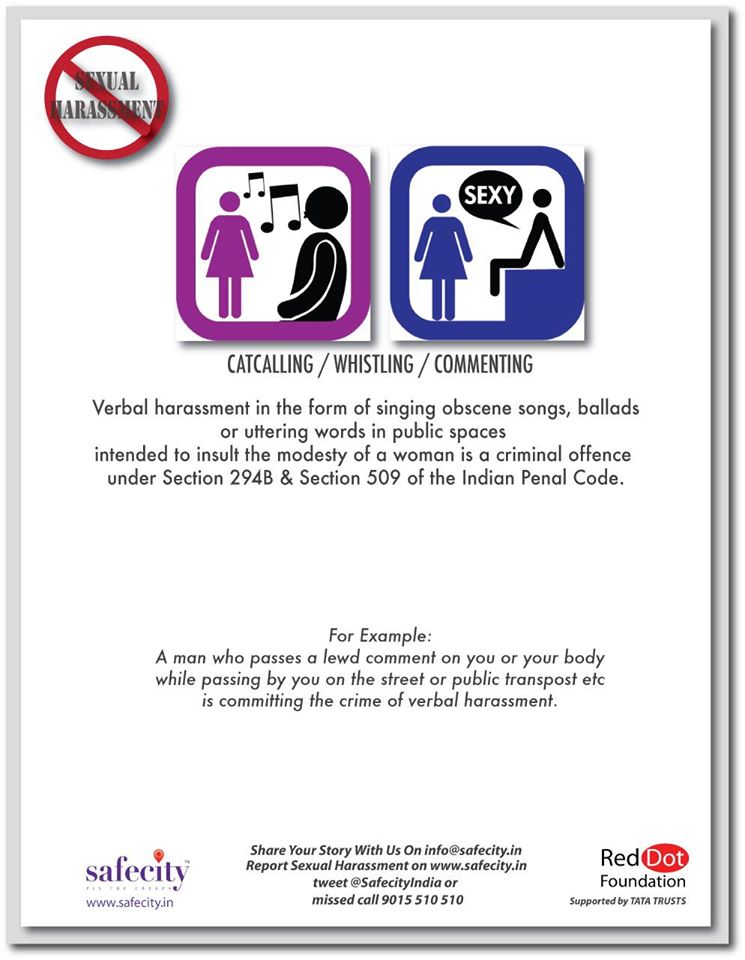
Verbal Harassment - IndiaThe 2012 case of the young woman who was fatally raped and assaulted on a bus in the Indian city of Delhi led to a number of decisions made at the State and Central levels to address violence against women, including several new laws against rape and sexual assault. The new laws include specific mentions of sexual harassment, voyeurism and stalking as punishable offences.

The publicity and international attention around the issue has led to more open conversation on the subject and encouraged more (mostly educated) women to report sexual assault and harassment. Unfortunately, passing laws to criminalize behaviour does little to change the prevalent rape culture and attitudes towards women held by much of the population. Even judges in other countries seem to assume that Indian culture means men simply do not understand boundaries and so cannot be held accountable for their actions.

In May of 2015, Amnesty International India approached the feminist magazine The Ladies Finger about their upcoming Ready to Report initiative, aimed at making it easier for victims of sexual harassment and assault to report incidents to the police. The online magazine then threw their doors open to people who had experienced sexual assault or harassment, and asked if they had tales to tell.

The stories published (a woman assaulted in a car, a woman molested by a friend she was visiting, a woman stalked by an old classmate, a woman molested on the street by a stranger, a team of journalists stalked and harassed by a stranger) include examples of the victims being interviewed in front of their attackers, of them being forced to recount the most intimate details of their assaults in front of a station full of curious policemen, of being browbeaten into recanting or rewriting their stories, and of their being treated as overreactions to minor annoyances, and the police taking it upon themselves to mete out justice as they saw fit.

The campaign also included a twitter hashtag that paints a depressing picture of the narratives that surround victims and stories of sexual assault in the country. Women are hesitant to speak up for a number of reasons, ranging from the fear of reprisals, the social stigma around sexual assault, the fear of being slut shamed for their choices, the stress of filing and following reports while fearing more harassment at the hands of the police force, the fear of negative media attention, and the fear of not being supported by friends and family, and the horror that surrounds medical examinations.

The founder of The Ladies Finger, Nisha Susan writes:

“The variables that affect whether an Indian woman’s claim is taken seriously by the police range considerably, from class, caste, the site of the assault, to the time of day. The more familiar the complainant was with the assaulter/ rapist/ stalker the less likely she was to successfully register a case. Our findings backed up results from the more rigorous studies undertaken by activists: in the legal system, you are likely to fare better if you have been violently assaulted by a working-class stranger in a public place.” (emphasis mine)

This only underscores the fact that marital rape is not a punishable offence, or indeed, a term recognized by the law at all, and it explains why so many reports of stalking are ignored or not taken seriously.

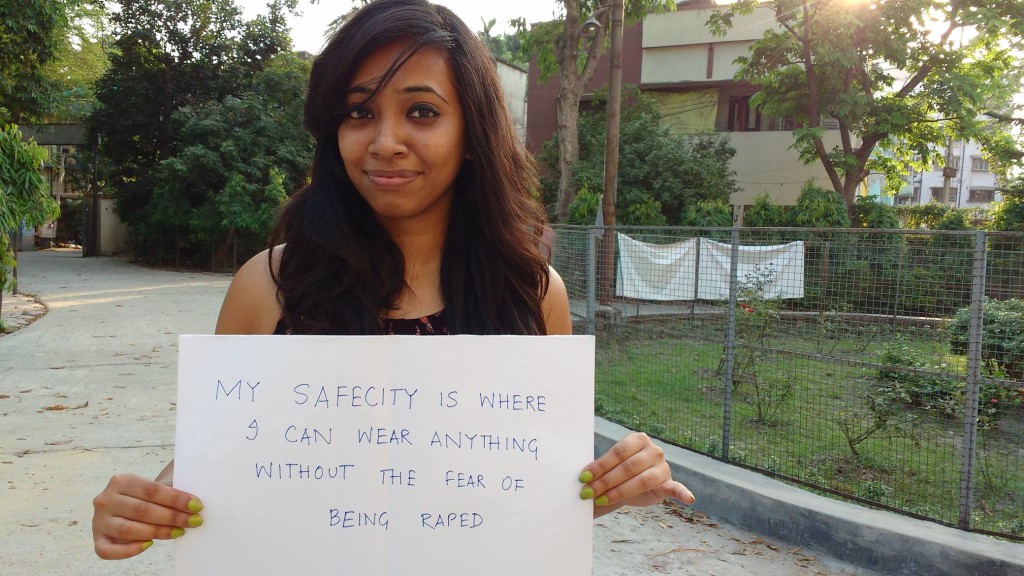
#SafeCity
#SafeCity

There is a lack of genuine discussion around the way women and women’s bodies are perceived in this country. The original text of the law (section 354 of the Indian Penal Code) defines as criminal the “assault or criminal force to woman with intent to outrage her modesty”, and it is this idea of “modesty” in the India context that is still such a sticking point. It is this idea that lies at the heart of the victim blaming, the slut shaming, and the dehumanizing treatment of rape and assault victims when they do come forward.

It is not just female victims who suffer under our archaic ideas of modesty and bodily autonomy. The sections of the Indian Penal Code that refer to rape are not gender neutral, and they do not acknowledge male victims of rape. There is something deeply embarrassing about a country whose leaders and whose laws are the equivalent of an ostrich sticking its head in the sand and pretending that what it sees does not exist. Treating sex as a taboo, refusing to understand the spectrums of gender and sexuality, ignoring the contradictions between what is portrayed in our media and what is taught to our children in schools and homes, and

What we are in dire need of in our country is real sex education: real conversations on consent and real understandings of the ways in which someone’s body and person can be violated by another’s actions.

Tharunya is an urban planner and architect with a passion for issues of social, environmental and spatial justice, including the gendered ways in which urban spaces are designed and function. She has a bachelor’s degree in architecture and a master’s degree in City and Regional Planning from the Georgia Institute of Technology, where she will be returning to obtain a degree in Geographic Infomations Systems Technology later this year. 

Share

Filed Under: correspondents Tagged With: India, reporting

Calvin Klein and the glamourisation of sexual harassment

May 14, 2016 By Contributor

Cross-posted with permission from SallyOReilly.com.

OffensiveCalvinKleinAd-May2016
“Upskirt” shot Calvin Klein ad

You’ve probably already heard about the new Calvin Klein advertising campaign. It’s worked, that’s for sure, in that Twitter and Facebook can’t get enough of complaining about it. And of course the pro-sexism and creepy factions can’t get enough of defending it and lashing out at people who recognise it for what it is – blatant sexist glamourisation of and dismissal of sexual harassment.

It’s so depressingly predictable. I almost didn’t write about it because I don’t want to give the advertisers my attention when I have better things to do right now – like eat lunch for example.

However, I’m incensed. I’ll be brief (that’s not a pun).

This new campaign features butt selfies, dodgy slogans, curiously vagina-like grapefruit and ‘upskirt’ shots of a girl who is not only not annoyed but is kind of, pleased looking. Because it’s flattering to have an upskirt shot taken right? At least that’s what they want us to think. They want us to think that women should be pleased to be objectified, and that being available in this way is what female sexuality is about. That this is erotica (yes ..they’ve actually officially called it “Erotica”). After all, women are the target market – right? (!!??)

“Eat_in #MyCalvins”

#RollsEyes

This shot, despite vast amounts of complaints (which I’m THRILLED about) is still live on their Instagram account as I type.

It is appalling, and utterly lacking in awareness and basic empathy, that womens’ experiences of sexual assaults and sexualisation are being normalised and packaged as ‘Erotica’ in this way.

Erotic for whom exactly? Well, I think we can answer that..

But that’s Calvin Klein for you. I don’t know if you’re aware of this but if you have a teenage daughter who has recently insisted that you buy her CK underwear there is a very real chance that on her Instagram there is now a shot of her in said underwear, possibly with some sideboob showing and a host of ‘likes’ from strangers, hashtagged #MyCalvins or #meandmycalvins.

This is grooming.

At ‘best’, teenaged girls are being trained to view themselves as sexual objects without desires of their own. At worst the brand is encouraging underaged girls to pose in ways that will attract sexual predators and who will grow up to believe that their function is to look and be sexually available and to be OK with , indeed to like with being viewed as such. How is that erotic for them?

And now, these predators can feel more OK about it, after all the ads have gone viral and teens themselves are hashtagging away, blissfully unaware of the sinister side of their online activities.

I’m concerned, very concerned.

Please engage your teenagers in a conversation about this when you get a chance and consider signing any online petitions you can find. While there is the irritating reality that we are giving CK more publicity here, there is a more positive reality too – people are beginning to see how very real the threat of advertising is to the self esteem and sexuality of our women and girls. And people power is a real thing.

Meanwhile – #NotBuyingIt.

Sally O’Reilly is a psychologist, psychotherapist & clinical supervisor based in East Cork, Ireland. She holds the European Certificate of Psychotherapy from the EAP and is a graduate member of the Psychological Society of Ireland. Visit her websites and follow her on Twitter, @psychosal.

Share

Filed Under: offensive ads, Resources Tagged With: calvin klein, offensive ads, sexual harassment, teenager, upskirt

“There wasn’t a way for me to respond”

May 13, 2016 By Contributor

A guy about my age pulled up in a car and yelled, “Hey, faggot!”

I was carrying something at the time, so I couldn’t flip him off, and I didn’t want to respond verbally and engage. So I kept walking and turned onto a one-way street where he couldn’t follow. I felt frustrated and angry; there wasn’t a way for me to respond, and I couldn’t really talk to my friends about it. What do you say? “Some guy yelled at me from a car.”

There’s not a follow-up or a “poor you” that you’d get or anything; it feels like a “so?” kind of thing to say.

– GK

Location: Outskirts of Chicago, IL, while walking to a friend’s house.

Share your street harassment story for the blog.
See the book 50 Stories about Stopping Street Harassers for more idea.
Share

Filed Under: Stories, street harassment

« Previous Page
Next Page »

Share Your Story

Share your street harassment story for the blog. Donate Now

From the Blog

  • #MeToo 2024 Study Released Today
  • Join International Anti-Street Harassment Week 2022
  • Giving Tuesday – Fund the Hotline
  • Thank You – International Anti-Street Harassment Week 2021
  • Share Your Story – Safecity and Catcalls Collaboration

Buy the Book

Search

Archives

  • September 2024
  • March 2022
  • November 2021
  • April 2021
  • March 2021
  • January 2021
  • April 2020
  • March 2020
  • February 2020
  • December 2019
  • November 2019
  • September 2019
  • August 2019
  • July 2019
  • June 2019
  • May 2019
  • April 2019
  • March 2019
  • February 2019
  • January 2019
  • December 2018
  • November 2018
  • October 2018
  • September 2018
  • August 2018
  • July 2018
  • June 2018
  • May 2018
  • April 2018
  • March 2018
  • February 2018
  • January 2018
  • December 2017
  • November 2017
  • October 2017
  • September 2017
  • August 2017
  • July 2017
  • June 2017
  • May 2017
  • April 2017
  • March 2017
  • February 2017
  • January 2017
  • December 2016
  • November 2016
  • October 2016
  • September 2016
  • August 2016
  • July 2016
  • June 2016
  • May 2016
  • April 2016
  • March 2016
  • February 2016
  • January 2016
  • December 2015
  • November 2015
  • October 2015
  • September 2015
  • August 2015
  • July 2015
  • June 2015
  • May 2015
  • April 2015
  • March 2015
  • February 2015
  • January 2015
  • December 2014
  • November 2014
  • October 2014
  • September 2014
  • August 2014
  • July 2014
  • June 2014
  • May 2014
  • April 2014
  • March 2014
  • February 2014
  • January 2014
  • December 2013
  • November 2013
  • October 2013
  • September 2013
  • August 2013
  • July 2013
  • June 2013
  • May 2013
  • April 2013
  • March 2013
  • February 2013
  • January 2013
  • December 2012
  • November 2012
  • October 2012
  • September 2012
  • August 2012
  • July 2012
  • June 2012
  • May 2012
  • April 2012
  • March 2012
  • February 2012
  • January 2012
  • December 2011
  • November 2011
  • October 2011
  • September 2011
  • August 2011
  • July 2011
  • June 2011
  • May 2011
  • April 2011
  • March 2011
  • February 2011
  • January 2011
  • December 2010
  • November 2010
  • October 2010
  • September 2010
  • August 2010
  • July 2010
  • June 2010
  • May 2010
  • April 2010
  • March 2010
  • February 2010
  • January 2010
  • December 2009
  • November 2009
  • October 2009
  • September 2009
  • August 2009
  • July 2009
  • June 2009
  • May 2009
  • April 2009
  • March 2009
  • February 2009
  • January 2009
  • December 2008
  • November 2008
  • October 2008
  • September 2008
  • August 2008
  • July 2008
  • June 2008
  • May 2008

Comment Policy

SSH will not publish any comment that is offensive or hateful and does not add to a thoughtful discussion of street harassment. Racism, homophobia, transphobia, disabalism, classism, and sexism will not be tolerated. Disclaimer: SSH may use any stories submitted to the blog in future scholarly publications on street harassment.
  • Contact
  • Events
  • Join Us
  • Donate
  • Facebook
  • Instagram
  • Pinterest
  • Tumblr
  • Twitter
  • YouTube

Copyright © 2026 Stop Street Harassment · Website Design by Sarah Marie Lacy