• About Us
    • What Is Street Harassment?
    • Why Stopping Street Harassment Matters
    • Meet the Team
      • Board of Directors
      • Past Board Members
    • In The Media
  • Our Work
    • National Street Harassment Hotline
    • International Anti-Street Harassment Week
    • Blog Correspondents
      • Past SSH Correspondents
    • Safe Public Spaces Mentoring Program
    • Publications
    • National Studies
    • Campaigns against Companies
    • Washington, D.C. Activism
  • Our Books
  • Donate
  • Store

Stop Street Harassment

Making Public Spaces Safe and Welcoming

  • Facebook
  • Instagram
  • Pinterest
  • Tumblr
  • Twitter
  • YouTube
  • Home
  • Blog
    • Harassment Stories
    • Blog Correspondents
    • Street Respect Stories
  • Help & Advice
    • National Street Harassment Hotline
    • Dealing With Harassers
      • Assertive Responses
      • Reporting Harassers
      • Bystander Responses
      • Creative Responses
    • What to Do Before or After Harassment
    • Street Harassment and the Law
  • Resources
    • Definitions
    • Statistics
    • Articles & Books
    • Anti-Harassment Groups & Campaigns
    • Male Allies
      • Educating Boys & Men
      • How to Talk to Women
      • Bystander Tips
    • Video Clips
    • Images & Flyers
  • Take Community Action
  • Contact

NPR Looks at Street Harassment Globally and Locally

April 9, 2016 By HKearl

What’s street harassment like around the world?

This was a question that Malaka Gharib at NPR wanted to have answered after she experienced street harassment first-hand in Egypt and the USA. I connected her to women I’d worked with, from Afghanistan to Japan, from Nepal to South Africa, and they shared their stories with her. She also kindly interviewed me and gave a shoutout to International Anti-Street Harassment Week.

The article went online on Wednesday. Here’s one story example:

India: “A growing trend is pictures being taken on mobile phones”

Women and girls are constantly stared at, groped in crowded spaces and on public transportation, catcalled, whistled and commented on regularly. A growing trend is pictures being taken on mobile phones without permission by strangers. Women and girls, through experience, either avoid certain areas, do not stay out late, limit their movements in public or wear loose clothing.

Public spaces should be safe and accessible to all, especially women and girls. It is crucial and essential if we want them to fully participate in society and the economy. If not, then choices and movements are restricted — and that in turn has a negative impact on society.

ElsaMarie D’Silva, 42, founder and managing director of Safecity

The article led to over 1000 comments to the article, on Facebook, on Twitter, and today, there’s a follow-up story highlighting some of the stories shared, from Canada to Italy to Switzerland. For example:

Switzerland: “He pushed me up against a wall”

I was 14 in Endingen, Switzerland. I was walking to school when a man working on street construction grabbed me. His friends and colleagues immediately surrounded us, laughing. He pushed me up against a wall, felt me up and tried to pin me for a kiss. The men pressed closer. I got away. I told people. I told my parents. Nobody did anything. It was kind of funny, they said, and boys will be boys. — Stephanie Nakhleh via Facebook

The amazing Noorjahan Akbar, founder of Free Women Writers, and I joined Malaka and other NPR staff in studios on Wednesday to create a Snapchat video too.

The NPR team + Noorjahan and Holly

I’m so grateful to Malaka and her team for providing space for women’s stories on the huge and respected platform of NPR.

Related, the Kojo Nnamdi Show had a segment on street harassment on Monday, featuring Jessica Raven Executive Director, Collective Action for Safe Spaces, Arthur Espinoza, Jr. Executive Director, DC Commission on the Arts and Humanities, and Brianne Nadeau Member, D.C. Council (D-Ward 1). YES!!!

Share

Filed Under: anti-street harassment week, News stories, Stories, street harassment Tagged With: Egypt, India, NPR, switzerland

100% of Women in Buenos Aires have Experienced Street Harassment

April 9, 2016 By HKearl

International Anti-Street Harassment Week officially kicks off tomorrow, but the global activism is already starting…!!

Last year, there was legislation passed in Argentina to designate an annual day against street harassment, to coincide around the time of International Anti-Street Harassment Week.

The day was yesterday and The Movement of Women of the Motherland of Latin American released a new study showing 100% of women in the City of Buenos Aires have experienced street harassment. The full survey results are available in Spanish. They include the following:

“Half the participants reported being subjected to sexually explicit comments, 59 percent reported obscene gestures, 47 percent had been followed by a man and 37 percent reported having a man’s genitalia exposed to them unasked…

87 percent reported avoiding dark or deserted streets, 63 percent won’t walk in certain areas unaccompanied and 51 percent dress in a manner that ‘doesn’t attract attention.'”

April2016-BuenosAiresStudy

The survey is part of larger campaign launched by MuMaLá called #ParemosElAcosoCallejero (#StopStreetHarassment).

The campaigners have an up-hill battle as the country’s President once said, “All women like to be told compliments, even if if it’s something something rude like, ‘What a cute ass you have’… it’s all good,” but documenting the problem and showing the negative affects it can have is an important way to start changing public opinion.


Share

Filed Under: anti-street harassment week, Resources, street harassment Tagged With: Argentina, Buenos Aires, study

The 7 Days of Anti-Street Harassment: A Vlog Series To Tackle The Issue

April 9, 2016 By Contributor

International Anti-Street Harassment Week is once again upon us. For the past three years, I’ve done something to take action against street harassment, from sidewalk chalking, to hosting Tweet Chats, and this year, vlogging! I wanted to create a tool that would be relevant long after the week was over, that could break down the issue, while also giving a very human perspective and voice to street harassment.

I’ve been on the board of Stop Street Harassment for almost two years now and I’m constantly both inspired by the great work we’re doing as an organization, and horrified at the gap in knowledge that still exists for so many. The question of “What is street harassment?” Has started to become less prevalent in recent years as awareness increases, but there’s still a lot of work to be done.

This video series is going to focus on both of these things: the positive work of SSH and the work that still needs to be done. I wanted to be able to speak to both the common person and activists alike, including information and ideas that would be relevant to both. Together, I know we have the power to end street harassment and I hope to do my part in taking action through this video series.

You can expect to see a new video uploaded each day of International Anti-Street Harassment week to Stop Street Harassment’s YouTube channel (as well as my personal channel), so you should subscribe to see the videos pop up in your subscriptions each day. I would love to hear your perspectives, thoughts, and comments on the videos, so make sure to interact directly in the comments section of the videos, or tweet using the #EndSH hashtag and tag me @ErinMcKelle. The videos are going to cover a variety of subjects, from the findings of our 2014 national study, to easy ways to respond to street harassment, and my scariest experience of street harassment.

I’m excited to share these 7 days of International Street Harassment Week with you and hope you’ll tune in!

UPDATE: Here’s Day 1!

Erin McKelle is a SSH board member, previous blog correspondent and social media volunteer. She is a digital media consultant, writer, feminist blogger, entrepreneur, and creative evangelist. She divides her time between working as a consultant for clients ranging from startups to small non-profits, writing for popular online publications, and building her empire.

Share

Filed Under: anti-street harassment week

“With or without a shirt, street harassment in San Francisco is a frightening”

April 8, 2016 By Contributor

It’s legal for both men and women to be topless in San Francisco. On the rare occasion that I exercise this freedom by myself, I am met by hoards of street harassers, slut shamers, and “well-intended” warnings about how much exposed skin warrants me being raped.

In the middle of the day as I was walking home, a man followed me very closely for 5 blocks. I told him to go away, but he kept following me. I slowed down my pace. I sped up my pace. He matched it. I started recording him. Finally I decided I had no choice but to stop and scream. When I stopped in my tracks, he backed away, circled me grinning, and finally left.

With or without a shirt, street harassment in San Francisco is a frightening, day to day reality for women. But I won’t let a few slut shamers and street harassers keep my flat chest from taking in the rare San Francisco sun.

Optional: What’s one way you think we can make public places safer for everyone?

Encourage women to report and record harassers.

– Chelsea Ducote

Location: San Francisco, CA

Share your street harassment story for the blog.
See the book 50 Stories about Stopping Street Harassers for more idea
.


Share

Filed Under: Stories, street harassment

Chalking in Ohio to Raise Awareness

April 7, 2016 By Contributor

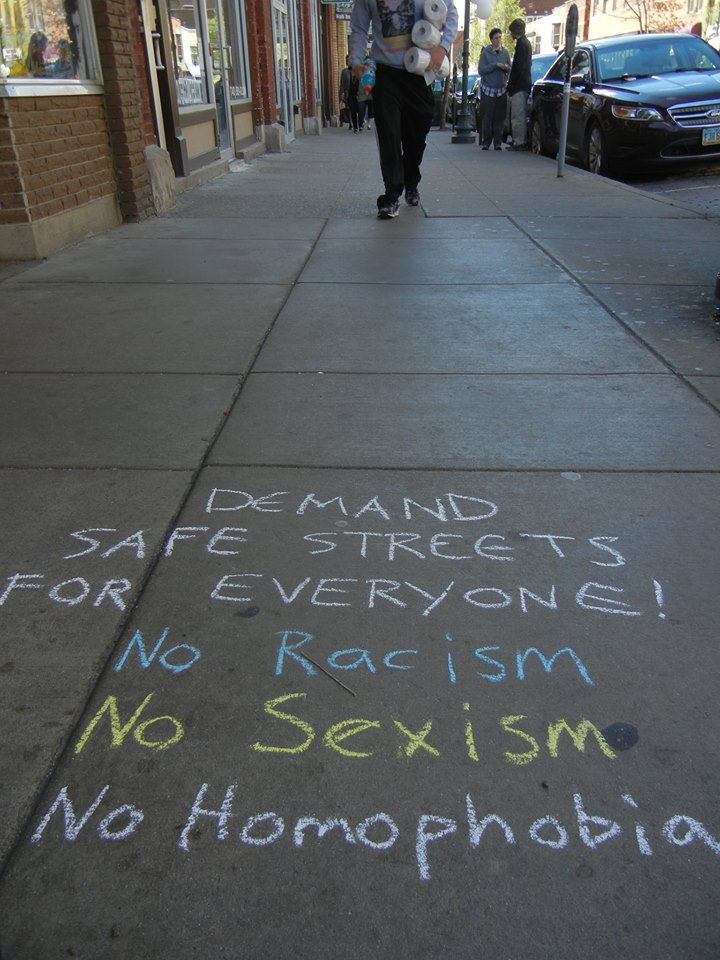
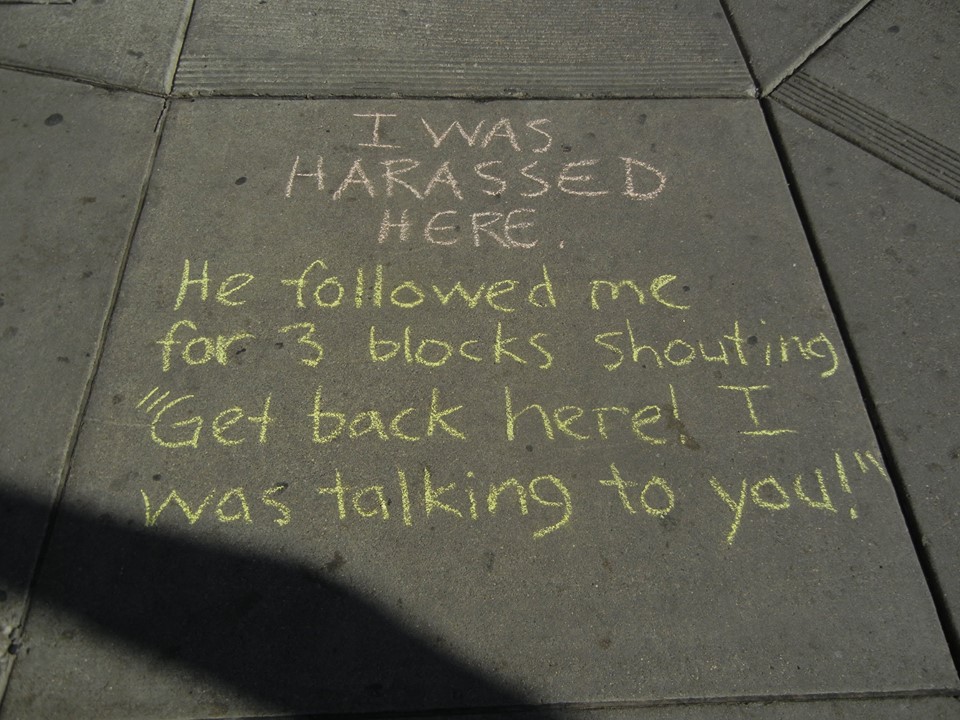
Sarah Fick, a founding organizer of the People’s Justice League posted this last week on her Facebook page and gave me permission to share it on the SSH blog:

True story I wrote on the sidewalk earlier today. As I was taking this photo, two prim and proper looking college aged girls walked by.

Chalking in Athens, Ohio, by Sarah Fick.
Image by Sarah Fick
Image by Sarah Fick

One of them tossed their hair dismissively and said in a snotty tone to the other one, who was still looking at it, “That’s fake.” I’m not upset, because I have come to expect this sort of thing. I’m posting it so that folks can see how deep misogyny runs in this culture. Young women have internalized it so hard. They are taught not to believe each other, not to believe themselves even.

[On the positive side,] we also got a lot of positive comments, shared chalk with total strangers, and had a few engaged conversations about street harassment and Black Lives Matter.

People’s Justice League will be hosting sidewalk chalking in Athens, Ohio over International Anti-Street Harassment Week – April 8 at 10 a.m. and April 9 at 8 a.m. and April 16.

Share

Filed Under: anti-street harassment week Tagged With: ohio, sidewalk chalking

« Previous Page
Next Page »

Share Your Story

Share your street harassment story for the blog. Donate Now

From the Blog

  • #MeToo 2024 Study Released Today
  • Join International Anti-Street Harassment Week 2022
  • Giving Tuesday – Fund the Hotline
  • Thank You – International Anti-Street Harassment Week 2021
  • Share Your Story – Safecity and Catcalls Collaboration

Buy the Book

Search

Archives

  • September 2024
  • March 2022
  • November 2021
  • April 2021
  • March 2021
  • January 2021
  • April 2020
  • March 2020
  • February 2020
  • December 2019
  • November 2019
  • September 2019
  • August 2019
  • July 2019
  • June 2019
  • May 2019
  • April 2019
  • March 2019
  • February 2019
  • January 2019
  • December 2018
  • November 2018
  • October 2018
  • September 2018
  • August 2018
  • July 2018
  • June 2018
  • May 2018
  • April 2018
  • March 2018
  • February 2018
  • January 2018
  • December 2017
  • November 2017
  • October 2017
  • September 2017
  • August 2017
  • July 2017
  • June 2017
  • May 2017
  • April 2017
  • March 2017
  • February 2017
  • January 2017
  • December 2016
  • November 2016
  • October 2016
  • September 2016
  • August 2016
  • July 2016
  • June 2016
  • May 2016
  • April 2016
  • March 2016
  • February 2016
  • January 2016
  • December 2015
  • November 2015
  • October 2015
  • September 2015
  • August 2015
  • July 2015
  • June 2015
  • May 2015
  • April 2015
  • March 2015
  • February 2015
  • January 2015
  • December 2014
  • November 2014
  • October 2014
  • September 2014
  • August 2014
  • July 2014
  • June 2014
  • May 2014
  • April 2014
  • March 2014
  • February 2014
  • January 2014
  • December 2013
  • November 2013
  • October 2013
  • September 2013
  • August 2013
  • July 2013
  • June 2013
  • May 2013
  • April 2013
  • March 2013
  • February 2013
  • January 2013
  • December 2012
  • November 2012
  • October 2012
  • September 2012
  • August 2012
  • July 2012
  • June 2012
  • May 2012
  • April 2012
  • March 2012
  • February 2012
  • January 2012
  • December 2011
  • November 2011
  • October 2011
  • September 2011
  • August 2011
  • July 2011
  • June 2011
  • May 2011
  • April 2011
  • March 2011
  • February 2011
  • January 2011
  • December 2010
  • November 2010
  • October 2010
  • September 2010
  • August 2010
  • July 2010
  • June 2010
  • May 2010
  • April 2010
  • March 2010
  • February 2010
  • January 2010
  • December 2009
  • November 2009
  • October 2009
  • September 2009
  • August 2009
  • July 2009
  • June 2009
  • May 2009
  • April 2009
  • March 2009
  • February 2009
  • January 2009
  • December 2008
  • November 2008
  • October 2008
  • September 2008
  • August 2008
  • July 2008
  • June 2008
  • May 2008

Comment Policy

SSH will not publish any comment that is offensive or hateful and does not add to a thoughtful discussion of street harassment. Racism, homophobia, transphobia, disabalism, classism, and sexism will not be tolerated. Disclaimer: SSH may use any stories submitted to the blog in future scholarly publications on street harassment.
  • Contact
  • Events
  • Join Us
  • Donate
  • Facebook
  • Instagram
  • Pinterest
  • Tumblr
  • Twitter
  • YouTube

Copyright © 2026 Stop Street Harassment · Website Design by Sarah Marie Lacy