• About Us
    • What Is Street Harassment?
    • Why Stopping Street Harassment Matters
    • Meet the Team
      • Board of Directors
      • Past Board Members
    • In The Media
  • Our Work
    • National Street Harassment Hotline
    • International Anti-Street Harassment Week
    • Blog Correspondents
      • Past SSH Correspondents
    • Safe Public Spaces Mentoring Program
    • Publications
    • National Studies
    • Campaigns against Companies
    • Washington, D.C. Activism
  • Our Books
  • Donate
  • Store

Stop Street Harassment

Making Public Spaces Safe and Welcoming

  • Facebook
  • Instagram
  • Pinterest
  • Tumblr
  • Twitter
  • YouTube
  • Home
  • Blog
    • Harassment Stories
    • Blog Correspondents
    • Street Respect Stories
  • Help & Advice
    • National Street Harassment Hotline
    • Dealing With Harassers
      • Assertive Responses
      • Reporting Harassers
      • Bystander Responses
      • Creative Responses
    • What to Do Before or After Harassment
    • Street Harassment and the Law
  • Resources
    • Definitions
    • Statistics
    • Articles & Books
    • Anti-Harassment Groups & Campaigns
    • Male Allies
      • Educating Boys & Men
      • How to Talk to Women
      • Bystander Tips
    • Video Clips
    • Images & Flyers
  • Take Community Action
  • Contact

The Netherlands: The Revolution Will be Tweeted

December 16, 2015 By Correspondent

Eve Aronson, Amsterdam, the Netherlands, SSH Blog Correspondent

What’s in a word? In a character?

During last February’s Super Bowl Sunday in the US, presidential candidate Hillary Clinton found out.
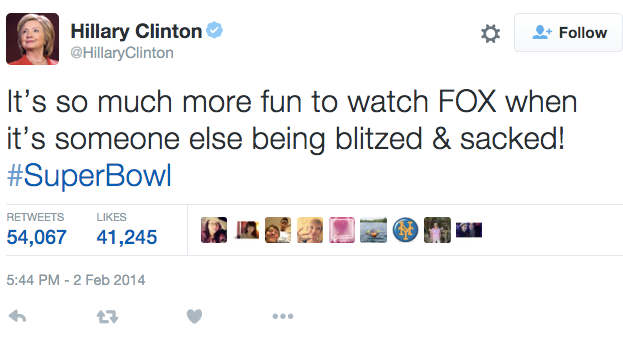
hillaryclintonWith her excruciatingly ordinary tweet about American football and politics, Clinton unintentionally showed the power of 140 characters broadcast to 4.9 million vaguely- connected social media followers.

According to blogger Bridget Coyne, the tweet was retweeted over 57,000 times and prompted 33,600 new followers, ten times Clinton’s average daily follower growth.

While there are plenty of social media critics out there (and there are many), there is no denying the powerful potential of social media platforms to provoke engagement and build interest in everything from funny cats to presidential debates.

In the sphere of anti-street harassment, social media is being used to not only quickly broadcast people’s experiences but to connect and empower folks with shared experiences.

Not unlike Clinton’s wildly popular tweet, more and more people are engaging with social media platforms like Twitter, and important issues like street harassment are gaining some serious momentum.

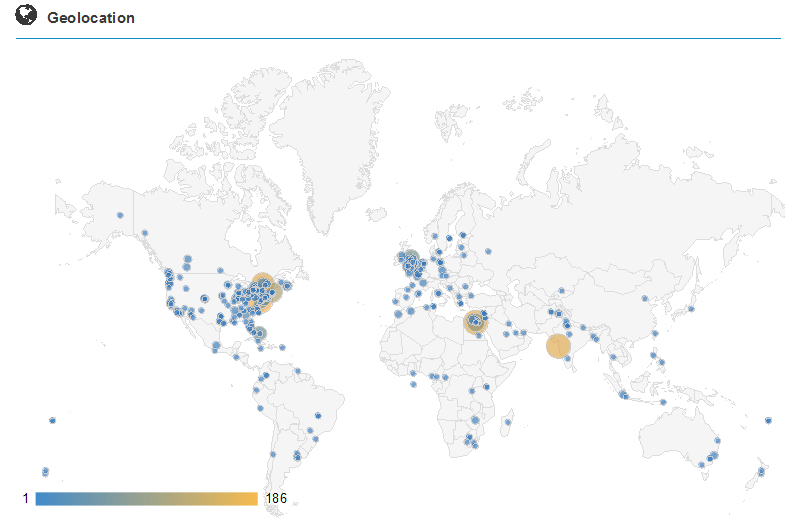
The figure below maps the global conversation about street harassment using the hashtag #endSH from 2014-2015:
endsheweek

(Source: Followthehashtag 2015)

With a reach of over 13 million, the above map speaks not only to global experiences of street harassment, but also to individuals around the world collectively exposing the phenomenon and, in doing so, working to unsettle and resist the power structures that sustain it.

Towards Sousveillance

We can also look at simple actions like tweeting as a means to empower those targeted in street harassment interactions— like women of all backgrounds and people of color or LGBTQ folks of all genders— by turning what is conventionally known as the “gaze” back onto harassers.

This practice of using social media to do this— either by sharing a story, an opinion or by offering virtual support to someone else posting about their experience— is what is called “sousveillance”.

Coupled with digital technologies like mobile phone apps, geo mapping or online platforms for sharing experiences about street harassment, what ‘sousveillence’ does is put the ball back into the court of the individual who experiences street harassment.

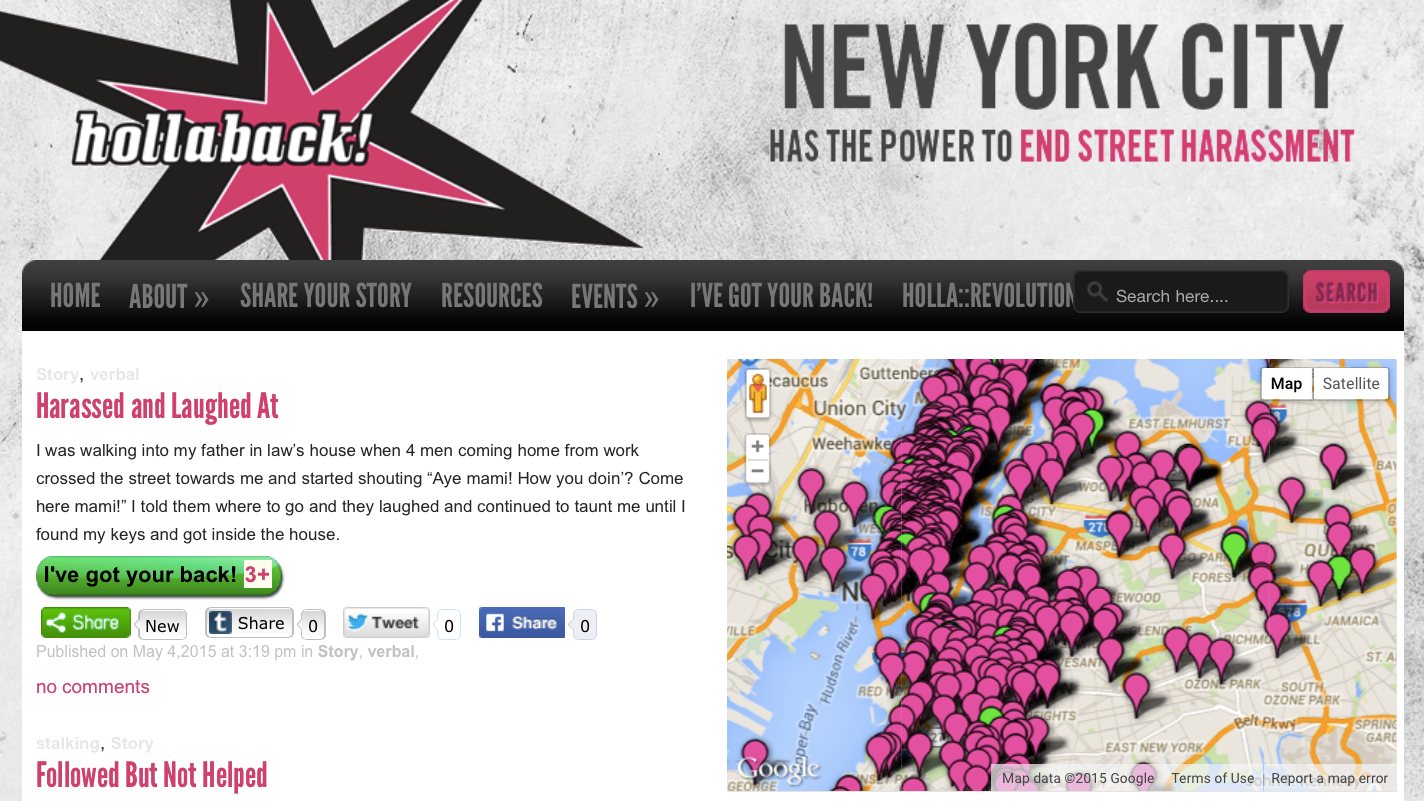
We can see in the map below how, for example, Hollaback! New York embeds geo mapping into its site to “sousvey” harassers as well as to visualize and map bystander presence. On the map, red dots represent reports of street harassment, while green dots represent individuals reporting bystander presence:
hb nyc

(source: Hollaback! NYC)

The image above isn’t just a bunch of red and green dots— each dot represents an experience of street harassment like hissing, leering or groping. And having experienced street harassment and knowing that you’re not along has a greater impact than you might think.

“[I]t makes me feel better to know that there are other women going through the same thing,” stated an anonymous submitter to Hollaback!. “I know I can be a little star on the map for someone else so they know they are not alone either”.

In the Netherlands Online

Although most Amsterdam survey respondents in my research earlier this year had not visited a specific website dedicated to combatting street harassment, almost half have tweeted or posted their thoughts or experiences of street harassment on social media. This finding is huge and signals a need that, for example, engaging more with these technologies could help to fill.

When searching for online platforms and digital technologies in the Netherlands being used to map and resist street harassment, Straatintimidatie (Street intimidation), an online campaign in the Netherlands that is vying for a law against street harassment, was the only online presence that I came across.

Straatintimidatie does not have a space—online or off—for community members to share stories and strategies about street harassment. Nevertheless, the campaign’s Twitter feed has a combined reach of over 52,000 people, which is considerable and indicates that engaging more in online activism about street harassment in Amsterdam and throughout the Netherlands could gain significant momentum with the introduction of more diverse online platforms.

As we saw with the hashtag campaigns above, there are evidently immense pools of people using these online platforms, which can be tapped into in the fight against street harassment in the Netherlands.

If a single tweet like Clinton’s can instantly engage tens of thousands, imagine the disruptive potential of billions of virtual voices— in the Netherlands and beyond— demanding an end to street harassment.

Hashtag activism is not only a lot of people talking; it’s a lot of people talking about specific issues that gain momentum over time and have the potential to effect change on unprecedented scales.

So the next time you sign onto your social media account, get excited. Get excited about the incredible amount of power at your fingertips; the millions of people ready to answer your call to action; and, one character at a time (but not more than 140!); it’s time to turn the tide against street harassment together.

You can find the full analysis of the Amsterdam survey results here or by contacting Eve atevearonson@gmail.com. Follow Eve and Hollaback! Amsterdam on Twitter at @evearonson and @iHollaback_AMS and show your support by liking Hollaback! Amsterdam’s Facebook pagehere.

Share

Filed Under: correspondents, street harassment Tagged With: EndSH, social media, twitter

Three Years Since Delhi Gang Rape

December 16, 2015 By HKearl

Today marks three years since the horrific Delhi gang rape of a young woman – dubbed Nirbhaya by the media — at the hands of several men on a bus in India. Their attack ultimately led to her death and sparked some of the largest anti-rape protests the world has seen.

 
This incident and the response of ordinary people, activists and the Delhi government comprises one of the case studies in my new book Stop Global Street Harassment.
 
Today, let’s remember Nirbhaya. She was a university student who was simply trying to get home safely after seeing a movie with her male friend. She should have been able to. In her honor, let’s double our efforts to make public spaces safe for everyone.
Share

Filed Under: News stories Tagged With: activism, Delhi Gang Rape, India

Sexual Abuse by American Police Officers

December 16, 2015 By HKearl

Sadly, there are street harassers and sexual abusers among the members of the (mostly male) law enforcement in the U.S. and internationally (and of course, in the U.S. we also have racists and murderers among them too). This is a topic I touch on in my new book Stop Global Street Harassment: Growing Activism Around the World.

But I also want to highlight two recent news stories in the U.S. that exemplify this problem… and show why so many people hesitate to or refuse to go to law enforcement officers for help when they do face street harassment or other forms of sexual violence. We need a law enforcement #revolution before many of us will ever feel safe turning to them.

From the Washington Post:

“In a yearlong investigation of sexual misconduct by U.S. law enforcement, The Associated Press uncovered about 1,000 officers who lost their badges in a six-year period for rape, sodomy and other sexual assault; sex crimes that included possession of child pornography; or sexual misconduct such as propositioning citizens or having consensual but prohibited on-duty intercourse.

The number is unquestionably an undercount because it represents only those officers whose licenses to work in law enforcement were revoked, and not all states take such action. California and New York — with several of the nation’s largest law enforcement agencies — offered no records because they have no statewide system to decertify officers for misconduct. And even among states that provided records, some reported no officers removed for sexual misdeeds even though cases were identified via news stories or court records.

‘It’s happening probably in every law enforcement agency across the country,” said Chief Bernadette DiPino of the Sarasota Police Department in Florida, who helped study the problem for the International Association of Chiefs of Police. “It’s so underreported and people are scared that if they call and complain about a police officer, they think every other police officer is going to be then out to get them.’….

Even as cases around the country have sparked a national conversation about excessive force by police, sexual misconduct by officers has largely escaped widespread notice due to a patchwork of laws, piecemeal reporting and victims frequently reluctant to come forward because of their vulnerabilities — they often are young, poor, struggling with addiction or plagued by their own checkered pasts.

In interviews, lawyers and even police chiefs told the AP that some departments also stay quiet about improprieties to limit liability, allowing bad officers to quietly resign, keep their certification and sometimes jump to other jobs.

The officers involved in such wrongdoing represent a tiny fraction of the hundreds of thousands whose jobs are to serve and protect. But their actions have an outsized impact — miring departments in litigation that leads to costly settlements, crippling relationships with an already wary public and scarring victims with a special brand of fear.”

Via CNN.com:

“For about six months, [Oklahoma City police officer Daniel] Holtzclaw preyed on women — all African-American — in one of Oklahoma’s poorest neighborhoods, exploiting his police badge to intimidate them into keeping quiet.

Prosecutors say the Oklahoma City officer selected his victims based on their criminal histories, figuring their drug or prostitution records would undermine any claims they might make against him.

Then, he would subject them to assaults that escalated from groping to oral sodomy and rape.

On Thursday, his 29th birthday, Holtzclaw rocked back and forth in his chair, sobbing, as the judge read the verdict [convicting him on 18 of 36 counts of rape and other sexual offenses against women he encountered on patrol. Jurors recommended a total of 263 years of prison time. He will be sentenced in January.]”

Read about the brave women who reported him, eventually leading to his conviction.

Share

Filed Under: News stories, police harassment, race Tagged With: black women, Daniel Holtzclaw, oklahoma, police abuse, police harassment

UK: “This is my culture man, this is my show”

December 15, 2015 By Correspondent

Tracey Wise, London, UK, SSH Blog Correspondent

Frank Turner, courtesy of his press agent

After the unfortunate harassment incident that led me to create Safe Gigs for Women, I was acutely aware that the band I had gone to see, Manic Street Preachers, would not have condoned such behaviour, so why did someone at one of their shows think this was appropriate?

With its focus on music, it makes perfect sense that Safe Gigs for Women should seek to work with bands and artists to get them on side. They have a ready-made platform to reach out to people, so having their support is essential.

In approaching artists to gain their support, Frank Turner seemed a natural choice. Known for his beliefs in libertarianism, egalitarianism and a passion for music that more than rivals my own, he very kindly offered his support and agreed to meet me to discuss this during his recent UK tour, at Nottingham’s Rock City. I also met his supporting artists Will Varley and Lorna Thomas from Skinny Lister. It seems like an odd time to be writing this blog, after the events in Paris, but these interviews were planned before the terrorist attack which left 89 people who had been at an Eagles of Death Metal gig, dead.

Safety at gigs seems a much wider notion right now. But in discussing whether Frank Turner believes artists have a responsibility towards the safety of their fans, his stance is that of having “a duty of care” towards those that have paid to see him. Indeed, Turner has been known to stop shows to confront unwanted behaviour by members of the crowd, and further states “of course, I don’t want people getting hurt at my shows”. Whilst he may be comfortable, at times to intervene, he is also thankful for the role of security at shows, proving, again, that achieving safer gigs at women will take a multi-faceted response.

As I acknowledged in my first blog for Stop Street Harassment, there have been notable cases of female artists being groped at shows. When I raised this with Turner, Varley and Thomas, Varley highlighted that, unfortunately, that there is a small “proportion of arseholes” at gigs. Thomas admitted to being recently groped whilst crowd surfing at a Skinny Lister show. In discussing this with Turner he acknowledges that he believes he was “naive”, having never realised that this happens, further stating his reaction to be “Really? Who would do that?” and being certain that no men he knows would ever act in such a way. And this is the crux of the matter – if Turner, my friends and myself are sure that the people we know are not behaving like this, then it is a small group of people making it difficult for women, emphasising the need for campaigns like this, and bands and artists to engage with gig goers to get them to think about their behaviour.

Since starting this project, some commentators have put it to me that women-only shows are the answer. I do not agree, for numerous reasons. I am not an economist, or schooled in the music business, but how would the cost of this impact on smaller, independent labels, venues and acts? As a consumer of music in my own right, as covered in my last blog, surely I have the right to attend the events I choose, with whomever I want to?

Furthermore, and most importantly, it automatically assumes the worst of men. As most of my friends are male, and as the aunt to a 5-year-old boy, this offends me as much as it upsets me. Discussing the notion of women only gigs, Frank Turner states he finds this “defeatist” and “sexist, it says men are beyond any redemption”. This was also shared by Will, stating that “segregation is not the answer”, and Lorna emphasising that what is really needed is a “mind shift”. Considering there are so many men out there doing good to support this project, such as the White Ribbon Project, the artists who supported our first fundraiser, including Jukebox Monkey and Peter Von Toy, and Frank Turner himself, women only gigs feels like a massive step backwards.

Recent world events have shown just how crucial music is in the world around us. And that is why the support of artists like Will Varley, Skinny Lister and Frank Turner is so important. Because, as Turner puts it, “what better forum is there to try and teach people not to be pricks?”

Born and raised in London, Tracey is a graduate of City University. She has spent the best part of her life at gigs and festivals and obsessing about music and created the “Safe Gigs for Women” project.

Share

Filed Under: Activist Interviews, correspondents Tagged With: music, safe gigs

USA: Engaging Male Allies to End Violence Against Women

December 14, 2015 By Correspondent

Meghna Bhat, Chicago, USA, SSH Blog Correspondent

A few months ago, I came across Emma Watson’s brave efforts to promote gender equality. Her interview with Malala Yousafzai highlighted the need to address feminism and how this movement should include men as allies. As Watson correctly pointed out, “Let’s not make it scary to say you’re a feminist. I want to make it a welcoming and inclusive movement. Let’s join our hands and move together so we can make real change. Malala and I are pretty serious about it but we need you.”

It’s our collective responsibility, especially male allies, to create awareness about gender violence, prevent and intervene this vicious cycle.

My experiences growing up with positive male role models/allies and Watson’s message resonates with the research and advocacy of Dr. Jackson Katz. He is an educator, author, filmmaker and cultural theorist who is a pioneer in the fields of gender violence prevention education and media literacy. His 2013 speech on TED talk titled, “Violence against women—it’s a men’s issue” showed that domestic violence and sexual abuse, which are often labeled as “women’s issues,” are often “intrinsically men’s issues” and he “shows how these violent behaviors are tied to definitions of manhood.”

According to a report by the New York State Department of Health, research has consistently shown that a majority of men are conflicted about violence against women. Most of these men may not even “recognize when it is happening nor know how to stop it”. Another factor that can make men defensive and doubtful of participating in the efforts to end gender violence is “treating [or stereotyping] males as potential perpetrators.”

There are many social service agencies and organizations promoting and practicing this model of engaging men as allies to prevent and intervene gender-violence. Have you watched the powerful documentary “The Mask You Live In” by The Representation Project? I highly recommend it. I have found this film to be educating, inspiring and an eye-opening experience that needs to be screened to our children and youth.

This film focuses on boys’ and young men’s struggle to stay true to themselves while negotiating America’s narrow definition of masculinity. Young children, especially boys, need to feel safe to be themselves and express their emotions without the fear of being bullied, labeled, mocked, or rejected by other children and adults. They must not feel pressured to fit within the problematic binary roles or other rigid frameworks of masculinity our society expects them to claim.

If you need further details of how these programs and agencies implement this model of engaging male allies or men as partners in combating gender violence, I have listed a few of the examples and resources that I have come across and found to be useful (including as teaching resources):

  1. Mentors in Violence Prevention: A program intended to create public awareness about men’s violence against women, challenge how the mainstream society thinks, and initiating community dialogues between men and women to identify long-term tangible options.
  1. Coaching Boys into Men: The only evidence-based prevention program designed to train high school coaches to teach their male athletes healthy relationship skills and that “violence never equals strength.”
  1. Men as Partners: At EngenderHealth, this program includes working with “men to play constructive roles in promoting gender equity and health in their families and communities”. Through their interactive skills -building workshops and enhanced health care facilities among other services, they strive to confront negative stereotypes about being men and provide men with quality care.
  1. Men Can Stop Rape: Works towards mobilizing men for creating cultures free from violence, especially men’s violence against women through their strengths and sustainable initiatives.
  1. Movement against Sexual Violence: At the University of Illinois at Chicago, I am fortunate to have colleagues who represent and lead the Men against Sexual Violence, now called as the Movement against Sexual Violence. This student group aims to engage and involve people, especially male-identified allies to join in the fight against sexual violence. Through their workshops such as ‘Reimagining Masculinity’ and events, they encourage us to challenge the negative stereotypes and images of gender roles. Although I haven’t got an opportunity to attend these events myself, I am looking forward to being a part of these important and powerful dialogues and community conversations next semester!

Dr. Katz calls out to all men and women to stand up and advocate for changes to end violence against women. He further raises these very critical questions that we all need to think about:

“How can we do something differently? How can we change the practices? How can we change the socialization of boys and the definitions of manhood that lead to these current outcomes? These are the kind of questions that we need to be asking and the kind of work that we need to be doing?”

If you want more ideas for what men can do to prevent gender violence, click here.

Meghna is a doctoral candidate in the Criminology, Law, and Justice program at the University of Illinois at Chicago, with a specialization in Gender and Women Studies. She is currently working on her dissertation, which focuses on representations of violence against women in a widely viewed form of Indian popular culture, Bollywood cinema.

Share

Filed Under: Advice, correspondents, male perspective, Resources Tagged With: engaging men, male allies, violence against women

« Previous Page
Next Page »

Share Your Story

Share your street harassment story for the blog. Donate Now

From the Blog

  • #MeToo 2024 Study Released Today
  • Join International Anti-Street Harassment Week 2022
  • Giving Tuesday – Fund the Hotline
  • Thank You – International Anti-Street Harassment Week 2021
  • Share Your Story – Safecity and Catcalls Collaboration

Buy the Book

Search

Archives

  • September 2024
  • March 2022
  • November 2021
  • April 2021
  • March 2021
  • January 2021
  • April 2020
  • March 2020
  • February 2020
  • December 2019
  • November 2019
  • September 2019
  • August 2019
  • July 2019
  • June 2019
  • May 2019
  • April 2019
  • March 2019
  • February 2019
  • January 2019
  • December 2018
  • November 2018
  • October 2018
  • September 2018
  • August 2018
  • July 2018
  • June 2018
  • May 2018
  • April 2018
  • March 2018
  • February 2018
  • January 2018
  • December 2017
  • November 2017
  • October 2017
  • September 2017
  • August 2017
  • July 2017
  • June 2017
  • May 2017
  • April 2017
  • March 2017
  • February 2017
  • January 2017
  • December 2016
  • November 2016
  • October 2016
  • September 2016
  • August 2016
  • July 2016
  • June 2016
  • May 2016
  • April 2016
  • March 2016
  • February 2016
  • January 2016
  • December 2015
  • November 2015
  • October 2015
  • September 2015
  • August 2015
  • July 2015
  • June 2015
  • May 2015
  • April 2015
  • March 2015
  • February 2015
  • January 2015
  • December 2014
  • November 2014
  • October 2014
  • September 2014
  • August 2014
  • July 2014
  • June 2014
  • May 2014
  • April 2014
  • March 2014
  • February 2014
  • January 2014
  • December 2013
  • November 2013
  • October 2013
  • September 2013
  • August 2013
  • July 2013
  • June 2013
  • May 2013
  • April 2013
  • March 2013
  • February 2013
  • January 2013
  • December 2012
  • November 2012
  • October 2012
  • September 2012
  • August 2012
  • July 2012
  • June 2012
  • May 2012
  • April 2012
  • March 2012
  • February 2012
  • January 2012
  • December 2011
  • November 2011
  • October 2011
  • September 2011
  • August 2011
  • July 2011
  • June 2011
  • May 2011
  • April 2011
  • March 2011
  • February 2011
  • January 2011
  • December 2010
  • November 2010
  • October 2010
  • September 2010
  • August 2010
  • July 2010
  • June 2010
  • May 2010
  • April 2010
  • March 2010
  • February 2010
  • January 2010
  • December 2009
  • November 2009
  • October 2009
  • September 2009
  • August 2009
  • July 2009
  • June 2009
  • May 2009
  • April 2009
  • March 2009
  • February 2009
  • January 2009
  • December 2008
  • November 2008
  • October 2008
  • September 2008
  • August 2008
  • July 2008
  • June 2008
  • May 2008

Comment Policy

SSH will not publish any comment that is offensive or hateful and does not add to a thoughtful discussion of street harassment. Racism, homophobia, transphobia, disabalism, classism, and sexism will not be tolerated. Disclaimer: SSH may use any stories submitted to the blog in future scholarly publications on street harassment.
  • Contact
  • Events
  • Join Us
  • Donate
  • Facebook
  • Instagram
  • Pinterest
  • Tumblr
  • Twitter
  • YouTube

Copyright © 2026 Stop Street Harassment · Website Design by Sarah Marie Lacy