• About Us
    • What Is Street Harassment?
    • Why Stopping Street Harassment Matters
    • Meet the Team
      • Board of Directors
      • Past Board Members
    • In The Media
  • Our Work
    • National Street Harassment Hotline
    • International Anti-Street Harassment Week
    • Blog Correspondents
      • Past SSH Correspondents
    • Safe Public Spaces Mentoring Program
    • Publications
    • National Studies
    • Campaigns against Companies
    • Washington, D.C. Activism
  • Our Books
  • Donate
  • Store

Stop Street Harassment

Making Public Spaces Safe and Welcoming

  • Facebook
  • Instagram
  • Pinterest
  • Tumblr
  • Twitter
  • YouTube
  • Home
  • Blog
    • Harassment Stories
    • Blog Correspondents
    • Street Respect Stories
  • Help & Advice
    • National Street Harassment Hotline
    • Dealing With Harassers
      • Assertive Responses
      • Reporting Harassers
      • Bystander Responses
      • Creative Responses
    • What to Do Before or After Harassment
    • Street Harassment and the Law
  • Resources
    • Definitions
    • Statistics
    • Articles & Books
    • Anti-Harassment Groups & Campaigns
    • Male Allies
      • Educating Boys & Men
      • How to Talk to Women
      • Bystander Tips
    • Video Clips
    • Images & Flyers
  • Take Community Action
  • Contact

#16Days of Activism: Patrolling (Day 8)

December 2, 2015 By HKearl

Nov. 25 – Dec. 10 are the 16 Days of Activism Against Gender-Based Violence. To commemorate the week, we are featuring 1 activism idea per day. This information is excerpted from my new book Stop Global Street Harassment: Growing Activism Around the World (Praeger 2015).

At various times and places, a spate of well-publicized attacks on women in public spaces has inspired people to set up patrols or volunteer escort services. In recent years, this happened in Norway, the United States, and Egypt.

In 2011, after reading about men raping several young women who were walking home at night in Oslo, Norway, four young women in their early 20s formed Action Against Rape (AAR) and decided they would patrol the city after dark to help make the environment safer. The first weekend they went out, around 200 people joined them. During the next year, AAR organized patrol groups of 4–6 people every Friday and Saturday night from 10 p.m. to 3 a.m. Wearing yellow vests, they fanned out across the city. They rarely encountered harassers, but AAR co-founder Lisa Arntzen felt their very presence deterred harassment and violence. “I was 21 and didn’t have the power to make the big changes, so this was something easy I could do,” Arntzen told me. “That’s why so many people joined us. They realized they could contribute and it wasn’t hard at all.”

Similarly, in response to numerous sexual assaults of women in Brooklyn, New York, American bike messenger Jay Ruiz reacted by starting the Brooklyn Bike Patrol in 2011. He recruited 10 volunteers, and they began escorting women home from five neighborhood subway stops from 8 p.m. until midnight most nights. People could simply call them to request an escort. Within weeks, they expanded their volunteer base and service area. Wearing florescent-yellow T-shirts, the volunteers continue to receive up to a dozen calls each night.

New chapter 6-1Because many men in Egypt take advantage of crowds at protests and holidays to harass, grope, and commit gang assaults against women, activism groups set up patrols during these times in 2012. Wearing bright-yellow vests, they look for harassment situations and break them up. They also publicize a phone number people can call if they need help. For example, in 2012 during Eid-ul-Fitr, the holiday at the end of the Islamic holy month of Ramadan, volunteers with Bassma (Imprint) interrupted many instances of harassment and helped police arrest several harassers each day. Founder Nihal Zaghloul wrote for the SSH blog, “It is OUR RIGHT as women to walk in the streets safely, and [since] NO ONE will give us this right, we must take it ourselves.”

Similarly, during political protests, as many as 300 volunteers with groups like Operation Anti-Sexual Harassment wear shirts proclaiming Tahrir Square a “safe square for all” while standing at every checkpoint, atop watchtowers, and throughout the crowd. They pass out hotline numbers and instructions on handling rape trauma victims. After one of their patrols in December 2012, Yasmine Abdelhamid said it was the first time since the uprising that she felt it was safe for her to protest in Tahrir Square.

Help fund our work in 2016, donate to our end-of-year giving campaign!

Share

Filed Under: 16 days, street harassment Tagged With: Egypt, norway, patrolling, usa

#GivingTuesday 2016!

December 1, 2015 By HKearl

You can help make public spaces safer on Giving Tuesday with a $10+ donation. Donate TODAY and Lyft will match it, doubling your impact!

Your donations will fund our 2016 programs, including our mentoring program and the 6th annual International Anti-Street Harassment Week (April 10-16, 2016). THANK YOU for making a difference.

SupportOur2016Programs


Share

Filed Under: SSH programs Tagged With: donate, GivingTuesday

#16Days of Activism: Marching (Day 7)

December 1, 2015 By HKearl

Nov. 25 – Dec. 10 are the 16 Days of Activism Against Gender-Based Violence. To commemorate the week, we are featuring 1 activism idea per day. This information is excerpted from my new book Stop Global Street Harassment: Growing Activism Around the World (Praeger 2015).

Since the mid-1970s, Take Back the Night and Reclaim the Night marches have occurred annually in many cities worldwide to challenge rape. Starting in 2011, SlutWalk marches spread globally, too, with participants criticizing rape culture and victim blaming. In recent years, there have also been marches in countries like Afghanistan, Colombia, Nepal, Romania, South Africa, and the United States.

Afghanistan. Image via Gender Across Borders

On a hot day in 2011, 50 women and men carrying banners and signs with messages like, “We will not tolerate harassment,” “Islam forbids men from insulting women,” and “I have the right to walk freely in my city” marched together from Kabul University to the Afghanistan Independent Human Rights Commission. Organized by Young Women for Change, marchers handed out fliers to raise awareness about the problem of street harassment in their country. Most of the people they passed on the street stood shocked, staring, since openly supporting women’s rights can be dangerous. Despite the presence of a police escort, some men heckled the marchers and called them names. But others were supportive and took fliers or joined the march. Organizer Noorjahan Akbar, then a 20-year-old college student, told me in an interview at the time: “It was so thrilling to see that none of us are alone in this fight and we are willing to stand up for each other.”

In 2012, between 3,000 and 5,000 women and men joined together to march through Johannesburg, South Africa, outraged by the sexual assault of two women wearing short skirts at a taxi rank and by the daily street harassment most women face. They carried signs with messages like “I will wear my mini-skirt anywhere!” and “Humiliating women is a sin before God.” Lulu Xingwana, the minister of women and children and people with disabilities marched too, and told the local news station: “Through this march, we are reclaiming our streets from those who abuse and terrorize women and children.” She also warned she would close down taxi ranks if harassment and assault against women continued there.

In Bogota, Observatorio Contra el Acoso Callejero Colombia held a march against street harassment in the center of the city in 2014. More than 100 people participated, carrying signs with messages like “Nuestros Cuerpos No Hacen Parte Del Espacio Publico!” (Our bodies are not public space!). The group joined forces with a female percussion group called La tremendarevoltosabatucadafeminista and a performance group called Tulpadanza, which both brought extra energy to the march.

Also in 2014, with the help of volunteers from the feminist organization Filia, Simona-Maria Chirciu organized a 100-person march through Bucharest, Romania. Women and men of all ages held signs that read, “Harassment is violence,” “We don’t need your validation,” and “It is NEVER ok to harass people! So stop doing it.” Numerous women’s rights groups participated. Chirciu wrote for the SSH blog: “People on the streets interacted with us, greeted us, and asked questions about our march: ‘Hey, do you think a march will solve the problem? Boys need to be educated or legally punished for doing this.’ Yes! Maybe a march doesn’t solve the street harassment issue, but it can raise awareness and is empowering for the march participants.”

Help fund our work in 2016, donate to our end-of-year giving campaign!

Share

Filed Under: 16 days Tagged With: Afghanistan, colombia, marches, Romania, south africa

UK: Venues Must Help Make Gigs Safer

November 30, 2015 By Correspondent

Tracey Wise, London, UK, SSH Blog Correspondent

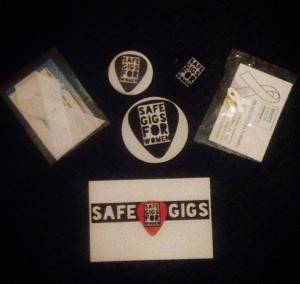
safegigsSince establishing Safe Gigs for Women, one of its core aims has been to get venues and festivals on board. Whilst it is clear venues themselves cannot be fully held accountable for the actions of individuals, there are many actions they can take to ensure a better experience for all their customers, male and female alike, and make it clear that such behaviour is not acceptable in their establishment.

Firstly, having been on the receiving end of unwanted attention by a festival security guard, it should go without saying that staff at such events and venues should be the first line in preventing harassment in the first place. They should also be taking reports of harassment seriously and doing everything they reasonably can to assist the complainant. Venues in Boston, USA provide a safe refuge for anyone in trouble at a gig, and this seems like a fairly simple approach. Dedicated members of staff can then engage with anyone with any concerns or needs. This seems a very practical, low cost approach towards safety.

I understand the music industry, live music in particular, cannot exist without the support of alcohol companies. However, isn’t it time this was reframed? Whilst there has been a campaign in the UK to ‘drink responsibly’ and be drink aware, with so much attention surrounding alcohol and its role in sexual assault, is it perhaps not time that am alcohol company came out to state it will be taking proactive action against this? Actually take the initiative and be the first to challenge this head on? And whilst we’re at it… Soft drinks companies, how about lowering the price of your products in venues, in order to contribute towards greater safety and the enjoyment of others? And venues can reinforce this with greater provision of free water, available at any time, to those who need it. Better use of cooling systems in venues would also reduce the instances of people getting drunk and improve safety all round.

Quite early on from establishing safe Gigs for Women, I was approached by a local authority in London, Camden Council, an area well known for its musical history and links to alternative cultures. To enact the above changes we will need support from local authorities, those ultimately responsible for licensing venues. We’ve been lucky to have Camden on our side. But what about venues and authorities not in favour of projects like this?

Then consider this. I am a self-declared music obsessive person. In working with Camden Council, I did some tough sums, and estimated that with the gigs I have attended in Camden alone this year, the cost of tickets, food and drink that I have spent in their local economy is somewhere between £1500 – £1800. When women who have experienced harassment at gigs state that their experiences now stop them going to gigs, venues should consider the effect on them, economically.

Safe Gigs for Women welcomes any venue that wishes to work with us — and thanks Camden Council for its support.

Born and raised in London, Tracey is a graduate of City University. She has spent the best part of her life at gigs and festivals and obsessing about music and created the “Safe Gigs for Women” project.

Share

Filed Under: correspondents, public harassment Tagged With: harassment, music, safe gigs for women, UK

“Keep standing up for your rights, friends”

November 30, 2015 By Contributor

I had just pulled up to a red light at an intersection, alone in my car, with one couple in their car behind me. A car pulled up to my left, waiting to turn left. I saw from the corner of my eye that a young-ish white man with dark hair and facial hair was gesturing at me and saying things through the window of the car he was a passenger in. He kept doing this for over a minute, and I completely ignored him, looking at the lights and waiting for them to change to green.

I saw out of the corner of my eye that he seemed to be giving up, and he seemed to turn away for a moment to say something to the driver of the car he was in. At that moment, the lights started changing and I slowly pulled forward to go straight, as they pulled forward to turn left; at that moment, I flicked the middle finger at this person and looked over to make sure the disgusting individual saw this; he did, and he seemed very happy with this sudden attention being payed to his pathetic and disrespectful behaviour.

This individual’s behavior made me disappointed, and made me feel insulted; it is unfortunate that this person chose to try to foist an uninvited interaction upon another, and also that this person did not demonstrate respect. I find that although this individual is obviously a symptom of a larger societal problem with treating women properly, the individual themselves is also entirely responsible for their pathetic and unbecoming actions.

I think my response was great, because I 1) ignored the fool for the entire minute because that behaviour is pathetic and useless, and 2) responded with a calm, cool, collected, strong, brief, and self-confident rejection of the person, while remaining in my car. I kept driving straight and that car turned left, driving off.

I do hope I do not see that person again, as my mother upon hearing this story, got very worried that it could escalate into a fight or something. (I also considered photographing the individual, but did not try because I don’t have room on my phone for pics at the moment.)

Guess what? That kid is lucky I had somewhere to be and couldn’t spend more time than I did; otherwise I would have been tempted to turn my car off, get out, and knock on that car’s window to ask what was the matter, and if nothing was wrong then to encourage him to cease the disrespectful gesturing.

As a side note, I have been taught (mostly by my mother) that women cannot defend themselves. I have seen, however, thankfully that this is not true; women are oppressed, of course, but we can stand up for ourselves and every instance in which our allies do the same, I do think will bring us all closer to a world we can be proud of, and a society we don’t have to be embarrassed to bequeath to our children. Keep standing up for your rights, friends.

Optional: What’s one way you think we can make public places safer for everyone?

This is a very good question, how we can make public places safe– I do not know how we can make intersections at night safe for everyone. It really would be great to figure out a way; I think there’s even a traffic video-camera mounted on one of the traffic lights, but I’m not sure it would catch this. In any event, video can only deter so much, and then all it becomes is evidence once the harm is done; so that’s not really ideal. I’ll keep thinking; anyone reading this, please keep brainstorming, as well!

– Anonymous

Location: Illinois, street intersection while in my car.

Share your street harassment story for the blog.
See the book 50 Stories about Stopping Street Harassers for more idea
.

Share

Filed Under: Stories, street harassment

« Previous Page
Next Page »

Share Your Story

Share your street harassment story for the blog. Donate Now

From the Blog

  • #MeToo 2024 Study Released Today
  • Join International Anti-Street Harassment Week 2022
  • Giving Tuesday – Fund the Hotline
  • Thank You – International Anti-Street Harassment Week 2021
  • Share Your Story – Safecity and Catcalls Collaboration

Buy the Book

Search

Archives

  • September 2024
  • March 2022
  • November 2021
  • April 2021
  • March 2021
  • January 2021
  • April 2020
  • March 2020
  • February 2020
  • December 2019
  • November 2019
  • September 2019
  • August 2019
  • July 2019
  • June 2019
  • May 2019
  • April 2019
  • March 2019
  • February 2019
  • January 2019
  • December 2018
  • November 2018
  • October 2018
  • September 2018
  • August 2018
  • July 2018
  • June 2018
  • May 2018
  • April 2018
  • March 2018
  • February 2018
  • January 2018
  • December 2017
  • November 2017
  • October 2017
  • September 2017
  • August 2017
  • July 2017
  • June 2017
  • May 2017
  • April 2017
  • March 2017
  • February 2017
  • January 2017
  • December 2016
  • November 2016
  • October 2016
  • September 2016
  • August 2016
  • July 2016
  • June 2016
  • May 2016
  • April 2016
  • March 2016
  • February 2016
  • January 2016
  • December 2015
  • November 2015
  • October 2015
  • September 2015
  • August 2015
  • July 2015
  • June 2015
  • May 2015
  • April 2015
  • March 2015
  • February 2015
  • January 2015
  • December 2014
  • November 2014
  • October 2014
  • September 2014
  • August 2014
  • July 2014
  • June 2014
  • May 2014
  • April 2014
  • March 2014
  • February 2014
  • January 2014
  • December 2013
  • November 2013
  • October 2013
  • September 2013
  • August 2013
  • July 2013
  • June 2013
  • May 2013
  • April 2013
  • March 2013
  • February 2013
  • January 2013
  • December 2012
  • November 2012
  • October 2012
  • September 2012
  • August 2012
  • July 2012
  • June 2012
  • May 2012
  • April 2012
  • March 2012
  • February 2012
  • January 2012
  • December 2011
  • November 2011
  • October 2011
  • September 2011
  • August 2011
  • July 2011
  • June 2011
  • May 2011
  • April 2011
  • March 2011
  • February 2011
  • January 2011
  • December 2010
  • November 2010
  • October 2010
  • September 2010
  • August 2010
  • July 2010
  • June 2010
  • May 2010
  • April 2010
  • March 2010
  • February 2010
  • January 2010
  • December 2009
  • November 2009
  • October 2009
  • September 2009
  • August 2009
  • July 2009
  • June 2009
  • May 2009
  • April 2009
  • March 2009
  • February 2009
  • January 2009
  • December 2008
  • November 2008
  • October 2008
  • September 2008
  • August 2008
  • July 2008
  • June 2008
  • May 2008

Comment Policy

SSH will not publish any comment that is offensive or hateful and does not add to a thoughtful discussion of street harassment. Racism, homophobia, transphobia, disabalism, classism, and sexism will not be tolerated. Disclaimer: SSH may use any stories submitted to the blog in future scholarly publications on street harassment.
  • Contact
  • Events
  • Join Us
  • Donate
  • Facebook
  • Instagram
  • Pinterest
  • Tumblr
  • Twitter
  • YouTube

Copyright © 2026 Stop Street Harassment · Website Design by Sarah Marie Lacy