• About Us
    • What Is Street Harassment?
    • Why Stopping Street Harassment Matters
    • Meet the Team
      • Board of Directors
      • Past Board Members
    • In The Media
  • Our Work
    • National Street Harassment Hotline
    • International Anti-Street Harassment Week
    • Blog Correspondents
      • Past SSH Correspondents
    • Safe Public Spaces Mentoring Program
    • Publications
    • National Studies
    • Campaigns against Companies
    • Washington, D.C. Activism
  • Our Books
  • Donate
  • Store

Stop Street Harassment

Making Public Spaces Safe and Welcoming

  • Facebook
  • Instagram
  • Pinterest
  • Tumblr
  • Twitter
  • YouTube
  • Home
  • Blog
    • Harassment Stories
    • Blog Correspondents
    • Street Respect Stories
  • Help & Advice
    • National Street Harassment Hotline
    • Dealing With Harassers
      • Assertive Responses
      • Reporting Harassers
      • Bystander Responses
      • Creative Responses
    • What to Do Before or After Harassment
    • Street Harassment and the Law
  • Resources
    • Definitions
    • Statistics
    • Articles & Books
    • Anti-Harassment Groups & Campaigns
    • Male Allies
      • Educating Boys & Men
      • How to Talk to Women
      • Bystander Tips
    • Video Clips
    • Images & Flyers
  • Take Community Action
  • Contact

Four Examples of #EndSHWeek Efforts

April 16, 2015 By HKearl

There are so many amazing efforts and campaigns happening for International Anti-Street Harassment Week! Here are four examples….

Nepal:

Activista Nepal held a street demonstration demanding safe public toilets at Sundhara, Kathmandu. Yesterday they held a youth workshop on street harassment.

The Netherlands, via Den Haag FM:

“Dozens of men were this afternoon on the square shouted at by a group of women. These women are part of the action group Citizens Street Harassment wants to bring this behavior to the attention and wants to fining.

Anti street “What we do can not make it, but the men who do that to us can not make it. I am a random person who never asks, just as they are. How strange is it that someone in an unpleasant way interfere with you? “Said Jessica van der Pluijm, one of the protesters.

The ladies have collected signatures to eventually submit a citizens’ initiative to criminalize street harassment. MP Ahmed Marcouch (PvdA) has pledged to get started with the criminalization of street harassment.”

Italy:

NO Molestie Di Strada is posting stickers against harassment across Italy!

India, via I am in DNA of India:

“I am in dna of India, iamin.in, a hyperlocal news platform and Safe City, an NGO that provides a platform for people to share their personal stories of sexual harassment and abuse in public spaces have teamed up to bring you local and concerned voices pained by everyday street harassment.

In our research to find most unsafe zones for women in Delhi, South Delhi’s Lal Kuan area topped the list. It was not just street harassment that we found rampant there, it was a whole lot of issues surrounding it that prompted us to amplify the voices of victimized locals and bring to you their concerns through a dedicated page.“

Share

Filed Under: anti-street harassment week

Afghanistan: Words Matter

April 16, 2015 By Contributor

In our society, if a woman is known as being promiscuously or immoral, it is nearly impossible for her to free herself of that label.

Guest Blog Post for International Anti-Street Harassment Week 2015

When I speak about street harassment, I notice the ears of men go red. I wish it was out of shame or fear of it. Women face many different kinds of harassment and abuse in our society: physical, sexual and or mental.

I have often thought about how mental abuse and harassment can be one of the worse methods of marginalizing women. This kind of harassment cannot be seen and pointed to, but it can leave a lasting impact on people’s emotional and mental health. Unfortunately, I have also noticed that most women tolerate this kind of abuse in silence for many difference reasons. One of the reasons may be that they feel standing up to defend themselves is not effective. Especially in Afghanistan where religion and traditions have been mixed and hard to distinguish from one another, it is hard to prove to men that their behavior and the harassment they perpetuate is unjustified. In addition, these men have access to many different weapons to justify their behavior and silence anyone who objects. When it comes to shutting women up, the most efficient weapon has been character assassination.

Opinionated and educated women are more likely to be hunted down by this weapon because they are viewed as a threat to patriarchy. The men who attack these women know very well that if a woman is known as being promiscuously or immoral, it is nearly impossible for her to free herself of that label. Therefore, it is not a coincidence that usually women are attacked when they disobey the laws of our patriarchal society and stop bowing their head to misogynistic systems and structures. When women don’t submit to men’s power and desires, take ownership of their own bodies, view themselves as more than commodities and things or speak up using logic, their character is immediately assassinated.

The literature of this form of terror is simple, but specific. It is enough to call a woman certain things over and over at different settings and venues in order for her to be delegitimized. These words include but are not limited to promiscuous, immoral, prostitute, whore, infidel, man-hatter, angry, bitch…. Isn’t it fascinating that there are no male equivalents for the words bitch, whore, slut…?

If one tries to fight harassment by talking to misogynists as two fully developed human beings who are deserving of equal rights, if one decides to respect oneself and not give into this myth of female inferiority, one is immediately labeled shameless. If one uses logic, she is called infidel. If one points out to inappropriate behavior by men, she is called a man-hater.

Standing strong despite the devastating effects of these words is not easy, especially if a woman wants to have some public approval and impact. These words cause long term emotional and mental issues. They destroy women’s confidence and exhaust them. They break women’s spirits and tear them to pieces. Perhaps that is why one should learn how to gather one’s pieces and stand against the angry wave of misogyny.

By Farima Nawabi, cross-posted from the Dukhtarane Rabia (Daughters of Rabia): A blog on social justice in Afghanistan

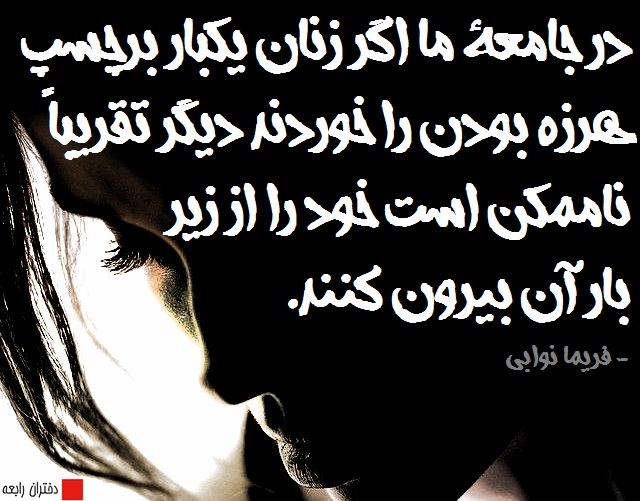
Poster text: In our society, if a woman is known as being promiscuously or immoral, it is nearly impossible for her to free herself of that label.

Share

Filed Under: anti-street harassment week Tagged With: #EndSHWeek, Afghanistan, Daughters of Rabia, Dukhtarane Rabia

Los Angeles Metro Commits To Fighting Sexual Harassment

April 16, 2015 By BPurdy

(Photo by Juliet Bennett Rylah/LAist)

Great news out of Los Angeles! The LA Metro has launched a new campaign called “Its Off Limits” to dissuade harassment on trains and buses and encourage victims to report.

The campaign follows a recent survey that found that while approximately 20% of LA Metro’s 22,604 riders have experienced sexual harassment during their commute, only 99 people reported this behavior in the past year.

With the new campaign, victims can report harassment either using a special hotline or a phone app.

The campaign officially launches tomorrow with a press release at 11am at Union Station, though the posters are up today!

Share

Filed Under: News stories, public harassment, Resources, street harassment

Study: All Women In France have been Harassed on Public Transit

April 16, 2015 By HKearl

More soon, but quickly wanted to share that the first report on gender harassment and sexual violence on public transport across France was released today.  It found that ALL of the more than 600 women surveyed had experienced it at least once in their life on public transportation. In half of the cases, the victims were minors when it first occurred.

Via English RFI:

“You ask a woman, ‘Have you been a victim of harassment or violence in public transportation?’ And she will say, ‘No, not at all’,” explains Elisabeth Moiron-Braud. “But then you ask, ‘Has a man ever pressed up against you or put his hand on your bottom?’ And she will say, ‘Yes!’”

Moiron-Braud is a lawyer who worked on the report for the High Council on Equality between Men and Women (HCEfh) which was presented to the deputy minister for women’s rights, Pascale Boistard.

It is aimed at tackling the range of sexual harassment and assault on public transportation, from catcalls at bus stops, to groping in the metro, to rape in train cars.

The report calls these behaviours “manifestations of sexism” which affect women’s rights to feeling secure, and which limit their use of public space and their ability to move around.

The challenge is identifying the problem. Catcalls can be considered by women and men as flirtation; groping is seen as so common as to not warrant a complaint.

“Women are used to it,” says Laure Salmona, of the Association Mémoire Traumatique et Victimologie, a victims’ rights advocacy group.”

High Council for equality between women and men plans to launch a comprehensive national campaign around harassment on buses, subways and trains next month. To my knowledge, France would be the first country to do this across the whole country!!

H/T Dan Moshenberg

Share

Filed Under: News stories, public harassment, Resources

Kenya: “Because I Speak Out, I Feel Safer”

April 16, 2015 By Contributor

Guest Blog Post for International Anti-Street Harassment Week 2015

Setting up Hollaback! Nairobi dates back to late 2013. I was harassed by two drunk men on my way home. I was actually on my street surrounded by people that had known me since I was a child and it hurt that none of them did anything to help me. The two men were walking behind me and saying a lot of nasty things because I had a long slit in the back of my dress that showed my thighs. I tried to ignore them and kept walking. I don’t really remember the details of the altercation now but what I will never forget is that one after the other they put their hands up my dress and though I did manage to hit one of them before they ran off I was violated. I have never been able to forget what that few seconds felt like and I have never been able to wear that dress again. I told many of my friends about it and it was one of them told me about Hollaback and the work they do. It was very easy to make the decision to sign up and setup a site for Nairobi.

A lot of things happened in my life that made it difficult to setup immediately but every new experience I had or heard about from a friend strengthened my resolve to make sure it was actually set up. Hollaback! Nairobi’s official launch was in January 2015.

Three months later I am still a one woman team and it’s a little daunting since I also have a full time job. I am often second guessing myself about whether to speak out about an issue or stay quiet and there is also some procrastinating on whether to advertise, print out stickers and flyers but I believe in time it will all get easier and I will find a couple of team members willing to join the movement for all the right reasons. So far in the recruitment process, I have encountered two types of people. Type 1 wants to take over and turn the movement into something it’s not; a full time job with massive donors and trips abroad. Type 2 are interested in taking part but don’t really want to put in the time.

Unfortunately, getting people to speak out and share their stories has been very slow despite the growing number of rape cases, and other forms of gender based violence. In fact two of my school mates, one from primary school and another from law school were killed by their boyfriends in 2014. Additionally, in November and December 2014 videos were shared all over social media of men publicly stripping women on the streets for what they call dressing indecently that went viral and had many Kenyans take to the streets to protest against these actions. In 2015 public a member of parliament has been accused of raping a journalist in his publicly funded office.

The need for activism on any form of gender based violence in this country grows every single day and it will only be a matter of time before people are able to speak out more on the issue, before people are able to share their stories and maybe even put their names and faces on their experience.

Before that day comes, Hollaback! Nairobi’s main focus is education. People have yet to accept that street harassment is a violation, that it causes harm to the victims, eating into their self-confidence little by little. It certainly isn’t rape but that doesn’t make it any less important. Besides, if we were to teach people to respect us on the streets in broad daylight they will certainly respect us even in the dead of night.

Getting victims to speak out in a society where people say they have larger problems to deal with like terrorism and starvation will be an uphill task but I think it can be done. Building a society where people feel safe and respected is an all rounded affair. We cannot focus on one and ignore the other.

What I have loved most since joining Hollaback! is the support this community provides. It’s like having a personal team of cheerleaders every step of the way. As a person, I feel more confident about myself because I can speak out. And because I can speak out I feel safer. I had completely stopped taking any public means of transport but it’s now the exact opposite. I rarely drive myself anywhere on weekends. Life is so much better when you can walk and enjoy the sunshine.

My community hasn’t yet accepted our existence here but if it has had this effect on me, I am sure it will spread.

Wacu Mureithi Directs Hollaback! Nairobi

Share

Filed Under: anti-street harassment week, hollaback Tagged With: #EndSHWeek, anti-street harassment week, EndSH, Hollaback! Nairobi, kenya

« Previous Page
Next Page »

Share Your Story

Share your street harassment story for the blog. Donate Now

From the Blog

  • #MeToo 2024 Study Released Today
  • Join International Anti-Street Harassment Week 2022
  • Giving Tuesday – Fund the Hotline
  • Thank You – International Anti-Street Harassment Week 2021
  • Share Your Story – Safecity and Catcalls Collaboration

Buy the Book

Search

Archives

  • September 2024
  • March 2022
  • November 2021
  • April 2021
  • March 2021
  • January 2021
  • April 2020
  • March 2020
  • February 2020
  • December 2019
  • November 2019
  • September 2019
  • August 2019
  • July 2019
  • June 2019
  • May 2019
  • April 2019
  • March 2019
  • February 2019
  • January 2019
  • December 2018
  • November 2018
  • October 2018
  • September 2018
  • August 2018
  • July 2018
  • June 2018
  • May 2018
  • April 2018
  • March 2018
  • February 2018
  • January 2018
  • December 2017
  • November 2017
  • October 2017
  • September 2017
  • August 2017
  • July 2017
  • June 2017
  • May 2017
  • April 2017
  • March 2017
  • February 2017
  • January 2017
  • December 2016
  • November 2016
  • October 2016
  • September 2016
  • August 2016
  • July 2016
  • June 2016
  • May 2016
  • April 2016
  • March 2016
  • February 2016
  • January 2016
  • December 2015
  • November 2015
  • October 2015
  • September 2015
  • August 2015
  • July 2015
  • June 2015
  • May 2015
  • April 2015
  • March 2015
  • February 2015
  • January 2015
  • December 2014
  • November 2014
  • October 2014
  • September 2014
  • August 2014
  • July 2014
  • June 2014
  • May 2014
  • April 2014
  • March 2014
  • February 2014
  • January 2014
  • December 2013
  • November 2013
  • October 2013
  • September 2013
  • August 2013
  • July 2013
  • June 2013
  • May 2013
  • April 2013
  • March 2013
  • February 2013
  • January 2013
  • December 2012
  • November 2012
  • October 2012
  • September 2012
  • August 2012
  • July 2012
  • June 2012
  • May 2012
  • April 2012
  • March 2012
  • February 2012
  • January 2012
  • December 2011
  • November 2011
  • October 2011
  • September 2011
  • August 2011
  • July 2011
  • June 2011
  • May 2011
  • April 2011
  • March 2011
  • February 2011
  • January 2011
  • December 2010
  • November 2010
  • October 2010
  • September 2010
  • August 2010
  • July 2010
  • June 2010
  • May 2010
  • April 2010
  • March 2010
  • February 2010
  • January 2010
  • December 2009
  • November 2009
  • October 2009
  • September 2009
  • August 2009
  • July 2009
  • June 2009
  • May 2009
  • April 2009
  • March 2009
  • February 2009
  • January 2009
  • December 2008
  • November 2008
  • October 2008
  • September 2008
  • August 2008
  • July 2008
  • June 2008
  • May 2008

Comment Policy

SSH will not publish any comment that is offensive or hateful and does not add to a thoughtful discussion of street harassment. Racism, homophobia, transphobia, disabalism, classism, and sexism will not be tolerated. Disclaimer: SSH may use any stories submitted to the blog in future scholarly publications on street harassment.
  • Contact
  • Events
  • Join Us
  • Donate
  • Facebook
  • Instagram
  • Pinterest
  • Tumblr
  • Twitter
  • YouTube

Copyright © 2026 Stop Street Harassment · Website Design by Sarah Marie Lacy