• About Us
    • What Is Street Harassment?
    • Why Stopping Street Harassment Matters
    • Meet the Team
      • Board of Directors
      • Past Board Members
    • In The Media
  • Our Work
    • National Street Harassment Hotline
    • International Anti-Street Harassment Week
    • Blog Correspondents
      • Past SSH Correspondents
    • Safe Public Spaces Mentoring Program
    • Publications
    • National Studies
    • Campaigns against Companies
    • Washington, D.C. Activism
  • Our Books
  • Donate
  • Store

Stop Street Harassment

Making Public Spaces Safe and Welcoming

  • Facebook
  • Instagram
  • Pinterest
  • Tumblr
  • Twitter
  • YouTube
  • Home
  • Blog
    • Harassment Stories
    • Blog Correspondents
    • Street Respect Stories
  • Help & Advice
    • National Street Harassment Hotline
    • Dealing With Harassers
      • Assertive Responses
      • Reporting Harassers
      • Bystander Responses
      • Creative Responses
    • What to Do Before or After Harassment
    • Street Harassment and the Law
  • Resources
    • Definitions
    • Statistics
    • Articles & Books
    • Anti-Harassment Groups & Campaigns
    • Male Allies
      • Educating Boys & Men
      • How to Talk to Women
      • Bystander Tips
    • Video Clips
    • Images & Flyers
  • Take Community Action
  • Contact

#YouthWill Tweet Chat Today

March 20, 2015 By HKearl

All day today, thousands of people will be sharing ideas on how to end ‪#‎StreetHarassment‬ through an online conversation conducted by NGOs from various countries, including Stop Street Harassment We invite you to participate and share your ideas! Use: ‪#‎YouthWill‬

Participating groups:

Twitter:
@ocacchile @ocaccolombia @ocacnic @hollaback242 @equality242 @HollabackTC @HollabackHRM @hollabackmumbai @atrevetebogota @noacosocalles @StopStHarassmnt @ThinkOlga

Facebook:
https://www.facebook.com/ocacchile
https://www.facebook.com/ocaccol
https://www.facebook.com/ocacnic
https://www.facebook.com/ocacuruguay
https://www.facebook.com/HollaBack242
https://facebook.com/hollabacktwincities
https://www.facebook.com/HollabackHALIFAX
https://www.facebook.com/mumbaihollaback
https://www.facebook.com/AtreveteBogota
https://www.facebook.com/paremoselacosocallejero
https://www.facebook.com/StopStreetHarassment
https://www.facebook.com/thinkolga

Share

Filed Under: Resources, street harassment

Second Street Harassment Study in Chile

March 19, 2015 By BPurdy

Posted with the permission of Observatorio Contra el Acoso Callejero Chile

* New study shows that serious street harassment practices such as touching, exhibitionism and masturbation affect two in every five people on average.

* High percentage of citizens agree that sexual harassment in streets should be punished.

SANTIAGO, 19 March.- This week (March, 16th), at the former Congress, the Observatorio Cotra el Acoso Callejero – OCAC Chile (Observatory Against Street Harassment) presented the results of its second study, “Is Chile willing to punish street harassment? Study of characterization and opinion about street harassment and possible sanctions.”

Among the findings of the study, notes that three out of four people have suffered street harassment in Chile in the last 12 months, which means 75% of the population. In the case of women, the percentage reaches 85% and of men 55%.

The study also revealed that cases of street harassment are common: two in five people have suffered rubbing, touching or groping in public spaces, and 23% of women have experienced some form of serious harassment (persecution, exhibitionism, public masturbation).

Regarding the perception of the public on this issue, the results show that 84% of people totally disapprove any practice of harassment, whether “compliments”, groping or exhibitionism.

Another surprising fact was the boldness of the result of the question “Are you willing to punish street harassment?”. The answer was a resounding yes: over 90% of people said they would sanction any for of street harassment. What, in the Observatory’s opinion, demonstrates the need to legislate.

“This study reinforces our policy action: analyze a type of violence that has been naturalized and do not accept to have 12 years old girls who need to be “used to street harassment. The results of our second study demonstrate that we are facing a significant social change, Chileans think street harassment is harmful and should be punished”, said María José Guerrero, sociologist and parti of the OCAC Chile’s Studies team.

To conduct this study, OCAC Chile was sponsored by UN Women and European Union.


Press contacts

Observatorio contra el Acoso Callejero (OCAC)
Javiera Contreras
comunicaciones@ocacchile.org
+569 8136 7869

Programa de Fortalecimiento de Organizaciones de la Sociedad Civil que Promueven la Igualdad de Género ONU Mujeres – Unión European
Mónica Maureira M.
maureira.monica@gmail.com
+569 9959 4156


Share

Filed Under: News stories, Resources Tagged With: chile, OCAC, Santiago, study, survey

OCAC Chile presents New Bill to Congress

March 19, 2015 By BPurdy

Posted with the permission of Observatorio Contra el Acoso Callejero Chile

VALPARAISO, 17 March.- In the month of International Women’s Day and the UN CSW 59th, which discusses the status of women in the world, Chile advances in the struggle for gender equality. In order to remove street harassment from the bad number of violence complaints, as well as prevent future attacks and protect victims, the Observatorio Contra el Acoso Callejero Chile – OCAC Chile (Observatory Against Street Harassment), Tuesday, presented to Congress the Bill “Law for Street Respect”, which seeks to enroll street harassment in Chilean law.

The project is divided into four main areas: it defines what is understood as street harassment, defines what acts shall constitute a minor offense, incorporates into the Penal Code the offense of street harassment and proposes alternative measures with an educational focus. In parallel, OCAC Chile submitted to the Executive power a set of recommendations to promote educational and preventive public policy, and thus not merely criminalize the problem.

“We believe that the Law for Street Respect is a vital step towards a more friendly and safe public space for everyone. This will be a tool that will prevent attacks and protect victims, besides having a preventive, educational and committed to gender equity approach”, said Maria Francisca Valenzuela, President of OCAC Chile.

The document is sponsored by the deputies Camila Vallejo (PC) and Karla Rubilar (Amplitud) and was signed by parliamentarians of cross militancy, as Giorgio Jackson (Independiente-RD), Daniella Cicardini (PS), Loreto Carvajal (PPD) Marcela Sabat (RN), Karol Cariola (PC), Vlado Mirosevic (Liberal), Yasna Provost (DC) and Gabriel Boric (Self-IA).

“It is important to legislate on street assaults so they do not become naturalized, since in an almost imperceptibly way they can affect psychologically who is the subject of such aggression. I hope we can have a transverse support this motion,” said Santiago’s  deputy, Giorgio Jackson.

For its part, the parliamentary Camila Vallejo, sponsor of the bill, said that “every day, women of all ages, regardless of socioeconomic status, are discriminated against and abused physically or psychologically. Laws like this are intended to assert our struggle for gender equality, for recognition of our humanity, so often trampled and abused”.

To develop this initiative, OCAC Chile had the support of UN Women and the European Union. If passed the law, Chile would join countries like Peru, and various nations of Europe which have already moved towards regulations that address, prevent and punish this form of violence.

For more information, OCAC has developed the respetocallejero.cl website, where you can download the full bill, review an explanatory video and read testimonials about street harassment in Chile.

Video with english subtitles: https://www.youtube.com/watch?v=Mm2cQ8wixPc&feature=youtu.be

Press Contacts

Observatory Against Street Harassment (OCAC Chile)

Javiera Contreras
comunicaciones@ocacchile.org
+569 8136 7869

Program to Strengthen Civil Society Organizations that Promote Gender Equality UN Women – European Union
Monica M. Maureira
maureira.monica@gmail.com
+569 9959 4156

Share

Filed Under: News stories, street harassment Tagged With: chile, International Women's Day, IWD2015, OCAC, Valparaiso

USA: How to Talk with Someone who Disagrees with You

March 19, 2015 By Correspondent

Madison Ford, Texas, USA, Blog Correspondent

Street harassment awareness is spreading. A year ago, when I talked about my research on the subject with casual acquaintances I had to explain what exactly street harassment is almost every single time. Nowadays, street harassment shows up in the media often enough that people have at least some conception of what it is.

Every once in a while, I end up having these conversations with people who have actively participated in street harassment. Most of the time these conversations end very well: we have an engaging discussion about masculinity or gender inequality and my acquaintance will express regret for ever participating in harassing behaviors. But this isn’t always how it goes down. Sometimes the people I speak with will admit they have harassed women on the street, and despite the public outcry against the act they continue to do so because they don’t see it as a problem. It’s only a game, women need to just get over it, the same old story.

Now no two people’s opinions can ever be exactly alike, but I abide by these four tips when I’m speaking with somebody who not only disagrees with my opinions on street harassment – but actively participates in harassing behaviors as well. In your discussions with friends, acquaintances, and colleagues – I hope these tips help you keep things civil and on topic.

1) Stay calm. Believe me, if anyone has ever wanted to spit fire during a conversation about street harassment – it’s me. If you let your emotions overwhelm you it will be much more difficult to word a convincing argument on the spot. Whenever your conversation partner says something frustrating, take a deep breath and move on to step two.

2) Remember the facts. Many websites have abundant research with scientific conclusions about street harassment. If somebody tells you that women are overreacting, point them to statistics on sexual assault. We live in a culture that blames the victims for the actions of perpetrators. It’s hard to walk through life as a woman not knowing that, but often it’s a fact that men overlook since sexual assault so overwhelmingly affects women. If these logical tactics still don’t sway the opinion of your acquaintance, it’s time to move on to an emotional argument.

3) Empathy. Everyone who has harassed somebody else has women in their life in some form: a mother, a sister, an aunt, a cousin, or a girlfriend. Ask the harasser how they would feel knowing someone said something sexually violent to the women in their lives. Ask them if they know the alternate routes their family members take to avoid certain men on certain streets or if their family members carry weapons to protect themselves from the threat of sexual violence. Most importantly, remember that this empathy needs to go both ways. Empathize with the harasser. Ask him why he harasses, why he thinks it’s okay, and even ask his opinion on the street harassment research you may have presented earlier in the conversation. By asking someone to truly evaluate their actions, they may realize their impact. But not everyone will – some will resist no matter what you do or say, and that’s where the last step comes in handy.

4) Recognize a lost cause. People are stubborn, especially when they’re feeling defensive. Maybe he’ll change his mind later, maybe he’ll never change his mind. Point is, some people won’t listen to what you have to say. Some people are stubborn enough they’ll wait to change their minds until after you’re gone. If the conversation has gone on for a while and you’re both just parroting the same things back to one another, realize that this conversation will probably not end with changing the other person’s mind. Never look back at conversations like this as if they’re a waste of time – think of it as your own training for future conversations. You’ll learn how to more eloquently word your arguments and you may even learn more about why you feel the way you feel about certain issues. For a while, almost nobody was even having a conversation about street harassment; so now, every conversation is integral to the fight against it.

Madison is a soon-to-be graduate of the University of Texas at Austin studying literature and sociology. Follow her on Twitter, @madiford222.

Share

Filed Under: correspondents, street harassment

Meeting with WMATA to talk next steps in harassment campagin

March 18, 2015 By HKearl

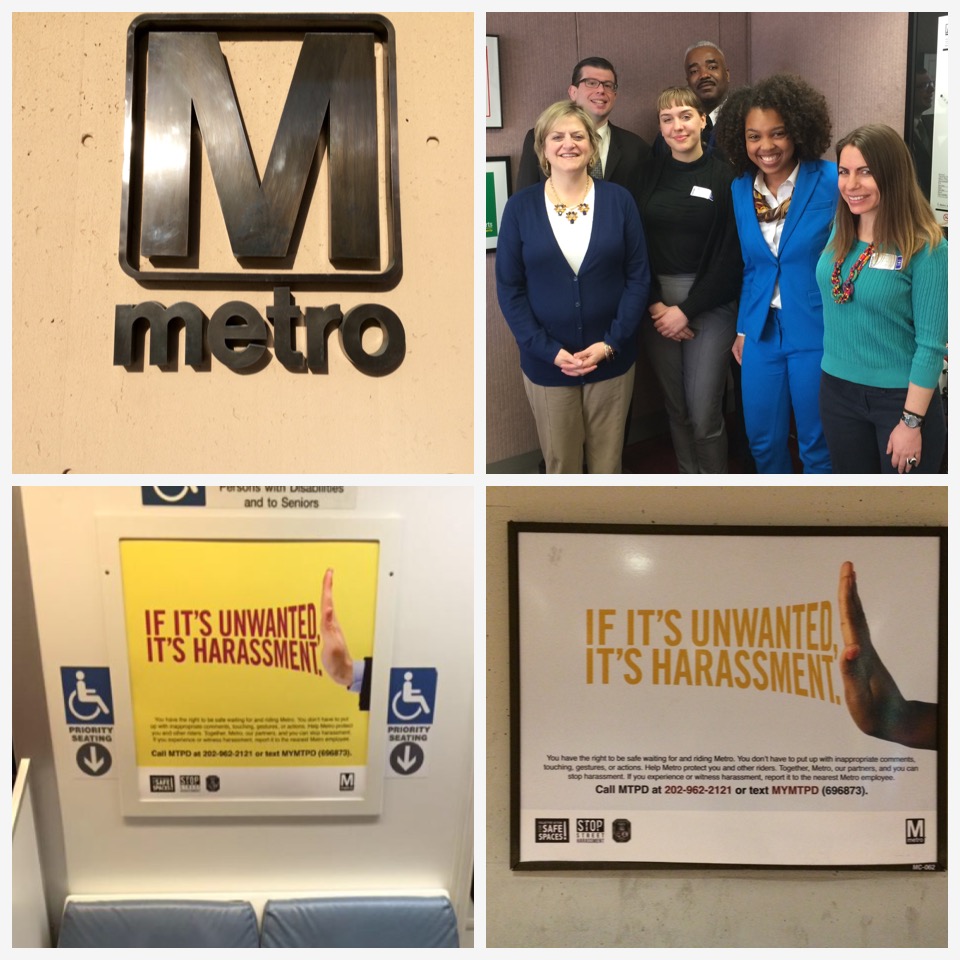
Today Zosia Sztykowski, Co-Executive Director of Collective Action for Safe Spaces and I met with the Washington Metropolitan Area Transit Authority (WMATA) at their headquarters in Washington, D.C. to talk about sexual harassment on the system. For three years, we’ve been working with them to see the implementation of an online reporting options, collating of reports on verbal harassment incidents (instead of only forms of harassment that rise to the level of a crime), employee training, and a PSA campaign. We’ve collaborated on a number of outreach days, too.

This meeting was in part a celebration of the second wave of ads (see an example on the right) and an opportunity to plan our outreach efforts for International Anti-Street Harassment Week/Sexual Assault Awareness Month. We also discussed other ways the system could do more around this issue. Stay tuned.

WMATA has been responsive to our suggestions and ideas and we are proud to work with them. We hope many other transit systems follow suit!

Share

Filed Under: public harassment, SSH programs

« Previous Page
Next Page »

Share Your Story

Share your street harassment story for the blog. Donate Now

From the Blog

  • #MeToo 2024 Study Released Today
  • Join International Anti-Street Harassment Week 2022
  • Giving Tuesday – Fund the Hotline
  • Thank You – International Anti-Street Harassment Week 2021
  • Share Your Story – Safecity and Catcalls Collaboration

Buy the Book

Search

Archives

  • September 2024
  • March 2022
  • November 2021
  • April 2021
  • March 2021
  • January 2021
  • April 2020
  • March 2020
  • February 2020
  • December 2019
  • November 2019
  • September 2019
  • August 2019
  • July 2019
  • June 2019
  • May 2019
  • April 2019
  • March 2019
  • February 2019
  • January 2019
  • December 2018
  • November 2018
  • October 2018
  • September 2018
  • August 2018
  • July 2018
  • June 2018
  • May 2018
  • April 2018
  • March 2018
  • February 2018
  • January 2018
  • December 2017
  • November 2017
  • October 2017
  • September 2017
  • August 2017
  • July 2017
  • June 2017
  • May 2017
  • April 2017
  • March 2017
  • February 2017
  • January 2017
  • December 2016
  • November 2016
  • October 2016
  • September 2016
  • August 2016
  • July 2016
  • June 2016
  • May 2016
  • April 2016
  • March 2016
  • February 2016
  • January 2016
  • December 2015
  • November 2015
  • October 2015
  • September 2015
  • August 2015
  • July 2015
  • June 2015
  • May 2015
  • April 2015
  • March 2015
  • February 2015
  • January 2015
  • December 2014
  • November 2014
  • October 2014
  • September 2014
  • August 2014
  • July 2014
  • June 2014
  • May 2014
  • April 2014
  • March 2014
  • February 2014
  • January 2014
  • December 2013
  • November 2013
  • October 2013
  • September 2013
  • August 2013
  • July 2013
  • June 2013
  • May 2013
  • April 2013
  • March 2013
  • February 2013
  • January 2013
  • December 2012
  • November 2012
  • October 2012
  • September 2012
  • August 2012
  • July 2012
  • June 2012
  • May 2012
  • April 2012
  • March 2012
  • February 2012
  • January 2012
  • December 2011
  • November 2011
  • October 2011
  • September 2011
  • August 2011
  • July 2011
  • June 2011
  • May 2011
  • April 2011
  • March 2011
  • February 2011
  • January 2011
  • December 2010
  • November 2010
  • October 2010
  • September 2010
  • August 2010
  • July 2010
  • June 2010
  • May 2010
  • April 2010
  • March 2010
  • February 2010
  • January 2010
  • December 2009
  • November 2009
  • October 2009
  • September 2009
  • August 2009
  • July 2009
  • June 2009
  • May 2009
  • April 2009
  • March 2009
  • February 2009
  • January 2009
  • December 2008
  • November 2008
  • October 2008
  • September 2008
  • August 2008
  • July 2008
  • June 2008
  • May 2008

Comment Policy

SSH will not publish any comment that is offensive or hateful and does not add to a thoughtful discussion of street harassment. Racism, homophobia, transphobia, disabalism, classism, and sexism will not be tolerated. Disclaimer: SSH may use any stories submitted to the blog in future scholarly publications on street harassment.
  • Contact
  • Events
  • Join Us
  • Donate
  • Facebook
  • Instagram
  • Pinterest
  • Tumblr
  • Twitter
  • YouTube

Copyright © 2026 Stop Street Harassment · Website Design by Sarah Marie Lacy