• About Us
    • What Is Street Harassment?
    • Why Stopping Street Harassment Matters
    • Meet the Team
      • Board of Directors
      • Past Board Members
    • In The Media
  • Our Work
    • National Street Harassment Hotline
    • International Anti-Street Harassment Week
    • Blog Correspondents
      • Past SSH Correspondents
    • Safe Public Spaces Mentoring Program
    • Publications
    • National Studies
    • Campaigns against Companies
    • Washington, D.C. Activism
  • Our Books
  • Donate
  • Store

Stop Street Harassment

Making Public Spaces Safe and Welcoming

  • Facebook
  • Instagram
  • Pinterest
  • Tumblr
  • Twitter
  • YouTube
  • Home
  • Blog
    • Harassment Stories
    • Blog Correspondents
    • Street Respect Stories
  • Help & Advice
    • National Street Harassment Hotline
    • Dealing With Harassers
      • Assertive Responses
      • Reporting Harassers
      • Bystander Responses
      • Creative Responses
    • What to Do Before or After Harassment
    • Street Harassment and the Law
  • Resources
    • Definitions
    • Statistics
    • Articles & Books
    • Anti-Harassment Groups & Campaigns
    • Male Allies
      • Educating Boys & Men
      • How to Talk to Women
      • Bystander Tips
    • Video Clips
    • Images & Flyers
  • Take Community Action
  • Contact

Turkey Marches and Tweets, Los Angeles Prepares for a Transit Campaign

February 20, 2015 By HKearl

TURKEY: Last week, a mini bus driver tried to rape Ozgecan Aslan, a student at Cag University in the southern province of Mersin, when she was the last passenger. He beat and killed her, cut off her hands, burned her body and tossed it into a river. News of her grisly death sparked outrage. Over the weekend, thousands of people marched in black and online, the hashtag  #sendeanlat (#tellyourstory) trended as women shared their stories of harassment and abuse.

Via Al Jazeera:

“Women across Turkey used the hashtags to share experiences of public harassment, as well as incidents within the family, from adolescence through to adulthood.

Many said their lives were restricted by harassment and that they had to take precautions to avoid it, such as dressing more conservatively and carrying pepper spray.

Some said they have had to alter their routes on the street and get off public transportation to avoid harassment. Others said they have had to seek refuge in cafes and shops to avoid stalkers..”

USA: Peace Over Violence will be partnering with the Los Angeles County Metropolitan Transportation Authority on an anti-harassment transit campaign in April!  A survey last year showed that 1 in 5 riders has faced unwanted sexual behavior. In the meantime: “Anyone who sees inappropriate behavior can call 911 or the sheriff’s hotline: (888) 950-SAFE (7233).”

Share

Filed Under: News stories, street harassment

Scotland: Sexual Harassment Survey and Poster

February 20, 2015 By HKearl

The Amina: The Muslim Women’s Resource Centre in Scotland “works with mainstream agencies and policy makers, to enhance their understanding of the Muslim community and of barriers that prevent Muslim women from accessing services and participating in society. [They] provide a range of services to Muslim women.” This includes running campaigns against negative stereotypes and violence against women.

One of their current campaigns focuses on street harassment. Sarah Todd, their Administration Officer, told me by e-mail:

“We were concerned that attitudes about women, especially relating to how they dress, were impacting their treatment on the streets, etc. This was an issue which our organisation had come across on several occasions. We did a survey [see below] and then consequently developed the poster. The poster has been well received across social media and has been developed into a workshop that was delivered by an external party to a men’s group. They found the image hard hitting and had a lively debate around it.”


Share

Filed Under: street harassment

USA: Dear Men of New York

February 19, 2015 By Correspondent

Dr. Dena Simmons, New York City, USA, Blog Correspondent

Dear Men of New York City,

Please let me walk the streets without your sweet-nothings, your unwanted advances. I don’t care for the elaborate details of what you’d like to do to my body.

No, you cannot take a picture of my badankadonk,
lick my thighs,
suck my toes,
ravage me with your hard cock,
join me on my run,
have my number,
bang me silly.
No, no, no!

I am more than my body. I don’t owe you a smile, a thank you, or a hello. I am not a bitch for ignoring you. I don’t deserve your street-abuse just because I don’t give you my attention or affection.

Please, please, please let me walk down the streets without having to map out a route to avoid your verbal daggers. I don’t like the way you devour me with your eyes, the way you make me feel unsafe, the way you strip me of my humanity.

Your disrespect massacres me.

Please leave me alone. Please don’t touch me. Please let me walk in peace.

My body is not yours. I do not exist for your pleasure.  I exist for me.

Respectfully,
Dena

Dr. Dena Simmons serves as the Associate Director of Education and Training at Yale’s Center for Emotional Intelligence. She is a recent graduate of Teachers College, Columbia University, where her research focused on teacher preparedness to address bullying in the middle school setting.

Share

Filed Under: correspondents, Stories, street harassment

New Anti-Harassment Ads on DC-Area Metro!

February 18, 2015 By HKearl

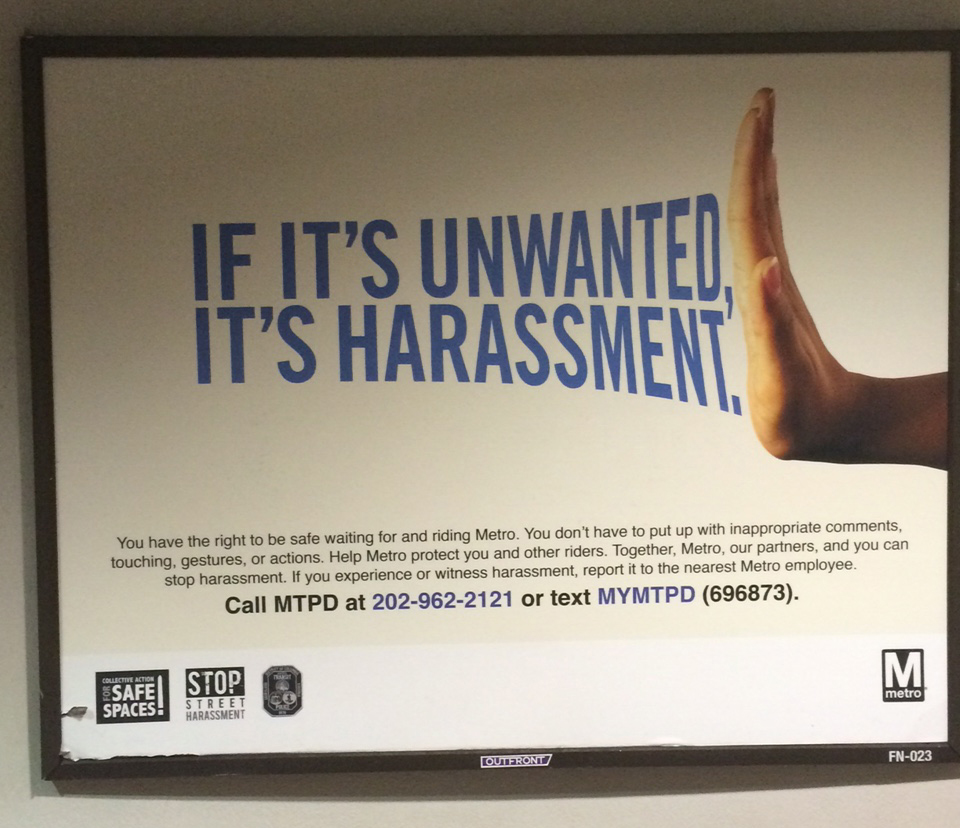
Nearly three years after the first anti-harassment transit ads went up in the Washington, DC-area, I’m excited to announce that the second wave of ads are up! They are a collaboration between WMATA, Collective Action for Safe Spaces & SSH. #GoTeam

If you experience or witness harassment on the Metro, you can report by phone or text and online: www.wmata.org/harasssment. They are looking for patterns and hotspots, so please report if you have a moment (even incidents that happened in the past).

(Photo by Rebecca Henry)

Share

Filed Under: Resources, SSH programs, street harassment

USA: Turning to the Research

February 18, 2015 By Correspondent

Madison Ford, Texas, USA, Blog Correspondent

By Amy Mastrine

Talking about street harassment with people who aren’t familiar with the issue can often be frustrating, especially when not knowing leads to not believing that it’s a serious problem.  Writing my honors thesis on street harassment has led to this type of interaction more times than I can count. When I speak with somebody who believes street harassment isn’t a big problem, my imperfect solution is to turn to the research.

Why is this imperfect? Well, studies all have some flaws and limitations. Science can never be 100% certain, and social science is often beneath the proverbial microscope rather than looking through it. Some people don’t trust statistics and cling to anecdotes that support their own worldview. I believe everyone is guilty of this, even the researchers who try very hard to avoid it. The point is, nothing is ever perfect or certain. That’s why continuing to study street harassment is integral to the fight against it: the more research we have about its prevalence, how it affects victims, and the mechanisms involved in changing the way women navigate public space, the more scientific evidence illuminates the realities of harassment.

Here are some of the things we know about street harassment, in addition to its prevalence, thanks to the blood, sweat, and tears of researchers.

1. All kinds of street harassment have negative effects on women.

In Dr. Harmon B. Sullivan’s 2011 study, women were separated into two groups. One group watched a video of a woman being harassed on the street and the other watched a scene on a street with no harassment. In the experimental group, women who had experienced more street harassment themselves reported more negative feelings than those who experienced less harassment. This held true for women who mostly experienced hostile or threatening harassment and for women who experienced mostly “benign” harassment. This goes to show that “compliments” or “just saying hi” are not as innocent as they seem to be.

Rachel H. Pain’s 1997 study shows how different types of harassment may lead to fear of sexual attack. More than 20% of respondents reported that unwanted sexual comments or being leered at made them fear sexual attack. Forty-two percent of respondents indicated that being touched up made them fear sexual attack and almost 50% reported that being flashed at incited that fear. Finally, a whopping 85% of women who report being followed in public say that this makes them fear sexual attack. Less intense types of street harassment show corresponding lower levels of fear, but fear remains nonetheless.

A study released in late 2014 conducted by researchers at the University of Mary Washington found that sexual harassment is traumatizing for women, especially for those who have experienced sexual abuse.

2. Street harassment and fear of rape are highly correlated across multiple studies.

Street harassment is an active factor in preventing women from going out in public on their own. Cynthia Grant Bowman refers to this pattern as the informal ghettoization of women in her legal article “Street Harassment and the Informal Ghettoization of Women,” and that if women are going to continue fighting for social equality, they must be able to leave their homes without crippling fear. In her book Back Off! How to Confront and Stop Sexual Harassment and Harassers Martha Langelan wrote that for women, an underlying tension is always wondering how far the harasser will go, if he will become violent.

More recently, in early 2015 researchers at the University of Missouri-Kansas City released a study showing that the treatment of women as sexual objects – including through street harassment – contribute to increased feelings of anxiety about their physical safety, causing them to fear both physical and sexual harm.

3. Stranger harassment can be more damaging than harassment from people the victim knows, and the consequences could be dangerous.

In a 2000 study of Canadian women, findings suggested that women’s perceptions of safety were vastly influenced by their experiences of stranger harassment. While non-stranger harassment had very little effect on perceptions of safety, for each additional type of stranger harassment experienced, the odds of feeling safe decreased by 17-23%.

Knowing this, it makes sense that Pain’s 1997 study also discovered that women are almost twice as fearful of sexual attack from strangers than non-strangers despite the fact that “86.1% of women who have experienced rape, physical violence, and/or stalking during their lifetime reported that the perpetrator was a current intimate partner at the time when the violence first occurred.” Street harassment directs women’s fear of rape towards people who may very well not assault them and confuses an already messy discussion about sexual assault.

This is by no means an exhaustive list of all the things we know about street harassment. Social scientists continue to search for answers and anti-street harassment organizations are conducting surveys of their own. If you’re committed to the fight against street harassment, take a look at these studies – or even better, start your own research project! Distribute a survey to your peers, coworkers, or friends and find out how street harassment affects the people around you. Then in your discussions about street harassment, you’ll have the tools to keep everyone informed.

Madison is a soon-to-be graduate of the University of Texas at Austin studying literature and sociology. Follow her on Twitter, @madiford222.

Share

Filed Under: correspondents, Resources, street harassment

« Previous Page
Next Page »

Share Your Story

Share your street harassment story for the blog. Donate Now

From the Blog

  • #MeToo 2024 Study Released Today
  • Join International Anti-Street Harassment Week 2022
  • Giving Tuesday – Fund the Hotline
  • Thank You – International Anti-Street Harassment Week 2021
  • Share Your Story – Safecity and Catcalls Collaboration

Buy the Book

Search

Archives

  • September 2024
  • March 2022
  • November 2021
  • April 2021
  • March 2021
  • January 2021
  • April 2020
  • March 2020
  • February 2020
  • December 2019
  • November 2019
  • September 2019
  • August 2019
  • July 2019
  • June 2019
  • May 2019
  • April 2019
  • March 2019
  • February 2019
  • January 2019
  • December 2018
  • November 2018
  • October 2018
  • September 2018
  • August 2018
  • July 2018
  • June 2018
  • May 2018
  • April 2018
  • March 2018
  • February 2018
  • January 2018
  • December 2017
  • November 2017
  • October 2017
  • September 2017
  • August 2017
  • July 2017
  • June 2017
  • May 2017
  • April 2017
  • March 2017
  • February 2017
  • January 2017
  • December 2016
  • November 2016
  • October 2016
  • September 2016
  • August 2016
  • July 2016
  • June 2016
  • May 2016
  • April 2016
  • March 2016
  • February 2016
  • January 2016
  • December 2015
  • November 2015
  • October 2015
  • September 2015
  • August 2015
  • July 2015
  • June 2015
  • May 2015
  • April 2015
  • March 2015
  • February 2015
  • January 2015
  • December 2014
  • November 2014
  • October 2014
  • September 2014
  • August 2014
  • July 2014
  • June 2014
  • May 2014
  • April 2014
  • March 2014
  • February 2014
  • January 2014
  • December 2013
  • November 2013
  • October 2013
  • September 2013
  • August 2013
  • July 2013
  • June 2013
  • May 2013
  • April 2013
  • March 2013
  • February 2013
  • January 2013
  • December 2012
  • November 2012
  • October 2012
  • September 2012
  • August 2012
  • July 2012
  • June 2012
  • May 2012
  • April 2012
  • March 2012
  • February 2012
  • January 2012
  • December 2011
  • November 2011
  • October 2011
  • September 2011
  • August 2011
  • July 2011
  • June 2011
  • May 2011
  • April 2011
  • March 2011
  • February 2011
  • January 2011
  • December 2010
  • November 2010
  • October 2010
  • September 2010
  • August 2010
  • July 2010
  • June 2010
  • May 2010
  • April 2010
  • March 2010
  • February 2010
  • January 2010
  • December 2009
  • November 2009
  • October 2009
  • September 2009
  • August 2009
  • July 2009
  • June 2009
  • May 2009
  • April 2009
  • March 2009
  • February 2009
  • January 2009
  • December 2008
  • November 2008
  • October 2008
  • September 2008
  • August 2008
  • July 2008
  • June 2008
  • May 2008

Comment Policy

SSH will not publish any comment that is offensive or hateful and does not add to a thoughtful discussion of street harassment. Racism, homophobia, transphobia, disabalism, classism, and sexism will not be tolerated. Disclaimer: SSH may use any stories submitted to the blog in future scholarly publications on street harassment.
  • Contact
  • Events
  • Join Us
  • Donate
  • Facebook
  • Instagram
  • Pinterest
  • Tumblr
  • Twitter
  • YouTube

Copyright © 2026 Stop Street Harassment · Website Design by Sarah Marie Lacy