• About Us
    • What Is Street Harassment?
    • Why Stopping Street Harassment Matters
    • Meet the Team
      • Board of Directors
      • Past Board Members
    • In The Media
  • Our Work
    • National Street Harassment Hotline
    • International Anti-Street Harassment Week
    • Blog Correspondents
      • Past SSH Correspondents
    • Safe Public Spaces Mentoring Program
    • Publications
    • National Studies
    • Campaigns against Companies
    • Washington, D.C. Activism
  • Our Books
  • Donate
  • Store

Stop Street Harassment

Making Public Spaces Safe and Welcoming

  • Facebook
  • Instagram
  • Pinterest
  • Tumblr
  • Twitter
  • YouTube
  • Home
  • Blog
    • Harassment Stories
    • Blog Correspondents
    • Street Respect Stories
  • Help & Advice
    • National Street Harassment Hotline
    • Dealing With Harassers
      • Assertive Responses
      • Reporting Harassers
      • Bystander Responses
      • Creative Responses
    • What to Do Before or After Harassment
    • Street Harassment and the Law
  • Resources
    • Definitions
    • Statistics
    • Articles & Books
    • Anti-Harassment Groups & Campaigns
    • Male Allies
      • Educating Boys & Men
      • How to Talk to Women
      • Bystander Tips
    • Video Clips
    • Images & Flyers
  • Take Community Action
  • Contact

“I hope it doesn’t scar me forever”

January 31, 2015 By Contributor

The first time I was harassed was today. I just froze up. A group of boys who were younger than me were walking behind me and my friend. We were just walking to the subway, and they made loud comments about my body. I was disgusted, embarassed,and scared. I could not believe an (about) 11 year old could do that. I tried to walk away but snow was on the ground. It has pretty much ruined my day. I just froze up. This has left me wishing I did more than freeze up. Apparently they thought it was funny. It’s not. I hope it doesn’t scar me forever.

– Anonymous

Location: On my way home

Share your street harassment story for the blog.
See the book 50 Stories about Stopping Street Harassers for more idea

Share

Filed Under: Stories, street harassment

“That’s really inappropriate, sir”

January 31, 2015 By Contributor

I brought my dog to work. Naturally, I have to take him out to pee. I have this tiny little park like 2 blocks from the office to which I take him. I work in downtown San Diego, so there are all sorts of people in the area.

As I’m walking back from taking the dog out to pee in the morning and am on the corner to cross the street to go back to my office, this guy walks up to me from behind me on my right and said, “You have no idea how badly I want to play with your boobs.”

I took probably a second to register that YES, HE JUST SAID THAT and then said, “That’s really inappropriate, sir,” in a pretty pissed off, stern voice.

He said, “My bad. My bad. I apologize,” as he sort of walked past me and then off to my left.

I looked him in the eye and said, “Thanks.”

However, he then decided it would be a good idea to tell me, “You should take it as a compliment.”

At that point, the walk sign came on and he was staying on that side of the street. As I was crossing the street, I turned over my left shoulder and yelled back, “That’s NOT a compliment!”

He then decided to give me some bogus explanations about why it was a compliment like “you’re beautiful.”

Although I was shocked and absolutely expecting him to end the sentence with “your dog” and not “your boobs,” I can say that I was prepared because of the prevalence of the street harassment awareness campaigns in the last year or so. I didn’t really feel threatened largely because I was in a public area and there were other people waiting to cross the street. I also don’t really envision exactly what is being said to me, so it has much less of the grossness factor. Instead, I just view it as inappropriate, However, had he said that in a less populated area, I’m sure I would’ve responded the same but felt a lot more threatened.

I can’t even tell my significant other about what happened because I know he’d be very concerned and wouldn’t feel comfortable with me walking around downtown any more than I had to.

Optional: Do you have any suggestions for dealing with harassers and/or ending street harassment in general?

From what I can tell from talking to men about this, most men actually think thoughts about women’s bodies, regardless of whether or not they think street harassment is terrible. If they think it’s bad, they’re not going to say anything. The thoughts are still there, which I blame on the hyper-sexualization of our culture. Anyway, some men are too scared to say anything, but they still think sexual thoughts about women that they see. My only thought on how to stop it is to let the harasser know what he is doing is wrong and unwelcome and that it’s not a compliment in order to help convert him to viewing it as a bad thing.

It would be great if men would also call out other men but they have to view it as a problem first. I think most men think that it is, in fact, a compliment. That mentality needs to change in order to get men to stand up for women they see being harassed. A lot of men would step in if they saw a woman being physically assaulted and they need to view street harassment similarly.

– AM

Location: Downtown San Diego, CA

 Share your street harassment story for the blog.
See the book 50 Stories about Stopping Street Harassers for more idea
Share

Filed Under: Stories, street harassment

USA: What To Do When What We’re Doing Isn’t Working

January 31, 2015 By Correspondent

Emily Gillingham, Washington, DC, USA, Blog Correspondent

If you’re reading this, we’re probably on the same page that street harassment is awful. You’ve probably read about the toll that street harassment has on victims. If you study street harassment in the United States, you understand that there are a slew of laws covering every inch of the country designed to protect people from things like threatening language, upskirt photos, unwanted touching, being followed, obscene language, indecent exposure, and more. Penalties for violating those laws can include large fines or jail or prison time. But you also know that street harassment persists. It is pervasive. It directs where we go, what we do, the company we keep, and the clothes we wear.

As a law student hoping to spend my career advocating for women, I think often about what public policy changes could address street harassment. Clearly, there are laws meant to protect victims of street harassment on the books. But I can say that I have no confidence that those laws would protect me from the run-of-the-mill sexual and harassing remarks hurled at me as I commute to and from work, even if a man hissed “hey baby” at me in earshot of a police officer. If I were to videotape an incident of street harassment I’d put my physical safety, personal property, and others around me at risk, with little expectation that the police would take my report seriously or bring the harasser to justice. If I were groped on the Metro, I would not expect bystanders to assist me and logistically could not fathom how I would ensure the perpetrator’s arrest and prosecution short of taping the incident and then cold-cocking him. Make no mistake: this is why these things continue to happen.

I don’t think that stopping street harassment can be solved by legislating against harassing behaviors. But I do think that progress lies in stressing the importance and attainability of street harassment reform to policymakers. If politicians, public health advocates, and nonprofits were to zealously pursue the following package of reforms, real progress will be made in eradicating street harassment.

Legislative, Legal, and Judicial Reforms

Laws should be comprehensive designed to keep up with new technology. Legislatures should pass well-drafted laws barring upskirt photos and other harassment with technology. State and federal evidentiary rules should be updated to ensure that electronic evidence of stalking and recordings made with digital recorders and cell phones are admissible into evidence when vetted properly. State bar associations should continue to expand training offered to attorneys and judges about how to obtain and preserve electronic evidence of stalking and street harassment in an admissible format.

Education

Education about street harassment is crucial; it can prevent people from becoming street harassers, better equip stakeholders to respond effectively to street harassment incidents, and change cultural attitudes that treat street harassment as a minor problem or no problem at all. School curricula should include age-appropriate education about respect for others, scientifically-rooted information about how being harassed is harmful to mental health, and safe means of responding to street harassment incidents they witness. School honor codes should explicitly state the school’s opposition to street harassment and describe penalties for students who engage in street harassment. College and university honor codes should reflect the same, and new student orientation should emphasize why street harassment is unacceptable and that harassment on-campus will not be tolerated.

Police officers and transit employees should be trained about street harassment laws and encouraged to take incidents reported to them seriously. Efforts should be made to teach the public how to report officials who fail to respond effectively to reports of street harassment.

Most importantly, nationwide movements encouraging bystander awareness in other areas should be built upon in the street harassment context. PSAs and other means of educating the public should be engaged to encourage bystanders to intervene when they witness street harassment incidents. They should stress why bystander intervention is important and describe effective strategies that bystanders can employ.

Funding

This is the most critical piece. Funding is why many reports of street harassment cannot be properly addressed and why public education about street harassment is so lacking. Funds should be allocated to build cybercrime units to take seriously the taking and distribution of upskirt photos- both to remove the content and to identify perpetrators and hold them accountable. Lawmakers need to earmark funds for street harassment prevention and prosecution, and tie funding for public safety, public health, and public transit to meeting benchmarks for street harassment training, education, and enforcement efforts. These proposals aren’t costly, but they won’t work without clearly defined benchmarks and penalties for failure to meet them.

Street harassment is a cultural problem and public health issue worthy of being prioritized in our public policy in these ways. Let’s hope that our policymakers start to see it this way too, to make our streets and public transportation safe and welcoming for everyone.

Emily is a 3L at Michigan State University College of Law, and the president of her school’s chapter of LSRJ. Follow her on Twitter @emgillingham.

Share

Filed Under: correspondents, street harassment

“Carry bear mace EVERYWHERE you go”

January 30, 2015 By Contributor

Biking to work and as usual some guy starts catcalling me. He was biking as well. Considering my cardio is awesome I flip him the bird and tell him cat callings rude! At the next set of lights he’s cut off from following me because of a red light cut just in case I had my bear spray in my hand. Frustrating because this probably didn’t phase this unintelligent piece of shit in the least.

A neighbour catcalled me as well.

Optional: What’s one way you think we can make public places safer for everyone?

Learn a martial art. Brazilian jiu jitsu is incredible for women. It’s about technique not size. As well carry bear mace EVERYWHERE you go. A few times I’ve taken it out and they understood my none verbal message very well 😉

– Anonymous

Location: A well used road

Share your street harassment story for the blog.
See the book 50 Stories about Stopping Street Harassers for more ide

Share

Filed Under: Stories, street harassment

USA: Yik Yak Messages Promote a Culture of Harassment

January 30, 2015 By Correspondent

Tyler Bradley, Michigan, USA Blog Correspondent

Up until a year ago or so, I hadn’t considered street harassment as being as prevalent in small communities like the one I live in. I’m enrolled at Saginaw Valley State University, a mid-sized public institution in Mid-Michigan with a student population of about 9,800. I always considered it being more so a problem in large cities, where harassers assume they won’t run into their victims again. The shroud of anonymity I think is a large prerequisite that prompts an environment of harassment. Harassers act when they may feel they cannot be identified nor judged for the actions they perform.

That’s why, at my institution, harassment does not often take the form of sidewalk catcalling incidents. The institution is just too small to provide anonymity. But new outlets enable individuals at the institution to take on the shroud of anonymity, which has prompted a culture of harassment.

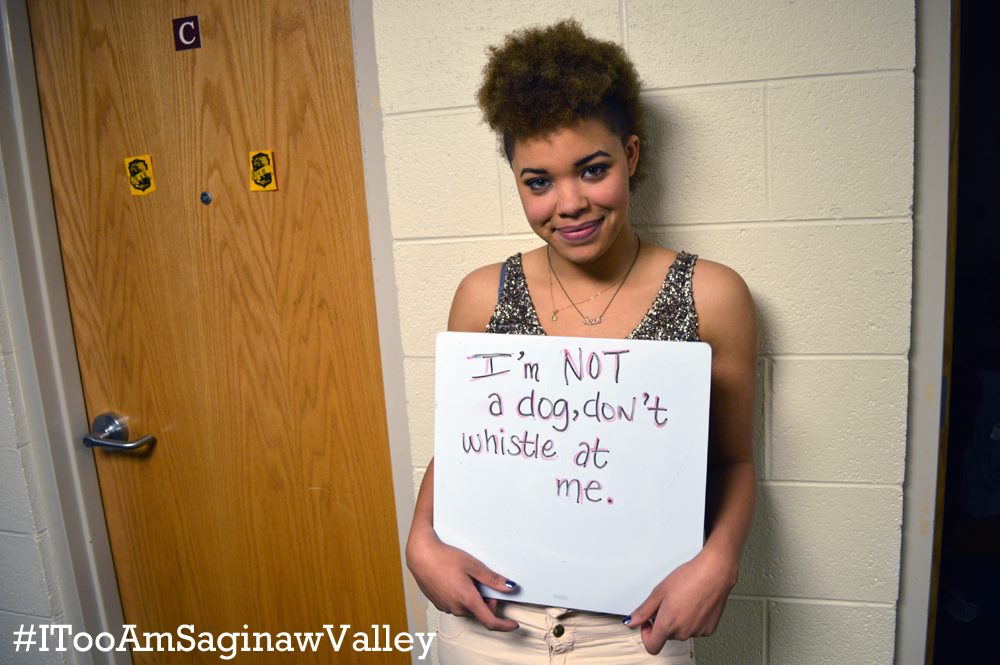
I first took a more critical look at harassment after a launching an “I, Too, Am Saginaw Valley” campaign, similar to “I, Too, Am Harvard” that highlights the voices and faces of black students, but opening it too all identities — mostly to get a more positive reception within the community. One of my participants wrote on her board, “I’m NOT a dog, don’t whistle at me,” after perpetually being catcalled from others shouting out their residence hall windows. After this, I began seeing the other methods students utilize to victimize others.

Yik Yak, a popular college app where users post anonymous messages that are then voted up or down by their peers, has stormed through the campus community, and brought harassment issues to light. While many of the posts can take on humorous perspectives of campus life, many of them venture on to defaming women, treating them as objects, and other forms of harassment.

It’s been an issue at many campuses, and Boston College even made a video to address some of the Yaks from their students, although it received much backlash from its student body.

Here are a few Yaks that have appeared on our campus:

“If her bra matches her panties when you take off her clothes, it wasn’t you who decided to have sex.”

“You probably shouldn’t be at college if you can’t tell a guy “stop.”

“To the girl who posted about sexual harassment… there’s no way you get sexually harassed, if you catch my drift.”

“Do you ever sit in class and look at this cute girl and think, I would love to bang you after class!”

“You ever just look at a girl and think ‘she could probably suck a mean dick.'”

I shouldn’t need explanation on why each of these posts contribute to a negative campus climate, but they perpetuate myths that “she was asking for it” and that there’s a standard of beauty required to be sexually harassed.

I usually feel more comfortable seeing these posts down-voted to the point where they are removed, which requires a total down-vote of a -5 before it vanishes from the app. But nearly all of these posts registered as positive messages within the campus community and became some of the most popular Yaks on the feed at the time.

While the app usually refrains from targeting individuals, it can justify beliefs that lead to a culture with highly sexualized and objectified women.

Further perpetuating this culture, in March of 2013, we had a Twitter page go rampant among our community. Dubbed “Dbags of the Valley” students submitted passive aggressive complaints about the university, faculty, students, or really whatever they felt like complaining about through Ask.fm, and then the posts would be re-posted on a now-disbanded Twitter account.

Full of hate speech, posts ventured into areas such as “To the girl wearing those tight, see-thru leggings in the library; stop wearing that shit, or I’ll rape you. #DressForSuccess #SVSUdbags.”

By September 2013, assumedly, the manager of the page promptly shut the page down after complaints. The university eventually identified the student behind the page, but decided to not release the name to the public.

Yik Yak and this page are not the only perpetrators of harassment on campus.

Sitting in at 4,585 followers and counting, is the ever-so-popular @SVSUCrushes2. It has a stronger social media following than any university-affiliated accounts, with the exception of the main SVSU social media pages.  It takes the same approach as the “Dbags” page, getting submissions from Ask.fm then posting on Twitter. Independently-operated pages began ravaging college campuses for the past couple of years. This account has racked up more than 14,000 crushes tweeted in its two-year lifetime. Most students see this page as harmless, despite relative agreement that some tweets that include “She can sit on my face anytime though..” cross the line. That tweet, by the way, is within the top fifteen favorited and retweeted posts by the page.

Despite becoming temporarily unavailable when the “Dbags” account went under heavy scrutiny, the account still holds a strong presence on campus. The operators of the page reported in an anonymous interview “We know for sure that we know how to handle Crushes in a responsible way,” but it enables a culture of window shopping and objectification on physical appearance.

Through these contributors of harassment, I’ve learned changing a culture is easier said than done, but not doing anything about this would be a greater injustice than the injustice itself. I only have a few more months left at this institution, but I remain hopeful that education will advance the environment here.

Tyler is a senior majoring in graphic design at Saginaw Valley State University and plans to undertake a graduate program in higher education in the fall. Follow Tyler on Twitter, @MysteriousLuigi.

Share

Filed Under: correspondents, male perspective, street harassment

« Previous Page
Next Page »

Share Your Story

Share your street harassment story for the blog. Donate Now

From the Blog

  • #MeToo 2024 Study Released Today
  • Join International Anti-Street Harassment Week 2022
  • Giving Tuesday – Fund the Hotline
  • Thank You – International Anti-Street Harassment Week 2021
  • Share Your Story – Safecity and Catcalls Collaboration

Buy the Book

Search

Archives

  • September 2024
  • March 2022
  • November 2021
  • April 2021
  • March 2021
  • January 2021
  • April 2020
  • March 2020
  • February 2020
  • December 2019
  • November 2019
  • September 2019
  • August 2019
  • July 2019
  • June 2019
  • May 2019
  • April 2019
  • March 2019
  • February 2019
  • January 2019
  • December 2018
  • November 2018
  • October 2018
  • September 2018
  • August 2018
  • July 2018
  • June 2018
  • May 2018
  • April 2018
  • March 2018
  • February 2018
  • January 2018
  • December 2017
  • November 2017
  • October 2017
  • September 2017
  • August 2017
  • July 2017
  • June 2017
  • May 2017
  • April 2017
  • March 2017
  • February 2017
  • January 2017
  • December 2016
  • November 2016
  • October 2016
  • September 2016
  • August 2016
  • July 2016
  • June 2016
  • May 2016
  • April 2016
  • March 2016
  • February 2016
  • January 2016
  • December 2015
  • November 2015
  • October 2015
  • September 2015
  • August 2015
  • July 2015
  • June 2015
  • May 2015
  • April 2015
  • March 2015
  • February 2015
  • January 2015
  • December 2014
  • November 2014
  • October 2014
  • September 2014
  • August 2014
  • July 2014
  • June 2014
  • May 2014
  • April 2014
  • March 2014
  • February 2014
  • January 2014
  • December 2013
  • November 2013
  • October 2013
  • September 2013
  • August 2013
  • July 2013
  • June 2013
  • May 2013
  • April 2013
  • March 2013
  • February 2013
  • January 2013
  • December 2012
  • November 2012
  • October 2012
  • September 2012
  • August 2012
  • July 2012
  • June 2012
  • May 2012
  • April 2012
  • March 2012
  • February 2012
  • January 2012
  • December 2011
  • November 2011
  • October 2011
  • September 2011
  • August 2011
  • July 2011
  • June 2011
  • May 2011
  • April 2011
  • March 2011
  • February 2011
  • January 2011
  • December 2010
  • November 2010
  • October 2010
  • September 2010
  • August 2010
  • July 2010
  • June 2010
  • May 2010
  • April 2010
  • March 2010
  • February 2010
  • January 2010
  • December 2009
  • November 2009
  • October 2009
  • September 2009
  • August 2009
  • July 2009
  • June 2009
  • May 2009
  • April 2009
  • March 2009
  • February 2009
  • January 2009
  • December 2008
  • November 2008
  • October 2008
  • September 2008
  • August 2008
  • July 2008
  • June 2008
  • May 2008

Comment Policy

SSH will not publish any comment that is offensive or hateful and does not add to a thoughtful discussion of street harassment. Racism, homophobia, transphobia, disabalism, classism, and sexism will not be tolerated. Disclaimer: SSH may use any stories submitted to the blog in future scholarly publications on street harassment.
  • Contact
  • Events
  • Join Us
  • Donate
  • Facebook
  • Instagram
  • Pinterest
  • Tumblr
  • Twitter
  • YouTube

Copyright © 2026 Stop Street Harassment · Website Design by Sarah Marie Lacy