• About Us
    • What Is Street Harassment?
    • Why Stopping Street Harassment Matters
    • Meet the Team
      • Board of Directors
      • Past Board Members
    • In The Media
  • Our Work
    • National Street Harassment Hotline
    • International Anti-Street Harassment Week
    • Blog Correspondents
      • Past SSH Correspondents
    • Safe Public Spaces Mentoring Program
    • Publications
    • National Studies
    • Campaigns against Companies
    • Washington, D.C. Activism
  • Our Books
  • Donate
  • Store

Stop Street Harassment

Making Public Spaces Safe and Welcoming

  • Facebook
  • Instagram
  • Pinterest
  • Tumblr
  • Twitter
  • YouTube
  • Home
  • Blog
    • Harassment Stories
    • Blog Correspondents
    • Street Respect Stories
  • Help & Advice
    • National Street Harassment Hotline
    • Dealing With Harassers
      • Assertive Responses
      • Reporting Harassers
      • Bystander Responses
      • Creative Responses
    • What to Do Before or After Harassment
    • Street Harassment and the Law
  • Resources
    • Definitions
    • Statistics
    • Articles & Books
    • Anti-Harassment Groups & Campaigns
    • Male Allies
      • Educating Boys & Men
      • How to Talk to Women
      • Bystander Tips
    • Video Clips
    • Images & Flyers
  • Take Community Action
  • Contact

Street Harassment Weekly – Jan. 19-25

January 26, 2015 By BPurdy

Catcalling is More Sinister Than You Might Think – “Our research supports previous findings that the rampant sexual objectification of women, an act of sexual terrorism, can heighten women’s fears of incurring physical and sexual harm,” says lead author Dr. Laurel Watson, a psychology professor specializing in traumatology at the University of Missouri-Kansas City.

I Confronted Every Man Who Catcalled Me (And It Didn’t End Well) – “How can you explain to a stranger that a compliment makes us feel afraid? That words like “gorgeous” and “beautiful” sound like threats when we hear them whispered to us on an empty street late at night? That we feel uneasy, objectified and uncomfortable when you say this to us while we’re going about our normal routine, not asking to be judged on our appearance out loud? That this thing they do for fun is at the expense of our peace of mind?”

Victim of Eve-Teasing, Teenager Kills Self – “A family member of the victim said, “We had gone to the police and complained about the incident. They did not take appropriate action against the guilty, which led to the girl’s death.””

SHE Teams Power Fight Against Eve-Teasing– ““We have constituted 100 such teams where police personnel in plainclothes mix with the crowd outside colleges, popular hangouts, cinemas and in public transport. They go armed with a small hidden camera that records the goings-on as they happen.” Sometimes, women police personnel themselves end up as “victims” and the entire act is caught on camera. The eve-teasers are immediately taken to the police station where his family is called in and he is let off with a warning and a petty fine.”

Ain’t No Hollaback Girl – Men And Women Speak Out Against Street Harassment Through Hollaback!NOLA– “Hollaback, which started in New York, is a non-profit movement that aims to end street harassment. Hollaback branches exist in 25 countries and 84 cities. The city of New Orleans was finally added to the list last December. According to Hollaback’s mission statement, street harassment is a form of sexual harassment that takes place in public spaces. They claim that at its core, street harassment is a power dynamic that constantly reminds historically subordinated groups of their vulnerability to assault in public places.”

Students Enact Skits About Violence Against Women – “Concerns about violence against girls and security of school students were highlighted in a unique drama competition on Sunday. Students’ groups from 15 schools performed on issues like eve teasing, addiction, sexual abuse of girls, adolescence and crime against women. The competition was part of ‘Nirbhay Vidyarthi Abhiyaan’-an initiative taken up by the Pune police to create awareness about crimes against students. A total of 116 schools in the city had registered for the drama competition. Eighty-five schools came up with performances and 15 were selected for the finals.”

Video: When Men Accidentally CatCall Their Own Mothers – “Often in trying to get men to understand how awful street harassment is, we use rhetorical techniques like “Would you talk to your mother like that?” But thanks to a project by Everlast, the men in this video really did catcall their mothers. The results are exactly as epic as you’d expect.”

Wearing Her “Whorepants” – How One Runner Turned Getting Harassed Into a Movement– “A year ago, I wrote a column for the Philadelphia Inquirer about female runner harassment. I didn’t offer safety tips. Instead, I called for us to take the blame off women who were harassed and hoisting it on to the people doing the harassing. To prove that point, I wrote about what had happened to me when I wore a pair of purple below-the-knee Nike capris, which I’d bought for $10 at the Nike outlet in Atlantic City. Reaction was swift and fierce.”

Are Women Traveling Into a Safer 2015? – “Every 51 minutes, a woman faces harassment or assault in India’s public spaces, according to a 2011 report by the National Crime Records Bureau. Staggering numbers of reported and unreported cases of violence and harassment make transportation difficult and dangerous for women and girls, especially after dark. So should safety issues simply keep women and girls indoors—or does their vulnerability in public spaces highlight a desperate need for gender considerations in designing and planning public transport?”

Share

Filed Under: News stories, weekly round up Tagged With: hollaback, India, NOLA, philadelphia, SHE team

The Bahamas: Small Islands and Good MANners (Part 2)

January 26, 2015 By Correspondent

Alicia Wallace, Nassau, The Bahamas, Blog Correspondent
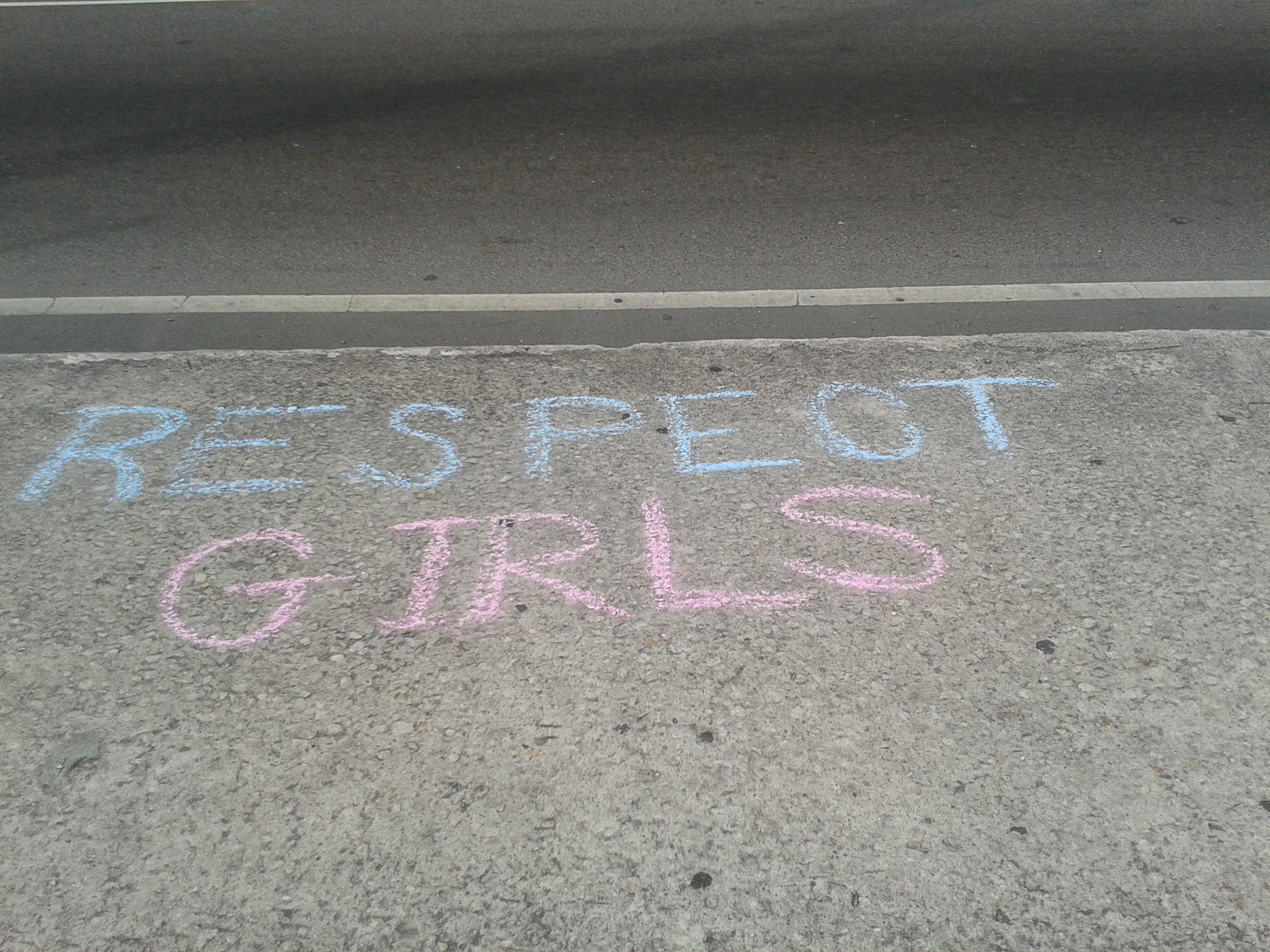
Via Hollaback! Appalachian Ohio

In Part I, we explored street harassment and the resistance of Bahamians to respond to the evolution of society due to increased population and lived experience of women living in The Bahamas. I used the example of my first memory of street harassment which caused fear and shame. In Part II, we’ll delve into the differences between the Bahamian man’s experience and that of the Bahamian women. The Bahamian affinity for good manners will be weighed against the safety – if only by perception – of Bahamian women.

Bahamian men move through life with a tremendous amount of unrecognized privilege. They are concerned about their egos, manners and courtesies extended to them, and the subsequent feelings they inspire. They are unaware of – or simply unmoved by – the perpetual fear plaguing women simply for existing in a world where men dominate in the physical sphere. They are unfamiliar with a woman’s thought process as she approaches them, or any area where they could be lurking.

What am I wearing?

Can I run in these shoes?

Is he looking at me?

Where are my keys?

Place keys between my fingers.

Swivel safeguard on mace and place index finger on the trigger.

Dial someone’s cellphone number and keep thumb near the call button.

Do not drop any of these essential tools.

Look behind without looking like I’m looking behind.

Shoulders back, head up, eyes looking every which way.

Walk quickly – don’t run – and only on balls of feet so no one hears heels clicking.

Clutch bag tightly, but be prepared to toss it at any minute.

Get in the car quickly, lock all the doors, and start the engine. Don’t worry about the things in your lap right now.

Drive like hell.

Breathe.

Develop the plan for arrival.

Bahamian men are completely unable to reconcile their feelings and expectations of attention with the everyday lived experience of Bahamian women. They can’t begin to understand why any of this is necessary, and how it could even begin to excuse the outright refusal of women to give freely of their time and conversation. They’re steeped in their own experiences.

Bahamians are friendly people.

This is a small place.

My grammy taught me to speak to people when I see them. Anything different is just rude.

Bahamian women are too stuck up.

They don’t want no black man, and they don’t want no Bahamian man.

They think they’re too good for us.

They don’t appreciate how nice we are. We just want to say hello. Give them compliments.

Bahamian women look good! What’s so bad about that?

It’s easy for men to touch fists with other men, known or unknown to them. It’s not at all difficult to give a head nod or an “Erryting cool” to a man they’ve never seen before. They don’t have to know each other to be cordial. There’s a reason for this, but they don’t see it.

What’s the difference?

Power. It all boils down to the power differential. Between men, the playing field is fairly level. They generally have the same strength and abilities, neither holding any more power to cause harm to the other. A man can be relatively certain that another man saying “Sup?” is doing nothing more than acknowledging his existence and the exchange will end at will.

In the case of a man and a woman, there is an imbalance of power due to biological differences. Generally speaking, women can be overpowered by men. Women can be violently assaulted by men. A woman has no idea where an exchange can lead, and has little power to stop it. For this reason, many women choose not to engage at all.

Bahamian men fail to understand that this is not an affront to good manners or common courtesy. It’s survival.

The issue cannot be framed by the person in the position of power based on his own intent. That intent, however noble, is not apparent to the person with the least amount of power. All a Bahamian woman can tell you for certain is how it makes her feel when she is catcalled, followed, or otherwise greeted, and this is, in fact, what truly matters. The impact is of greater consequence than the intent.

It’s not the job of a woman to consider the feelings of a strange man she fears could wrestle her to the ground, drag her by her hair, and sexually assault her. Rather, it is the responsibility of a man to consider the way he is perceived, control his reaction to being ignored, and modify his behavior. If he is truly concerned about good manners and common courtesy, the Bahamian man will understand the position of the Bahamian woman, and he will act accordingly.

Good manners may make you feel good, but behaving in ways that minimize fear and increase access to public space for women should make you feel better. At the end of the day, it’s not about you, Bahamian man. It’s about the impact you have on the Bahamian women you claim you love, honor, and respect.

Alicia is a freelance writer and public educator in Nassau, Bahamas. You can connect with her on Twitter (@_AliciaAudrey and on her blog.

Share

Filed Under: correspondents, street harassment

The Bahamas: Small Islands and Good MANners (Part 1)

January 26, 2015 By Correspondent

Alicia Wallace, Nassau, The Bahamas, Blog Correspondent

Hollaback! Bahamas, International Anti-Street Harassment Week 2014

The first time I was street harassed, I was with my mother, wearing a plaid jumper, and 8 years old. It was terrifying, embarrassing, and guilt-inducing. My mother was furious, but I couldn’t tell whether the object of her rage was the creepy 30-something man or me.

“That’s a pretty girl, eh?”

My chest overheated and I froze. Something about it wasn’t right.

“Whatchu sayin’ mother-in-law. I wan’ marry your daughter.”

I looked at her, but quickly realized that was a bad call.

“Get in the car!” she roared.

I did, my head down, legs shaking, wishing my father was there because, surely, this would not have happened in his presence. Men may have looked when his back was turned, but no one had ever dared to say anything. To be honest, my memory and telling of this story is probably colored by my innocence, shock, and youth at the time, but that is, without prejudice, what happened.

Not much has changed since then. My mother doesn’t have to drive me everywhere, I don’t wear a school uniform, and there’s a 2 in front of that 8, but things are basically still the same. The feminist in me hates the truth in it, much less to admit it, but I always wish for the presence of my father or my brother when I’m harassed. They are still my protectors. They are still my best prevention tactic. In the eyes of the world at large, I am still only made safe, only honored, only protected, only of value and worth because of my relationship to men. Black men. Tall men. Thick men. Men with beards. Men with deep voices. Men with an authoritative walk. A powerful voice. A monopoly on strength. Testosterone. Oozing heterosexuality. Prone to violence. Voted most likely to bust a cap in someone for their woman – be she a mother, wife, daughter, or girlfriend – at the drop of a hat.

I’m not the only person who ever had that experience. I’ve had conversations with people of different ages and races about street harassment and how it made them feel. I spoke, as Director of Hollaback! Bahamas to a group of 8-12 year old girls about street harassment, and watched with horror as they each raised their hands in answer to the question, “How many of you have experienced street harassment?”

In The Bahamas, there’s an idea that girls only experience street harassment and other acts of sexual violence because their behavior or presentation is inappropriate. Her skirt is too short. She’s wearing too much lip gloss. Her mother was “like that”. Ain’ no daddy in that house. She likes grown people’s conversations too much. She walks “too slack”. She, she, she, she, she.

There’s also the overriding idea that people must be courteous, and this means speaking to everyone you see or pass. It’s not unusual for people to say a general “Good morning” when entering an occupied space which includes doctors’ offices, classrooms, banks, stores, and buses. This extends to the street, people greeting one another in passing on sidewalks.

The capital of this archipelago of islands, Nassau, is 21×7 miles. It is, indeed, a little rock. There was a time when all of its inhabitants – like other islands – were connected. People reprimanded children walking by after the school had rung because they knew it was so-and-so’s son or daughter. Those days, however, are a relic of the past, no matter how tightly anyone tries to hold onto it. The population of this country is reaching for 400,000, and I’d venture to guess that one-third of it lives in Nassau. This little rock is densely populated, and the degrees of separation have increased and decreased the likelihood that we can identify one another as Miss Madeline’s grandson or the tuck shop lady’s son-in-law. As a result, common courtesy is a bit less common, and there are many who continue to fight this change, seeing it as a plague brought by a rebellious generation. This, of course, is false.

Let’s take a moment to reflect on the memory of an 8 year old girl in her elementary school uniform, crossing the street with her mother. Think of the fear she felt when a man her father’s age spoke of marrying her. Feel her shame when her mother shouted at her to get in the car. Cary the weight of the blame she carried for years, and the burden of trying to make sure it never happened again. How could she find the balance between exercising her good manners and “keeping herself to herself”? No little girl should ever have to navigate this terrain, but for many Bahamian girls, this is a part of growing. There is little choice, and decisions have to be made. That 8 year old girl shouldn’t have to act based on expectations of good manners rather than her own safety, confidence, and comfort, the problem is not that little girl. Let’s face it. Those things are mutually exclusive.

We’ll explore the real reason for the evolution of societal interaction in Part II.

Alicia is a freelance writer and public educator in Nassau, Bahamas. You can connect with her on Twitter (@_AliciaAudrey and on her blog.

Share

Filed Under: correspondents, Stories, street harassment

“It’s made me concerned about leaving my office alone”

January 25, 2015 By Contributor

I was leaving work this evening and walking down the street where my office is located when a man said, “Excuse me” while looking me up and down. I ignored him. He proceeded to run after me and say, “Excuse me, you are very beautiful. Can I ask you a question?”

I said, “What?” And he said, “What’s your name?” I replied, “I’m in a rush.” To which he replied “that’s rude.” I said, “Well I’m not walking down the street waiting to be approached.” He then said, “F*** you, you f***ing bitch!’ And continued to yell out “F*** you!” as I walked away.

This happened on a busy street which I have to walk down every day, right in front of a police station. It’s made me concerned about leaving my office alone from now on, only to walk a single block to get on my bus.

Optional: Do you have any suggestions for dealing with harassers and/or ending street harassment in general?

I don’t have any suggestions. I tried to explain to this guy why I wasn’t going to give him my name (that I’m just walking down the street minding my own business) and then he still proceeded to swear at me aggressively. He wasn’t entitled to know my name or the reason why I wouldn’t give it to him. He also had the nerve to do this in front of a police station.

– Anonymous

Location: Kentish Town, London

Share your street harassment story for the blog.
See the book 50 Stories about Stopping Street Harassers for more idea

Share

Filed Under: Stories, street harassment

ʺI wanna ride you like a wild beast!ʺ

January 24, 2015 By Contributor

I was 16, walking down the street in broad daylight. A super buff guy in a fancy, red car slowed down beside me and rolled down the window and said, ʺI wanna ride you like a wild beast!ʺ I started walking faster and eventually he left.

– Sandy

Location: Berkeley, California, USA

Share your street harassment story for the blog.
See the book 50 Stories about Stopping Street Harassers for more idea

Share

Filed Under: Stories, street harassment

« Previous Page
Next Page »

Share Your Story

Share your street harassment story for the blog. Donate Now

From the Blog

  • #MeToo 2024 Study Released Today
  • Join International Anti-Street Harassment Week 2022
  • Giving Tuesday – Fund the Hotline
  • Thank You – International Anti-Street Harassment Week 2021
  • Share Your Story – Safecity and Catcalls Collaboration

Buy the Book

Search

Archives

  • September 2024
  • March 2022
  • November 2021
  • April 2021
  • March 2021
  • January 2021
  • April 2020
  • March 2020
  • February 2020
  • December 2019
  • November 2019
  • September 2019
  • August 2019
  • July 2019
  • June 2019
  • May 2019
  • April 2019
  • March 2019
  • February 2019
  • January 2019
  • December 2018
  • November 2018
  • October 2018
  • September 2018
  • August 2018
  • July 2018
  • June 2018
  • May 2018
  • April 2018
  • March 2018
  • February 2018
  • January 2018
  • December 2017
  • November 2017
  • October 2017
  • September 2017
  • August 2017
  • July 2017
  • June 2017
  • May 2017
  • April 2017
  • March 2017
  • February 2017
  • January 2017
  • December 2016
  • November 2016
  • October 2016
  • September 2016
  • August 2016
  • July 2016
  • June 2016
  • May 2016
  • April 2016
  • March 2016
  • February 2016
  • January 2016
  • December 2015
  • November 2015
  • October 2015
  • September 2015
  • August 2015
  • July 2015
  • June 2015
  • May 2015
  • April 2015
  • March 2015
  • February 2015
  • January 2015
  • December 2014
  • November 2014
  • October 2014
  • September 2014
  • August 2014
  • July 2014
  • June 2014
  • May 2014
  • April 2014
  • March 2014
  • February 2014
  • January 2014
  • December 2013
  • November 2013
  • October 2013
  • September 2013
  • August 2013
  • July 2013
  • June 2013
  • May 2013
  • April 2013
  • March 2013
  • February 2013
  • January 2013
  • December 2012
  • November 2012
  • October 2012
  • September 2012
  • August 2012
  • July 2012
  • June 2012
  • May 2012
  • April 2012
  • March 2012
  • February 2012
  • January 2012
  • December 2011
  • November 2011
  • October 2011
  • September 2011
  • August 2011
  • July 2011
  • June 2011
  • May 2011
  • April 2011
  • March 2011
  • February 2011
  • January 2011
  • December 2010
  • November 2010
  • October 2010
  • September 2010
  • August 2010
  • July 2010
  • June 2010
  • May 2010
  • April 2010
  • March 2010
  • February 2010
  • January 2010
  • December 2009
  • November 2009
  • October 2009
  • September 2009
  • August 2009
  • July 2009
  • June 2009
  • May 2009
  • April 2009
  • March 2009
  • February 2009
  • January 2009
  • December 2008
  • November 2008
  • October 2008
  • September 2008
  • August 2008
  • July 2008
  • June 2008
  • May 2008

Comment Policy

SSH will not publish any comment that is offensive or hateful and does not add to a thoughtful discussion of street harassment. Racism, homophobia, transphobia, disabalism, classism, and sexism will not be tolerated. Disclaimer: SSH may use any stories submitted to the blog in future scholarly publications on street harassment.
  • Contact
  • Events
  • Join Us
  • Donate
  • Facebook
  • Instagram
  • Pinterest
  • Tumblr
  • Twitter
  • YouTube

Copyright © 2026 Stop Street Harassment · Website Design by Sarah Marie Lacy