• About Us
    • What Is Street Harassment?
    • Why Stopping Street Harassment Matters
    • Meet the Team
      • Board of Directors
      • Past Board Members
    • In The Media
  • Our Work
    • National Street Harassment Hotline
    • International Anti-Street Harassment Week
    • Blog Correspondents
      • Past SSH Correspondents
    • Safe Public Spaces Mentoring Program
    • Publications
    • National Studies
    • Campaigns against Companies
    • Washington, D.C. Activism
  • Our Books
  • Donate
  • Store

Stop Street Harassment

Making Public Spaces Safe and Welcoming

  • Facebook
  • Instagram
  • Pinterest
  • Tumblr
  • Twitter
  • YouTube
  • Home
  • Blog
    • Harassment Stories
    • Blog Correspondents
    • Street Respect Stories
  • Help & Advice
    • National Street Harassment Hotline
    • Dealing With Harassers
      • Assertive Responses
      • Reporting Harassers
      • Bystander Responses
      • Creative Responses
    • What to Do Before or After Harassment
    • Street Harassment and the Law
  • Resources
    • Definitions
    • Statistics
    • Articles & Books
    • Anti-Harassment Groups & Campaigns
    • Male Allies
      • Educating Boys & Men
      • How to Talk to Women
      • Bystander Tips
    • Video Clips
    • Images & Flyers
  • Take Community Action
  • Contact

Day of the Girl 2014

October 11, 2014 By HKearl

Via Teen Library Toolbox

Today is the 3rd annual International Day of the Girl, an opportunity to reflect on the status of girls in the world and their needs.

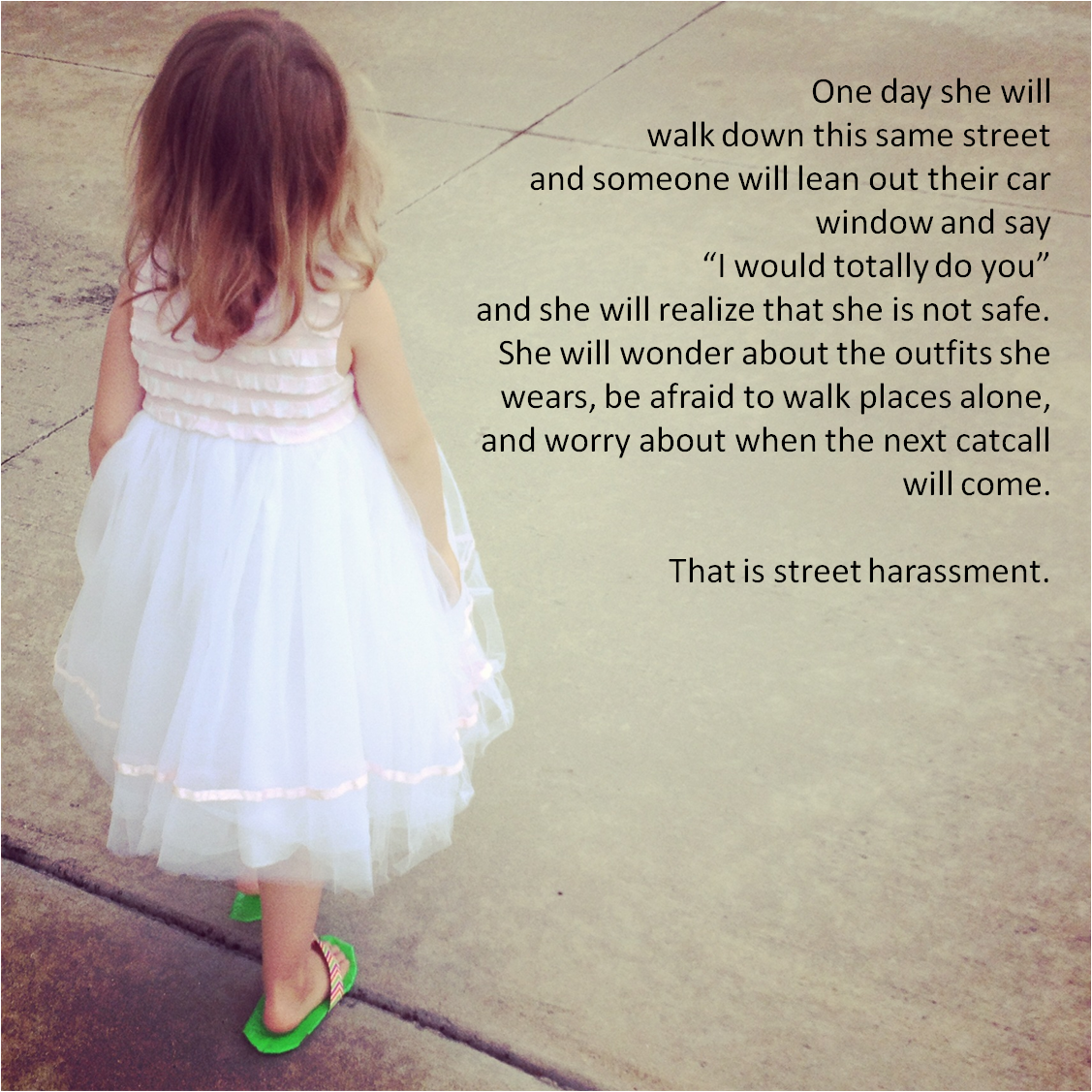
I, of course, always think about street harassment. I was harassed as a teenage girl and the older I get, the more outraged I am about my experiences and about the harassment and assault girls and teenagers continue to face today in public spaces. It angers me that the depictions of street harassment in the media would like us to believe it “only” happens to adult women and is no big deal, but the reality is, teenagers are targeted the most — and often by adult men. In fact, our national survey found that most people who are harassed (female and male) begin to experience it before age 17.

You can read stories on our blog showing this too,

Like K in New York shared her story… “I’ll never forget being in middle school and walking around my neighborhood and having these middle-aged men cat calling me. I was a 12-year-old girl, I wanted to dress pretty but the constant stares and whistles from older men made me feel insecure. It felt as if I wasn’t a person just a body with a vagina walking around.

At times I would yell and say you are disgusting but I was afraid that they might chase me down, so I didn’t do it as often. The majority of the time I would look down and walk away quickly. I was in middle school and these men were older and stronger than I was; all the news story scared me of what these men could do.”

Or Anonymous in CA who reflected on a lifetime of harassment…”I started being harassed as a pedestrian the summer I turned nine. A driver honked, catcalled, and threw a penny that hit me. Now I am 39 and I keep thinking I will eventually grow old enough to fall off the radar. Being honked at, whistled at, shouted at, followed, groped, and grabbed makes me angry, shaken up, and stressed out.”

Summer Al-Saleh, a high school senior at Foothill Technology High School in Ventura, California, wrote about street harassment for her school paper this week. She gave me permission to excerpt it:

“Over the past few months, I cannot begin to count how many times I have been harassed when I was by myself or accompanied with friends.

As I was on a run earlier in the summer, two middle-aged men drove by, stared, and whistled at me. They drove away, probably laughing at the fact that they caught me off guard and caused me to jump out of initial shock. They drove away, not even considering that I was on a run, trying to concentrate, existing in such a way that has no relative bearing on their existence, something that is very difficult for street harassers to understand.

When I was walking out of the grocery store two young men started following me into the parking lot, while asking questions and making comments about my appearance. As I briskly walked away they got the satisfaction of knowing that I was angry, disturbed, and threatened. They, just like the other men, did not see me as a person with somewhere to be, something to do, and something on my mind.

While finishing a run with my teammates, two middle-aged men drove by, slowed down to get our attention, yelled something that was incomprehensible and made kissy faces at us. The thing about this specific encounter, the former encounters, and other women’s experiences is that they are all much too similar: each and every act of harassment is steeped in entitlement. So much entitlement that it’s difficult to grasp how someone could do something so inconsiderate, objectifying, and privileged that they won’t even accept or may not even realize that what they’re doing is harassment.

Their over-flowing sense of entitlement coupled with their lack of sensibility creates a situation that makes women feel unsafe and uncomfortable in public spaces. It can and does determine where women choose to go, what we choose to wear, and where we choose to live. Ultimately, it limits our choices and freedom to be safe in public.”

What is different from when I was a teenager is that there is a lot more awareness about this issue. And thanks to social media and sites like mine, I know there are places teenagers can go to for advice, for support and to share their stories. Which is so important.

So today, I honor all the girls who are bravely speaking out and demanding the right to be safe in public spaces!

Share

Filed Under: News stories, street harassment Tagged With: day of the girl, harassment, teenagers

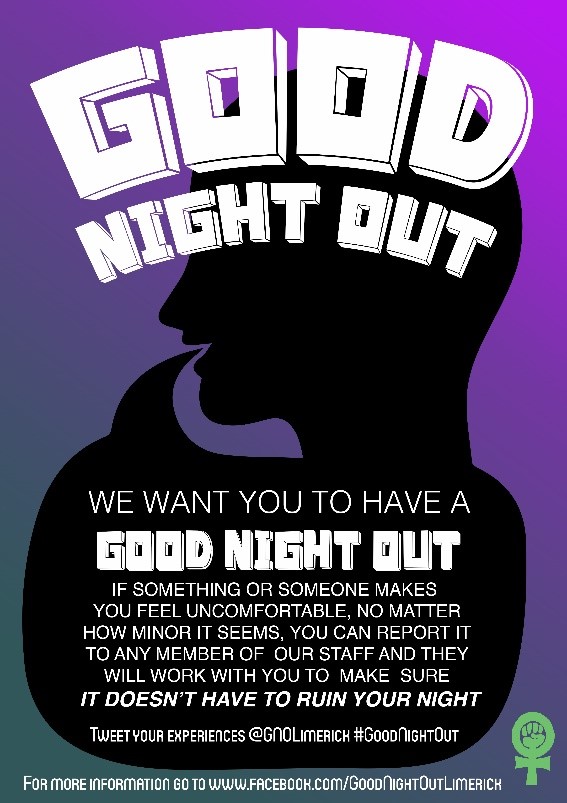
Ireland: Have a Good Night Out!

October 10, 2014 By Correspondent

Yvonne Ní Mhurchú, Limerick, Ireland, SSH Blog Correspondent

Credit: Colin Doherty

Harassment isn’t something that just happens on the street.  It isn’t just confined to ‘outside’, it is something that happens everywhere; outside, inside, work, school, university, bars, concerts, sporting events and nightclubs.  It is happening everywhere in every city and every country around the world.  For proof of this, look no further than the Stop Street Harassment blog, it has stories and reports of harassment by various people from across the globe.

Last month I wrote about how I walked home for the first time ever without any fear of street harassment.  This month I want to write about socialising without being subjected to harassment.  I currently run a feminist group in my town, we frequently liaise with other likeminded groups.  It is through this communication I heard about the Good Night Out Campaign.

Originally the brain child of Hollaback London, the premise of the Good Night Out Campaign is simple: we want nightlife venues to adopt and promote a zero tolerance policy when it comes to the harassment of their patrons – particularly female and those from the LGBTQ community.  Venues show their commitment by displaying official GNO posters around their establishment and training staff to deal with any complaints that might arise.

The reason I feel so strongly about this campaign is because I am all too aware of how problematic nightlife harassment can be.  My feminist group had a meeting to discuss the campaign.  I shared some of my own experiences as did the group, and the stories just kept on coming.  Comments, groping, sexually aggressive behaviour, being followed, yelled at and assaulted.  It is difficult not to get angry after hearing what all of these people had to put up with.  So, we decided to channel our anger positively and bring Good Night Out to Limerick.

The support we have received so far has been amazing.  Local newspapers have written about it and a local radio station did a short piece on it too.  Two weeks ago we asked the public to share their stories with us to help highlight just how serious a problem harassment in nightlife venues is.  Here is an example of two incidents that people were kind enough to share with us (TW):

“I was on a night out with some friends, a few of them were dancing while I was minding the drinks. I saw a guy on the dance floor start to follow one of my friends around, he was trying to grind up against her and touch her. She was not interested in the slightest but he wouldn’t leave her alone, eventually she got fed up and left the floor, as she did he pulled up her skirt. My ass was grabbed 3 times that same night.”

“I was in _____ during my freshers week. I didn’t know many people, but I was there with a solid group of people. I was upstairs dancing and some guy started grinding on me. I tried to back away and he and a friend pinned me up against a wall. They were laughing, I was shouting at them to let me go. A friend of mine was also pulling at them to get them off me, to no avail. I ended up biting one of them so he’d take his arm off me and running outside, closely followed by my friend who hugged me while I hyperventilated. To this day I regret not going up to security or something, because I doubt those guys even realised how much they terrified me.”

Stories like these are regular occurrences for a majority of people when they go out.  Not only can harassment completely ruin a person’s night out, it can also leave a lasting negative effect on them.  We want venues and patrons of these venues to send a message that this sort of negative behaviour won’t go unchallenged and will not be tolerated.  The more people that get involved the louder that message becomes.  If you would like to bring Good Night Out or a version of it to your town/city please feel free to contact me via twitter and I will do what I can to help get you started.

Yvonne volunteers as a SATU (psychological support) worker for her local Rape Crisis Centre and is an advocate for women’s issues and equality. You can follow her, her feminist group or her anti-harassment campaign on twitter: @YvonneNiMhurchu, @lmkfeminist and @GNOLimerick.

Share

Filed Under: correspondents, public harassment

“That same guy had been creeping on women before”

October 10, 2014 By Contributor

There weren’t very many people on the tram. I was wearing a black dress just above the knee and brown boots and jacket. Slutty? Why is that even part of the question- IT HAS NOTHING TO DO WITH HOW GUYS TREAT US. I had a bag of groceries and I was tired.

This older guy, maybe late 40’s, kept looking at me. I was on my way home and the ride was a little long. I finally looked at him in the eyes hoping to get him to stop. With no holding back he looked up and down my body and into my eyes again. I looked away. I looked back and he was still staring. Finally I motioned “What?” to him and he came up to me! He asked me what the problem was and I asked him why he kept staring at me. I was a bit shocked he walked up to me…

Then he got closer and said, “NO, you were staring at ME.”

I was shaking by now, “Yes, to try and get YOU to stop.” I said.

He was yelling, “You were staring, should I call the authorities?”

I was baffled. What was this guy talking about? As if I were the one harassing him! “The difference is, I looked away.”

“So did I.” He argued loudly. (I know he had not. He stared at me the ENTIRE time.)

Finally 3 men came up and stood around us, one guy separated me and the other guy. I was so thankful my legs felt weak.

The rude guy finally left for the front of the tram. One of the guys made a comment that that same guy had been creeping on women before…
I almost wanted to cry. I don’t know why. I guess because of how the guy treated me. How weak I felt. I don’t know. I am usually pretty strong and things don’t usually bother me. I am still shaking just thinking about it even though nothing happened….

I got home and told my boyfriend about it and his response?

“Why did you give him attention?”

WHAT! It hurt that his response was saying I was in the wrong. I can’t believe it. I told him I didn’t give him attention, the guy gave ME attention and any normal person would look away in the same circumstance and this guy did the opposite… if I felt uncomfortable didn’t I have a right to try and get him to stop? I am so offended by how my boyfriend reacted the feelings have come rushing back as fresh as if the event had just happened. (It happened an hour ago.)

I felt more security from the guy who stood between me and the disgusting guy than I did telling my own boyfriend. I am so confused over that.
He told me I should have just looked away. I explained that I had but the guy was blatantly staring at me. I had a right to try and get him to stop. If I felt uncomfortable I was not in the wrong to stand up for myself. People make eye contact on a regular basis- but usually they look away. They don’t keep staring.

We all have common courtesy and this guy did not show me this at all.

Optional: Do you have any suggestions for dealing with harassers and/or ending street harassment in general?

More women standing up and saying NO. By staying silent it will continue. Even having someone stare- there is a cultural accepted amount of time for eye contact. A person doesn’t have a right to look at someone else as if they are a piece of meat. SAY SOMETHING. If it escalates get authorities. This person obviously needs to be reminded that it is NOT okay and needs to be put straight.

– E. Nicole

Location: Yarra Trams, Coburg, VIC

Share your street harassment story for the blog.
See the book 50 Stories about Stopping Street Harassers for more idea

Share

Filed Under: Stories, street harassment

USA: I’m Going to NYCC! Let’s Geek Out About Ending Harassment

October 9, 2014 By Correspondent

Katie Bowers, NY, USA, SSH Blog Correspondent

This weekend marks my now-annual tradition: cosplaying at New York Comic Con (NYCC).  I’ve attended NYCC as Ramona Flowers (from Scott Pilgrim) and Amy Pond and Donna Noble (both from Doctor Who). Needless to say, as a geek girl, cosplayer, and advocate for ending street harassment, I’ve been pretty interested in the work of Geeks for CONsent.

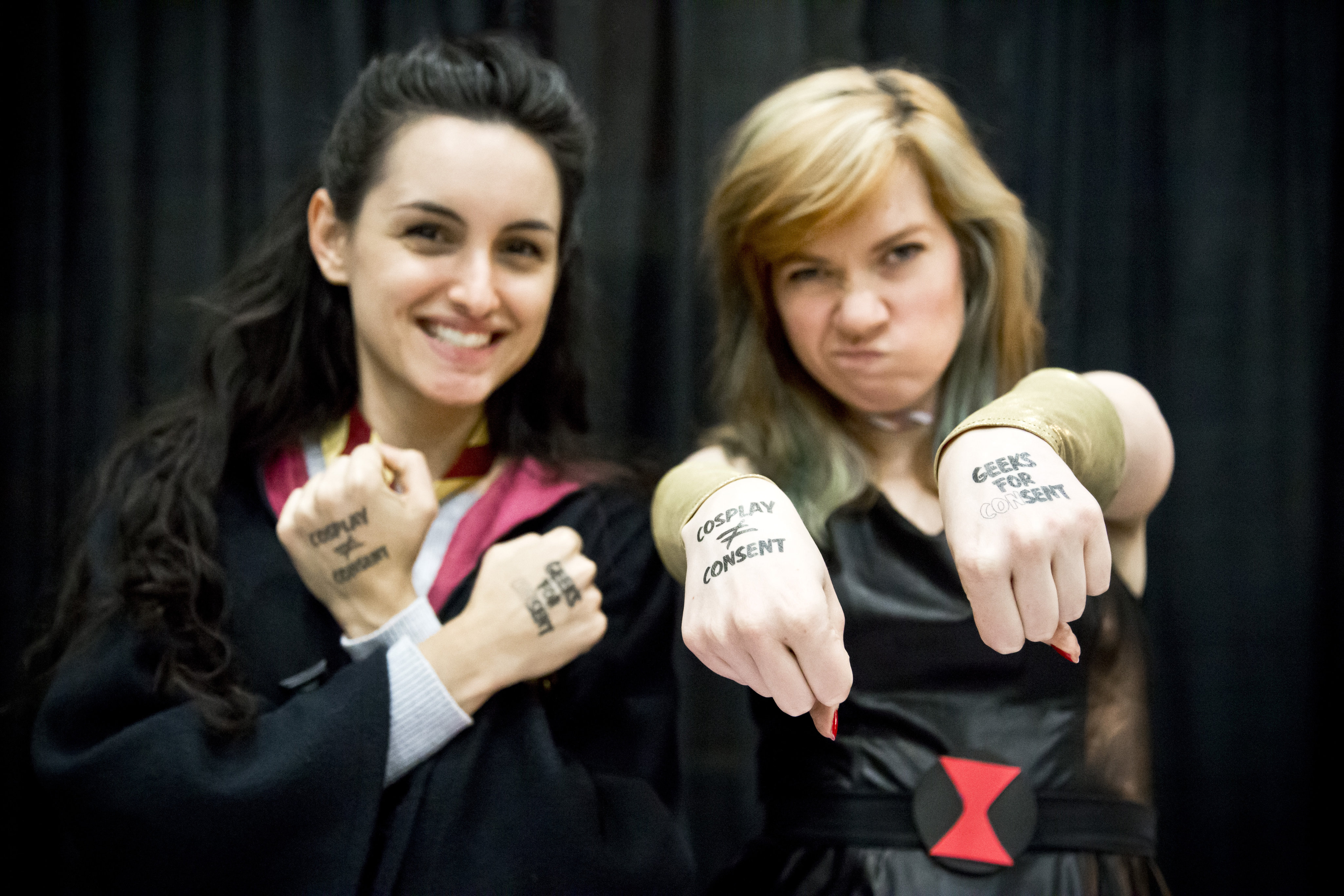
Geeks for CONsent is a group of female cosplayers and allies working to make sure that comic cons and the surrounding streets and events are harassment-free zones.  They have produced comic books, info sheets, and online resources for attendees, and they also advocate for and help convention staff to create high quality, well-publicized sexual harassment policies.

On the street or in the convention center, cosplay grabs attention and can inspire a lot of picture-taking.  If you ask for a photo and behave politely, most cosplayers are happy to oblige – we worked hard, after all, to look this awesome.  Unfortunately, some con-goers don’t apply that basic level of respect to cosplayers.  Harassment at cons often involves a camera: harassers may grab a cosplayer’s body parts during a photo, snap shots of cosplayers bending over, click quick up-skirt pics while sitting on the floor, and other clearly unconsented behaviors.  Other times, it won’t be on film.  It will be a passing comment in the hall about how a woman “fills out” a costume or the sudden, frightening sensation of a stranger’s hand feeling your costume or your hair.

This is a problem at every con, including that largest and most well known of the nerd conventions: San Diego Comic Con.  Back in July, we reported that despite Geeks for CONsent’s 2,500 signature petition, SDCC would not be updating their harassment policies or changing the ways they publicize those policies.

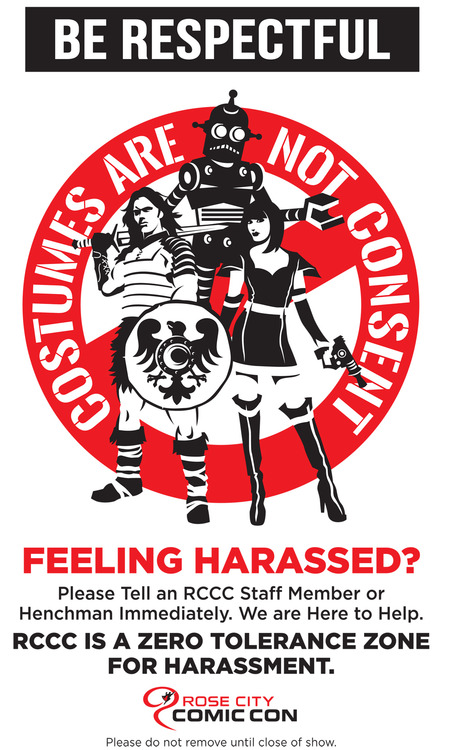
Fortunately, Geeks for CONsent and other anti-harassment advocates know that San Diego isn’t the only con around.  The work of the anti-harassment movement led both Emerald City Comic Con in Seattle and Rose City Comic Con in Portland to post some clear and beautiful signage throughout the convention center reminding attendees that “Costumes are not consent”.  Awesome Con, which hosts shows in Indianapolis, Milwaukee, and Washington, D.C., brought in Geeks for CONsent as their in-house anti-harassment team and used their anti-harassment training manual to train all of their volunteers in 2014.

Geeks for CONsent at Awesome Con DC, 2014

This weekend, NYCC will open their doors with a new anti-harassment policy, created by geek girl blog The Mary Sue and a panel of geeky advocates.  The policy includes a pretty comprehensive definition of harassment and protocols for reporting and dealing with harassers.  The policy also introduces the new Report Harassment feature of the NYCC app.  This cool piece of technology allows users to file an immediate, detailed report (provided, of course, that they have cell service in the concrete depths of the Javits Center).  Geeks for CONsent and Fan Girls’ Night Out will also be on hand to “spread the anti-harassment message, collect your stories, and provide a safe space to talk about your experiences”.

As geek culture becomes mainstream, making cons a place where all people feel welcome is more pressing than ever before.  At its core, geeking out is about enthusiasm.  It’s the type of unbridled exhilaration that gets you reading every installment, watching every episode, dressing up in character, traveling to cons.  Geeks are thrilled by seeing our favorite fictional heroes battle the forces of evil.  But what’s exciting now isn’t in the stories: it’s in us.

Major conventions are adopting new policies, geek celebs are speaking out against harassment, high traffic blogs and just-for-fun tumblrs are heralding the call that cosplay does not equal consent. Outside the geek-o-sphere, street harassment is being talked about by everyone from The Daily Show to Fox News (with, let’s say, “varying levels of support”).  After years of work, and even longer years of stifled silence, the heroic efforts of anti-harassment advocates are starting to turn the tide.

This weekend, I’ll be at NYCC and I’m excited to see how things are different.  Will the new policies eliminate harassment at the con?  Of course not – but this is the beginning.  It feels good to step into the Javits Center – wig, costume, and all – and know that the convention has my back.  And that?  That’s something to geek out about.

Katie is a social worker and community educator interested in ending gender-based violence, working with youth to make the world a better place, and using pop culture as a tool for social change. Check out her writing at the Imagine Better Blog and geek out with her on Twitter, @CornishPixie9.

Share

Filed Under: correspondents, Events, public harassment Tagged With: comic con, cosplay, NYCC

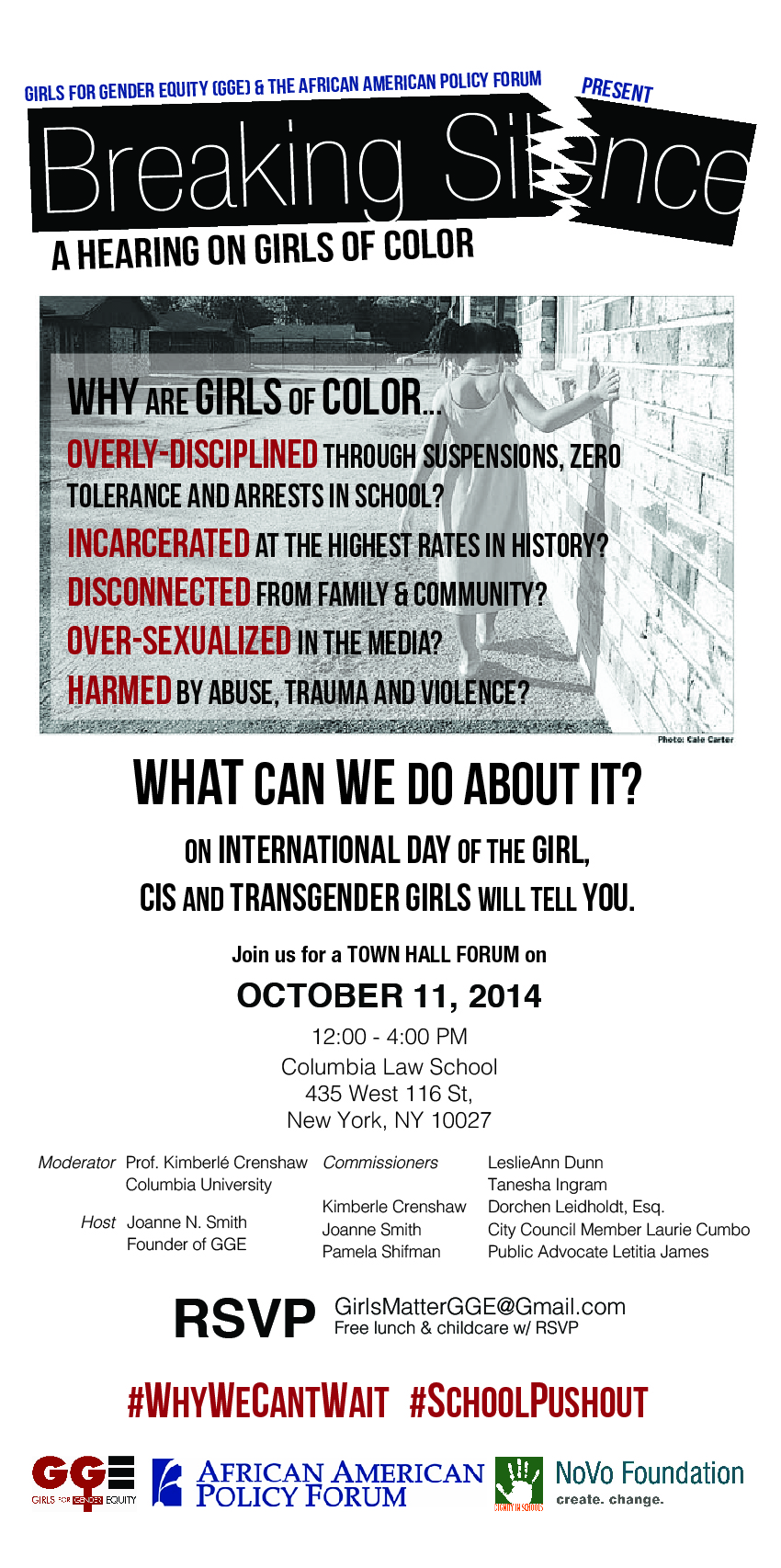
This Saturday: A Hearing on Girls of Color

October 9, 2014 By HKearl

If you’re in NYC with some free time on Saturday, check out this important event organized by Girls for Gender Equity. Our board member Maliyka Muhammad will attend on behalf of SSH.

Share

Filed Under: Events, street harassment

« Previous Page
Next Page »

Share Your Story

Share your street harassment story for the blog. Donate Now

From the Blog

  • #MeToo 2024 Study Released Today
  • Join International Anti-Street Harassment Week 2022
  • Giving Tuesday – Fund the Hotline
  • Thank You – International Anti-Street Harassment Week 2021
  • Share Your Story – Safecity and Catcalls Collaboration

Buy the Book

Search

Archives

  • September 2024
  • March 2022
  • November 2021
  • April 2021
  • March 2021
  • January 2021
  • April 2020
  • March 2020
  • February 2020
  • December 2019
  • November 2019
  • September 2019
  • August 2019
  • July 2019
  • June 2019
  • May 2019
  • April 2019
  • March 2019
  • February 2019
  • January 2019
  • December 2018
  • November 2018
  • October 2018
  • September 2018
  • August 2018
  • July 2018
  • June 2018
  • May 2018
  • April 2018
  • March 2018
  • February 2018
  • January 2018
  • December 2017
  • November 2017
  • October 2017
  • September 2017
  • August 2017
  • July 2017
  • June 2017
  • May 2017
  • April 2017
  • March 2017
  • February 2017
  • January 2017
  • December 2016
  • November 2016
  • October 2016
  • September 2016
  • August 2016
  • July 2016
  • June 2016
  • May 2016
  • April 2016
  • March 2016
  • February 2016
  • January 2016
  • December 2015
  • November 2015
  • October 2015
  • September 2015
  • August 2015
  • July 2015
  • June 2015
  • May 2015
  • April 2015
  • March 2015
  • February 2015
  • January 2015
  • December 2014
  • November 2014
  • October 2014
  • September 2014
  • August 2014
  • July 2014
  • June 2014
  • May 2014
  • April 2014
  • March 2014
  • February 2014
  • January 2014
  • December 2013
  • November 2013
  • October 2013
  • September 2013
  • August 2013
  • July 2013
  • June 2013
  • May 2013
  • April 2013
  • March 2013
  • February 2013
  • January 2013
  • December 2012
  • November 2012
  • October 2012
  • September 2012
  • August 2012
  • July 2012
  • June 2012
  • May 2012
  • April 2012
  • March 2012
  • February 2012
  • January 2012
  • December 2011
  • November 2011
  • October 2011
  • September 2011
  • August 2011
  • July 2011
  • June 2011
  • May 2011
  • April 2011
  • March 2011
  • February 2011
  • January 2011
  • December 2010
  • November 2010
  • October 2010
  • September 2010
  • August 2010
  • July 2010
  • June 2010
  • May 2010
  • April 2010
  • March 2010
  • February 2010
  • January 2010
  • December 2009
  • November 2009
  • October 2009
  • September 2009
  • August 2009
  • July 2009
  • June 2009
  • May 2009
  • April 2009
  • March 2009
  • February 2009
  • January 2009
  • December 2008
  • November 2008
  • October 2008
  • September 2008
  • August 2008
  • July 2008
  • June 2008
  • May 2008

Comment Policy

SSH will not publish any comment that is offensive or hateful and does not add to a thoughtful discussion of street harassment. Racism, homophobia, transphobia, disabalism, classism, and sexism will not be tolerated. Disclaimer: SSH may use any stories submitted to the blog in future scholarly publications on street harassment.
  • Contact
  • Events
  • Join Us
  • Donate
  • Facebook
  • Instagram
  • Pinterest
  • Tumblr
  • Twitter
  • YouTube

Copyright © 2026 Stop Street Harassment · Website Design by Sarah Marie Lacy