Here are some of the stories I’ve been reading the last few days:
“Ahmed Fayed, 17, was stabbed to death on Sunday while attempting to rescue women from sexual harassment, reported activist group Shoft Ta7arosh (‘I Saw Harassment’).
According to local media reports, the young man was stabbed in the heart after intervening to stop the sexual harassment of a group of women in the town of Ra’as Al-Bar, located in the governorate of Damietta….
Ahmed Fayed, 17, was stabbed to death on Sunday while attempting to rescue women from sexual harassment, reported activist group Shoft Ta7arosh (‘I Saw Harassment’).
According to local media reports, the young man was stabbed in the heart after intervening to stop the sexual harassment of a group of women in the town of Ra’as Al-Bar, located in the governorate of Damietta.”
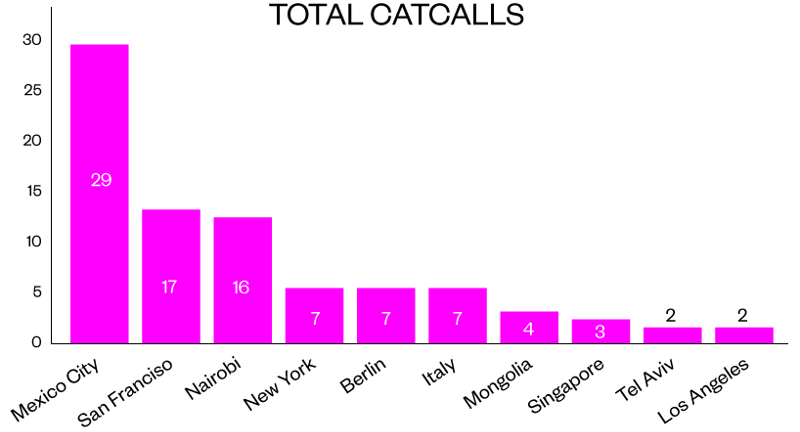
For one full week in September, we asked women from 10 different cities around the globe to keep a diary record of any kind of unwanted attention they received, including every untoward advance from a stranger, every leering stare and smile and “Hey baby” directed their way.
“Bin men working for Kingston Council have been suspended after a 13-year-old girl claimed they blew kisses and wolf-whistled at her.
The girl was waiting at a bus stop in Chessington on Tuesday, in her school uniform, when the Veolia workers are said to have passed her and made the lewd gestures.
The girl’s father said: “At the time of the incident, this caused her alarm, panic and distress and she immediately contacted me on my mobile.
“This in turn caused me stress, anger and panic because I was travelling to work and helpless at a time when she felt she needed me most.”
A spokesman for Veolia, the council contractor employing the men, said: “We have been made aware of these incidents and have acted swiftly to identify those involved, who have now been suspended pending our disciplinary process.”
CHR Michelsen Institute’s new report “Sexual violence and state violence against women in Egypt, 2011-2014”
“Egyptian women were crucial to the movement that overthrew Egyptian president Hosni Mubarak in the 2011 revolution. However, both in the revolutionary and post-revolutionary period women have also become targets of sexual violence, including by the state. This CMI Insight will analyze how we can understand sexual assaults of women in the context of political unrest in Egypt.”
“New York City has launched a Web page aimed at curbing sexual harassment on public transportation, joining a number of cities worldwide that have taken the fight against assault online.
The page went live on Oct. 1 on the New York City Metropolitan Transit Authority (MTA) website. It features a reporting tool for victims of harassment that allows passengers to file reports anonymously, submit of photo evidence and listen to safety tips.
Sexual harassment, which can range from leering and nonverbal gestures to comments and unwanted sexual contact, affects the daily commutes of countless people around the world.
The MTA’s new effort will also bring video cameras inside subway cars, where much of the harassment takes place.
According to Kevin Ortiz, an MTA spokesman, the agency will order 940 new subway cars equipped with cameras that will come into use over the next few years.
While there are many cameras throughout the subway system, Ortiz said, there are currently none inside subway cars.
“The cameras inside the cars will act as a further deterrent,” he added.
The new initiative resulted from conversations between MTA officials, the city’s Public Advocate Letitia James and organizations committed to supporting victims of sexual violence.”
The pro-democracy protests in Hong Kong took an ugly turn with women protesters alleging sexual assaults by men opposing the Occupy Central movement, which entered eight day today.
A woman protester has alleged that she and other male pro-democracy activists were sexually assaulted by a man opposing the Occupy movement in Causeway Bay on Friday and police did nothing about it.
A video uploaded on the website of the Hong Kong based South China Morning Post showed an older man in a white polo shirt violently groping a young woman while arguing with her.
A woman identified as Christine was quoted by the Post as saying that she was standing as part of a human chain when the man lying on the ground sexually assaulted the girl.
“I felt very, very scared, insulted and threatened,” she was quoted as saying by the Post.
“The movement against street harassment is growing. And leading anti-harassment advocacy groups like Hollaback and Stop Street Harassment characterize it as a basic human rights issue…
Wide access to social media is an important factor fueling the resurgence of interest in, and activism on, this issue, as women can easily share their experiences on-line and provide support for confronting the harassers or seeking policy changes. Indeed, the Belgian film went viral and prompted new legislation in Belgium to criminally punish harassers with fines or even imprisonment. In India, Egypt and a growing number of other locales, activists are using on-line mapping to pinpoint areas where street harassment most often occurs and to call for a greater law enforcement presence.
Socially-engaged art has also helped build momentum to take this issue seriously. For example, feminist artist Tatyana Fazlalizadeh, who will be in residence at Northeastern University next week, has traveled around the country with her participatory public art project on street harassment, Stop Telling Women to Smile.”
“Some people still think that men and women are at least generally on an even footing,” says Sara Tebeau, a new resident of Logan Square. “But a prime example of why we aren’t is that there are no women yelling at men on the street. None.”
Boamah-Archemapong agrees: “I don’t think you’d ever see a man walking around in Logan square—or anywhere—who feels uncomfortable because he’s being looked up. It’s crazy that it’s 2014 and we’re still fighting this kind of thing, but you’re going to hear about it until my 70 cents is no longer a problem, and until I’m not afraid to walk down the street or have people think calling me a b-tch or slut or ho is OK.”
Gender & Society (written by our new board member Dr. Laura S. Logan)
“It is important to look below the surface of street harassment to see why it might influence queer women’s community involvement and sense of safety and security. Some incidents of homophobic violence against members of queer communities begin with street harassment (here) but research suggests that gay men who are victims of hate crime are often targeted when they are in gay spaces, such as gay-borhoods and near gay bars. Those who attack gay men often premeditate the attack and operate in groups to outnumber a lone gay man or a gay male couple.
However, frequently when lesbians are victims of anti-gay harassment and violence, they are attacked in everyday spaces such as parking lots and college campuses (here and here). Perpetrators who target lesbians are most often men and alone; however, the lesbian is often not alone but is with another woman or more than one other woman. Typically the attacker is a man but he has not gone to a gay area to find his lesbian victim/s and he hasn’t premeditated his verbal, physical or sexual assault. Rather, the harasser has chosen to act in that moment, likely as he interprets visual cues that for him identify the women as queer. In other words, violence in public space against queer women surfaces in the moment – as does street harassment.
Feminists, queer scholars, and activists have long argued that street harassment and violence against gay men and queer and straight women is about policing gender and sexuality, and that the “police” are almost always heterosexual men. But the pattern here, the difference in the characteristics associated with attacks on gay men versus attacks on lesbians, suggests that harassment and violence against queer women (and indeed all women and queer individuals) is linked to rape culture where the male gaze conveys and embodies domination, entitlement and ownership.”
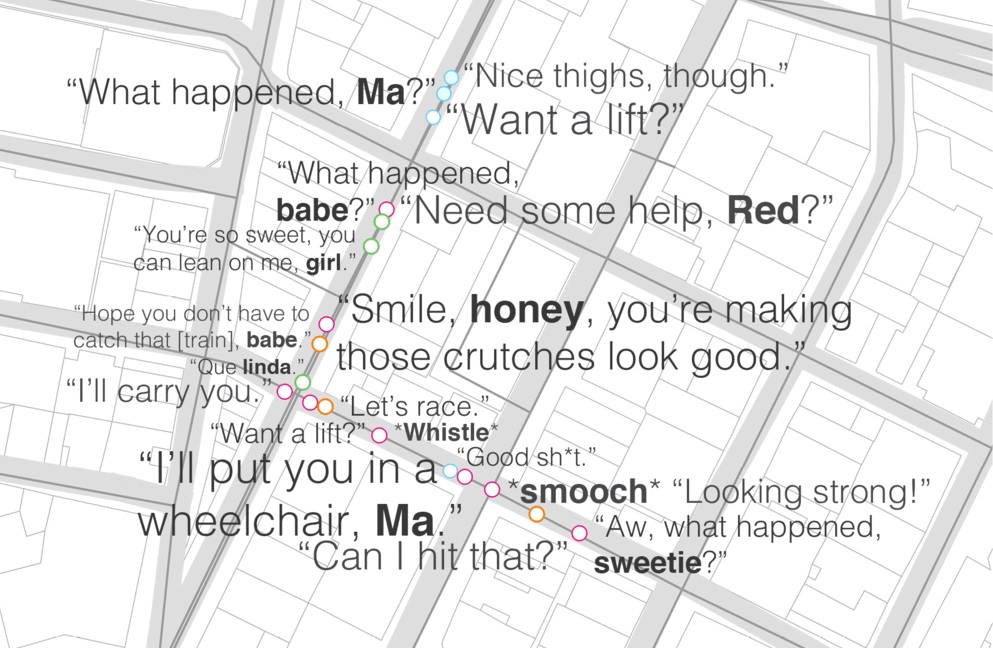 “After hurting my foot and winding up on crutches, I noticed an increase in comments I was getting on the street. I decided to record and map all the comments I received on my way home from work for the rest of the week.
The map was part whimsical, and part born from frustration. I’m not the first person to talk about street harassment, and this wasn’t the first time that I experienced it. Something about being on crutches made the experience more potent, as if I was being targeted specifically, if not deliberately, because I appeared more vulnerable.
The comments I received fell on a wide spectrum. Some were kind, playful, or sympathetic. Others were a bit infantilizing or bordered in offensive or intrusive. Others were clearly sexual, offensive, or even predatory. I’ve chosen to group them all together for an important reason.
I do not believe that a single man who made any of the comments on my map wished me harm, physically or otherwise. I believe they all had benign intent, and some probably thought they were encouraging me. I believe each man regarded his comments in isolation: as a single, direct interaction. However, pieced together over a 2.5 block commute, over four days of a week, and more, the comments affect me and my thoughts the same way they affect my map: they overwhelm, they disrupt, and they engulf.”
“Recently a friend of mine told me that she’s bothered by men on the street commenting on her four-year-old daughter’s looks. My first thought was, “Oh, people compliment little girls, it’s harmless.” But she did a little imitation of the men—the squinty eyes, the “so pretty” in a tone thisclose to crooning and teeth-sucking—and I believed her. Any woman can identify the tone of a catcall versus a friendly comment, and this was firmly in the zone of catcall. For a four-year-old girl.
So I decided to conduct my own amateur sociological survey. I posted, to our neighborhood listserv, a question to my fellow Brooklyn parents about the comments they get on their kids’ looks when they’re out on the street. Including my friend, I got 11 responses, all from mothers, for about 15 kids ranging in age from 18 months to six years. Nine of the kids were boys and six were girls….”
