• About Us
    • What Is Street Harassment?
    • Why Stopping Street Harassment Matters
    • Meet the Team
      • Board of Directors
      • Past Board Members
    • In The Media
  • Our Work
    • National Street Harassment Hotline
    • International Anti-Street Harassment Week
    • Blog Correspondents
      • Past SSH Correspondents
    • Safe Public Spaces Mentoring Program
    • Publications
    • National Studies
    • Campaigns against Companies
    • Washington, D.C. Activism
  • Our Books
  • Donate
  • Store

Stop Street Harassment

Making Public Spaces Safe and Welcoming

  • Facebook
  • Instagram
  • Pinterest
  • Tumblr
  • Twitter
  • YouTube
  • Home
  • Blog
    • Harassment Stories
    • Blog Correspondents
    • Street Respect Stories
  • Help & Advice
    • National Street Harassment Hotline
    • Dealing With Harassers
      • Assertive Responses
      • Reporting Harassers
      • Bystander Responses
      • Creative Responses
    • What to Do Before or After Harassment
    • Street Harassment and the Law
  • Resources
    • Definitions
    • Statistics
    • Articles & Books
    • Anti-Harassment Groups & Campaigns
    • Male Allies
      • Educating Boys & Men
      • How to Talk to Women
      • Bystander Tips
    • Video Clips
    • Images & Flyers
  • Take Community Action
  • Contact

“I rerouted my way home”

February 24, 2018 By Contributor

I was walking home from school (only a few blocks) and was whistled at… it made me feel uncomfortable and I was so close to being in front of my house that I rerouted my way home so that this person wouldn’t know where I lived. It made me feel unsafe and very angry. It made me sad for anyone else who has had a similar experience.

Optional: What’s one way you think we can make public places safer for everyone?

Support each other. Spread awareness that this behavior is totally unacceptable and should NOT be normalized.

– Anonymous

Location: Salt Lake City, UT

Need support? Call the toll-free National Street Harassment hotline: 855-897-5910

Share your street harassment story for the blog.
See the book 
50 Stories about Stopping Street Harassers for ideas.

Share

Filed Under: Stories, street harassment

USA: Compassion over Compliance on the College Campus

February 23, 2018 By Correspondent

Connie DiSanto, USA SSH Blog Correspondent

Street harassment, or sexual harassment in public spaces, involves an unwanted and unwarranted interaction with a stranger in a public place. Sexual harassment on a college campus also involves an unwanted and unwarranted interaction but it’s happening between peers (and in some cases, it involves faculty or staff) and the place could be an academic hallway, a quad, in a classroom or on the street in town that the college resides in. And when efforts are made by a harassed person to avoid a repeat interaction, it may be tough because of the community setting and the fact that often both the survivor and the harasser live on or near campus.

Although this type of behavior has been prevalent for decades across on campuses, it is not taken seriously enough, and in many cases, it is still seen as the normal culture of the college experience despite federal legislation prohibiting it.

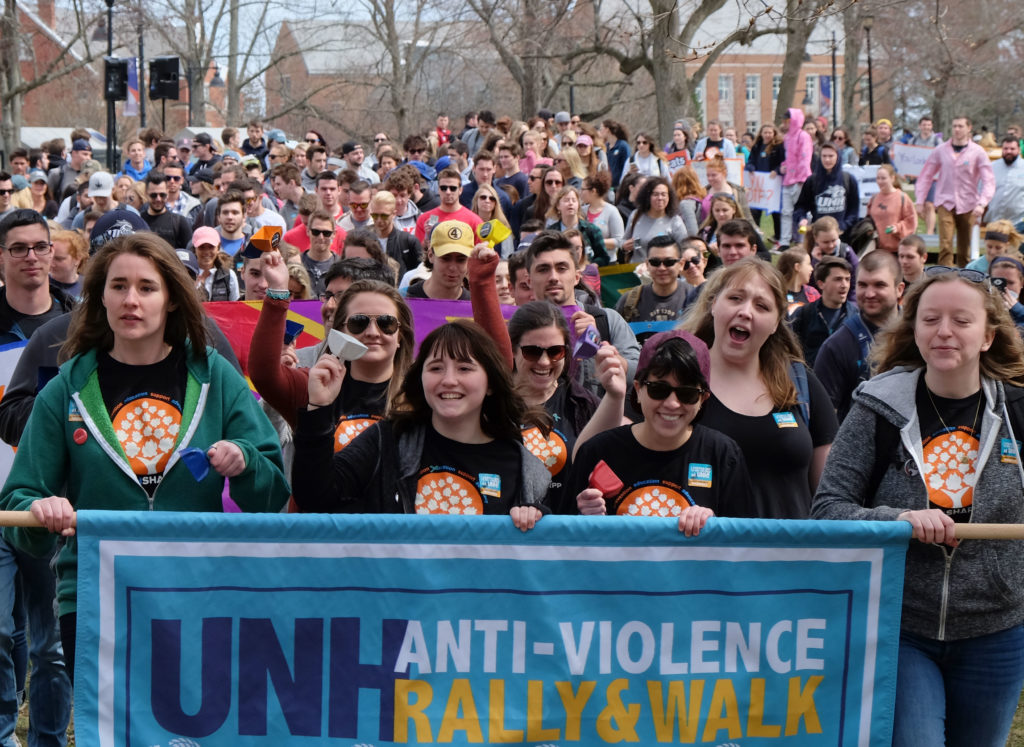
Students, staff and faculty at the 2017 UNH Anti-Violence Rally & Walk.

Long gone are the days when you heard someone reference Title IX of the Education Amendments of 1972 and it only brought to mind equal access to sports for girls and women in public education. Today Title IX acts as a federal civil rights law prohibiting sex discrimination and addresses sexual harassment, gender-based discrimination and sexual violence. Yet the original intent of this protection with survivor-based policies is now under siege.

The current administration has begun to dismantle Obama Administration-era guidance and protections claiming that it denies due process to accused students. But in reality, it provided more protections, to both the accused and the victim, then any other law on the books. Under the leadership of current Secretary of Education Betsy DeVos, the Department of Education went as far as claiming that false accusations occur at the same rate as rapes, which is gross misrepresentation of the actual 2-6% of false accusations compared to the 1 in 5 women sexually assaulted, according to many studies. The Department of Education is supposed to be issuing new regulations to colleges for guidance sometime next month, and the general public will have an opportunity to give input via a “notice and comment” process, but until we see the actual proposed rules, we are left to wait and see and then act.

And despite demands for more funding to the Office on Violence Against Women, budget cuts to the Department of Education’s Office of Civil Rights, which investigates charges against schools for mishandling sexual assault claims and Title IX violations, are still among those cuts that will be made under the current administration.

If federal guidance becomes less strict on accountability and funding diminishes, then compliance becomes yet another barrier to a survivor’s protection under the law.

Just as the #MeToo movement recently spurred all 50 state attorney generals to demand from Congress an end to the practice of forcing sexual harassment cases into mandatory arbitration, changes need to be made on college campuses to help to put a stop to the culture of silence that protects perpetrators at the cost of their victims. One such promising recent action is the Alert Act which was introduced by a bipartisan group of U.S. Senators. It would ensure that the “I didn’t know” excuse can never again be used by university presidents for not protecting students from abusers, in particular, employees of universities. This bill would require an annual certification for federally-funded college and university presidents ensuring that they have reviewed all cases of sexual misconduct reported to their campus Title IX coordinator, and that they have not interfered with investigations of those cases.

Compassion for student survivors was the focus of the Obama-Biden campus sexual assault advocacy era, due to, in part, the “Dear Colleague Letter” that was announced here at the University of New Hampshire in 2011. We need that focus again.

Connie is the Marketing Communications Specialist for the Sexual Harassment & Rape Prevention Program (SHARPP) at the University of New Hampshire.

Share

Filed Under: correspondents Tagged With: rape, sexual violence, title ix

“I was in shock the whole night”

February 23, 2018 By Contributor

I was just finishing my shopping trip in NYC. I just left the store. I was wearing a light jacket and I had a small backpack on my back. I was holding one shopping bag from a store that is not a high end store at all. I wasn’t even all dressed up-I was wearing super casual clothes, my hair was in a bun and I just had eyeliner on. I looked super innocent. I did absolutely nothing and said nothing to anyone to have caused anything to have happened.

It’s kind of a blur in my mind how it all started, but all I could remember was someone cursing at me right when I left the store and was walking on the sidewalk. And then I think I kind of froze in fear because I didn’t know what to do. Then I was petrified that this person was going to hurt me, so I had my shopping bag all ready as my defense mechanism…I clearly wasn’t thinking at first.

Thank goodness my senses kicked in after that, and I then started to shriek and I ran as fast as I could. I ran into the first store that was still open because there were no cops on that street to be found. I told the store owners that I was seeking safety in their store. I was in such shock, my entire body was shaking like crazy and my heart was pounding so hard and fast.

The store owner asked me what happened and what the person looked like. I tried my best to recall, but it was a blur in my head. I don’t even know if it was a girl or boy. I was just really grateful that the store owner was really nice and he went outside to see if he could find anyone suspicious. He didn’t really know who to look for because I couldn’t describe the person to him. I then ubered home.

I was still shaking and my heart was still racing. Boy was I scared. I was in shock the whole night and then only a few hours it happened I started to cry from fear and shock of what happened.

I am tearing as I type this. I am still really traumatized from what happened. It feels good though to get this off my chest.

– Anonymous

Location: Broadway Street, NYC

Need support? Call the toll-free National Street Harassment hotline: 855-897-5910

Share your street harassment story for the blog.
See the book 
50 Stories about Stopping Street Harassers for ideas.
Share

Filed Under: Stories, street harassment

“The man grabbed her again”

February 22, 2018 By Contributor

I was in a store with a friend once when a man put his hands on her and made a lewd comment. I told him, “Get your hands off her.”

He pushed me into a stack of boxes which knocked me and the boxes over. The owner kicked all three of us out of the store into the parking lot.

The man grabbed her again. Again I told him to stop. Again he knocked me over. We ran to the nearest house and banged on the door. They let us in thankfully where we stayed until we saw the man drive away. SCARY.

Obviously, I’ll never forget that even though it was decades ago.

– Anonymous

Location: Atlanta, GA

Need support? Call the toll-free National Street Harassment hotline: 855-897-5910

Share your street harassment story for the blog.
See the book 
50 Stories about Stopping Street Harassers for ideas.
Share

Filed Under: Stories, street harassment

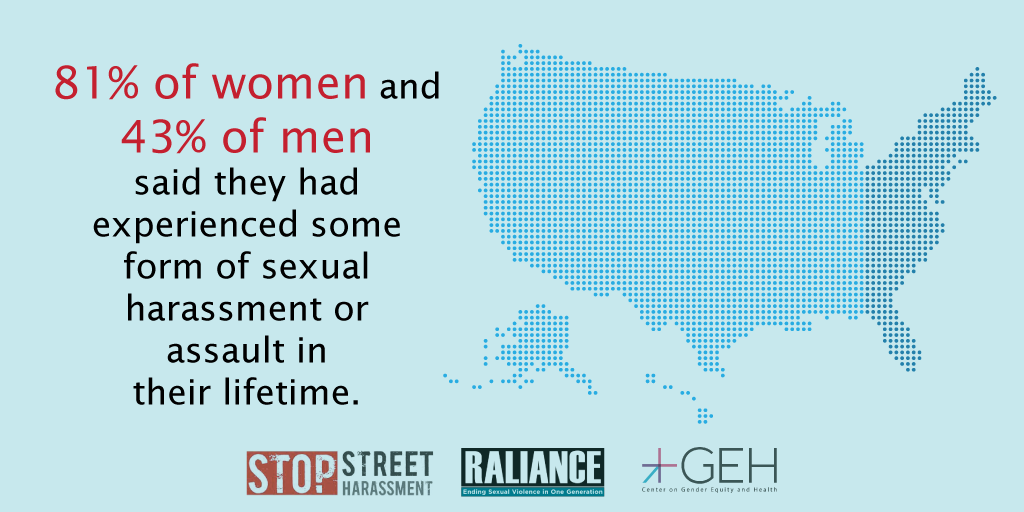
81% of Women and 43% of Men Have Experienced Sexual Abuse in USA

February 21, 2018 By HKearl

I’m excited to share that our new study was released this morning!

In January 2018, SSH commissioned a 2,000-person, nationally representative survey on sexual harassment and assault, conducted by GfK. It found that nationwide, 81% of women and 43% of men reported experiencing some form of sexual harassment and/or assault in their lifetime.

While verbal sexual harassment was the most common form (77% of women and 34% of men), an alarming 51% of women and 17% of men said they were touched or groped in an unwelcome way, and 27% of women and 7% of men survived sexual assault.

This survey is the first to look at a range of sexual harassment behaviors, track the various locations where people experience sexual harassment and assault (from public spaces to homes to schools to workplaces to online etc), and identify who perpetrators are in relation to the respondents (e.g. strangers, coworkers, family members).

When the sample size allowed, the report breaks down people’s experiences by demographics like race/ethnicity, sexual orientation, household income, disability status, age, and region of the country.

READ: Full Report | Two-Page Executive Summary | Survey Questions | Press Release 

Pro bono data analysis for the survey was completed by the UC San Diego Center on Gender Equity and Health. Their team, the team at Raliance and a dozen advisory committee members offered input and invaluable help throughout the process.

Here’s the media coverage so far!

New York Times, “Numbers Hint at Why #MeToo Took Off: The Sheer Number Who Can Say Me Too.“

NPR, “A New Survey Finds 81 Percent Of Women Have Experienced Sexual Harassment.“

VOX News, “Measuring #MeToo: more than 80 percent of women have been sexually harassed or assaulted.“

Ms. Magazine Blog, “What the Numbers Behind the #MeToo Movement Show Us.“

Many thanks to our donors, board and advisory committee for helping make this happen, as well as our partner orgs!!

Share

Filed Under: LGBTQ, national study, News stories, online harassment, race, Resources, SSH programs, street harassment Tagged With: metoo, national study, research

« Previous Page
Next Page »

Share Your Story

Share your street harassment story for the blog. Donate Now

From the Blog

  • #MeToo 2024 Study Released Today
  • Join International Anti-Street Harassment Week 2022
  • Giving Tuesday – Fund the Hotline
  • Thank You – International Anti-Street Harassment Week 2021
  • Share Your Story – Safecity and Catcalls Collaboration

Buy the Book

Search

Archives

  • September 2024
  • March 2022
  • November 2021
  • April 2021
  • March 2021
  • January 2021
  • April 2020
  • March 2020
  • February 2020
  • December 2019
  • November 2019
  • September 2019
  • August 2019
  • July 2019
  • June 2019
  • May 2019
  • April 2019
  • March 2019
  • February 2019
  • January 2019
  • December 2018
  • November 2018
  • October 2018
  • September 2018
  • August 2018
  • July 2018
  • June 2018
  • May 2018
  • April 2018
  • March 2018
  • February 2018
  • January 2018
  • December 2017
  • November 2017
  • October 2017
  • September 2017
  • August 2017
  • July 2017
  • June 2017
  • May 2017
  • April 2017
  • March 2017
  • February 2017
  • January 2017
  • December 2016
  • November 2016
  • October 2016
  • September 2016
  • August 2016
  • July 2016
  • June 2016
  • May 2016
  • April 2016
  • March 2016
  • February 2016
  • January 2016
  • December 2015
  • November 2015
  • October 2015
  • September 2015
  • August 2015
  • July 2015
  • June 2015
  • May 2015
  • April 2015
  • March 2015
  • February 2015
  • January 2015
  • December 2014
  • November 2014
  • October 2014
  • September 2014
  • August 2014
  • July 2014
  • June 2014
  • May 2014
  • April 2014
  • March 2014
  • February 2014
  • January 2014
  • December 2013
  • November 2013
  • October 2013
  • September 2013
  • August 2013
  • July 2013
  • June 2013
  • May 2013
  • April 2013
  • March 2013
  • February 2013
  • January 2013
  • December 2012
  • November 2012
  • October 2012
  • September 2012
  • August 2012
  • July 2012
  • June 2012
  • May 2012
  • April 2012
  • March 2012
  • February 2012
  • January 2012
  • December 2011
  • November 2011
  • October 2011
  • September 2011
  • August 2011
  • July 2011
  • June 2011
  • May 2011
  • April 2011
  • March 2011
  • February 2011
  • January 2011
  • December 2010
  • November 2010
  • October 2010
  • September 2010
  • August 2010
  • July 2010
  • June 2010
  • May 2010
  • April 2010
  • March 2010
  • February 2010
  • January 2010
  • December 2009
  • November 2009
  • October 2009
  • September 2009
  • August 2009
  • July 2009
  • June 2009
  • May 2009
  • April 2009
  • March 2009
  • February 2009
  • January 2009
  • December 2008
  • November 2008
  • October 2008
  • September 2008
  • August 2008
  • July 2008
  • June 2008
  • May 2008

Comment Policy

SSH will not publish any comment that is offensive or hateful and does not add to a thoughtful discussion of street harassment. Racism, homophobia, transphobia, disabalism, classism, and sexism will not be tolerated. Disclaimer: SSH may use any stories submitted to the blog in future scholarly publications on street harassment.
  • Contact
  • Events
  • Join Us
  • Donate
  • Facebook
  • Instagram
  • Pinterest
  • Tumblr
  • Twitter
  • YouTube

Copyright © 2026 Stop Street Harassment · Website Design by Sarah Marie Lacy