• About Us
    • What Is Street Harassment?
    • Why Stopping Street Harassment Matters
    • Meet the Team
      • Board of Directors
      • Past Board Members
    • In The Media
  • Our Work
    • National Street Harassment Hotline
    • International Anti-Street Harassment Week
    • Blog Correspondents
      • Past SSH Correspondents
    • Safe Public Spaces Mentoring Program
    • Publications
    • National Studies
    • Campaigns against Companies
    • Washington, D.C. Activism
  • Our Books
  • Donate
  • Store

Stop Street Harassment

Making Public Spaces Safe and Welcoming

  • Facebook
  • Instagram
  • Pinterest
  • Tumblr
  • Twitter
  • YouTube
  • Home
  • Blog
    • Harassment Stories
    • Blog Correspondents
    • Street Respect Stories
  • Help & Advice
    • National Street Harassment Hotline
    • Dealing With Harassers
      • Assertive Responses
      • Reporting Harassers
      • Bystander Responses
      • Creative Responses
    • What to Do Before or After Harassment
    • Street Harassment and the Law
  • Resources
    • Definitions
    • Statistics
    • Articles & Books
    • Anti-Harassment Groups & Campaigns
    • Male Allies
      • Educating Boys & Men
      • How to Talk to Women
      • Bystander Tips
    • Video Clips
    • Images & Flyers
  • Take Community Action
  • Contact

“Sticking my middle finger up was a reflex action”

February 20, 2018 By Contributor

I was out in a shopping centre with my boyfriend when two guys catcalled me as they walked past us. I turned around and they looked back laughing. I stopped and stuck my middle finger at them, and one of them got angry and came charging back at me. He said I was being disrespectful and I shouldn’t have stuck my middle finger up at him.

We ended up walking away from the situation, but I cried in frustration that this has happened over and over again since I turned 13.

I shouldn’t have stooped down to their level and ruined a lovely day out, but as an advocate for equality for women, sticking my middle finger up was a reflex action. Women should not have to go through this and then be made to feel like the bad person for retaliating. I just wish guys like that could be more respectful to women and keep their comments to themselves.

Optional: What’s one way you think we can make public places safer for everyone?

Better policing.

– Sami

Location: Xscape centre, Milton Keynes, UK

Need support? Call the toll-free National Street Harassment hotline: 855-897-5910

Share your street harassment story for the blog.
See the book 
50 Stories about Stopping Street Harassers for ideas.

Share

Filed Under: Stories, street harassment

USA: Harassment Doesn’t End on the Street

February 19, 2018 By Correspondent

Nearly Half of Working American Women Face Harassment in the Workplace, and 75% of Workplace Harassment Victims Faced Retaliation When they Spoke Up

Patrick Hogan, Chicago, IL, USA, SSH Blog Correspondent

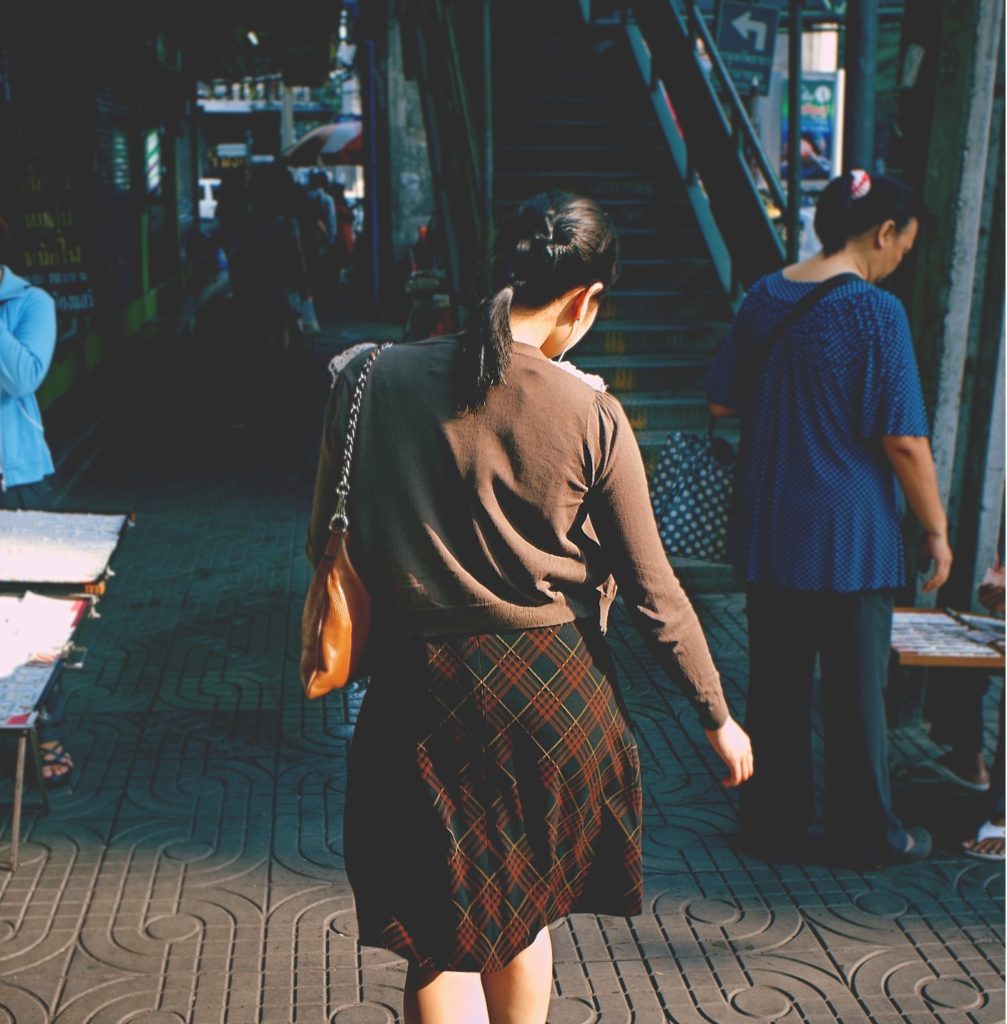
“With My Headphones On… With My Headphones On” by Norsez via Flickr

Street harassment is generally an interaction between strangers. The victims, trying to mind their own business; and the harassers, strangers intent on degrading and endangering people they may never see again. The harassers enjoy a sense of anonymity: they will not have to face their victims, nor any retaliation. Women may face harassment on the streets by strangers while walking to work, but at least they are safe in their work environments with people they hold professional relationships with, right?

Unfortunately, wrong.

A poll conducted by the Wall Street Journal and NBC News found that 48% of working women in the United States are victims of workplace sexual harassment. The poll found that 56 percent of working woman under the age of 35, 44 percent of working women between the ages of 35 to 44 years old, and 40 percent of working women over the age of 55 faced harassment in the workplace.

What happens if these women speak up against their harassers? Quite probably retaliation. According to a 2016 report by the US Equal Employment Opportunity Commission (EEOC), 25% to 85% of working women experienced workplace harassment (the disparity in percentages a result of different responses to different surveys). The study goes on to state that only between 6 and 13 percent of workplace harassment victims file a formal complaint. Why wouldn’t victims file formal complaints? According to the EEOC’s report, 75 percent of women who made complaints about their workplace harassment were retaliated against in some form or another.

When women filed complaints they were met with retaliatory behaviors such as disbelief, humiliating remarks, social stagnation, and continued harassment by employers and coworkers alike.

I interviewed Dr. Amy Blackstone, Professor of Sociology at the University of Maine, on her research on workplace harassment. When I asked her about the effects of retaliation against working women, she explained: “Retaliation is not limited to targets of harassment. Even women who are not themselves harassed, but who spoke up when they saw it happening are sometimes targets of retaliation so they too could be bullied for speaking up against harassment.”

This harassment and retaliation directly affects potential for career progression. Dr. Blackstone described to me a 2017 research paper she and others published:

“We were looking at women in the early point in their careers, and what we found was that indeed experiencing harassment early in your career does have or can have a derailing effect. We found this one example that women who experienced harassment are six-and-a-half times more likely than those who are not harassed to change jobs after harassment– and often not even just change jobs, but change entire career paths. In addition to our survey data, we interviewed a number of women and we learned in the interviews that some sought out jobs that they thought they would be less likely to be harassed in. And oftentimes that meant choosing jobs…that are not on the fast track to getting promoted; jobs where they could kind of be alone and not have to risk interacting with too many people because of the fear that they might be harassed again.”

But what of women who are in leadership roles or positions of power in their workplaces? According to Dr. Blackstone, they may not be free from harassment either. She stated: “Women who try to move up in the workplace may be targeted [for harassment] simply because they’re trying to move up in the workplace.” She explained that, “Harassing women who are supervisors is a way of ‘putting them in their place.'”

Dr. Blackstone provided an example: “A woman I interviewed who is a manager in a manufacturing firm was the only woman in management at the firm. She attended a dinner with some clients and some colleagues of hers and, in this case, it was a client who was harassing her by groping her and making sexual comments about her and to her. This is a woman who had a position of power in her workplace, but she was experiencing the kinds of behaviors that we often hear about happening to women with less power in the workplace.”

It is clear that workplace harassment is not merely a terrible phenomenon—it is an all-too-common occurrence. It affects women trying to advance in their careers and even women in positions of power. We live in a world where many women face harassment on their way to or from work and also cannot be at work without worrying about their safety. Then they cannot even report harassment without fear of retaliation. Something needs to change.

Patrick is an undergraduate student majoring in anthropology and minoring in Islamic World Studies at Loyola University Chicago, preparing to continue onto law and graduate school. He is particularly interested in legal anthropology and the ways victims are viewed by legal systems.

Share

Filed Under: correspondents, street harassment Tagged With: workplace harassment

Brazil: Feminist ‘bloco’ at the 2018 Rio Carnival

February 18, 2018 By Correspondent

Yasmin Curzi, Rio de Janeiro, Brazil, SSH Blog Correspondent

”Márcia Benevides. Presente.”[1]

It was with tears that the “Women who get around” feminist Carnival block began its procession on Ash Wednesday, in the South Zone of Rio de Janeiro. In September of last year, one of its members, Marcia, was cruelly murdered by her former partner, from whom she was getting separated. She had sought the workshops of the bloco – which take place throughout the year, in preparation for Carnival – precisely to deal with the separation process. From the workshops, she found the comfort and strength to go ahead.

In her honor, the first song of the Carnival procession was “Folhas Secas” by Nelson Cavaquinho, from “Estação Primeira de Mangueira” one of the first of Rio’s samba schools. “They killed one of us,” said Renata Rodrigues, one of the founders of the bloco. She was heartbroken that Márcia was supposed to be free and alive and parading this year, but now  she was dead due to misogynist violence.

Next, the band, comprised mainly of women, followed the procession, playing classic samba and popular music as Clementina de Jesus’ “Marinheiro Só”, “Ouvi alguém me chamar” by Dona Ivone Lara, “Ô abre alas” by Chiquinha Gonzaga and “Lenda das Sereias” by Marisa Monte, but also funk, making the audience shout while walking through the streets, “I don’t wait for the carnival to be a bitch, I am one everyday”, verses of Pablo Vittar’s “Todo dia” and “Hoje” by MC Ludmilla. The members of the bloco wielded banners of female canons of Brazilian music, but also of Nina Simone.

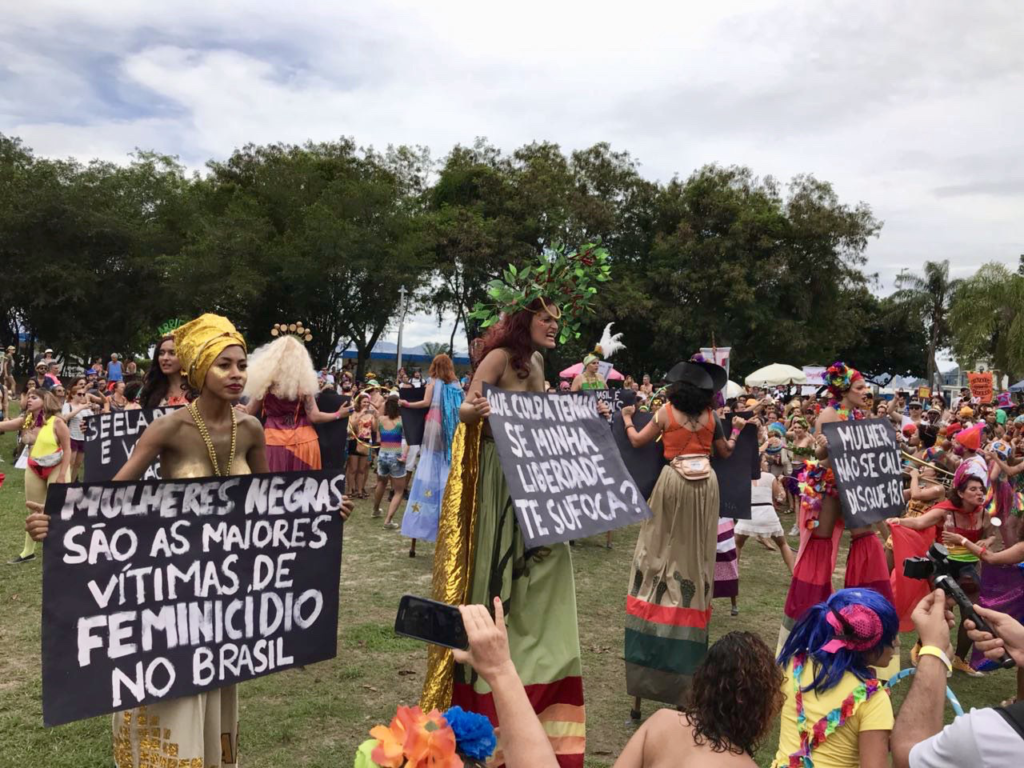
The “hula hoop dancers section” was the Commission of Front of the bloco. The women spinning and dancing with the hula hoops were followed by the “wooden leg section”: seven women and a girl of about 10 years old, wearing costumes and wooden legs. Finally, they were followed by the band and around them, hundreds of women, men and children, jumping, shouting and singing along.

Photo by: Ana Clara Jansen

The procession went from Largo do Machado to Aterro (about 1km), where there was an incredible performance set to the music of “Geni e o Zepelim” by Chico Buarque. The “wooden leg section” held posters denouncing feminicide and misogynist violence. One could read that Brazil ranks fifth in the world for the number of women murdered due to their gender (crimes motivated by gender hate, such as domestic violence and sexual violence) and that Black women are still the number one victims of gender violence in the country. There also were signs encouraging women to report harassment.

Photo by: Ana Clara Jansen

They then simulated a funeral and threw flowers over a woman’s body. While the band played “Throw rocks at Geni! / Throw shit at Geni! / She’s made to be beaten! / She’s good to spit on! / She will screw anyone! / Damn you, Geni!”, the audience shouted, “No!”

This was an example of how art can be utilized for feminist causes, in this case, to show that it is intolerable for women to be victims of violence only because they want to be free.

Another highlight to me were efforts by the “Mete a Colher”[2] organization, which, in partnership with the organization “Meu Recife” produced the report “Happened in Carnival.” This report focused on reports of violence suffered during the Carnival and highlighted the necessity of public policies to address the problem. Renata Albertim (co-founder of Mete a Colher) said that in the, “(…) Last year we collected 66 reports and presented them to the Women’s Secretariat of Recife and to the Women’s Secretariat of the State of Pernambuco. This year, the Secretary of State promised a more ostensible policing at the points we identified that the more the harassment happens.”

In Rio de Janeiro, the “Carnival without Harassment” campaign took over several blocos – promoted by Catraca Livre, in partnership with “Azmina” magazine and the collectives “Now it’s them”, “We Women of the Periphery” and “Let’s go together?”

The stickers were distributed free of charge during the processions and it was also possible to buy removable tattoos with “No is no!” to wear.

The denunciation of the coup was also remembered by the bloco, which sang the cries of “Fora Temer” and “Fora Crivella”.

“Women who get around” is more than just a fun bloco: it is the materialization of the counter-discourse in the streets and is absolutely necessary to change our culture.

Conservative parties define all these movements as part of a “gender ideology.” They think that to show the many ways that female subordination and male domination are normalized is to threaten a “natural order” of things. They use this phrase as a motto and turn it into a great scarecrow, capable of camouflaging their real intentions: economic programs of religious sectors, alliances with private capital and support for labor rights retrogressions. These conservative sectors do not want to debate gender roles and are generally extremely reactionary to social transformations. One group placed a figure simulating Judith Butler in a “bonfire”, in an “inquisitorial act,” calling her a witch – they wanted to crystallize the “place of women” around an ideal of femininity and subalternization. They don’t see toxic masculinity as the real cause of violence and instead, they blame victims for the attacks suffered.

Photo by: Ana Clara Jansen

In her book Caliban and the Witch, Silvia Federici discusses the transition from feudalism to capitalism from a gender perspective, pointing out that it was essential for capitalist accumulation to make women circumscribed to private spaces, with domestic work being unpaid, in addition to state control of reproductive functions. The myth of witchcraft was fundamental to legitimize the genocide of women and the control of bodies, solidifying this social structure. The reproductive autonomy of women was precisely the greatest of all crimes – not surprisingly, witches were generally represented by women who did not dedicate their lives to the domestic sphere and who broke with the ideals of the time in some way.

For today’s conservatives, as well as the inquisitors of the Middle Ages, it is an assault on the natural order of things that gender roles are put into question. Federici also shows that capitalism is responsible for producing these moments of intellectual retreat to maintain its hegemony. Certain segments of the political elite enact it to remain in power in times of profound economic crisis.

But we also know that a certain noise is being produced when we see the reactionary extremely uncomfortable. If the status quo were not being shook, there would be no need to organize so many obscure acts. There is, therefore, room for women to infiltrate cultural “gaps” and contest the hegemonic discourse – denouncing, questioning and talking about corporal autonomy, about violence, about their places in public institutions and in the market. Bringing these issues to the streets makes Carnival a way for feminists to raise awareness and agitate for change!

Although during this Carnival there were some of the same problems as always – there were a lot of cases of sexual harassment, abuse and violence – overall, Carnival 2018 was marked by political acts, anti-harassment campaigns and demonstrations of sorority.

[1]         “Presente” is what people say in protests to remember people who were victims of violence and public personalities that are important for the cause.

[2]         In Brazil there’s a popular quote that says, “Em briga de marido e mulher  não se mete a colher.” It means, “When husband and wife fights, one does not interfere.” The campaign “mete a colher” puts in evidence the necessity to look to domestic violence as a social issue.

Yasmin is a Research Assistant at the Center for Research on Law and Economics at FGV-Rio. She has a Master’s Degree in Social Sciences from PUC-Rio where she wrote her thesis on street harassment and feminists’ struggles for recognition. 

Share

Filed Under: correspondents Tagged With: art, brazil, Carnival, feminist acts, resistance

Latest Survey Update – Feb. 21 Release

February 12, 2018 By HKearl

Just a quick update on our national study about sexual harassment and assault… it’s on track to be released next week, on February 21st!! Stay tuned for more information.

Share

Filed Under: Resources, SSH programs Tagged With: research

USA: Time Machine: Street Harassment

January 31, 2018 By Correspondent

Elizabeth Kuster, Brooklyn, NY, USA, SSH Blog Correspondent

When I first started making notes about the harassment I received from random men on a daily basis — and began talking to other women about it, to get their stories — thousands of people around the country were taking buses to Washington so they could march in protest of the Republican president who was trying to limit a woman’s right to choose.

The beating of a Black man by a group of white police officers had created a dark and disturbing negative energy in New York City. Thousands of demonstrators in Times Square were protesting against police departments’ blatant racial discrimination.

A female editor from the same publication that was going to print my first street harassment article was working on an exposé of the pay-or-play casting couch. “Hollywood’s ugliest secret goes public, but will actresses take action against a power broker who can make them a star?” she asked, before quoting a frustrated Halle Berry: “How many complaints will have to be filed before something happens to these guys?”

I can testify firsthand that it is really hard to write about street harassment when there’s so much other terrible shit going on.

Meanwhile, in my personal life, I had just been dumped by the stable (read: unimaginative) older man I thought I loved. (“I need some space,” he said — proving that even when breaking up, he wasn’t capable of originality.) I was in the midst of casually dating an actor/comedian (!) while dealing with crippling menstrual cramps that kept me laser-focused on my uterus for far too many days a month.

And through it all, I was keeping a diary of all of the random ugly comments, stares, propositions and unwanted touches I was receiving from strange men on a daily basis. Let me tell you: It’s hard to “go high” like Michelle Obama when the cultural mood — and the article you’re working on — demand that you focus for months on the lowest of the low. And that lowest of the low is alternately staring at you, ordering you to smile, stroking your hair on the subway train and yelling things like, “I want to f*ck you!” and “You got a fat ass!”

Anyway, I guess it’s time for me to tell you when all of this was going on in my world. You probably think you know. But I bet you don’t.

Hint: It wasn’t 2017.

It wasn’t 2016, either.

Give up?

It was 1992.

1992, people.

Nineteen.

F*cking.

Ninety.

Two.

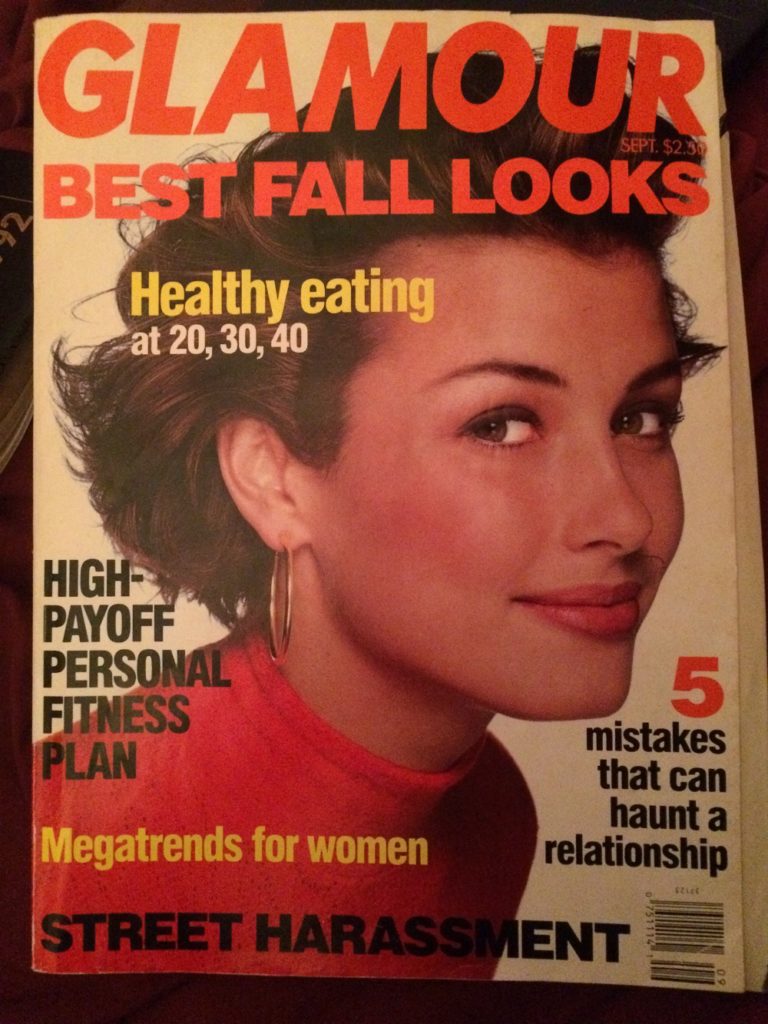
Here’s the cover of the September, 1992, issue of Glamour magazine, which featured my groundbreaking cover story on street harassment:

It was the first time the topic had ever been covered in the mainstream media. A few articles describing a phenomenon called “street harassment” had been published in academic journals or a feminist publication, but that was about it. Back then, I looked toward the future with hope, confident that my article, which ultimately reached 15 million American readers, would empower women and help lawmakers name, fight, and eventually put an end to the problem.

Spoiler alert: It didn’t.

So perhaps my current despair is understandable. Because I seem to be stuck in a feminist’s Groundhog Day. On the face of it, so very little has changed. It’s 25 years since my article came out, and street harassment — and so many other issues — are still huge problems.

The September 1992 issue of Glamour featured Charla Krupp’s prescient article about Hollywood’s casting couch. Today, there’s Harvey Weinstein, Bill Cosby, #TimesUp, and #MeToo.

In May of 1992, there were race riots after the beating of Rodney King. Today, there’s Trayvon Martin, #BlackLivesMatter, the Wall, the Muslim Ban, and ICE.

On April 5, 1992, a massive pro-choice march took place in D.C. Just this week, Republicans tried to shove through yet another misogynist abortion ban. A pussy grabber is in the White House. Women are marching by the millions. And I’m still hoping against hope that I will someday find a human being with a penis who is capable of loving and supporting me and my uterus.

But of course, some things have changed. In my upcoming blogs for Stop Street Harassment, I will revisit my original article and its aftereffects, and explore some of the progress women have made since 1992 in the areas of personal space and physical safety. I’ll celebrate our victories and spotlight areas that still need work. Because those who cannot remember the past are condemned to repeat it. And it’s high time for us women to put this particular Groundhog Day to bed once and for all.

Stay tuned.

Elizabeth pitched and wrote the very first mainstream-media article about street harassment. She has held full-time editorial positions at publications such as Glamour, Seventeen and The Huffington Post and is author of the self-help/humor book Exorcising Your Ex. You can follow Elizabeth on Twitter at @bethmonster.

Share

Filed Under: correspondents, History, street harassment

« Previous Page
Next Page »

Share Your Story

Share your street harassment story for the blog. Donate Now

From the Blog

  • #MeToo 2024 Study Released Today
  • Join International Anti-Street Harassment Week 2022
  • Giving Tuesday – Fund the Hotline
  • Thank You – International Anti-Street Harassment Week 2021
  • Share Your Story – Safecity and Catcalls Collaboration

Buy the Book

Search

Archives

  • September 2024
  • March 2022
  • November 2021
  • April 2021
  • March 2021
  • January 2021
  • April 2020
  • March 2020
  • February 2020
  • December 2019
  • November 2019
  • September 2019
  • August 2019
  • July 2019
  • June 2019
  • May 2019
  • April 2019
  • March 2019
  • February 2019
  • January 2019
  • December 2018
  • November 2018
  • October 2018
  • September 2018
  • August 2018
  • July 2018
  • June 2018
  • May 2018
  • April 2018
  • March 2018
  • February 2018
  • January 2018
  • December 2017
  • November 2017
  • October 2017
  • September 2017
  • August 2017
  • July 2017
  • June 2017
  • May 2017
  • April 2017
  • March 2017
  • February 2017
  • January 2017
  • December 2016
  • November 2016
  • October 2016
  • September 2016
  • August 2016
  • July 2016
  • June 2016
  • May 2016
  • April 2016
  • March 2016
  • February 2016
  • January 2016
  • December 2015
  • November 2015
  • October 2015
  • September 2015
  • August 2015
  • July 2015
  • June 2015
  • May 2015
  • April 2015
  • March 2015
  • February 2015
  • January 2015
  • December 2014
  • November 2014
  • October 2014
  • September 2014
  • August 2014
  • July 2014
  • June 2014
  • May 2014
  • April 2014
  • March 2014
  • February 2014
  • January 2014
  • December 2013
  • November 2013
  • October 2013
  • September 2013
  • August 2013
  • July 2013
  • June 2013
  • May 2013
  • April 2013
  • March 2013
  • February 2013
  • January 2013
  • December 2012
  • November 2012
  • October 2012
  • September 2012
  • August 2012
  • July 2012
  • June 2012
  • May 2012
  • April 2012
  • March 2012
  • February 2012
  • January 2012
  • December 2011
  • November 2011
  • October 2011
  • September 2011
  • August 2011
  • July 2011
  • June 2011
  • May 2011
  • April 2011
  • March 2011
  • February 2011
  • January 2011
  • December 2010
  • November 2010
  • October 2010
  • September 2010
  • August 2010
  • July 2010
  • June 2010
  • May 2010
  • April 2010
  • March 2010
  • February 2010
  • January 2010
  • December 2009
  • November 2009
  • October 2009
  • September 2009
  • August 2009
  • July 2009
  • June 2009
  • May 2009
  • April 2009
  • March 2009
  • February 2009
  • January 2009
  • December 2008
  • November 2008
  • October 2008
  • September 2008
  • August 2008
  • July 2008
  • June 2008
  • May 2008

Comment Policy

SSH will not publish any comment that is offensive or hateful and does not add to a thoughtful discussion of street harassment. Racism, homophobia, transphobia, disabalism, classism, and sexism will not be tolerated. Disclaimer: SSH may use any stories submitted to the blog in future scholarly publications on street harassment.
  • Contact
  • Events
  • Join Us
  • Donate
  • Facebook
  • Instagram
  • Pinterest
  • Tumblr
  • Twitter
  • YouTube

Copyright © 2026 Stop Street Harassment · Website Design by Sarah Marie Lacy