• About Us
    • What Is Street Harassment?
    • Why Stopping Street Harassment Matters
    • Meet the Team
      • Board of Directors
      • Past Board Members
    • In The Media
  • Our Work
    • National Street Harassment Hotline
    • International Anti-Street Harassment Week
    • Blog Correspondents
      • Past SSH Correspondents
    • Safe Public Spaces Mentoring Program
    • Publications
    • National Studies
    • Campaigns against Companies
    • Washington, D.C. Activism
  • Our Books
  • Donate
  • Store

Stop Street Harassment

Making Public Spaces Safe and Welcoming

  • Facebook
  • Instagram
  • Pinterest
  • Tumblr
  • Twitter
  • YouTube
  • Home
  • Blog
    • Harassment Stories
    • Blog Correspondents
    • Street Respect Stories
  • Help & Advice
    • National Street Harassment Hotline
    • Dealing With Harassers
      • Assertive Responses
      • Reporting Harassers
      • Bystander Responses
      • Creative Responses
    • What to Do Before or After Harassment
    • Street Harassment and the Law
  • Resources
    • Definitions
    • Statistics
    • Articles & Books
    • Anti-Harassment Groups & Campaigns
    • Male Allies
      • Educating Boys & Men
      • How to Talk to Women
      • Bystander Tips
    • Video Clips
    • Images & Flyers
  • Take Community Action
  • Contact

“I am still a child and I am being sexualized”

January 25, 2018 By Contributor

First of all, I am thirteen. I was walking my dog around the block and a car filled with young men, possibly 16-22 whistled and shouted, “Damnnn” as I bent over fix my dog’s harness. I felt extremely violated and I still do. People comment on how I am so lucky to have larger hips, butt and thighs. But I am still a child and I am being sexualized. This needs to stop.

– Anonymous

Need support? Call the toll-free National Street Harassment hotline: 855-897-5910

Share your street harassment story for the blog.
See the book 50 Stories about Stopping Street Harassers for idea
s.

Share

Filed Under: Stories, street harassment Tagged With: 13 years old, child

I said, “Please respect yourself.”

January 24, 2018 By Contributor

I was heading home from school while wearing my Universal Camouflage Pattern ACU uniform because I am in the JROTC program. On my way, I faced a group of guys walking my way about 150 ft away. They start yelling, “Yo are you in the air force?”

Then they nudged each other and laughed, then repeated it all over again. From that, I learned that they just wanted to mess around, so I ignored them.

However, as I passed by, one of them said, “Look at them big juicy tits,” followed by “That ass should hop on my dick.”

And let me remind you, I was wearing an army uniform meaning that it is no way “sexual” or even appealing. Anyways, I continued walking because the words hadn’t registered in my mind yet. But once they did, I turned around and to my shock they’re standing right in their place looking back at me. So, I said, “Please respect yourself.”

They acted like they couldn’t hear and laughed. So, I turned around and continued on my way home and I balled my eyes out. I regretted my decision to speak back at them. I wished that I had ignored them.

Once I was home, I felt like I wanted to cry again, but I was just too tired. Instead of studying, I just sat on my bed thinking of the scene over and over again. Thinking of what I should have done and what should I do now. It’s the worst feeling on the planet. I told some adults, but all I received was “sorry”s and “shrug it off”s.

Actual help?

Optional: What’s one way you think we can make public places safer for everyone?

Teach boys not to sexualize women

– Anonymous

Location: Right outside school

Need support? Call the toll-free National Street Harassment hotline: 855-897-5910

Share your street harassment story for the blog.
See the book 50 Stories about Stopping Street Harassers for idea
s.


Share

Filed Under: Stories, street harassment

Brazil: How Feminists are Changing Street Carnival

January 22, 2018 By Correspondent

Yasmin Curzi, Rio de Janeiro, Brazil, SSH Blog Correspondent

Credit: Marcelo Valle

“Street carnival” in Brazil can be defined as an open encounter for all kinds of people in public spaces, such as streets, corners and squares, across hours (or days).

Each neighborhood has its favorite blocks, blocos, and during Carnival in early February, there will be nearly 500. It’s the only moment during the whole year when people actually stand in these spaces; during the rest of the year they only serve as transitory spots.

The fact that people can remain in the city in order to celebrate life, dancing, drinking, flirting, wearing costumes (many of them with political themes) contrasts with a certain vision of a “blasé” city, that serves only to reproduce capitalism. Street Carnival, therefore, is a political manifesto by itself.

Carnival brings a general feeling of freedom – and that is a beautiful thing. But too much freedom, with our cultural issues such as misogyny, can lead to an increase in harassment and sexual violence cases. Men can turn really aggressive in their approach toward women and it’s almost impossible, as a woman, to go anywhere alone without being vulnerable to these aggressions. Thus, in order to try to stay safe, women worry about their behavior, what they should or should not wear, what amount of alcohol to ingest, and how they’ll get to and from places. Of course, these are all the things that most of us women worry about everyday in order to avoid sexual violence (a study by Think Olga showed that of almost 8,000 respondents in Brazil, 98 percent of them had faced street harassment) – but during Carnival, we pay even more attention. In contrast, men are free to do anything they want in the blocks, with their only  fear perhaps being pickpockets.

Despite these situations, Carnival in Rio is one of the most wonderful spectacles we have. The city is always colorful and there’s an inexplicable magic in the air that everyone can feel. Its energy reaches even the grumpiest person. Carnival itself is not a problem; the violence that occurs during it is the problem that we want to eradicate. But we can’t do that without a profound cultural change. Therefore, feminists are organizing campaigns, safe spaces and blocks to enable equity in Carnival.

In Rio, the journalist and activist Renata Rodrigues started a “safe space” samba street block named “Mulheres Rodadas” (Women Who Get Around). The name was in response to a viral post of a man with a sexist sign reading, “I don’t want a woman who gets around.” This feminist Carnival block “Women Who Get Around” attracted thousands of followers and supplied much more than street samba. It built a whole network of support to battered women who can learn how to play instruments. It serves as a support group. Also, they promoted an awareness-raising campaign for a harassment-free Carnival with the hashtag “#CarnavalSemAssedio” (#CarnivalWithoutHarassment).

Image via Minas de Vermelho Facebook page

Last Carnival there was also a campaign called “Minas de Vermelho” (“Girls in Red”). Women wear red lace on their arm to symbolize solidarity with other women, so if one girl or woman suffers or is afraid of suffering an aggression, she can search for women wearing these laces to find safety.

These are examples of how feminists are tackling sexism in Carnival and transforming it from being more than just a party, but a disruptive demonstration. This is one hell of a way to advocate for women’s right to the city and produce cultural changes.

Yasmin is a Research Assistant at the Center for Research on Law and Economics at FGV-Rio. She has a Master’s Degree in Social Sciences from PUC-Rio where she wrote her thesis on street harassment and feminists’ struggles for recognition. 

Share

Filed Under: correspondents Tagged With: brazil, Carnival, festival, street party

USA: A Defense of #MeToo

January 19, 2018 By Correspondent

Dovie Jenkins, Detroit, MI, USA, SSH Blog Correspondent

#MeToo has been a boon to those seeking justice for the victims of sexual harassment and assault. However, celebrities and regular people alike have recently criticized #MeToo and other anti-harassment movements. One species of criticism claims that the individuals accused of harassment are merely exercising their expressive freedoms, like freedom of speech or the “right to pester.” The basic argument works like this: “Pesterers” have a right to exercise expressive freedoms, even if some find the exercise of these freedoms offensive. Constraining the exercise of these freedoms is an injustice. The #MeToo movement and others like it constrain the exercise of these expressive freedoms. So, the #MeToo movement and others like it, are unjust.
I assert that this particular indictment of #MeToo fails: it is perfectly possible to exercise one’s rights in a way that warrants moral condemnation and sanction, and #MeToo is a reasonable response to these kinds of moral wrongs.

To understand this, consider the following hypothetical person. Jones enjoys saying whatever cruel thing pops into his mind. He tells a cashier that the cashier is a loser. He informs the bank teller that she is a fat idiot. When a Facebook acquaintance loses a parent, Jones comments “hahahhahaha.” It’s hard to deny that Jones has a right to say these things, but it’s also clear to most of us that Jones is doing something morally wrong. If the recipients of Jones’ cruelty started #JonesisaJerk to call attention to the abuse they’ve suffered at Jones’ hands, we’d think this is reasonable. Furthermore, if Jones’ cruel behavior resulted in a hostile workplace, many think that it would be appropriate to sanction Jones. Like Jones, pesterers exercise their expressive rights in ways that make others feel hurt, afraid, uncomfortable, ashamed, and undervalued. We generally think that comments that cause needless harm are morally bad. The #MeToo movement calls attention to these comments, and like #JonesisaJerk, this is a reasonable response to moral wrongs. Furthermore, like the Jones case, it’s reasonable for others to react negatively to pestering behavior.

One might worry that there are two important points of dis-analogy between Jones and the pesterers: (1) Jones intended to be cruel, whereas pesterers intend to compliment the objects of their pestering; and (2) the content of Jones’ comments is insulting, whereas the content of pestering is complimentary, even if these compliments are sometimes phrased in vulgar ways. These differences, one might argue, are morally relevant. However, both objections fail for similar reasons. (2) presumes that the content of a comment is what makes the comment morally acceptable. “Fat idiot” is an insult, and therefore is morally wrong. “Hey beautiful” is a compliment and should therefore be regarded as morally acceptable. This attitude in fact ignores many of the experiences recounted with #MeToo, but even if we assume that the content of pestering is not overtly insulting, this objection doesn’t succeed. Imagine that Smith is particularly sensitive about her appearance. Jones knows this. However, since Jones is a jerk, he sarcastically comments “hey beautiful” as she walks past. As predicted, Smith feels uncomfortable and self-conscious as a result. Though the content of Jones’ comment is superficially complimentary, the intent to cause Smith discomfort is enough to make Jones’ comment wrong.

This brings us to (1). Some claim that, unlike Jones, pesterers do aim to compliment pesterees. They argue that sometimes these efforts are misguided and miss the mark, but #MeToo and other anti-harassment initiatives ultimately penalize individuals for well-intentioned gestures. However, one of the following must be true: either pesterers know that the objects of pestering resent these “compliments” or the pesterers do not know this. If the pesterers know that these “compliments” are unwelcome and cause distress, then the pesterers don’t have benevolent motives. If the pesterers do not know how individuals respond to their comments, then they have failed to be a responsibly informed citizen (there’s considerable evidence that these comments cause distress), and this is a moral failing. In either case, (1) doesn’t cut it.

#MeToo and other grassroots anti-harassment initiatives raise a number of important questions about what should be done about harassment. However, I have shown that an appeal to the expressive rights of harassers/pesterers is not a satisfactory moral objection to anti-harassment movements. Sexual pestering is morally wrong for the same reason that bullying is wrong- it causes needless distress in its targets. The moral wrongness of pestering/harassment is compatible with the exercise of expressive freedoms. Most importantly, given that pestering is morally wrong, #MeToo and other anti-harassment initiatives rightly call attention to this abuse.

Dovie is a Graduate Teaching Assistant at Wayne State University in Detroit, Michigan, where she is currently pursuing an M.A. in Anthropology and Philosophy. Dovie’s academic interests include the evolution of moral reasoning, moral psychology, ethics, and epistemology. She is also interested in public philosophy, specifically issues relating to gender equality.

Share

Filed Under: correspondents Tagged With: metoo

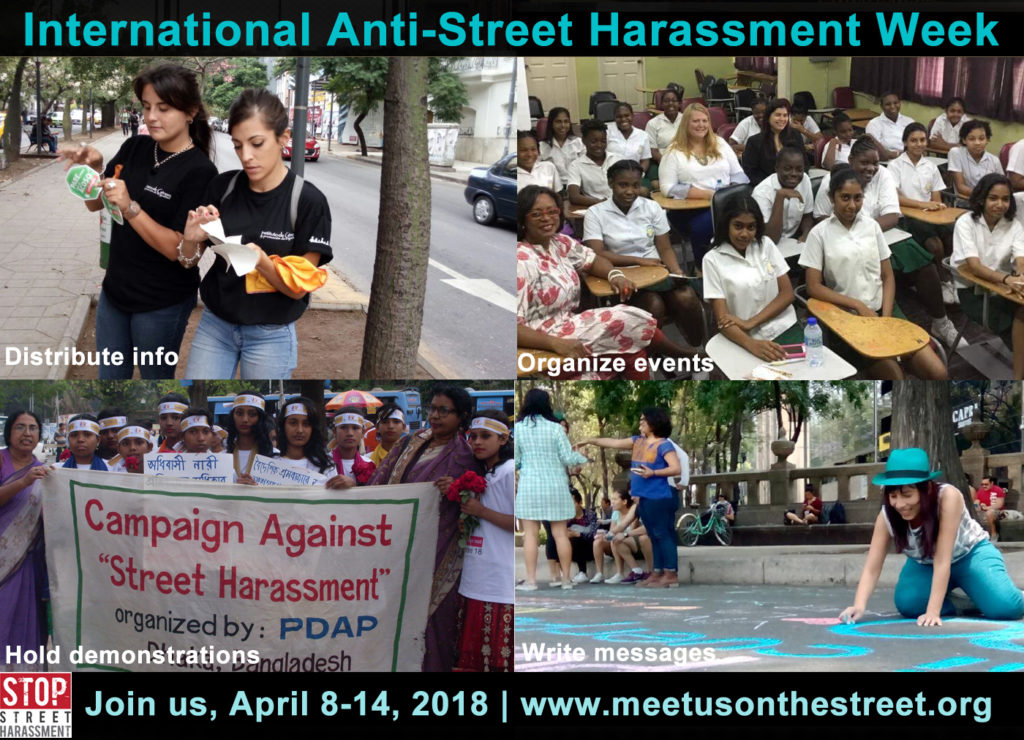
Save the Date for Anti-Street Harassment Week 2018!

January 17, 2018 By HKearl

This  is our 8th year organizing global action across International Anti-Street Harassment Week! Groups and people in around 40 countries participate each year. Will you?

Dates: April 8 – 14, 2018

Co-Sponsors: Join us as a participating co-sponsoring organization, group, campus or institution

Participate: No action is too small to make a difference in raising awareness. Find ideas here!

Events: If you’re planning an event, let us know so we can help advertise it! This can include on- or off-line actions, including tweet chats! Complete this form with the details.

Contact: StopStreetHarassment@gmail.com if you plan to co-sponsor, participate and/or host an event!! (And fill out this form for your event.)

View photos from our 2017 actions and read the wrap-up report.

Share

Filed Under: anti-street harassment week, SSH programs

« Previous Page
Next Page »

Share Your Story

Share your street harassment story for the blog. Donate Now

From the Blog

  • #MeToo 2024 Study Released Today
  • Join International Anti-Street Harassment Week 2022
  • Giving Tuesday – Fund the Hotline
  • Thank You – International Anti-Street Harassment Week 2021
  • Share Your Story – Safecity and Catcalls Collaboration

Buy the Book

Search

Archives

  • September 2024
  • March 2022
  • November 2021
  • April 2021
  • March 2021
  • January 2021
  • April 2020
  • March 2020
  • February 2020
  • December 2019
  • November 2019
  • September 2019
  • August 2019
  • July 2019
  • June 2019
  • May 2019
  • April 2019
  • March 2019
  • February 2019
  • January 2019
  • December 2018
  • November 2018
  • October 2018
  • September 2018
  • August 2018
  • July 2018
  • June 2018
  • May 2018
  • April 2018
  • March 2018
  • February 2018
  • January 2018
  • December 2017
  • November 2017
  • October 2017
  • September 2017
  • August 2017
  • July 2017
  • June 2017
  • May 2017
  • April 2017
  • March 2017
  • February 2017
  • January 2017
  • December 2016
  • November 2016
  • October 2016
  • September 2016
  • August 2016
  • July 2016
  • June 2016
  • May 2016
  • April 2016
  • March 2016
  • February 2016
  • January 2016
  • December 2015
  • November 2015
  • October 2015
  • September 2015
  • August 2015
  • July 2015
  • June 2015
  • May 2015
  • April 2015
  • March 2015
  • February 2015
  • January 2015
  • December 2014
  • November 2014
  • October 2014
  • September 2014
  • August 2014
  • July 2014
  • June 2014
  • May 2014
  • April 2014
  • March 2014
  • February 2014
  • January 2014
  • December 2013
  • November 2013
  • October 2013
  • September 2013
  • August 2013
  • July 2013
  • June 2013
  • May 2013
  • April 2013
  • March 2013
  • February 2013
  • January 2013
  • December 2012
  • November 2012
  • October 2012
  • September 2012
  • August 2012
  • July 2012
  • June 2012
  • May 2012
  • April 2012
  • March 2012
  • February 2012
  • January 2012
  • December 2011
  • November 2011
  • October 2011
  • September 2011
  • August 2011
  • July 2011
  • June 2011
  • May 2011
  • April 2011
  • March 2011
  • February 2011
  • January 2011
  • December 2010
  • November 2010
  • October 2010
  • September 2010
  • August 2010
  • July 2010
  • June 2010
  • May 2010
  • April 2010
  • March 2010
  • February 2010
  • January 2010
  • December 2009
  • November 2009
  • October 2009
  • September 2009
  • August 2009
  • July 2009
  • June 2009
  • May 2009
  • April 2009
  • March 2009
  • February 2009
  • January 2009
  • December 2008
  • November 2008
  • October 2008
  • September 2008
  • August 2008
  • July 2008
  • June 2008
  • May 2008

Comment Policy

SSH will not publish any comment that is offensive or hateful and does not add to a thoughtful discussion of street harassment. Racism, homophobia, transphobia, disabalism, classism, and sexism will not be tolerated. Disclaimer: SSH may use any stories submitted to the blog in future scholarly publications on street harassment.
  • Contact
  • Events
  • Join Us
  • Donate
  • Facebook
  • Instagram
  • Pinterest
  • Tumblr
  • Twitter
  • YouTube

Copyright © 2026 Stop Street Harassment · Website Design by Sarah Marie Lacy