• About Us
    • What Is Street Harassment?
    • Why Stopping Street Harassment Matters
    • Meet the Team
      • Board of Directors
      • Past Board Members
    • In The Media
  • Our Work
    • National Street Harassment Hotline
    • International Anti-Street Harassment Week
    • Blog Correspondents
      • Past SSH Correspondents
    • Safe Public Spaces Mentoring Program
    • Publications
    • National Studies
    • Campaigns against Companies
    • Washington, D.C. Activism
  • Our Books
  • Donate
  • Store

Stop Street Harassment

Making Public Spaces Safe and Welcoming

  • Facebook
  • Instagram
  • Pinterest
  • Tumblr
  • Twitter
  • YouTube
  • Home
  • Blog
    • Harassment Stories
    • Blog Correspondents
    • Street Respect Stories
  • Help & Advice
    • National Street Harassment Hotline
    • Dealing With Harassers
      • Assertive Responses
      • Reporting Harassers
      • Bystander Responses
      • Creative Responses
    • What to Do Before or After Harassment
    • Street Harassment and the Law
  • Resources
    • Definitions
    • Statistics
    • Articles & Books
    • Anti-Harassment Groups & Campaigns
    • Male Allies
      • Educating Boys & Men
      • How to Talk to Women
      • Bystander Tips
    • Video Clips
    • Images & Flyers
  • Take Community Action
  • Contact

Welcome Blog Correspondents – Cohort #1 of 2018!

January 15, 2018 By HKearl

Please join me in welcoming our newest Blog Correspondents! They represent four countries, four continents and will write monthly articles about street harassment issues in their communities and/or activism to address it.

Megan, Melbourne, Victoria, Australia

Megan calls Melbourne, Australia, home. She has a Bachelor’s of Social Work from Latrobe University and a Master’s in Criminology from the University of Melbourne. Megan is honoured to be a part of the first SSH cohort for 2018 and believes that the sharing of stories through such initiatives goes a long way in preventing street harassment from being part of the narrative of the “everyday” for women all over the world. She’s new to Twitter, so come say hello and share your story at @thecutlerydraw.

Yasmin Curzi, Rio de Janeiro, Brasil

Yasmin is a Research Assistant at the Center for Research on Law and Economics at FGV-Rio. She has a Master’s Degree in Social Sciences from PUC-Rio where she wrote her thesis on street harassment and feminists’ struggles for recognition. She has a B.A. in Social Sciences from FGV-Rio and is concluding a second B.A. in law. Her main academic interests are political sociology, feminist theories and global social movements.
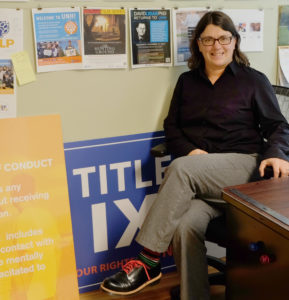
Connie DiSanto, New Hampshire, USA

Connie is a visual communicator who has been working in the field for over 30 years. She is currently a marketing communications specialist for the Sexual Harassment & Rape Prevention Program (SHARPP) at the University of New Hampshire where she is responsible for designing and implementing multi-media campaigns and marketing materials for SHARPP events, education, messaging and outreach. She is also the “face” behind SHARPP’s social media presence and the content creator for the program’s website. Connie also assists with direct service to those impacted by sexual violence on the UNH campus. Being able to combine her creative background with her desire in advocating for an end to sexual violence is a unique opportunity that she feels lucky to be a part of. You can reach her by email here.

Patrick Hogan, Chicago, IL, USA

Patrick Hogan is an undergraduate student majoring in anthropology and minoring in Islamic World Studies at Loyola University Chicago, preparing to continue onto law and graduate school. He is particularly interested in legal anthropology and the ways victims are viewed by legal systems. He has held positions in social justice and charity programs, including Public Relations for Loyola Hunger Week and board positions with the University’s chapter of the American Red Cross. He hopes to find research-based solutions to social issues. In his free time, he enjoys mountain biking and skiing.

Dovie Jenkins, Detroit, MI, USA

Dovie is a Graduate Teaching Assistant at Wayne State University in Detroit, Michigan. She earned her B.A. in Anthropology at Wayne State, graduating summa cum laude. She is currently pursuing an M.A. in Anthropology and Philosophy. She hopes to complete a Ph.D. in Philosophy and one day secure a tenure-track position. Dovie’s academic interests include the evolution of moral reasoning, moral psychology, ethics, and epistemology. She is also interested in public philosophy, specifically issues relating to gender equality. She is also a member of Phi Beta Kappa. Dovie’s non-academic interests include endurance running, hiking, wilderness camping, kayaking, and various board-related sports.
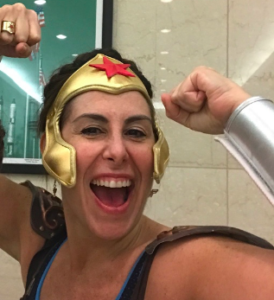
Elizabeth Kuster, Brooklyn, NY, USA

Elizabeth is an Iowa-born and -raised writer and editor who has a B.A. in journalism from the University of Iowa, where she was a member of the undergrad Writer’s Workshop for fiction. Back in the day, she pitched and wrote the very first mainstream-media article about street harassment (for Glamour). Throughout her career, she has focused on developing content that empowers women and helps them live more vibrant, badass lives. She has held full-time editorial positions at publications such as Glamour, Seventeen and The Huffington Post and is author of the self-help/humor book Exorcising Your Ex. In her spare time, Elizabeth enjoys trolling the #FakePresident on Twitter. You can follow Elizabeth on Twitter at @bethmonster, but be advised that she’s been dropping a lot of F-bombs lately.
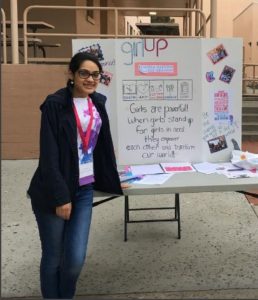
Isha Raj-Silverman, San Diego, CA, USA

Isha Raj-Silverman is a high school senior at La Jolla High School in San Diego, California. She is a local activist on various women’s issues, but particularly sexual harassment and assault. She has organized her high school’s sexual assault awareness campaigns as president and founder of La Jolla Girl Up, and helped to organize various feminist activism and advocacy events in her community such as the International Day of the Girl Child and a youth art silent auction and concert benefiting the Center for Community Solutions, her local rape crisis center. Isha is also an active member in her high school theatre community, and spends what time she has while not in school, acting, or advocating discussing politics and reading terrible young adult literature, and then loudly discussing how very feminist or misogynistic said literature was and how it may affect or be affected by the views young women have of themselves.

Adetayo Talabi, Lagos, Nigeria

Adetayo resides in Lagos. He is a Judicial Assistant/Law Clerk to Justices of the Lagos Division of the Court of Appeals. He has a Diploma and Bachelor of Laws Degree from the University of Benin, Nigeria. Although his educational and professional backgrounds are in law, Adetayo volunteers with several Non-Government Organizations (NGOs) including Just Justice, Irede Foundation, The Soup Kitchen with focus on legal aid, domestic/gender-based violence, gender equality and human rights. You can reach him by mail here or follow him on twitter at @TalabiJ_.

Share

Filed Under: correspondents, street harassment Tagged With: correspondents

2018 Plans for DC-Area Anti-Harassment Transit Efforts

January 9, 2018 By HKearl

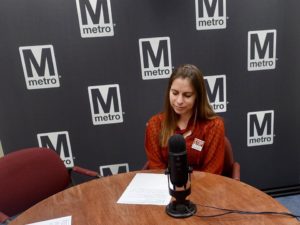
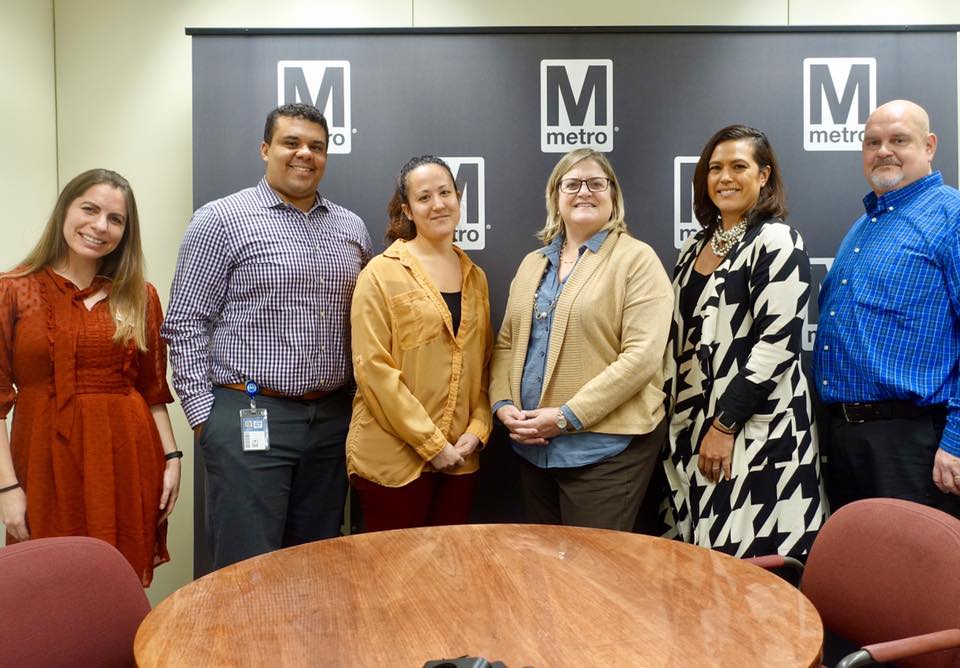
WMATA, CASS and SSH Staff at a 2018 planning meeting

It’s been nearly six years since we started working with Collective Action for Safe Spaces (CASS) and the Washington Metropolitan Area Transit Authority on efforts to address and prevent sexual harassment on the transit system. Today, Chantal from CASS and I attended a 2018 planning meeting at WMATA HQ and we are looking forward to various forthcoming projects:

1) Audio announcements letting people know how to report harassment they experience or witness will start being played on Metro trains this month and on buses in the spring. They asked if one of us would record them and I ended up being the one who did. So if you’re in the area, listen for my voice on Metro!!

2) During International Anti-Street Harassment Week (April 8-14), we will partner together for our annual outreach day at various Metro stations. We’ll have new flyers, bracelets, and perhaps other giveaways, so stay tuned. We’ll also be looking for volunteers to help distribute information (date TBD but likely during evening rush hour on April 10 or 11).

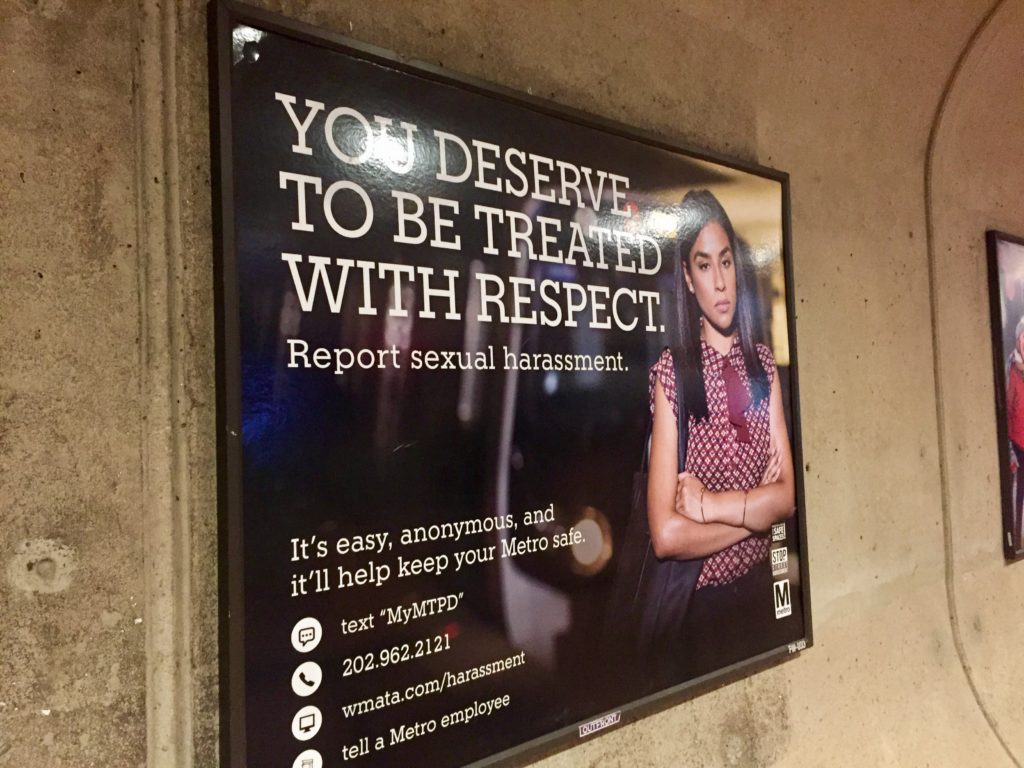
3) Currently the third wave of print PSAs are up on the system. They are gorgeous! But if they’re up too long, people get used to them and don’t notice them anymore. They went up in Nov 2016, so it’s about time for new ads. We will work on a new set of ads over the summer.

4) We began a discussion about doing a follow-up survey of some kind to the 2016 ridership survey on sexual harassment to see how the latest print ads have been received and to see if people’s experiences with harassment have changed at all.

Those were the main updates. We are grateful that WMATA continues to dedicate time and resources to making the transit system safer.

Share

Filed Under: anti-street harassment week, public harassment, SSH programs Tagged With: anti-street harassment week, DC, PSA, research, survey, transit system, WMATA, WMATA ads

Looking Ahead to SSH Programs in 2018

January 2, 2018 By HKearl

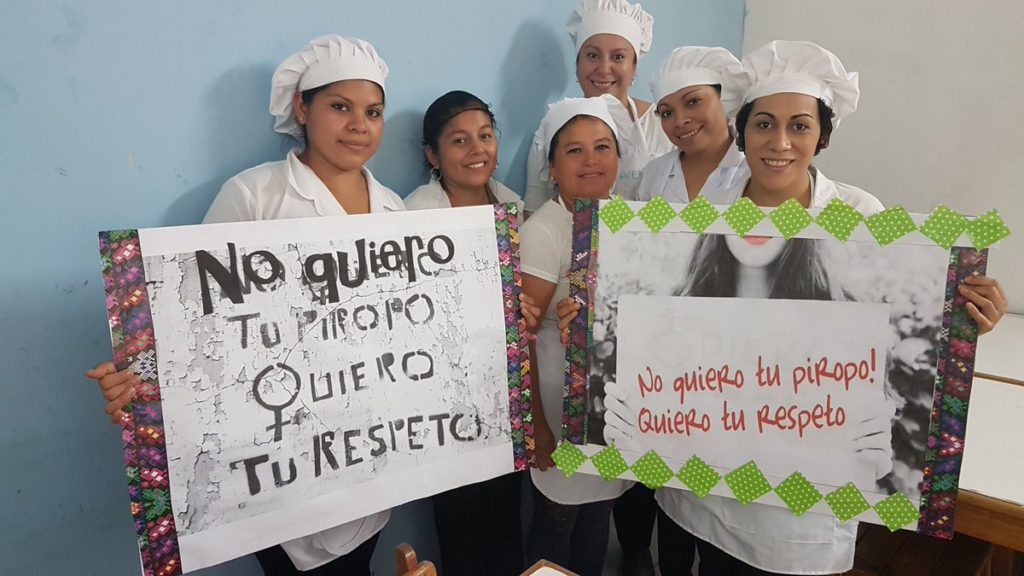
Municipal Office of Women of Villa Nueva Guatemala took part in Anti-SH Week 2017. Will you take part in our week in 2018?

2017 was a big year, and 2018 looks like it will be even bigger!

As we look toward 2018, we already have a few projects on the horizon:

1. Blog Correspondents Program: We are looking for applicants for our first cohort of Blog Correspondents! Apply by Jan. 7!

2. National Survey: Thanks to our generous donors, PinPoint Foundation and Raliance, we are moving forward with the survey firm GfK to conduct a nationally representative survey on sexual abuse across all the spaces it occurs. The survey draft is under review by our advisory committee right now and we hope to see the 2000-person survey conducted in mid-January. Afterward, pro bono data analyst will be conducted by Dr. Anita Raj, Director of UC San Diego’s Center on Gender Equity and Health. We hope to release the timely report in March 2018!

3. International Anti-Street Harassment Week: Our 8th annual week of awareness will take place from April 8 to 14, 2018! If your group or organization would like to co-sponsor, please be in touch with StopStreetHarassment@yahoo.com. Stay tuned for more information, including a toolkit for community action that is tied to the national survey.

4. National Hotline: We will continue to partner with RAINN to offer the only national hotline dedicated to ending street harassment. It costs about $400 per month to run both the phone and online hotline. Your tax-deductible donation can help keep the hotline running!

May 2018 will mark our 10-year anniversary, so that will also make it a big year for us.

Thank you for being part of our community, and we look forward to working with you more in 2018!

Share

Filed Under: national study, SSH programs, street harassment Tagged With: anti-street harassment week, correspondents, hotline, programs, research

Panel about Apps to Address Gender-Based Violence

December 31, 2017 By HKearl

Learn about apps to address gender-based violence in this online panel organized by Red Dot Foundation.

Moderator: Holly Kearl, Stop Street Harassment

Panelists: Elsa Marie D’silva, Red Dot Foundation; Kalpana Vishwanathan, Safetipin; Kirthi Jayakumar, The Red Elephant; Ciera Blehm, Ciera

Share

Filed Under: Resources Tagged With: apps, phone, Resources, safecity

What Can Men Do?

December 30, 2017 By HKearl

Dr. Gary Barker, President of Promund-US, did an interview with Mashable a few weeks ago about what men can do in light of the #MeToo movement and ending sexual abuse. Check out all 5 actions in the full article, as well as excerpts below:

“1. Listen to women. Women are sharing their stories, from just two words to details about harassment and assault. If you as a man feel compelled to comment beyond words of support, think twice. Women who’ve made themselves vulnerable by sharing their painful stories don’t need men second-guessing their accounts or making contrarian remarks.  Before you do anything, listen.

2. Talk to other boys and men about #MeToo. If you can’t believe so many women have experienced sexual violence, other boys and men probably don’t realize it either. #MeToo is an opportunity for men to talk to each other about how those experiences are universal for women, and to talk about what men can do.

3. Call it out when you see it.* Too often men see other men harassing or abusing power and turn the other way. It’s uncomfortable for us to question other men, particularly when it’s a friend, a co-worker, or even a relative. Lots of other men knew what Harvey Weinstein did and said nothing. Take a stand and call it out even if it’s uncomfortable – and even if it puts you at risk.

4. Advocate for better education and prevention. Use #MeToo as an opportunity to advocate for long-term education and prevention efforts in schools, campuses, and workplaces. Meaningful change happens through multiple education sessions over time, institutional messages about prevention, and comprehensive training for staff and leadership. Boys and girls need to learn about consent, sexuality, and respect in open, honest ways.

We cannot let our silence be deafening as men. We cannot look the other way and pretend that it’s those other men. We need to speak out and take action today, first and foremost listening to women who have experienced harassment.”

Learn how Promundo is working with partners in the United States and more than 40 countries worldwide to challenge the root causes of sexual harassment and sexual assault and to promote gender justice.

Check out our male allies section and my books Stop Street Harassment: Making Public Places Safe & Welcoming for Women and Stop Global Street Harassment: Growing Activism Around the World for information specifically around what men can do to stop street harassment.

For programming ideas, check out Collective Action for Safe Spaces’ “Rethinking Masculinity” program.

Share

Filed Under: male perspective, Resources Tagged With: male allies, men's role, what men can do

« Previous Page
Next Page »

Share Your Story

Share your street harassment story for the blog. Donate Now

From the Blog

  • #MeToo 2024 Study Released Today
  • Join International Anti-Street Harassment Week 2022
  • Giving Tuesday – Fund the Hotline
  • Thank You – International Anti-Street Harassment Week 2021
  • Share Your Story – Safecity and Catcalls Collaboration

Buy the Book

Search

Archives

  • September 2024
  • March 2022
  • November 2021
  • April 2021
  • March 2021
  • January 2021
  • April 2020
  • March 2020
  • February 2020
  • December 2019
  • November 2019
  • September 2019
  • August 2019
  • July 2019
  • June 2019
  • May 2019
  • April 2019
  • March 2019
  • February 2019
  • January 2019
  • December 2018
  • November 2018
  • October 2018
  • September 2018
  • August 2018
  • July 2018
  • June 2018
  • May 2018
  • April 2018
  • March 2018
  • February 2018
  • January 2018
  • December 2017
  • November 2017
  • October 2017
  • September 2017
  • August 2017
  • July 2017
  • June 2017
  • May 2017
  • April 2017
  • March 2017
  • February 2017
  • January 2017
  • December 2016
  • November 2016
  • October 2016
  • September 2016
  • August 2016
  • July 2016
  • June 2016
  • May 2016
  • April 2016
  • March 2016
  • February 2016
  • January 2016
  • December 2015
  • November 2015
  • October 2015
  • September 2015
  • August 2015
  • July 2015
  • June 2015
  • May 2015
  • April 2015
  • March 2015
  • February 2015
  • January 2015
  • December 2014
  • November 2014
  • October 2014
  • September 2014
  • August 2014
  • July 2014
  • June 2014
  • May 2014
  • April 2014
  • March 2014
  • February 2014
  • January 2014
  • December 2013
  • November 2013
  • October 2013
  • September 2013
  • August 2013
  • July 2013
  • June 2013
  • May 2013
  • April 2013
  • March 2013
  • February 2013
  • January 2013
  • December 2012
  • November 2012
  • October 2012
  • September 2012
  • August 2012
  • July 2012
  • June 2012
  • May 2012
  • April 2012
  • March 2012
  • February 2012
  • January 2012
  • December 2011
  • November 2011
  • October 2011
  • September 2011
  • August 2011
  • July 2011
  • June 2011
  • May 2011
  • April 2011
  • March 2011
  • February 2011
  • January 2011
  • December 2010
  • November 2010
  • October 2010
  • September 2010
  • August 2010
  • July 2010
  • June 2010
  • May 2010
  • April 2010
  • March 2010
  • February 2010
  • January 2010
  • December 2009
  • November 2009
  • October 2009
  • September 2009
  • August 2009
  • July 2009
  • June 2009
  • May 2009
  • April 2009
  • March 2009
  • February 2009
  • January 2009
  • December 2008
  • November 2008
  • October 2008
  • September 2008
  • August 2008
  • July 2008
  • June 2008
  • May 2008

Comment Policy

SSH will not publish any comment that is offensive or hateful and does not add to a thoughtful discussion of street harassment. Racism, homophobia, transphobia, disabalism, classism, and sexism will not be tolerated. Disclaimer: SSH may use any stories submitted to the blog in future scholarly publications on street harassment.
  • Contact
  • Events
  • Join Us
  • Donate
  • Facebook
  • Instagram
  • Pinterest
  • Tumblr
  • Twitter
  • YouTube

Copyright © 2026 Stop Street Harassment · Website Design by Sarah Marie Lacy