• About Us
    • What Is Street Harassment?
    • Why Stopping Street Harassment Matters
    • Meet the Team
      • Board of Directors
      • Past Board Members
    • In The Media
  • Our Work
    • National Street Harassment Hotline
    • International Anti-Street Harassment Week
    • Blog Correspondents
      • Past SSH Correspondents
    • Safe Public Spaces Mentoring Program
    • Publications
    • National Studies
    • Campaigns against Companies
    • Washington, D.C. Activism
  • Our Books
  • Donate
  • Store

Stop Street Harassment

Making Public Spaces Safe and Welcoming

  • Facebook
  • Instagram
  • Pinterest
  • Tumblr
  • Twitter
  • YouTube
  • Home
  • Blog
    • Harassment Stories
    • Blog Correspondents
    • Street Respect Stories
  • Help & Advice
    • National Street Harassment Hotline
    • Dealing With Harassers
      • Assertive Responses
      • Reporting Harassers
      • Bystander Responses
      • Creative Responses
    • What to Do Before or After Harassment
    • Street Harassment and the Law
  • Resources
    • Definitions
    • Statistics
    • Articles & Books
    • Anti-Harassment Groups & Campaigns
    • Male Allies
      • Educating Boys & Men
      • How to Talk to Women
      • Bystander Tips
    • Video Clips
    • Images & Flyers
  • Take Community Action
  • Contact

LGBQT street harassment: info, tweetchat today

April 8, 2013 By Contributor

[Editor’s Note: This blog post is cross-posted with permission from Fem2Pt0.]

Tweet Chat: On Monday, April 8, from 1-2PM ET Fem.2.0 will host a Tweet Chat, as part of the International Anti-street Harassment Week  with special guests, Shawna Potter, Executive Site Leader & Melanie Keller, site leader of Hollaback! Baltimore  to discuss  the unique experience of street harassment that the LGBT individuals face. You can join the conversation at #EndSH.
I was talking to a friend on Facebook last week and, when he asked me what I was doing, I told him I was writing something for International Anti-Street Harassment Week.

He had no idea what I was talking about.

I sent him a link to the website and showed him some pieces I had written before on the topic of street harassment. And he was really surprised. He’d never seen public harassment framed this way and wasn’t familiar with the concept. He certainly understood that it happens, but not to the degree that I was describing.

My research in particular focuses on the street harassment of men who identify as gay or bisexual – research I undertook for my women’s studies MA thesis that attracted 331 responses from men around the world. What I found, and what should concern every one, is that about 90 percent of the men I surveyed said they are sometimes, often, or always harassed or made to feel unwelcome in public spaces because of their perceived sexual orientation.

I’m not sure that I was surprised by my friend’s response, though.

Of the 227 men who answered the question on my survey asking them to define street harassment, only 12 referenced sexual orientation, among other identity categories, as a reason for harassment. Since street harassment has been popularized as a largely gender-specific form of violence, it is possible that men do not conceptualize it as something by which they could possibly be affected – a thought process that is documented in gay and bisexual male domestic violence research. Many men view their experiences of victimization as inconsistent with their male identity – but this shouldn’t be so.

Men who are perceived to be anything other than heterosexual (and cisgendered) face harassment from straight (and other gay/bisexual) men who operate in homosocial spaces, distancing themselves from and adversely reacting to anyone whose masculinity falls short of comporting with what they view as appropriate. They face sexualized harassment from other gay/bisexual men (usually older men, according to my research participants, but certainly not exclusively). They face harassment from a lot of people and, like the street harassment of women across all identity categories, it’s not fair.

The men I conducted follow-up interviews with disclosed a lot to me, sometimes experiences (including rape) they hadn’t ever disclosed to anyone before. And after talking to them, that’s the biggest take-away: it really, really isn’t fair.

I don’t want to live in a world where my queer brothers and sisters feel compelled to hide physical evidence of their sexual orientation, to disguise any legibility of difference. Too many men involved in my research shared that they concealed particular parts of themselves in public to pass as heterosexual. This process is draining – emotionally, mentally, and physically. As is the perpetual fear of experiencing harassment.

Approximately 71 percent of the men who took my survey said they constantly assess their surroundings when navigating public spaces. In addition, 69 percent said they avoid specific neighborhoods/areas, 67 percent reported not making eye contact with others, and 59 percent said they cross streets or take alternate routes to avoid potential harassment.

I can’t say that I experience street harassment every day, as I know many women can. I don’t have to experience it to feel its affects, because I am always afraid. I’m afraid because it’s possible, because it’s happened before and will happen again, and because we live in a society where it’s unfortunately normal and expected.

And that’s why International Anti-Street Harassment Week is so important – because, like my friend, not everyone is familiar with how systemic this all-too-common phenomenon is and how many people it affects in very real ways. The more of us who speak out, the more attention it will get. It’s about collectively amplifying each other’s voices, about standing in solidarity and saying that this isn’t okay. It’s about human rights, and creating social spaces where all humans are free from this form of public harassment.

Patrick Ryne  McNeil is a feminist, a non-profit worker and an anti-street harrasment advcoate. Follow him @patrickryne

Share

Filed Under: anti-street harassment week, male perspective, street harassment

New Anti-Harassment Transit Ads in Philadelphia

April 8, 2013 By HKearl

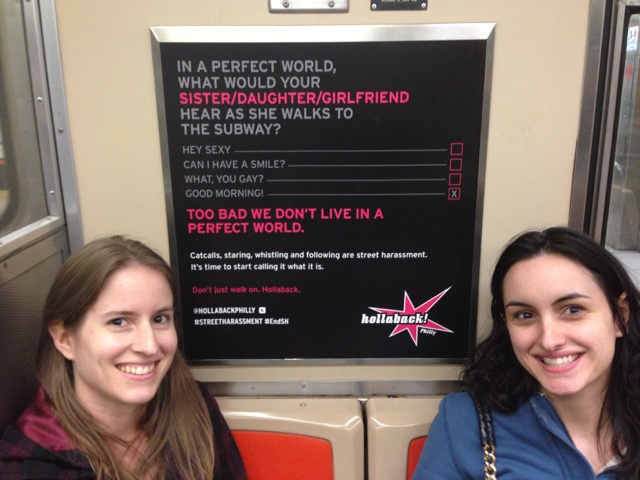
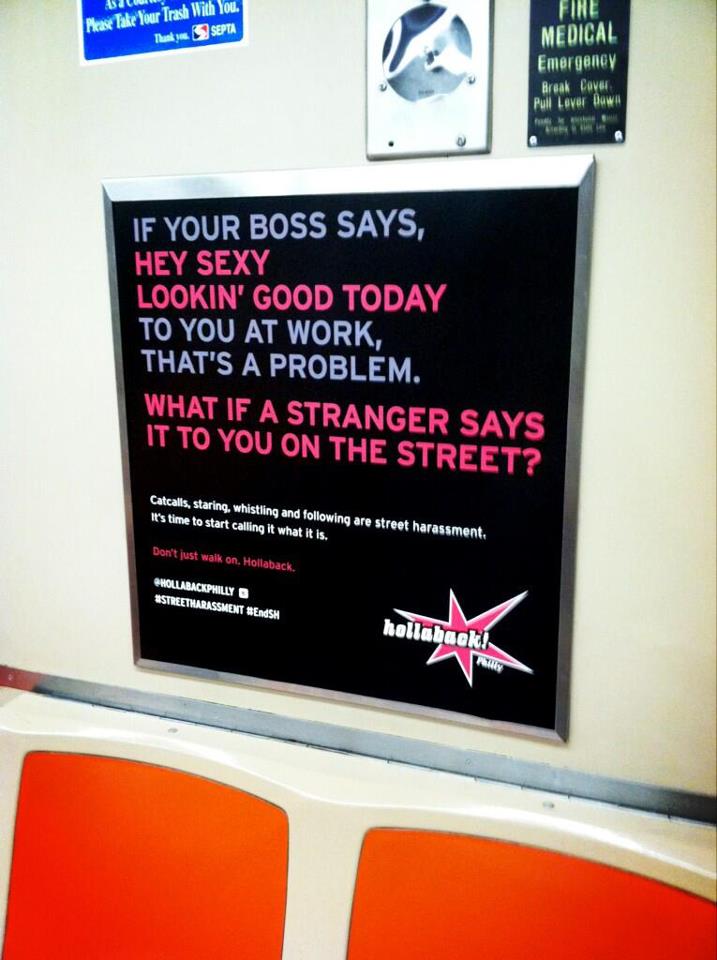
After a lot of hard work and fundraising, Hollaback! Philly is proud to launch a series of anti-harassment ads on the public transportation system this week, timed to coincide with International Anti-Street Harassment Week! Congratulations to them.

Hollaback! Philly’s Rochelle Keyhan and Anna Kegleranswered a few questions for me about their great ad campaign. Learn more on their website and share your views about the issue and the ads.

1. Stop Street Harassment (SSH): Where did the inspiration for the subway ad campaign and the messaging on the ads come from?

Rochelle: Our tourist bureau here, VisitPhilly.com, has an “Love, Philadelphia, XOXO” series. One of the ads was this huge billboard that explicitly street harassed everyone who walked past it, commenting “I like the way you move it move it”. We asked them to take it down, and they refused while adamantly defending the advertisement as not offensive. That was the first push we needed to realize that if we want the conversation to reflect our reality, we need to get out there and force our voices to be heard.

Anna: One ad outlines various catch phrases men said to a group of high school students we did a workshop with for buildOn’s Alternative Spring Break in 2012 (in partnership with Nuala Cabral). They created a video PSA from their experiences, and the stories they recounted largely inspired that advertisement. The other ads we developed through many conversations within Hollaback Philly and through input with other activists. I did a lot of research on framing and messaging to create them as conversation starters that would encourage even the non-believers to think twice about street harassment. We tried to enter the conversation from various perspectives to engage the largest number of people, so there are three larger advertisements, and three smaller, simpler advertisements, all aiming to get people thinking about the issue.

2. SSH: What impact do you how the ads will have in Philadelphia?

Anna: All we’re really trying to do is start a conversation, and get people to start associating the term “street harassment” with “problem” and “solvable”, instead of “inevitable” and “acceptable”.

Rochelle: We hope people will use the ads to start conversations about their experiences with street harassment. I am most hopeful that men will use the ads to start conversations with women in their lives who may not share with them the harassment they experience every week.

Anna: Overall, if we can increase understanding and get a conversation going about ways we can work together to create a safer street culture, I will consider these successful!

3. SSH: What advice or strategies would you suggest to someone else who wants to get an ad campaign on their local public transportation system?

Rochelle: Don’t take no for an answer. There’s no money in the budget for PSAs? Raise your own money. Your cause isn’t important enough? Don’t talk to that person again until you’ve gotten the ads up, then invite them to reconsider that opinion. I’m not going to lie though, this was a LOT of work. From raising enough money, to designing the ads, to figuring out messaging and what they should say, to negotiating the contract – we only succeeded because it was something we really believed needed to be done, and no one else was doing it so it was our time to stand up and act.

Anna and Rochelle

4. SSH: Anything else?

Anna: In creating and designing the ads, we obviously could have done a Philly-specific set of ads. But, we are just one branch of a robust international organization, so we specifically designed these ads to be scalable so that we can share them with other Hollaback branches.

Rochelle: We don’t want the conversation to end here. This is only the beginning.

Share

Filed Under: Activist Interviews, anti-street harassment week, street harassment

Anti-Street Harassment Week: Day 1

April 7, 2013 By HKearl

View photos of the great activities that took place today!


Share

Filed Under: anti-street harassment week

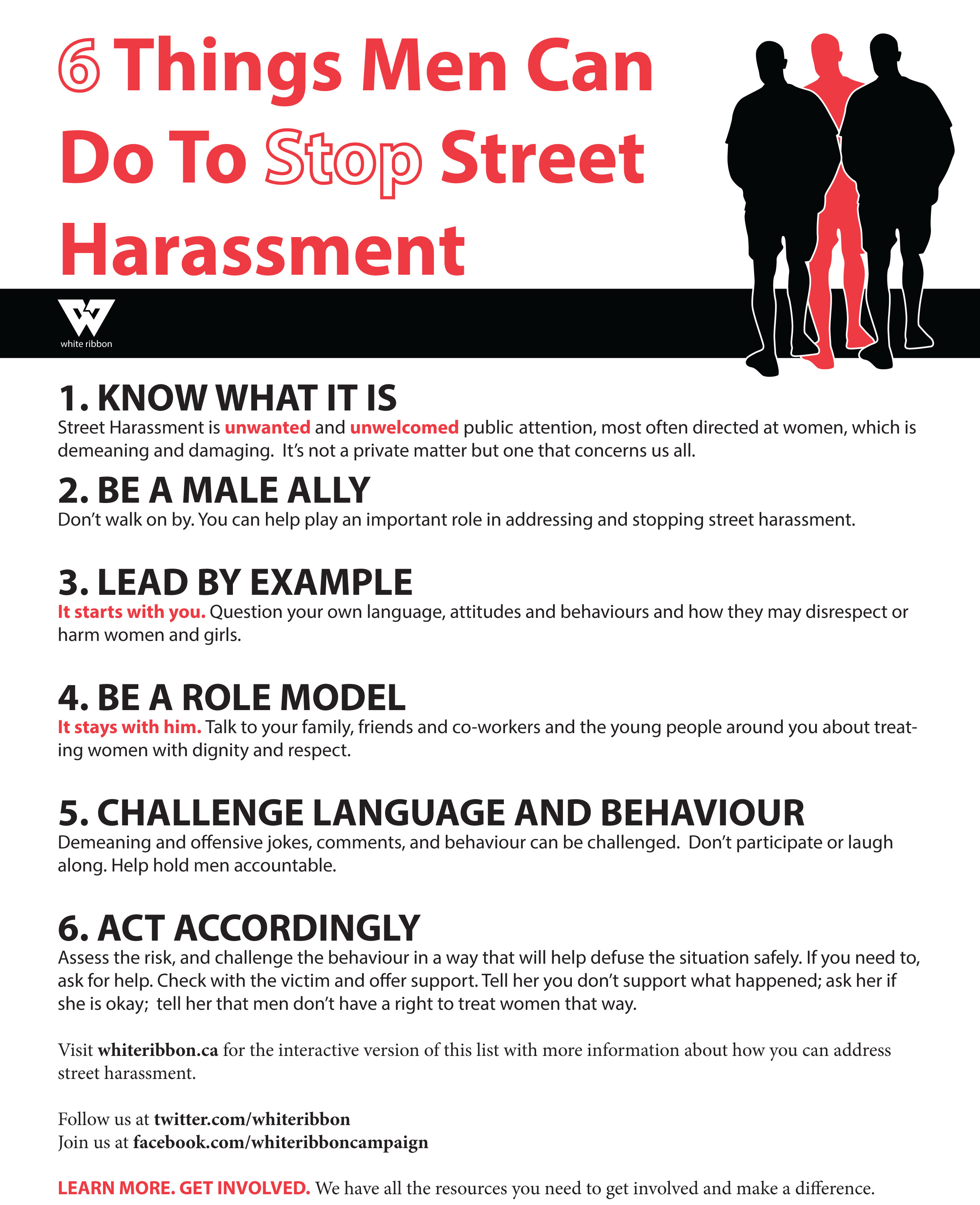
6 Things Men Can Do To Stop Street Harassment

April 7, 2013 By HKearl

The White Ribbon Project created this graphic for International Anti-Street Harassment Week! Learn more about what men can do here.

Related, watch the “Shit Men Say to Men Who Say Shit to Women on the Streets” video from last year’s week of awareness.

Share

Filed Under: anti-street harassment week, male perspective, street harassment

Meet change in the streets

April 7, 2013 By Contributor

This is a guest blog post for International Anti-Street Harassment Week 2013 by Laura Palumbo, USA.

As soon as my sneakers hit pavement, I might as well be a lamp post. Does that sound absurd to you? Believe it or not, it’s how I’ve been made to feel by onlookers and passersby who have treated me like an object in public spaces. Yes, they are the vocal minority, the harassers and near-do-wells. But they still have a power and they abuse and enforce it in the form of street harassment. Despite however many positive, neighborly interactions I experience each day in public spaces – I am still forced to expect the worst every time a nearby car slows down or a stranger’s eye contact lingers.

Meet my fear in the streets.

In these spaces, my individual strengths, personal successes, my gifts and values – they don’t really matter anymore. They can’t protect or humanize me as long as there’s anyone else whose can express a disvalue of my gender. [Insert: race, ethnicity, class, sexual orientation, ability, body type…] As a walk-to-work commuter and runner, this fear of street harassment follows me daily. Sometimes the word street harassment feels sanitizing, because what we are really talking about is sexual harassment and sexual violence in the context of any public space: streets, sidewalks, public transportation, stairwells, elevators, etc.

Meet my rage in the streets.

Catcalls, sexist comments, flashing, groping, stalking, and assault impact all women and many men, especially in the LGBQT community. Street harassment like all sexual violence is a global issue, and the impact is far reaching. Hostility in our streets or public spaces changes the dynamic for everyone, and it makes these environments unsafe, unfriendly and less accessible. That is why we need to reclaim our streets.

Meet us in the streets.

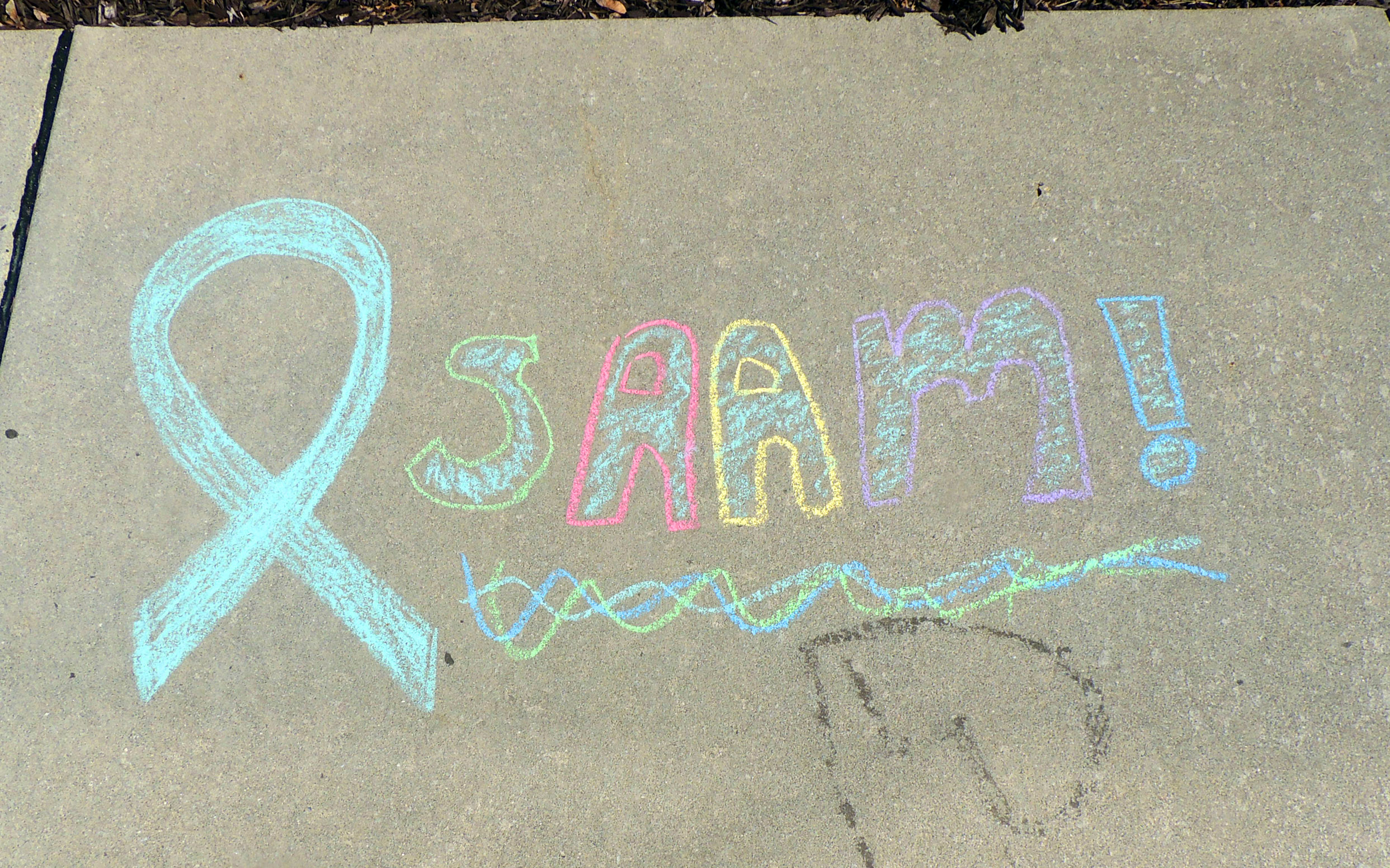
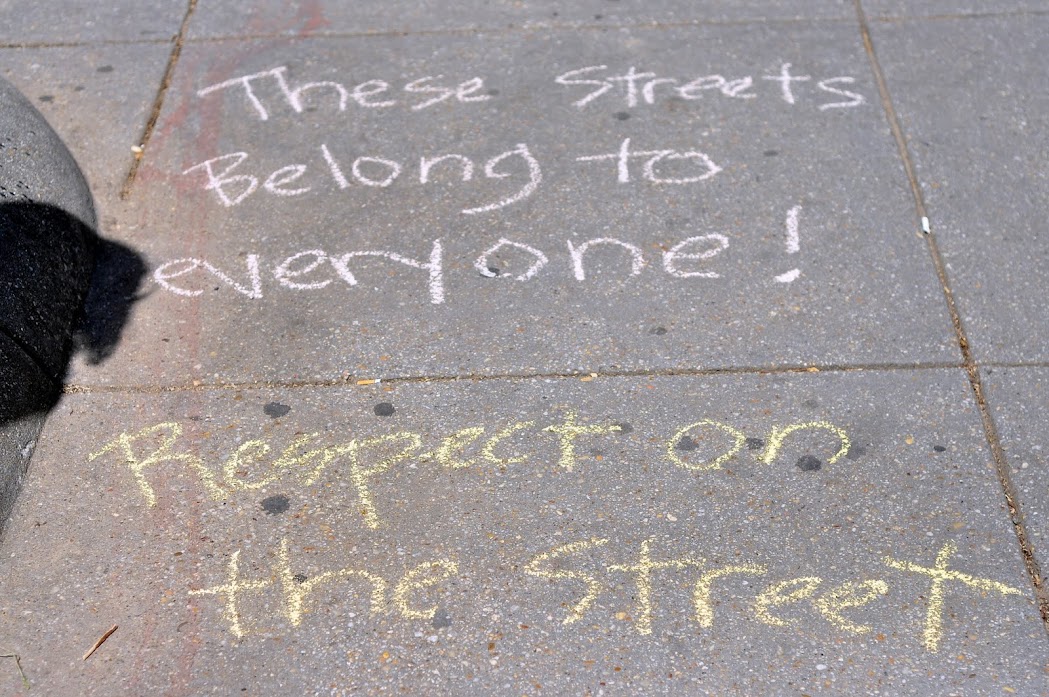
As spring begins to unfold, warmer weather often means an increase in the likelihood of street harassment. This April, as a part of Sexual Assault Awareness Month, it’s time to welcome a new dynamic to our streets. Meet Us On the Street: International Anti-Street Harassment Week (April 7-13) is an opportunity to collectively raise awareness that street harassment happens and that it’s not okay. During this week, join tens of thousands of people worldwide who will be using sidewalk chalk, posters, street theater, rallies, and marches to reclaim public spaces.

Meet change in the streets.

By making the connection between sexual violence and street harassment, we can change the dynamics in our streets, schools, and homes. How will you participate?

Laura is the Prevention Campaign Specialist for the National Sexual Violence Resource Center in Pennsylvania and helps oversee Sexual Assault Awareness Month.


Share

Filed Under: anti-street harassment week, street harassment

« Previous Page
Next Page »

Share Your Story

Share your street harassment story for the blog. Donate Now

From the Blog

  • #MeToo 2024 Study Released Today
  • Join International Anti-Street Harassment Week 2022
  • Giving Tuesday – Fund the Hotline
  • Thank You – International Anti-Street Harassment Week 2021
  • Share Your Story – Safecity and Catcalls Collaboration

Buy the Book

Search

Archives

  • September 2024
  • March 2022
  • November 2021
  • April 2021
  • March 2021
  • January 2021
  • April 2020
  • March 2020
  • February 2020
  • December 2019
  • November 2019
  • September 2019
  • August 2019
  • July 2019
  • June 2019
  • May 2019
  • April 2019
  • March 2019
  • February 2019
  • January 2019
  • December 2018
  • November 2018
  • October 2018
  • September 2018
  • August 2018
  • July 2018
  • June 2018
  • May 2018
  • April 2018
  • March 2018
  • February 2018
  • January 2018
  • December 2017
  • November 2017
  • October 2017
  • September 2017
  • August 2017
  • July 2017
  • June 2017
  • May 2017
  • April 2017
  • March 2017
  • February 2017
  • January 2017
  • December 2016
  • November 2016
  • October 2016
  • September 2016
  • August 2016
  • July 2016
  • June 2016
  • May 2016
  • April 2016
  • March 2016
  • February 2016
  • January 2016
  • December 2015
  • November 2015
  • October 2015
  • September 2015
  • August 2015
  • July 2015
  • June 2015
  • May 2015
  • April 2015
  • March 2015
  • February 2015
  • January 2015
  • December 2014
  • November 2014
  • October 2014
  • September 2014
  • August 2014
  • July 2014
  • June 2014
  • May 2014
  • April 2014
  • March 2014
  • February 2014
  • January 2014
  • December 2013
  • November 2013
  • October 2013
  • September 2013
  • August 2013
  • July 2013
  • June 2013
  • May 2013
  • April 2013
  • March 2013
  • February 2013
  • January 2013
  • December 2012
  • November 2012
  • October 2012
  • September 2012
  • August 2012
  • July 2012
  • June 2012
  • May 2012
  • April 2012
  • March 2012
  • February 2012
  • January 2012
  • December 2011
  • November 2011
  • October 2011
  • September 2011
  • August 2011
  • July 2011
  • June 2011
  • May 2011
  • April 2011
  • March 2011
  • February 2011
  • January 2011
  • December 2010
  • November 2010
  • October 2010
  • September 2010
  • August 2010
  • July 2010
  • June 2010
  • May 2010
  • April 2010
  • March 2010
  • February 2010
  • January 2010
  • December 2009
  • November 2009
  • October 2009
  • September 2009
  • August 2009
  • July 2009
  • June 2009
  • May 2009
  • April 2009
  • March 2009
  • February 2009
  • January 2009
  • December 2008
  • November 2008
  • October 2008
  • September 2008
  • August 2008
  • July 2008
  • June 2008
  • May 2008

Comment Policy

SSH will not publish any comment that is offensive or hateful and does not add to a thoughtful discussion of street harassment. Racism, homophobia, transphobia, disabalism, classism, and sexism will not be tolerated. Disclaimer: SSH may use any stories submitted to the blog in future scholarly publications on street harassment.
  • Contact
  • Events
  • Join Us
  • Donate
  • Facebook
  • Instagram
  • Pinterest
  • Tumblr
  • Twitter
  • YouTube

Copyright © 2026 Stop Street Harassment · Website Design by Sarah Marie Lacy