• About Us
    • What Is Street Harassment?
    • Why Stopping Street Harassment Matters
    • Meet the Team
      • Board of Directors
      • Past Board Members
    • In The Media
  • Our Work
    • National Street Harassment Hotline
    • International Anti-Street Harassment Week
    • Blog Correspondents
      • Past SSH Correspondents
    • Safe Public Spaces Mentoring Program
    • Publications
    • National Studies
    • Campaigns against Companies
    • Washington, D.C. Activism
  • Our Books
  • Donate
  • Store

Stop Street Harassment

Making Public Spaces Safe and Welcoming

  • Facebook
  • Instagram
  • Pinterest
  • Tumblr
  • Twitter
  • YouTube
  • Home
  • Blog
    • Harassment Stories
    • Blog Correspondents
    • Street Respect Stories
  • Help & Advice
    • National Street Harassment Hotline
    • Dealing With Harassers
      • Assertive Responses
      • Reporting Harassers
      • Bystander Responses
      • Creative Responses
    • What to Do Before or After Harassment
    • Street Harassment and the Law
  • Resources
    • Definitions
    • Statistics
    • Articles & Books
    • Anti-Harassment Groups & Campaigns
    • Male Allies
      • Educating Boys & Men
      • How to Talk to Women
      • Bystander Tips
    • Video Clips
    • Images & Flyers
  • Take Community Action
  • Contact

Digest of Street Harassment News: Jan. 13, 2013

January 13, 2013 By HKearl

** Sign up to receive a monthly e-newsletter from Stop Street Harassment ***

Street Harassment Stories:

Share your story! You can read street harassment stories on the Web at:

Stop Street Harassment Blog

Collective Action for Safe Spaces

HarassMap in Egypt

Bijoya in Bangladesh

Resist Harassment in Lebanon

Ramallah Street Watch in Palestine

Name and Shame in Pakistan

Safe City India

Safe Streets in Yemen

Street Harassment in South Africa

Many of the Hollaback sites

Everyday Sexism

Street Harassment In the News, on the Blogs:

* CNN, “7 men gang rape bus passenger in India“

* Huffington Post, “To New Delhi: A Letter Back, From Washington, DC“

* Tech President, “Mobile Apps to Combat Street Harassment Follow Brutal Delhi Gang-Rape Case“

* Ms. Blog, “Being Female in India: A Hate Story“

* Indian Country, “Rape, Kidnapping Being Investigated as Hate Crime in Thunder Bay“

 * The New York Times, “Is Delhi So Different From Steubenville?”

* Cosmo (UK), “You Said What?!”

* Hello Giggles, “Smile For Me, Pussycat“

* The Hindu, “Enough is enough“

* Jezebel, “SF Street Harassment Stabbing Is a Great Reminder That Catcalling Isn’t a Joke” | Hollaback SF’s response

* Business Standard, “Lecturer arrested for eve-teasing woman passenger in train“

* ZeeNews, “Haryana govt initiate efforts to check eve-teasing“

* The Independent, “The protests sparked by gang-rape in India aren’t the beginning and they won’t be the end“

* Cis White Female, “Wolf-whistle weight loss: Sexual harassment isn’t a compliment, Cosmo“

* Fit and Feminist, “Street harassment as weight-loss motivation? I don’t think so“

* Jezebel, “Singapore Anti-Groping PSA Features Terrible Puns, Victim-Blaming ‘Tips’“

* Women’s Media Center, “India Tragedy Seen as Transitional Moment“

* Mommyish, “After The Rape Stories From New Delhi & Steubenville & Everywhere, Women Are Tired – But Still #ShoutingBack“

* Fem2pt0, “We are #shoutingback against street harassment“

* Stylist Magazine, “Why women are #Shoutingback“

* Ebony Magazine, “‘I Stopped Telling Women to Smile (and You Should, Too)’”

* Three Inch Stitch, “Feminist Fridays // #1: Street Harassment“

* Left Standing Up, “40 (Un)Justifiable Reasons To Sexually Harass Me On the Street“

Announcements:

New:

* @TahrirBodyguard: Looking for volunteers to help us protecting women during the protests scheduled for 25 Jan. E Mail us. #endSH #Egypt

Reminders:

* Check out the new anti-harassment group in Sydney, Australia, “People Against Street Harassment“

*Follow Stop Street Harassment on Tumblr

* Read Jennifer Harrison’s dissertation, “Gender segregation on public transport in South Asia: A critical evaluation of approaches for addressing harassment against women.”

* Check out the Tumblr “Ish people say to me on my way to the train“

* HoodRules thebook is now available!

* Check out the project CATCALLED: the stories of 11 women in New York City from two weeks in August 2012, now online.

* Baltimore, MD, folks — take a survey about street harassment for Hollaback! Bmore

* METRAC released a free “Not Your Baby App” to provide responses you can use when experiencing harassment

15Tweets from the Week:

On Tuesday, @EveryDaySexism started a tweet chat about street harassment using the hashtag #shoutingback. Thousands of women have shared their stories!

1. @mujer_cita_MIA it would take me a month just to RT a small portion of the stories being shared on #shoutingback right now ~ #streetharassment

2. @iTingTrout @sarah_lafferty I hear ya. #BeingStaredLikeAnObject is a form of #StreetHarassment

3. @arthurstodgyn @EverydaySexism #ShoutingBack Street harassment. Twice in one evening.

4. @Watermarked Jeering from a car. Thanks assholes. #Streetharassment

5. @a_wonderlandd Last night I dreamt of being harassed but instead of being quiet, I fought back…this is symbolic of my new mindset & passion to #endSH

6. @Grammar_nazzzi @abhijitmajumder Every single Delhi girl has been a victim of street harassment Abhijit. Unless they live in their own utopian world.

7. @MissDC2009 I am happy to report that @Cosmopolitan removed the article supporting street harassment cc: @SafeSpacesDC @hkearl @StopStHarassmnt

8. @Moominmamma12 @EverydaySexism When I studied in France in the 90s the street harassment far outweighed anything I’d experienced at home & could be scary.

9. @MNM103 They disgust me.Their street harassment is not complementing at all.I don’t think ANY girl takes it as a complement. It’s highly annoying.

10. @ashish0712 #Help, Anyone in Goa “@makeysitlhou: Worst case of street harassment just happened. Anyone know people in the law enforcement in Goa?”

11. @CromulentGamer Don’t get why men think they can demand phone #’s. Who wants to go out with a man who intimidated them into a date? #ShoutingBack #logic

12. @fyeahmfabello #StreetHarassment doesn’t make me feel attractive, desirable, or worthwhile. It makes me feel degraded, devalued, and scared. #ShoutingBack

13. @TheBestDefense To the men on my feed: We have the power to stop street harassment. Don’t do it. Don’t let other men do it. #ShoutingBack @EverydaySexism

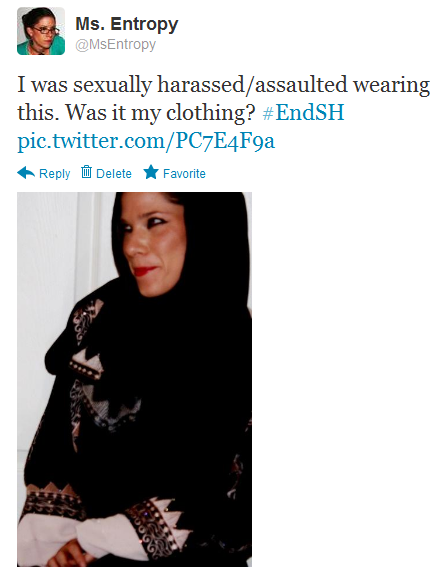
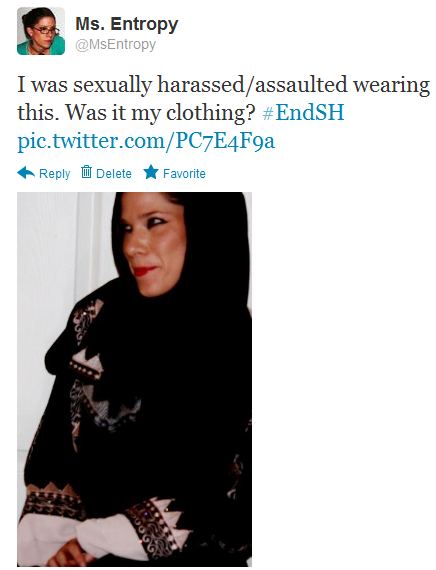
14. @MsEntropy I was sexually harassed/assaulted wearing this. Was it my clothing? #EndSH pic.twitter.com/5DcLNcD8

15. ‏@jessica_alice_ The #shoutingback hashtag documents the aggressive street harassment faced by women every single day. Reason #8124274 “why we need feminism”

Share

Filed Under: street harassment

Rape Culture is Global: Help Me Prove That, No—It Is Never What You Wear

January 13, 2013 By Contributor

By @MsEntropy

Lauren Wolfe, founder of the project Women Under Siege, issued a recent call to declare 2013 as the year to end rape.  The comments to her CNN post prove revealing—more than a decade into the twenty-first century, the discourse that facilitates rape culture is alive and well. Wolfe’s activism predates the horrific gang rape of Indian university student Jyoti Singh Pandey, but press coverage of the atrocity, and the debates it stimulated demonstrate that we—globally—have a long way to go.

Spiritual leader Asaram Bapu posthumously chastised the gang rape victim, Jyoti Singh Pandey, arguing that she should have grasped the hands of her attackers, called them “brother,” and begged them to salvage her “dignity.” A defense attorney for those accused in the Delhi attack, which resulted in the death of the young woman, recently declared that the victim was “wholly responsible” for her actions, as “respectable ladies” allegedly don’t get raped. In the wake of protests against this vicious assault, debates began spreading like wildfire about appropriate punishment, rape prevention and—stunningly—“culture” as an explanation.  The recent decision (to many, including myself, questionable) of Egyptian activist Alia al-Mahdy to ally herself with FEMEN has similarly provoked debates on “culture,” sexual mores, and additionally thrown back into the mix assumptions about an alleged linkage between clothing and harassment. Al-Mahdy first came to fame over a nude self-portrait posted on her blog; she later stood naked outside an Egyptian Embassy in Sweden to protest the Islamist nature of the proposed Constitution.  Egyptians debated whether or not al-Mahdi’s action merited stripping her of citizenship.

The horrific gang rape in Delhi, and the debates over Alia al-Mahdy’s alliance with FEMEN are not the only arenas in which rape culture, feminism and violence against women merit our attention.  For many Americans, we need to look at our own backyard just as much.  Remember Senate candidate Richard Murdock’s idea that pregnancy as a result of rape is a “gift from God?” What about Todd Akin’s inflammatory comments about “legitimate rape,” and his claim that women have a mysterious defense mechanism to “shut the whole thing down?” Georgia Representative (and obgyn) Phil Gingrey has appeared in a surreal, belated defense of Akin’s statements.

As a woman who has lived in the United States, France, Morocco, Algeria, Egypt and Tunisia—I am here to tell you: harassment is ubiquitous.  No—it does not matter what we wear. Manifestations of discrimination and sexual harassment may take a variety of forms, but the all-too often unacknowledged abuse of power dynamics does not.

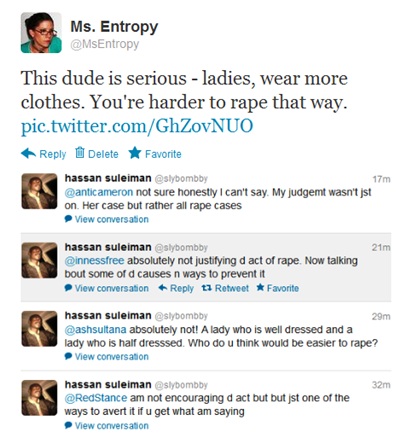
In light of all of these news stories, I decided to tackle one aspect to the discourse around rape culture, namely, the idea that what one wears matters in terms of drawing or repelling sexual assault and or harassment.  Although I usually use Twitter as a mechanism for commentary on Middle Eastern and North African political affairs, I was prompted to take on this aspect of rape apologism when I came across the following series of Tweets:

Twitter user @slyombby does not appear to be cognizant of the manner in which the “clothing” debate feeds into rape culture; in his mind, he is not passing “judgment,” but rather—discussing what he feels is a fact: that more clothes somehow means more protection from assault. This is, frankly, simply not the case.

In response, I posted a series of Tweets to my own account with the caption, “I was sexually harassed/assaulted wearing this. Was it my clothing? #EndSH.” The five pictures included a spectrum of clothing, worn in different countries, at different ages in my life—ranging from a baby photograph to a recently taken image:

To be fair, I received several heartening responses from both women and men.  Some eagerly took the idea that “clothing matters” to task; others seemed shocked at the question—and failed to detect the irony and sarcasm behind it.  However, responses such as the following firmly convinced me that we—women and men—urgently need to debunk the myths that sexual violence can be correlated with clothing, and that it is a phenomenon uniquely facing women:

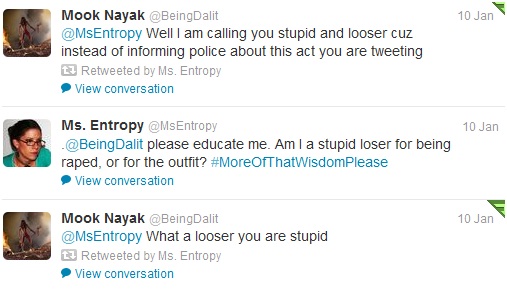
Twitter user @BeingDalit attacked me as a “stupid looser” [sic] for discussing my personal history, rather than going to the police (an assumption entirely of his own making).  He went on in a later exchange to accuse me of seeking attention, although how a mention of childhood sexual abuse fits into that, I’m not entirely clear. This accusation, however, does merit a brief analysis.

For both men and women who have encountered sexual violence and harassment, speaking out is a difficult action.  This is particularly the case for male victims, who are often far more reticent to relate their own experience of trauma.

I would like to call on others—critically, men and women—to post similar photos using the tagline, “I was sexually harassed/assaulted wearing this. Was it my clothing? #EndSH.” If you feel more comfortable blurring your face, do so.  I do, however, think contributions from both genders, in a variety of cultures and spanning the range of clothing choices can make a difference.  Refuse to take the shame of others as your own, and no—it is never, ever what you wear.

Share

Filed Under: street harassment Tagged With: clothes, rape, rape culture, victim blaming

India: Another gang rape on a bus

January 13, 2013 By HKearl

Trigger Warning

I woke up to the news that there was another gang-rape on a bus in India this weekend. A 29-year-old woman boarded a bus in the Gurdaspur district in Punjab. The bus driver and his helper waited until she was the only one left on the bus and then drove to a place where five other men joined them and they all violated and hurt her throughout the night.

“”They threatened me with a sharp edged weapon and did wrong things with me,” the victim told CNN‘s sister station, CNN-IBN. “They kept me confined all through the night and forced me to do what they want.”

The next day, the suspects dropped her off at her village, where she informed her family and alerted police, according to authorities.”

The police caught six of the seven men.

While it was amazing to see the tens of thousands of people march to protest the Delhi gang rape in December and it was encouraging to hear about all of the changes the police and government want to make to address gender violence, this incident is a clear reminder that these efforts are not enough. There must be a gender revolution, an end to women’s second-class citizenship, and also long-term, multilayer efforts to end gender violence.

I am sad. I am frustrated. I am outraged. How many more women must endure such violence, hate, and pain before this revolution happens?

My heart goes out to the 29-year-old woman. May she recover, heal, and still go on to live a happy life.

Share

Filed Under: News stories

“That was the point that I began to dislike…being in a crowd with men”

January 12, 2013 By Contributor

I was quite young, perhaps around 7 or 8 years old (not entirely sure). My parents and I had gone to a famous temple in South India (could have been Guruvayur, or possibly Tirupati). There were throngs of people in the temple, as it was during some festival or other. We were all waiting for the sanctum to be opened, I guess, and the moment the priests opened the doors, there was a great surge of people moving forward and I got separated from my parents by a middle-aged man wearing the garb of a devotee who came between me and them. He got his hand between my legs and squeezed painfully, all the while chanting the praise of God, pretending that he wasn’t doing what he was doing. I didn’t like it but I didn’t know why, and I couldn’t squirm away because I was hemmed in.

Finally I cried out for my dad, partly because I was afraid of being lost and partly because I thought it would make the man stop – and luckily it did. I didn’t tell my parents anything because I didn’t know how to express it, because I was afraid I’d done something wrong… even when I didn’t know what that wrong was. I think that was the point that I began to dislike going to the temple, and being in a crowd with men.

– Shammi Edwards

Location: South India


Share

Filed Under: Stories, street harassment

Resources for Talking with Boys about Gender Violence

January 11, 2013 By HKearl

Trigger Warning.

With the world still reeling from the brutal gang-rape and murder of the young woman in India by six men, and with the United States divided over the rape in Steubenville, Ohio, allegedly perpetrated by two high school football players and then laughed about by other male students, the time to talk to boys about being respectful and nonviolent is NOW.

In direct response to the Steubenville incident, Chris Menning, the Editor of ModernPrimate.com, created this passionate video about rape culture. He asks: “Is it possible that these boys didn’t question what they were doing because of the attitudes of their role models in school and society as a whole? Furthermore, can pre-emptively teaching them not to be creepy also teach them not to commit rape?”

I do think conversations about healthy masculinity and consent are important, as are conversations about entitlement (someone who is trying to look attractive isn’t necessarily doing it for YOU and if you see someone too drunk to talk coherently, it’s not your right to harm them) and how not to be a creeper. I also think the earlier adults have these conversations with boys the better.

Here are a just five examples of relevant programs and resources that parents, teachers, coaches, and other adults who work with youth or can be a good influence on them can use.

1. Men Can Stop Rape‘s youth development program, the Men of Strength Club, is the country’s premier primary violence prevention program for mobilizing young men to prevent sexual and dating violence.

2. The Futures Without Violence program Coaching Boys into Men (CBIM) provides men with a playbook/toolkit they can use to talk with boys about street harassment, domestic violence, and sexual violence.

3. The International Center for Research on Women (ICRW)’s Parivartan program teaches boys in India about healthy masculinity, respect for girls/women, and anti-violence through the unifying sport of cricket.

4. Roger’s Park Young Women’s Action Team compiled their work on addressing gender violence with boys in the Where Our Boys At? A Toolkit for Engaging Young Men as Allies to End Violence.

5. Jake Winn, a Peace Corps volunteer and a youth development facilitator in northern Azerbaijan helped his male students make an Anti-Street Harassment video. The title, “Ay Gardash! Kishi Ol!”, can be translated to, ‘Hey man, be a gentleman!” He also developed a companion lesson plan:  Street Harassment Lesson Plan (English) | Street Harassment Lesson Plan (Azerbaijani)

Share

Filed Under: male perspective, Resources

« Previous Page
Next Page »

Share Your Story

Share your street harassment story for the blog. Donate Now

From the Blog

  • #MeToo 2024 Study Released Today
  • Join International Anti-Street Harassment Week 2022
  • Giving Tuesday – Fund the Hotline
  • Thank You – International Anti-Street Harassment Week 2021
  • Share Your Story – Safecity and Catcalls Collaboration

Buy the Book

Search

Archives

  • September 2024
  • March 2022
  • November 2021
  • April 2021
  • March 2021
  • January 2021
  • April 2020
  • March 2020
  • February 2020
  • December 2019
  • November 2019
  • September 2019
  • August 2019
  • July 2019
  • June 2019
  • May 2019
  • April 2019
  • March 2019
  • February 2019
  • January 2019
  • December 2018
  • November 2018
  • October 2018
  • September 2018
  • August 2018
  • July 2018
  • June 2018
  • May 2018
  • April 2018
  • March 2018
  • February 2018
  • January 2018
  • December 2017
  • November 2017
  • October 2017
  • September 2017
  • August 2017
  • July 2017
  • June 2017
  • May 2017
  • April 2017
  • March 2017
  • February 2017
  • January 2017
  • December 2016
  • November 2016
  • October 2016
  • September 2016
  • August 2016
  • July 2016
  • June 2016
  • May 2016
  • April 2016
  • March 2016
  • February 2016
  • January 2016
  • December 2015
  • November 2015
  • October 2015
  • September 2015
  • August 2015
  • July 2015
  • June 2015
  • May 2015
  • April 2015
  • March 2015
  • February 2015
  • January 2015
  • December 2014
  • November 2014
  • October 2014
  • September 2014
  • August 2014
  • July 2014
  • June 2014
  • May 2014
  • April 2014
  • March 2014
  • February 2014
  • January 2014
  • December 2013
  • November 2013
  • October 2013
  • September 2013
  • August 2013
  • July 2013
  • June 2013
  • May 2013
  • April 2013
  • March 2013
  • February 2013
  • January 2013
  • December 2012
  • November 2012
  • October 2012
  • September 2012
  • August 2012
  • July 2012
  • June 2012
  • May 2012
  • April 2012
  • March 2012
  • February 2012
  • January 2012
  • December 2011
  • November 2011
  • October 2011
  • September 2011
  • August 2011
  • July 2011
  • June 2011
  • May 2011
  • April 2011
  • March 2011
  • February 2011
  • January 2011
  • December 2010
  • November 2010
  • October 2010
  • September 2010
  • August 2010
  • July 2010
  • June 2010
  • May 2010
  • April 2010
  • March 2010
  • February 2010
  • January 2010
  • December 2009
  • November 2009
  • October 2009
  • September 2009
  • August 2009
  • July 2009
  • June 2009
  • May 2009
  • April 2009
  • March 2009
  • February 2009
  • January 2009
  • December 2008
  • November 2008
  • October 2008
  • September 2008
  • August 2008
  • July 2008
  • June 2008
  • May 2008

Comment Policy

SSH will not publish any comment that is offensive or hateful and does not add to a thoughtful discussion of street harassment. Racism, homophobia, transphobia, disabalism, classism, and sexism will not be tolerated. Disclaimer: SSH may use any stories submitted to the blog in future scholarly publications on street harassment.
  • Contact
  • Events
  • Join Us
  • Donate
  • Facebook
  • Instagram
  • Pinterest
  • Tumblr
  • Twitter
  • YouTube

Copyright © 2026 Stop Street Harassment · Website Design by Sarah Marie Lacy