• About Us
    • What Is Street Harassment?
    • Why Stopping Street Harassment Matters
    • Meet the Team
      • Board of Directors
      • Past Board Members
    • In The Media
  • Our Work
    • National Street Harassment Hotline
    • International Anti-Street Harassment Week
    • Blog Correspondents
      • Past SSH Correspondents
    • Safe Public Spaces Mentoring Program
    • Publications
    • National Studies
    • Campaigns against Companies
    • Washington, D.C. Activism
  • Our Books
  • Donate
  • Store

Stop Street Harassment

Making Public Spaces Safe and Welcoming

  • Facebook
  • Instagram
  • Pinterest
  • Tumblr
  • Twitter
  • YouTube
  • Home
  • Blog
    • Harassment Stories
    • Blog Correspondents
    • Street Respect Stories
  • Help & Advice
    • National Street Harassment Hotline
    • Dealing With Harassers
      • Assertive Responses
      • Reporting Harassers
      • Bystander Responses
      • Creative Responses
    • What to Do Before or After Harassment
    • Street Harassment and the Law
  • Resources
    • Definitions
    • Statistics
    • Articles & Books
    • Anti-Harassment Groups & Campaigns
    • Male Allies
      • Educating Boys & Men
      • How to Talk to Women
      • Bystander Tips
    • Video Clips
    • Images & Flyers
  • Take Community Action
  • Contact

I Need Feminism Because My Sister Shouldn’t Have To Experience Street Harassment

December 11, 2012 By Contributor

This article is written by high school student Livia Brock who is taught by @FeministTeacher. It is cross-posted with permission from the class blog F to the Third Power.

I need feminism because my little sister should have the same amount of confidence in + respect for herself as I do for her! (photo credit: Ileana Jiménez)

The other day I was walking down the street with two of my friends.  I had fallen slightly behind them when an older man walking towards us suddenly locked eyes with me.  I looked away quickly, but he angled toward me, eyes full of something very creepy and unnerving, and asked, “Are you free for a date?”

Being polite, I said, “No thanks!” and ran to catch up to my friends.  I looked back once and caught him staring at me, eyes still full of that same disconcerting energy.

I began to notice men paying attention to me when I was twelve, near the beginning of seventh grade.  I still looked pretty young, but I was very tall, so maybe men thought I was older.  Or perhaps my actual age was not an issue.  I didn’t particularly mind being looked at.  It made me feel noticed. These men weren’t being vulgar, and they did not make comments or make me feel uncomfortable.  But it wasn’t until I got a little older, maybe around thirteen, that I started to receive a lot of attention.

Thirteen was really the year I started walking around and going on the subway by myself.  This was when the looks turned into much more. Men began saying passing remarks like, “So beautiful,” “Hey baby girl,” and once simply, “Nice tits.”  I wasn’t sure how to react to a lot of these.  Not all were rude, and sometimes I didn’t take much notice. Sometimes I enjoyed the comments.

Enjoying this kind of attention from men is often the case for girls without a strong support system at home, or for those girls who feel unwanted or undesired. As Rachel Lloyd, founder of the organization GEMS writes in her memoir, Girls Like Us, “She was uncomfortable with her body and her appearance . . . and she carried that knowledge with her like a weight that she desperately wanted to put down.  Attention from boys, or men, always helped ease that weight a little.”

Although Lloyd writes about girls who have been commercially exploited, even girls who have not been commercially exploited succumb to the attention of boys and men. These girls are often sucked into a relationship or a situation that is not healthy due to their desire for attention from men.  For example, sometimes I liked getting attention from these men because it made me feel like I was wanted and special.

Certain ones, though, made me extremely uncomfortable, and stick out in my mind.  There was one time when two obviously drunk men asked me if I wanted to come home with them.  Another time, an older man groped me on the subway, and I ended up being late to school because I was so uncomfortable, I got off the train for a while.  Then there was the time a homeless man at church tried to kiss me.  Another time, two men on the sidewalk called across the street at me, asking “how much” I was for an hour.

During all of these instances, I was dressed very much like a kid with bell-bottom jeans, a bright pink shirt, long thick coat, and sneakers.

Image

An Anti-Street Harassment Advertisement

Until I took this feminism course at my high school taught by my teacher Ileana Jiménez, I never realized how not ok all of this was and how much it was hurting me.  I had the attitude that no matter what we do, the way these men act will never change. At the same time, I had internalized the message that I was merely a sex object for these men and that it was somehow a good thing that they noticed me for my body.

I always assumed that in some way it was my fault for walking a certain way, looking men in the eyes, or wearing certain clothing.  After taking this course, I realize how fundamentally sexist this attention I was getting and my attitude towards it was.

The fact that these men felt they were allowed to make comments about my body is wrong.

The fact that these men felt it was all right to treat me as a sexual object, to touch me or ask me if I wanted to come home with them is wrong.

I never felt frightened to walk down the street, only resigned to what I expected to happen, which is perhaps the worst approach to street harassment. As Rebecca Walker writes in her essay, “Becoming the Third Wave,” “the ultimate rally of support for the male paradigm of harassment, sends a clear message to women: ‘Shut up! Even if you speak, we will not listen.’  I will not be silenced.  I acknowledge the fact that we live under siege. I intend to fight back. I have uncovered and unleashed more repressed anger than I thought possible. For the umpteenth time in my 22 years, I have been radicalized, politicized, shaken awake.”

My sister is fourteen years old.  She looks younger than I did at her age, but as I said before, I’m not sure how much age matters to these men.  I hope that she has never experienced anything along the lines of what I have experienced.  Even before I took this feminism class, I knew I wanted my sister to attend my high school.  I knew that she would be taught things she would not have been taught at any other school.

I know that my teacher, Ileana Jiménez, has been involved with the anti-street harassment movement including work with Hollaback! and with Holly Kearl’s Stop Street Harassment blog and activism. My teacher has also written about street harassment on her blog.  These are the sorts of things that should be taught to young men and women in all schools.

I hope my sister realizes that even the “positive” comments like “So beautiful,” are a way of putting women down.  They are a way of making women into sexual beings, with a complete disregard for personality and accomplishments. I am not telling her to engage in an argument with every man who says something to her on the street.  I just want her to understand, in a way that I didn’t at her age, that these comments are part of a systemic problem of sexism and misogyny.

It is not just some random uneducated man on the street, but a society that feels it is ok to hyper-sexualize women and make them feel less important by only focusing on their physical traits.  My sister is already much more sensible now than I have ever been, so I have faith that it will take her much less time than it did for me to realize how much there needs to be done to protect and empower ourselves and all other girls.

As Audre Lorde writes in her essay, “The Master’s Tools Will Never Dismantle The Master’s House,”: “Interdependency between women is the way to a freedom which allows the I to be, not in order to be used, but in order to be creative. This is a difference between the passive be and the active being.”

Share

Filed Under: street harassment Tagged With: feminist teacher, GEMS, girls like us, high school, Ileana Jiménez, New York City, rachel lloyd, sister, street harassment

“…what can you do? But FACE IT”

December 11, 2012 By HKearl

The Blog Shakesville posted this 1972 comic strip yesterday, writing,

“…what strikes me more than anything is this: how little has changed in the United States, despite 40 years of feminist protest against street harassment. It’s still ubiquitous. It’s still a barrier to full participation in public life. There are still no good options. And it’s still one of those things we’re just supposed to put up with, like wind or rain.”

While street harassment itself is the same, what has changed is how all of us are able to connect and support each other and speak out globally, thanks to the Internet! I believe that in 40 more years, this issue will be gone, or nearly gone.
Share

Filed Under: SH History

16 Days: Day 16, Egypt

December 10, 2012 By HKearl

During the 16 Days of Activism Against Gender Violence (Nov. 25 – Dec. 10), Stop Street Harassment is featuring activists who took action against street harassment this year, one new country per day.

Photo courtesy of Emad Karim.

Day #16: Egypt

From creating human chains and organizing rallies to protest street sexual violence, to organizing volunteers to speak to community members about the issue, to advocating for stronger anti-harassment laws, to creating volunteer anti-harassment patrols, activists in Egypt have been BUSY this year!

This summer, I traveled to Egypt and met with many of these activists, especially from HarassMap, and participated in some of their work. It was inspiring.

To better understand the issue and what activists there are fighting, watch this powerful (but possibly triggering) segment from Unreported World, released on Friday. To know that men are paid to sexually assault women who are participating in the political process by protesting is horrific, but I gain courage from their courage as they fight and speak out despite this grim truth.

Share

Filed Under: 16 days Tagged With: 16 days, Egypt, HarassMap, sexual harassment

Our Streets, Our Rights

December 10, 2012 By HKearl

I was recently contacted by a woman who almost dropped out of her PhD program. Why did she consider doing this? Because of the trauma and stress she felt after a group of men harassed her several times and then retaliated against her when she told them to stop. With some support, she has decided to stay at her program.
But I am still MAD she even felt she had to consider switching programs just because of some jerks on the street.

Street harassment is too often dismissed as being a joke, a compliment or no big deal, but it’s actually a human rights violation precisely because it does make us feel unsafe and to be safe, we feel like we have no other choice but to move, change jobs, switch schools, pick different routes or routines, quit hobbies, and stop shopping at local stores.

No country has achieved gender equality and no country ever will as long as we are unsafe in public spaces simply because we are or present as or are mistaken for being female.

Today is Human Rights Day and it is time for street harassment to be recognized as a human rights issue! It’s time for our government leaders, educators, law enforcement officials, and regular citizens to work in tandem to prevent street harassment.

It’s also time for us to each do our part. Speak out. Take community action. And safe the date to participate in Meet Us on the Street: International Anti-Street Harassment Week during April 7-13, 2013!

These are our streets, too.

Share

Filed Under: street harassment Tagged With: human rights day

3 Ways to Fight Street Harassment in December

December 9, 2012 By HKearl

Dear Friends,

Thank you for everything you’ve done this year to make public places safer for everyone. You’re making a difference.

With the holiday season upon us, I wanted to share three ways you can continue to fight street harassment…while also taking care of some of your holiday shopping!

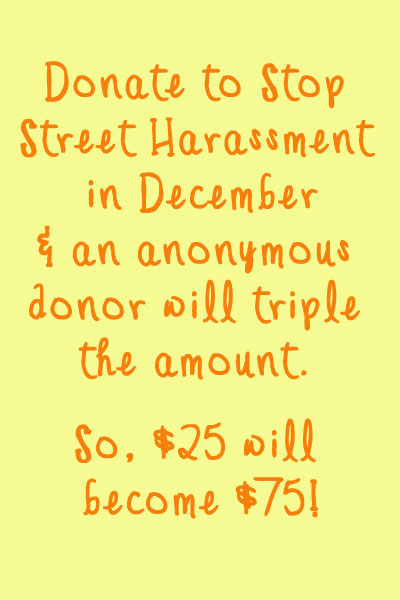
And if you’re doing end-of-the-year-giving, please consider making a tax-deductible donation to Stop Street Harassment. An anonymous donor will TRIPLE all donations made this month.

Thank you & happy holidays,
Holly Kearl, Stop Street Harassment Founder

1. Donate

Make a tax-deductible donation to Stop Street Harassment in honor of someone you care about, to thank them for speaking out against street harassment or because you want to help create a world where they are not harassed in public spaces.

Your donations can help make my 2013 to-do list possible, including helping me launch a hotline and support group for survivors of street harassment. Added incentive: this month only, an anonymous donor will TRIPLE all donations made to Stop Street Harassment!

2. Buy a Book

Help your loved ones and friends become more informed and empowered on the topic of street harassment and buy them a copy of Stop Street Harassment: Making Public Places Safe and Welcoming for Women. It’s in paperback (finally!) for the affordable price of $15. It’s also available as an e-book.

Additionally, one of my favorite books on the subject is Hey Shorty! A Guide to Combating Sexual Harassment and Violence in Schools and on the Streets, and it’s available in paperback for only $9.

3. Purchase SSH Swag

Changing the social acceptability of street harassment is an important way to help end it. Let your loved ones and friends make a public statement about stopping street harassment and purchase Stop Street Harassment pins, stickers, tote bags, mugs, bumper stickers, and more for them.

Earlier this year, my mother wore a SSH sticker when she was shopping after a rally. A group of men looked like they were going to harass her, but then noticed her sticker and backed off!! No joke.

Share

Filed Under: Resources, street harassment

« Previous Page
Next Page »

Share Your Story

Share your street harassment story for the blog. Donate Now

From the Blog

  • #MeToo 2024 Study Released Today
  • Join International Anti-Street Harassment Week 2022
  • Giving Tuesday – Fund the Hotline
  • Thank You – International Anti-Street Harassment Week 2021
  • Share Your Story – Safecity and Catcalls Collaboration

Buy the Book

Search

Archives

  • September 2024
  • March 2022
  • November 2021
  • April 2021
  • March 2021
  • January 2021
  • April 2020
  • March 2020
  • February 2020
  • December 2019
  • November 2019
  • September 2019
  • August 2019
  • July 2019
  • June 2019
  • May 2019
  • April 2019
  • March 2019
  • February 2019
  • January 2019
  • December 2018
  • November 2018
  • October 2018
  • September 2018
  • August 2018
  • July 2018
  • June 2018
  • May 2018
  • April 2018
  • March 2018
  • February 2018
  • January 2018
  • December 2017
  • November 2017
  • October 2017
  • September 2017
  • August 2017
  • July 2017
  • June 2017
  • May 2017
  • April 2017
  • March 2017
  • February 2017
  • January 2017
  • December 2016
  • November 2016
  • October 2016
  • September 2016
  • August 2016
  • July 2016
  • June 2016
  • May 2016
  • April 2016
  • March 2016
  • February 2016
  • January 2016
  • December 2015
  • November 2015
  • October 2015
  • September 2015
  • August 2015
  • July 2015
  • June 2015
  • May 2015
  • April 2015
  • March 2015
  • February 2015
  • January 2015
  • December 2014
  • November 2014
  • October 2014
  • September 2014
  • August 2014
  • July 2014
  • June 2014
  • May 2014
  • April 2014
  • March 2014
  • February 2014
  • January 2014
  • December 2013
  • November 2013
  • October 2013
  • September 2013
  • August 2013
  • July 2013
  • June 2013
  • May 2013
  • April 2013
  • March 2013
  • February 2013
  • January 2013
  • December 2012
  • November 2012
  • October 2012
  • September 2012
  • August 2012
  • July 2012
  • June 2012
  • May 2012
  • April 2012
  • March 2012
  • February 2012
  • January 2012
  • December 2011
  • November 2011
  • October 2011
  • September 2011
  • August 2011
  • July 2011
  • June 2011
  • May 2011
  • April 2011
  • March 2011
  • February 2011
  • January 2011
  • December 2010
  • November 2010
  • October 2010
  • September 2010
  • August 2010
  • July 2010
  • June 2010
  • May 2010
  • April 2010
  • March 2010
  • February 2010
  • January 2010
  • December 2009
  • November 2009
  • October 2009
  • September 2009
  • August 2009
  • July 2009
  • June 2009
  • May 2009
  • April 2009
  • March 2009
  • February 2009
  • January 2009
  • December 2008
  • November 2008
  • October 2008
  • September 2008
  • August 2008
  • July 2008
  • June 2008
  • May 2008

Comment Policy

SSH will not publish any comment that is offensive or hateful and does not add to a thoughtful discussion of street harassment. Racism, homophobia, transphobia, disabalism, classism, and sexism will not be tolerated. Disclaimer: SSH may use any stories submitted to the blog in future scholarly publications on street harassment.
  • Contact
  • Events
  • Join Us
  • Donate
  • Facebook
  • Instagram
  • Pinterest
  • Tumblr
  • Twitter
  • YouTube

Copyright © 2026 Stop Street Harassment · Website Design by Sarah Marie Lacy