• About Us
    • What Is Street Harassment?
    • Why Stopping Street Harassment Matters
    • Meet the Team
      • Board of Directors
      • Past Board Members
    • In The Media
  • Our Work
    • National Street Harassment Hotline
    • International Anti-Street Harassment Week
    • Blog Correspondents
      • Past SSH Correspondents
    • Safe Public Spaces Mentoring Program
    • Publications
    • National Studies
    • Campaigns against Companies
    • Washington, D.C. Activism
  • Our Books
  • Donate
  • Store

Stop Street Harassment

Making Public Spaces Safe and Welcoming

  • Facebook
  • Instagram
  • Pinterest
  • Tumblr
  • Twitter
  • YouTube
  • Home
  • Blog
    • Harassment Stories
    • Blog Correspondents
    • Street Respect Stories
  • Help & Advice
    • National Street Harassment Hotline
    • Dealing With Harassers
      • Assertive Responses
      • Reporting Harassers
      • Bystander Responses
      • Creative Responses
    • What to Do Before or After Harassment
    • Street Harassment and the Law
  • Resources
    • Definitions
    • Statistics
    • Articles & Books
    • Anti-Harassment Groups & Campaigns
    • Male Allies
      • Educating Boys & Men
      • How to Talk to Women
      • Bystander Tips
    • Video Clips
    • Images & Flyers
  • Take Community Action
  • Contact

What about equality in public spaces?

August 26, 2009 By HKearl

Today is Women’s Equality Day, a time not only to celebrate the gains we have for which our foremothers fought, but also a time to reflect on all of the areas where women continue to lack equality, including in public spaces.

Men who harass and assault women in public spaces – consciously or unconsciously – disrespect women. Their actions exhibit their belief that they have the right to interrupt women’s privacy, demand their attention, and sexualize, insult, humiliate, and hurt them whenever they want. These men generally do not care how their actions make women feel at the time nor do men on a whole understand or care about the many ways the fear or experience of harassment and assault limits women’s movement and feelings of comfort in public spaces.

Women are approached and harassed by men in all contexts, including when they are: commuting to work and school, on business trips and sightseeing in new places, doing errands or going to the club, and as they walk their dog or exercise. They are harassed by men when they are on foot, in a car, riding public transportation, waiting for public transportation, and even as they garden or stand in their own front yard. They are never completely free from the chance that someone will harass them, no matter their age, sexual orientation, race, class, or body type.

In lieu of laws or societal outrage and action over this sad reality, women take it upon themselves to try to stay safe, and in the process, often end up curtailing their public lives and access to public spaces. For example, some women avoid going in public places alone and many avoid going alone after dark or in an unfamiliar area to avoid assault.  This may mean they miss out on night classes, working extra shifts, or attending networking events.

Other ways women alter their lives to try to avoid being harassed include: taking alternate routes to their destination, mixing up their routine so they do not become predictable, paying for a taxi or driving a car rather than walking or relying on public transportation, wearing baggier and less flattering clothing, and wearing specific facial expressions (assertive, scowling).

To avoid upsetting men who relentlessly get in their space, women may pretend they have boyfriends or husbands (even if they are lesbian), make up fake phone numbers, turn up their ipod, and pretend to talk on the phone.

Women constantly have to be prepared for men to approach them in public and they instantly have to decide how to respond: will they ignore them, will they stand up to them, or will they try to humor and appease them.  All options have risks and a woman is never assured that she will be completely safe.   This reality is a huge setback in the trajectory toward gender equality.

All over the country and world, there are activists speaking out against and working to end gender-based harassment and assault in public spaces. Their voices are strong and their actions laudable, but they are few in number.  We need more activists and, most importantly, we need a widespread, coordinated, and concerted effort to end street harassment.

We must all do our part to make sure women and girls are safe and welcome in public spaces, and one day when they are (I’ll be an idealistic dreamer for a moment), only then will we be able to say women have made great strides toward achieving full equality.

Share

Filed Under: street harassment Tagged With: catcalling, equity, public space, street harassment, women's equality day, women's rights

Alternative use for scissors

August 24, 2009 By Contributor

Once when I was about 15 years old I was riding the subway when a man with an obvious erection weaved his way through the crowded car to stand directly in front of my friend and myself and proceeded to masturbate. As I was in the custom of carrying around a sharp pair of scissors, I pulled it out and stared at him as icily as possible until he retreated to a seat on the other side of the car.
– anonymous

Share your street harassment story today and help raise awareness about the problem. Include your location and it will be added to the Street Harassment Map.

Share

Filed Under: Stories Tagged With: masturbator, scissors, sexual harassment, street harasment, subway

Rape Culture

August 23, 2009 By HKearl

Check out this new youth-made documentary by Hard Cover, a television program in Chicago that is completely created and produced by teens, called “Our Hidden Culture” about “rape culture,” including how and why rape persists in American society, statistics about how many people are raped, and the impact rape has on survivors.

The video opens with a tie to street harassment, which I find timely as today for my book I’ve been writing about how the fear of rape complicates and informs the way many women feel in public spaces, particularly when they see or are harassed by a man in an isolated area.

While most rapists (73%) know their victim, the other 27% don’t, and this fact combined with the widespread socialization of women to fear stranger rape, causes a lot of fear among women.

In their study The Female Fear: The Social Cost of Rape, published in 1991, Margaret T. Gordon and Stephanie Riger found that one-third of the women they studied worry at least once a month about being raped. Many said they worry daily about that possibility. A third of the women said that their fear of rape is ‘part of the background’ of their lives and ‘one of those things that’s always there.’ Another third claimed they never worried about rape but still reported taking precautions, unconsciously or consciously, to try to avoid being raped.

In every street harassment study I’ve read, the majority of the women said the fear of rape greatly impacted their street harassment experiences. Does it impact yours?

Share

Filed Under: Resources, street harassment Tagged With: chicago, consent, hard cover, rape culture, rapists, sexual assault, street harassment, television program

Pioneer Motors Street Harassers

August 22, 2009 By Contributor

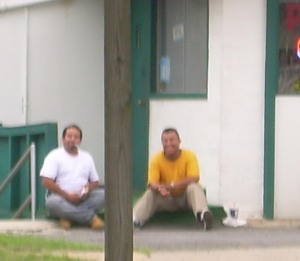
diennastreetharassersaug09I was in Arlington, VA, last Wednesday, and while walking down Lee Highway two men who were sitting across the street in front of Pioneer Motors wolf whistled at me. When I turned to look at them they started smiling and waving. I was furious.

“No! Do you see me smiling? That’s not cute, that’s tacky! Don’t do that to me or any other woman who walks by again!”

When I pulled out my camera (from a safe distance across the street) they got quieter than it’s kept and the grins were wiped off their faces. I didn’t have the energy to report them to their employers (I deal with this nonsense too often), but I feel my yelling at them was enough.

-Anonymous

Location: Across the street from Pioneer Motors, 2510 Lee Highway, Arlington, VA

Share your street harassment story today and help raise awareness about the problem. Include your location and it will be added to the Street Harassment Map.

Share

Filed Under: Stories, street harassment Tagged With: arlington, catcalling, lee highway, pioneer motors, street harassment, va, wolf whistle

Denied Peace of Mind

August 20, 2009 By HKearl

I’m skipping work for a few days to write a few chapters of my street harassment book. Near the hotel where I’m staying (to flee distractions), there is a beautiful trail alongside the Potomac River and before buckling down to write yesterday and today I went for a run on it. Having never run there before though, I ran with my phone and kept alert and I ran in a different direction each day. I quickly found out that the trail was isolated, deserted, and mostly far from any roads, buildings, or even people. The beauty of the scenery was dimmed by my hyper awareness of every unusual sound and nervousness when I passed by a few lone men because of the isolation. No one harassed or attacked me but, as any woman who is out alone in a deserted area knows, there is rarely relief from the fear that one day you’ll be the wrong woman in the wrong place at the wrong time.

This afternoon, after more than six hours of writing and a self-imposed internet ban, I came online to do a bit more research for the chapter I’m writing. When I also checked e-mail, I saw a friend had sent me a relevant link to an article in the Phildalphia Daily News called “Staying safe on the run” about the harassment and risk of assault women runners, including the article author, regularly face. She shares a recent story about being harassed while on a run and then highlights some of the women who have been in the news recently because they were abducted or assualted while running.

Ugh. As a runner, I have had men honk and whistle and make kissing noises at me, some have said sexually explicit comments, and two men followed me on two separate occasions, one by car and another on foot. As precautions against assault, I rarely run with music, I mix up my routes and the time of day I run so I don’t become predictable, I don’t run in the dark, and if I am running somewhere new, I usually run with my phone. Sometimes I wish I was a man because that would make being a runner so much easier.

Aside from my own experiences and those detailed in the Philly article, in the last few months I’ve reported on a female runner being attacked in New York, followed in Delaware, and murdered in Vancouver. I plan to address the particular issues that face women runners – and walkers and cyclists – in my book in a chapter that details ways women alter their lives because of actual or feared harassment.

Wouldn’t it be nice if men never harassed or assaulted women? Then we could run in peace and with peace of mind.

Share

Filed Under: News stories Tagged With: attack, philadelphia, rape, safety, sexual assault, street harassment, women runners

« Previous Page
Next Page »

Share Your Story

Share your street harassment story for the blog. Donate Now

From the Blog

  • #MeToo 2024 Study Released Today
  • Join International Anti-Street Harassment Week 2022
  • Giving Tuesday – Fund the Hotline
  • Thank You – International Anti-Street Harassment Week 2021
  • Share Your Story – Safecity and Catcalls Collaboration

Buy the Book

Search

Archives

  • September 2024
  • March 2022
  • November 2021
  • April 2021
  • March 2021
  • January 2021
  • April 2020
  • March 2020
  • February 2020
  • December 2019
  • November 2019
  • September 2019
  • August 2019
  • July 2019
  • June 2019
  • May 2019
  • April 2019
  • March 2019
  • February 2019
  • January 2019
  • December 2018
  • November 2018
  • October 2018
  • September 2018
  • August 2018
  • July 2018
  • June 2018
  • May 2018
  • April 2018
  • March 2018
  • February 2018
  • January 2018
  • December 2017
  • November 2017
  • October 2017
  • September 2017
  • August 2017
  • July 2017
  • June 2017
  • May 2017
  • April 2017
  • March 2017
  • February 2017
  • January 2017
  • December 2016
  • November 2016
  • October 2016
  • September 2016
  • August 2016
  • July 2016
  • June 2016
  • May 2016
  • April 2016
  • March 2016
  • February 2016
  • January 2016
  • December 2015
  • November 2015
  • October 2015
  • September 2015
  • August 2015
  • July 2015
  • June 2015
  • May 2015
  • April 2015
  • March 2015
  • February 2015
  • January 2015
  • December 2014
  • November 2014
  • October 2014
  • September 2014
  • August 2014
  • July 2014
  • June 2014
  • May 2014
  • April 2014
  • March 2014
  • February 2014
  • January 2014
  • December 2013
  • November 2013
  • October 2013
  • September 2013
  • August 2013
  • July 2013
  • June 2013
  • May 2013
  • April 2013
  • March 2013
  • February 2013
  • January 2013
  • December 2012
  • November 2012
  • October 2012
  • September 2012
  • August 2012
  • July 2012
  • June 2012
  • May 2012
  • April 2012
  • March 2012
  • February 2012
  • January 2012
  • December 2011
  • November 2011
  • October 2011
  • September 2011
  • August 2011
  • July 2011
  • June 2011
  • May 2011
  • April 2011
  • March 2011
  • February 2011
  • January 2011
  • December 2010
  • November 2010
  • October 2010
  • September 2010
  • August 2010
  • July 2010
  • June 2010
  • May 2010
  • April 2010
  • March 2010
  • February 2010
  • January 2010
  • December 2009
  • November 2009
  • October 2009
  • September 2009
  • August 2009
  • July 2009
  • June 2009
  • May 2009
  • April 2009
  • March 2009
  • February 2009
  • January 2009
  • December 2008
  • November 2008
  • October 2008
  • September 2008
  • August 2008
  • July 2008
  • June 2008
  • May 2008

Comment Policy

SSH will not publish any comment that is offensive or hateful and does not add to a thoughtful discussion of street harassment. Racism, homophobia, transphobia, disabalism, classism, and sexism will not be tolerated. Disclaimer: SSH may use any stories submitted to the blog in future scholarly publications on street harassment.
  • Contact
  • Events
  • Join Us
  • Donate
  • Facebook
  • Instagram
  • Pinterest
  • Tumblr
  • Twitter
  • YouTube

Copyright © 2026 Stop Street Harassment · Website Design by Sarah Marie Lacy