• About Us
    • What Is Street Harassment?
    • Why Stopping Street Harassment Matters
    • Meet the Team
      • Board of Directors
      • Past Board Members
    • In The Media
  • Our Work
    • National Street Harassment Hotline
    • International Anti-Street Harassment Week
    • Blog Correspondents
      • Past SSH Correspondents
    • Safe Public Spaces Mentoring Program
    • Publications
    • National Studies
    • Campaigns against Companies
    • Washington, D.C. Activism
  • Our Books
  • Donate
  • Store

Stop Street Harassment

Making Public Spaces Safe and Welcoming

  • Facebook
  • Instagram
  • Pinterest
  • Tumblr
  • Twitter
  • YouTube
  • Home
  • Blog
    • Harassment Stories
    • Blog Correspondents
    • Street Respect Stories
  • Help & Advice
    • National Street Harassment Hotline
    • Dealing With Harassers
      • Assertive Responses
      • Reporting Harassers
      • Bystander Responses
      • Creative Responses
    • What to Do Before or After Harassment
    • Street Harassment and the Law
  • Resources
    • Definitions
    • Statistics
    • Articles & Books
    • Anti-Harassment Groups & Campaigns
    • Male Allies
      • Educating Boys & Men
      • How to Talk to Women
      • Bystander Tips
    • Video Clips
    • Images & Flyers
  • Take Community Action
  • Contact

Romania: A Letter to All Men

February 14, 2017 By HKearl

Simona-Maria Chirciu, Bucharest, Romania, SSH Blog Correspondent

Dear men, if you are reading this, good for you and thank you for your interest.

This is a short letter, so don’t worry. I will not eat up your time, but I hope you will find something interesting here and you will take it with you and share it. Yes, I am a feminist. And I don’t hate men. So you are safe, because this article doesn’t blame men.

“Hey, sexy”, “Damn! What an ass!”, “Can I lick your boobs?” – These are examples of catcalls, but more important than this, they represent a manifestation of male power towards women in the public spaces.

Power relations exist within intimate relationship but not there alone. They exist also in public spaces in the form of street harassment, rape, etc. This means, YOU can stop street harassment, you can stop rape, you can stop domestic violence — or you can be a part of the problem if you don’t take an active stand against it. Here is information about this:

  1. Street harassment includes a lot of behaviors (from excessive staring or honking to public masturbation or following). You have to keep in mind that if your behavior makes a woman feeling anxious, angry or unsafe, then it is harassment and you should stop it.
  2. Street harassment doesn’t happens just on the street, but also in any public spaces, like parks, stores, buses, trains, the beach, taxis etc. Really, in any spaces that are open for people.
  3. Men and all LGBT folks are harassed in public spaces too. But women and LGBT are the ones that are the mainly targets and the most vulnerable.
  4. Street harassment is not about flirting or sexual attraction. If you are attracted to a woman even though she is passing by and you can barely notice her in two seconds, you should not disrespect her by saying sexist words to her or looking at her like she is a sexual object just because you feel soooo attracted to her. Your feelings (or hormones) don’t excuse this behavior.
  5. A) Street harassment is a form of gender-based violence. Keep this in mind! B) Street harassment is a violation of human rights. Keep this also in mind!
  6. Women fear that street harassment may escalate into rape, physical violence or even murder.
  7. Talk to women in your life and ask them if they feel safe in public spaces, if they fear rape or violence from stranger men.
  8. Mass-media gets it all wrong! Sexual objectification of women in advertising and movies affects us negatively. When men see women as sexual objects they tend to think that women are inferior to them and sexual violence is not such a big deal and that women enjoy harassment, violent sex and physical violence.
  9. Gender roles are wrong! Remember what you’ve learned is school about gender roles (example: what the mother does (the cooking) and what the father does (reading the newspaper)). As a PhD student I’ve conducted research regarding street harassment in Romania and when it comes to how the respondents (men and women) see the concept of masculinity or to be a man and the concept of femininity or to be a woman, they strongly associate men with power and intelligence and women with elegance and taking care of children and the husband. This is not fair, right? The normative form of masculinity or what it means to “be a man” is important in any patriarchal society. In commercials, in movies and in our school books we see what a man looks like and we grow up with the idea that a man is everything that a woman isn’t. This is so wrong. The results about what masculinity and femininity mean to my respondents (144 men and 1793 women) are astounding and do confirm the theories on how gender roles make us to fall into two categories when it comes to street harassment: the targets (women) and, on the other side, the perpetrators (men). Gender role socialization make us all, regarding our gender, feel and act like we are very different from each other. But in fact we aren’t.
  1. Street harassment is about power. The consent of the woman has zero importance to the harasser in the interaction. The harasser starts the interaction and only feels that he has the power to decide when and how to end it. The expression of heteronormative masculinity in public spaces seems a must for men that want to be considered like “real men” by exerting power on the ones they perceive being vulnerable and having lower value as human beings (women, LGBT folks).
  2. You have to address and fight rape culture. The victims aren’t the ones to blame. Ever! When you hear “she was wearing a short skirt! She is the one responsible!”; “Boys will be boys” etc. use your voice and break down rape and street harassment myths.
  3. You always can talk to stranger women in a kindly manner. If you have respect and good intentions and you see that the woman doesn’t feel uncomfortable, then you can be pretty sure that your action is not harassment.

~ ~ ~ ~ ~ ~ ~ ~ ~ ~ ~  ~ ~ ~ ~ ~ ~ ~ ~ ~ ~ ~ ~ ~ ~ ~

If you are a man harassed in public spaces – Don’t feel ashamed because nothing is wrong with you and you can try to fight this back, alone or with people that are also targets of street harassment.

If you think you harassed stranger women in public spaces – Next time when you want to do this, please think that women deserve your respect and the right to move freely and to be safe in the public spaces, without fear of harassment. You don’t have any right to treat them badly.

If you are a bystander, next time be an upstander! Act and react against street harassers! Men are looking to other men for role models. Be that role model!

If you are an ally, congrats! We need you.

And don’t forget that we together have the power to end this! The power to react, to answer back, to fight this abuse and to build safe spaces for us all.

Simona-Marie is a Ph.D. Student in Political Sciences, working on a thesis on gender-based street harassment in Romania. She is an activist and organizes numerous public actions (marches, flash-mobs, protests) against sexual violence and street harassment against women. Now she is part of an working-group trying to improve by public policies the situation of young homeless people in Romania. You can find her on Facebook.

Share

Filed Under: correspondents

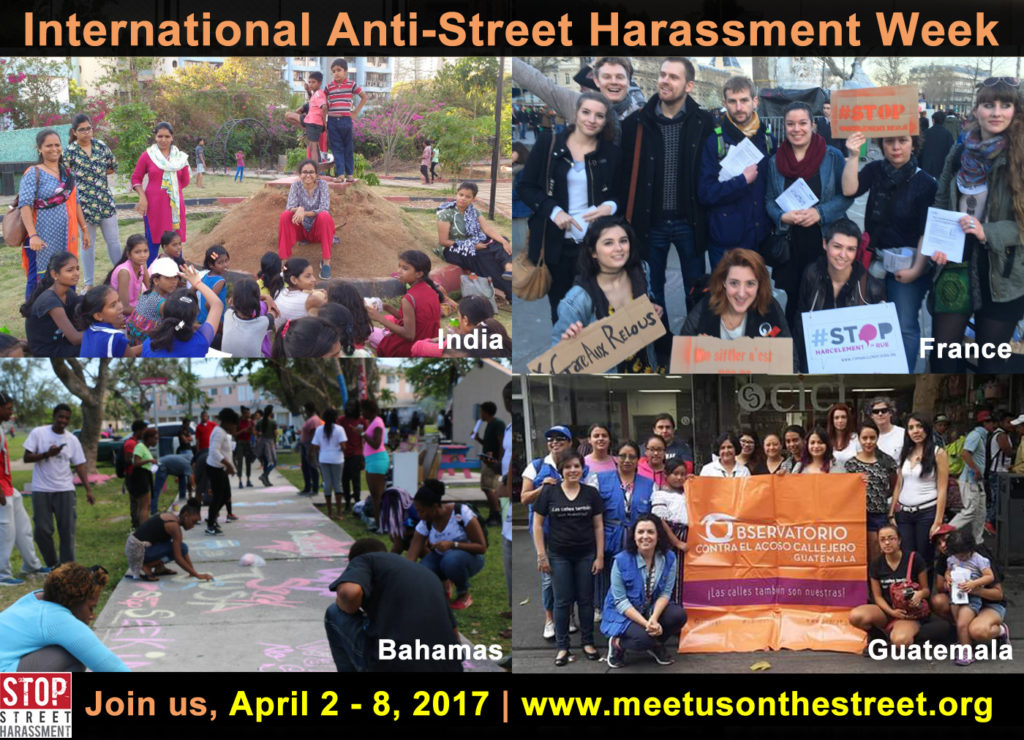
Join International Anti-Street Harassment Week!

February 13, 2017 By HKearl

Will you join us for the 8th annual International Anti-Street Harassment Week and demand safe public spaces for all?

Last year groups from 36 different countries joined in (here’s the wrap-up report).

Get involved:

  1. Advertise the week to your networks and encourage them to take action, whether that is sharing a story, putting info on social media, or organizing/attending offline action like a march, workshop or rally.
  2. Participate! And tell us what you plan to do.
  3. Join the 24 hour tweetathon on April 4! #EndSH

Share

Filed Under: anti-street harassment week, SSH programs, street harassment

Northern Ireland: The Deep Psychological Impact of Street Harassment

February 10, 2017 By Correspondent

Elaine Crory, Belfast, Northern Ireland, SSH Blog Correspondent

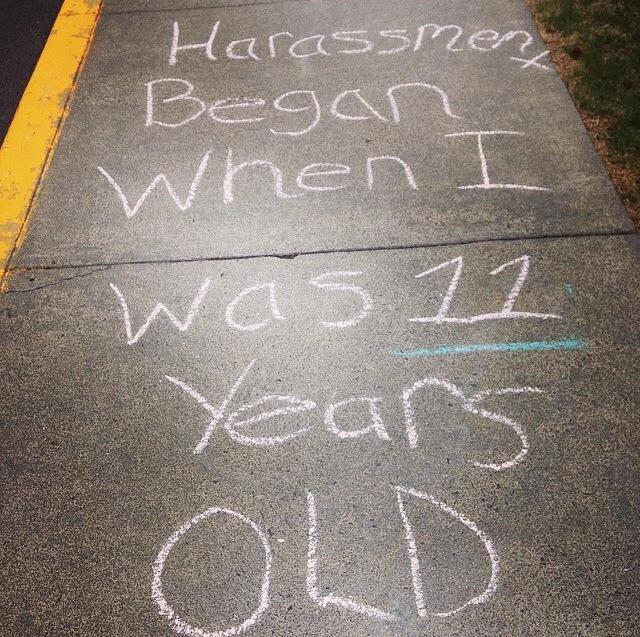
In survey after survey, women tell us that they begin to experience street harassment at a young age; many as young as 12 years old, almost all by the age of 18. In a world where so much divides us, this is something that is almost universal for young women.

The evidence for the harm that street harassment does is enormous, too. Young women learn to text friends to say they got home safe, to keep keys between their fingers or mace in their bag, to shrink away from large groups on the street or in public transport. They turn up the music on their headphones to drown out catcalls, or pretend to talk on the phone, or lie about imaginary boyfriends – because some men will respect another man’s supposed territory before they will heed a woman’s “no”.

But the effects goes beyond behavioural changes to avoid harassment. The impact on women’s sense of independence, on her comfort in her own skin is hard to gauge in numbers, but we hear testimony of it again and again, via resources like Stop Street Harassment, Hollaback!, and the Everyday Sexism Project. Teachers and parents see young women shrink into themselves and become less outgoing and confident, less willing to go out by themselves perhaps, more self-conscious of showing legs and bellies even in the height of summer. Projects like SSH, and the online realm generally, are invaluable resources for sharing stories and experiencing solidarity, but somehow the need to find support on the internet when surrounded by women – mothers, grandmothers, sisters, friends – who have been through the same ordeals is indicative of the greatest harm done by street harassment. It fills us with shame. It teaches us that it is our fault, our just desserts and as inevitable as death and taxes.

When we are still children in so many ways we learn that we are subjects to be observed, categorised and consumed by men. We are objects to be desired or to arouse disgust. At all times when we are out in public, we are inviting judgement and appraisal. Young men become consumers and arbiters of taste. It is no wonder that so many men take that supposed right to all other areas of their lives and that so many of us tolerate it, after all even the President of the USA grades women from 1 to 10. We knew this, and yet the majority of white American women voted for him. It’s unremarkable. It’s just how the world is, right?

I recalled in my last piece for SSH that my first experience of street harassment was being told that I was ugly, and that I immediately believed my harasser. I was ashamed of my own obviously strikingly ugly appearance, disrupting a man’s peaceable walk through the town on an unassuming afternoon. The sense of shame was so strong that I was in my 30s before I told anyone my experience, and as I did so I felt a strange lump on my throat and tears come to my eyes. After all the years that had passed in between, and even after the feminist texts and work on anti-harassment groups, the shame and humiliation is still there. It took a while before I realised that I felt much the same about the times I’d been cat-called, touched or groped, flashed and leered at. So different and yet so similar, because they all were rooted in the fact that we all grew up in a society that sees women as consumables and men as the consumers.

That is the real and frightening impact of street harassment. It is at the coalface of everyday sexism, the first clumsy instrument of rape culture, the insidious infection that makes so much of the sexism and misogyny that we encounter seem somehow natural and inevitable. And it starts alarmingly young, perhaps even younger than the figures can capture. I was 13 when I was told that I’m ugly by a stranger, and also 13 when a much older man furtively rubbed his erection against me on a bus. Legally and socially, I was a child – albeit one with breasts. Why had I already internalised the shame? Because it permeates all social interactions.

I walk my 5 year old home from school, and it is striking how often people – generally men – comment on her appearance. Usually it seems that she doesn’t notice. Once, though, an older man wanted to give “the lovely child” a coin. She recoiled and hid behind my coat, and his reaction was to curse, toss the coin towards me, instead, and to reach around me to tousle her hair. She cried in anger and shock most of the way home, and I felt choked with both anger and fear for the future, because this is how it starts. This is why I accepted verbal abuse at the age of 13, and now I worry that she will, too. We walk on the other side of the road now, more often than not, and I hate that fact.

Elaine is a part-time politics lecturer and a mother of two. She is director of Hollaback! Belfast, co-organises the city’s annual Reclaim the Night march, and volunteers with Belfast Feminist Network and Alliance for Choice to campaign for a broad range of women’s issues.

Share

Filed Under: correspondents, Stories, street harassment

Late January 2017 News Round-Up

January 31, 2017 By HKearl

Here are some of the news articles that caught my eye this month.

First, a new study says sexually objectifying a woman, including through catcalling, can lead to aggression towards women.

Via HuffPost:

“A study published late last year by the University of Kent says sexually objectifying a woman can very well lead to aggression towards women and “reduced moral concern for the objectified.”

The researchers, who worked with more than 200 participants aged 12 to 16, found the link between catcalling and aggression can begin to develop in the early teen years, and can lead to the harmful perception that women are solely to be seen as sexual objects as they age.”

Global News:

A female-only ridesharing service will launch in Queensland, Australia… but addressing root causes of street harassment is a must, too.

A Bartenders Against Sexual Harassment event was held in Canada to raise money and awareness about sexual harassment and assault in the Toronto bar scene.

In Egypt, the Central Agency for Public Mobilization and Statistics surveyed young people ages 15 to 29 in “informal urban areas of Greater Cairo” and 48% viewed street harassment as a problem.

Hundreds of men sexually assaulted women in Bangaluru, India, on New Year’s Eve. Among those speaking out afterward were those advocating for education and socialization of children to be respectful.

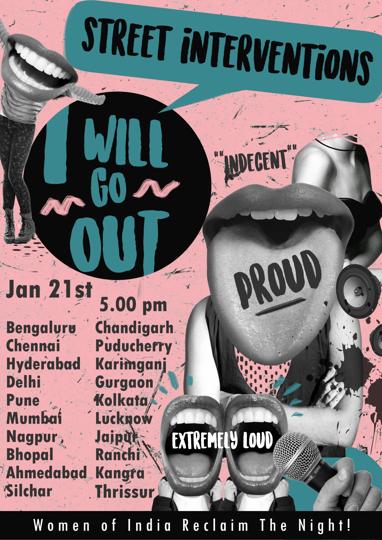
On Jan. 21, women across India marched to protest sexual harassment and misogyny using the hashtag #IWillGoOut.

Air India launched a women-only section of their airplane due to incidents of sexual harassment.

There’s a national competition in India encouraging people to rewrite the lyrics of sexist Bollywood songs.

Women in Jakarta, Indonesia, are taking action against street harassment.

The powerful Irish spoken word piece “Heartbreak” addresses street harassment.

A New Zealand woman writes an open letter to all cat-callers.

In Punjab, Pakistan, the Women Safety Smart Phone App launched.

Pakistani singer Atif Aslam called out and interrupted an incident of sexual harassment happening at his concert in Karachi

Reports of street harassment are on the rise in Cambridge, UK.

“Road to Equality” is a seven-minute documentary about street harassment in the UK.

USA News/Stories:

The Los Angeles Metro launched a hotline staffed by professional counselors to help people facing sexual harassment on the transit system.

Best-selling author and comedian Jen Kirkman tackled street harassment in her stand-up special Just Keep Livin’?.

What it’s like to be street harassed while seven months pregnant.

This is why street harassment is a mobility issue.

Hate crimes have swept the USA since the November presidential election and not even the liberal San Francisco Bay Area has been immune to it, including to street harassment.

A Maryland police officer pled guilty to taking upskirt photos of women.

Share

Filed Under: News stories, street harassment, weekly round up

“I had never called someone out for harassing another person before”

January 30, 2017 By Contributor

I was on my way to work in the morning on a Muni train and saw a guy shove his way onto the train car. He proceeded to stand really close to another girl from behind and kept getting closer to her in a disgusting manner. I stuck my luggage in between him and the girl because I was not completely sure what was happening–it was a full train.

He shoved my bag away and proceeded to turn around and stand close to another random girl who was unaware. The train had just gotten lighter with less passengers and there was plenty of room behind him.

I said, “Hey” a few times trying to get his attention and he ignored me so I tapped on the girl’s shoulder to tell her what he was doing. He immediately turned around and started to curse at me and shove my bag out of the way and all I could get out was that he was “standing a little too close to women”. He coughed in my face and then left the train.

I was very shaken up. I had never called someone out for harassing another person before, but I felt very protective of other women in that moment. People came up to me afterwards and said I did the right thing and they would have backed me up. The first girl also thanked me because she wasn’t sure what had happened until she saw him do it to someone else.

I hope that my choice to step out will cause others to be aware of their surroundings and to speak up if they see someone being harassed.

– AH

Location: San Francisco, CA

Need support? Call the toll-free National Street Harassment hotline: 855-897-5910

Share your street harassment story for the blog.
See the book 50 Stories about Stopping Street Harassers for idea
s.

Share

Filed Under: Stories, street harassment Tagged With: bystander, stopping harasser, witness

« Previous Page
Next Page »

Share Your Story

Share your street harassment story for the blog. Donate Now

From the Blog

  • #MeToo 2024 Study Released Today
  • Join International Anti-Street Harassment Week 2022
  • Giving Tuesday – Fund the Hotline
  • Thank You – International Anti-Street Harassment Week 2021
  • Share Your Story – Safecity and Catcalls Collaboration

Buy the Book

Search

Archives

  • September 2024
  • March 2022
  • November 2021
  • April 2021
  • March 2021
  • January 2021
  • April 2020
  • March 2020
  • February 2020
  • December 2019
  • November 2019
  • September 2019
  • August 2019
  • July 2019
  • June 2019
  • May 2019
  • April 2019
  • March 2019
  • February 2019
  • January 2019
  • December 2018
  • November 2018
  • October 2018
  • September 2018
  • August 2018
  • July 2018
  • June 2018
  • May 2018
  • April 2018
  • March 2018
  • February 2018
  • January 2018
  • December 2017
  • November 2017
  • October 2017
  • September 2017
  • August 2017
  • July 2017
  • June 2017
  • May 2017
  • April 2017
  • March 2017
  • February 2017
  • January 2017
  • December 2016
  • November 2016
  • October 2016
  • September 2016
  • August 2016
  • July 2016
  • June 2016
  • May 2016
  • April 2016
  • March 2016
  • February 2016
  • January 2016
  • December 2015
  • November 2015
  • October 2015
  • September 2015
  • August 2015
  • July 2015
  • June 2015
  • May 2015
  • April 2015
  • March 2015
  • February 2015
  • January 2015
  • December 2014
  • November 2014
  • October 2014
  • September 2014
  • August 2014
  • July 2014
  • June 2014
  • May 2014
  • April 2014
  • March 2014
  • February 2014
  • January 2014
  • December 2013
  • November 2013
  • October 2013
  • September 2013
  • August 2013
  • July 2013
  • June 2013
  • May 2013
  • April 2013
  • March 2013
  • February 2013
  • January 2013
  • December 2012
  • November 2012
  • October 2012
  • September 2012
  • August 2012
  • July 2012
  • June 2012
  • May 2012
  • April 2012
  • March 2012
  • February 2012
  • January 2012
  • December 2011
  • November 2011
  • October 2011
  • September 2011
  • August 2011
  • July 2011
  • June 2011
  • May 2011
  • April 2011
  • March 2011
  • February 2011
  • January 2011
  • December 2010
  • November 2010
  • October 2010
  • September 2010
  • August 2010
  • July 2010
  • June 2010
  • May 2010
  • April 2010
  • March 2010
  • February 2010
  • January 2010
  • December 2009
  • November 2009
  • October 2009
  • September 2009
  • August 2009
  • July 2009
  • June 2009
  • May 2009
  • April 2009
  • March 2009
  • February 2009
  • January 2009
  • December 2008
  • November 2008
  • October 2008
  • September 2008
  • August 2008
  • July 2008
  • June 2008
  • May 2008

Comment Policy

SSH will not publish any comment that is offensive or hateful and does not add to a thoughtful discussion of street harassment. Racism, homophobia, transphobia, disabalism, classism, and sexism will not be tolerated. Disclaimer: SSH may use any stories submitted to the blog in future scholarly publications on street harassment.
  • Contact
  • Events
  • Join Us
  • Donate
  • Facebook
  • Instagram
  • Pinterest
  • Tumblr
  • Twitter
  • YouTube

Copyright © 2026 Stop Street Harassment · Website Design by Sarah Marie Lacy