• About Us
    • What Is Street Harassment?
    • Why Stopping Street Harassment Matters
    • Meet the Team
      • Board of Directors
      • Past Board Members
    • In The Media
  • Our Work
    • National Street Harassment Hotline
    • International Anti-Street Harassment Week
    • Blog Correspondents
      • Past SSH Correspondents
    • Safe Public Spaces Mentoring Program
    • Publications
    • National Studies
    • Campaigns against Companies
    • Washington, D.C. Activism
  • Our Books
  • Donate
  • Store

Stop Street Harassment

Making Public Spaces Safe and Welcoming

  • Facebook
  • Instagram
  • Pinterest
  • Tumblr
  • Twitter
  • YouTube
  • Home
  • Blog
    • Harassment Stories
    • Blog Correspondents
    • Street Respect Stories
  • Help & Advice
    • National Street Harassment Hotline
    • Dealing With Harassers
      • Assertive Responses
      • Reporting Harassers
      • Bystander Responses
      • Creative Responses
    • What to Do Before or After Harassment
    • Street Harassment and the Law
  • Resources
    • Definitions
    • Statistics
    • Articles & Books
    • Anti-Harassment Groups & Campaigns
    • Male Allies
      • Educating Boys & Men
      • How to Talk to Women
      • Bystander Tips
    • Video Clips
    • Images & Flyers
  • Take Community Action
  • Contact

“Asking for it” – new PSA by Temple University sophmore

November 7, 2011 By HKearl

Read the background story from PSA creator Kara Lieff:

‘Asking For It’ was made for those who believe that there is a definitive connection between a woman’s clothing choice and her sexual availability. Many people think that women who dress a certain way are asking to be, or wouldn’t mind being, bothered, but this satirical take on street harassment shows that what a women really wants does not coincide with her attire.

This video was created for a class, and the assignment was to make a video that would get viewers to accomplish a certain action. I knew that I wanted my video to be a conversation starter – for my viewers to discuss street harassment, their experiences, why it happens, who is to blame, and what can be done to combat this problem. By featuring college-aged adults, I especially hope to reach out to my peers early on.

My sister Megan not only helped me develop this project, but over the years she has been a huge influence in my life, helping to develop my ideas about women’s rights, safety, and representation. Through her, I have learned that we need to focus on the source of the problem, not placing blame on the victim.

Just the other night while waiting for a few friends outside, two men decided that because I was wearing a short dress and tights, it would be appropriate to call out to me. As, unfortunately, I’m sure many of you reading this know, it’s not a good feeling when you walk down the street from where you live and are made uncomfortable for simply being there. Street harassment is a huge problem, and any method used – whether it be talking back, writing, art, or videos – to fight back is a step in the right direction.

Kara Lieff is a sophomore studying Film & Media Arts and Women’s Studies at Temple University. She loves to bicycle around Philadelphia, cook with friends, and watch TV and movies, while (somewhat successfully) making enough time for schoolwork, her job, and clubs. She hopes to one day have a career dedicated to creating and maintaining positive messages and visibility for women in media.

Share

Filed Under: Activist Interviews, street harassment Tagged With: Kara Lieff, PSA, street harassment, temple university

“At least your new hair cut screams, ‘Guys in trucks bark and howl now.'”

November 1, 2011 By HKearl

“In this country we tend to be proud of the fact that we don’t cover “our” women in burkas. But, as bell hooks said — whether it’s obvious or subtle, oppression is oppression. Ubiquitously practiced sex-based public harassment is a form of oppression that we tolerate as women and cultivate as a society to our net detriment. This is a social injustice that undermines our most lofty claims about what America represents.”

Artist and writer Soraya Chemaly penned this in her recent powerful Huffington Post piece, “Street Harassment is Everywhere; What do We Tell Our Daughters?”

Her article is spot on and speaks to the way street harassment limits women’s equality with men and makes public places less safe for us, and acknowledges that this is a messed up thing to have to tell our daughters.

Last week I had the good fortune to chat with her about street harassment. One thing we discussed is how humor can be an effective tool for raising awareness about street harassment. Since Soraya is a witty and creative feminist as well as an excellent writer, over the weekend she cooked up a cartoon. Watch and share it widely! The transcript is below.

Friend 1:

Good morning. Are you going to work dressed like that?

Friend 2:

Is it obvious? I’m practically begging some random dude in the coffee shop to tell me I have a luscious ass. That way I can make a fake phone call while I wait for my coffee and he can call me a stuck up dyke. It’s a great way to start the day.

Friend 1:

It’s so nice out. Are you sure that’s what you want? Look at me. I’m wearing my Nice Tits dress.

Friend 2:

I did try on my How-Much-Baby skirt but then I’d probably just get a quiet dick flash on the bus.

Friend 1:

Yeah, but, at least your new hair cut screams, “Guys in trucks bark and howl now.”  They might even stop and offer you a ride. You could save on bus fare!

Friend 2:

I want to mix it up a bit, like when you lost all that weight last year.

Friend 1:

I know, but I sort of miss the compliments I used to get. You know, it was nice to hear Fat Slut now and then. No one ever calls me Thin Slut.

Friend 2:

You sound like my mom.  She was at the grocery store in her vintage dumb bitch jacket yesterday and all she got was some guy grabbing her butt.  He didn’t say a word.

Friend 1:

Aging sucks.  Your Where’s-my-smile-baby coat might lift her spirits.

Friend 2:

My sister borrowed it. You know how much she likes flirting with guys she doesn’t know by not smiling at them and averting her eyes. It is so her. Before I forget, could I borrow a hair bow?

Friend 1:

Sure, why do you need a hair bow?

Friend 2:

I’m on air today doing a live broadcast. The anchor, you know, what’s his name, always says I’m gods-gift-to-men and so I thought a bow would be a nice touch.

Friend 1:

No problem. It’s in my sports bag wrapped up in the gym clothes I wear to get guys to help me when I’m exercising. I don’t know what I’d do without them.

Friend 2:

Forget how to lift things probably. I’m so glad to know you got some come hither sweaty gross guy spandex.  Have to run.

Friend 1:

Have a great day!

Friend 2:

I will, you too!

Share

Filed Under: Activist Interviews, street harassment Tagged With: huffington post, social control, Soraya Chemaly, street harassment

Interview: Sydnie L. Mosley and The Window Sex Project

October 29, 2011 By HKearl

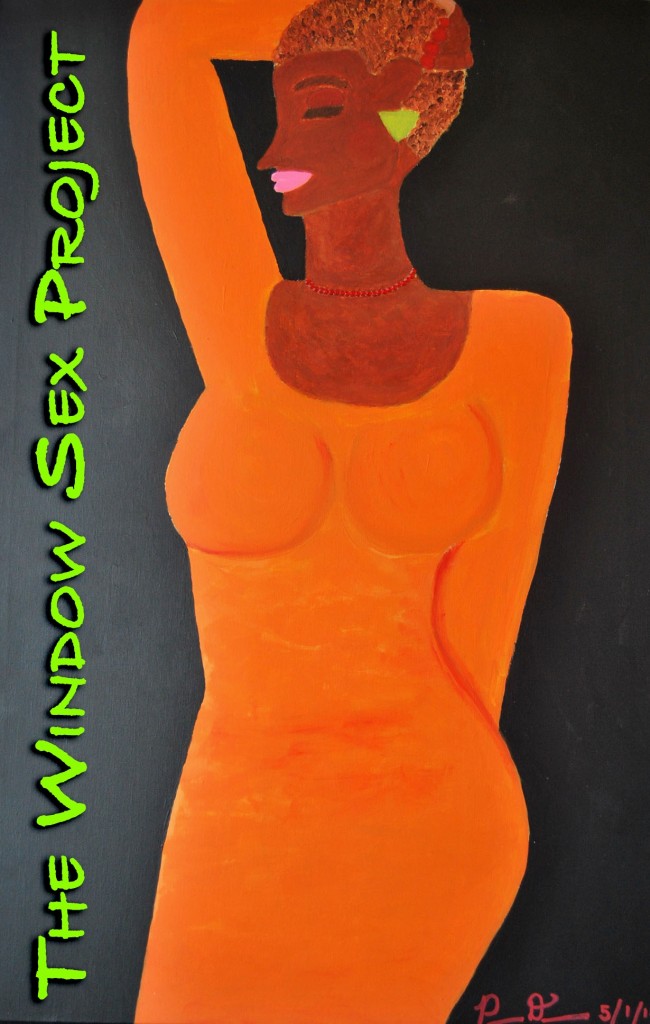
When I was in New York City two weeks ago, I had the opportunity to meet with Sydnie Mosely and talk about her anti-street harassment initiative The Window Sex Project. She has a big event coming up on November 12 and so I thought this was the perfect time to interview her so you all can learn about her creative project and how to get involved.

Stop Street Harassment (SSH): Hi Sydnie! To start, can you please share a little bit about who you are before we talk about the Window Sex Project?

Sydnie L. Mosley (SLM): Sure. I’m a New York City-based dancer, choreographer and teaching artist. I’m currently an Alumnae Fellow with the Barnard Center for Research on Women, a position that allows me to deepen my artistic work with the resources of the academy. I present my choreography with my Harlem-based company Sydnie L. Mosley Dances with works that seek to actively engage the audience’s physical and emotional senses with dance performance in addition to involving audiences in the artistic process. I earned an MFA in Dance with an emphasis on Choreography from the University of Iowa and a BA in Dance and Africana Studies from Barnard College.

SSH: Thank you. What is the Window Sex Project all about?

SLM: The Window Sex Project is a dance performance which addresses and tackles the every day practice in which women are “window shopped,” that is forced to bear unsolicited harassment from men while walking on the street. The Window Sex Project gives voice to these concerns and restores agency to women by celebrating their bodies in a public artwork informed by members of the Harlem community, for the Harlem community.

The work places women of varying races and body types on pedestals in an art gallery setting, forcing audiences to contend with the objectification of the female body in a contemporary society. The dance investigates how a woman’s sexuality is perceived based on these physical attributes. It aims to equally celebrate all the bodies which are unique, and do not fit into generic models of womanhood.

This work is grounded in personal experiences, feminist theory, and a collective need to take action. Much of the movement content was generated from women who participated in free workshops over the summer, who were asked to create movement expressions of their harassment experiences. This aspect makes this activist project unique. The Window Sex Project specifically uses bodies, the site of harassment, as the mode of response and activism.

The sound score orchestrated by Ebonie Smith includes newly composed instrumental and/or vocal selections, energetic dance beats, a collection of “hollas” heard on the street, and also the voices and bodies of the dancers. Visual media aspects of the work include projected video of Harlem women who participated in community workshops, as well as the work of some visual artists in Harlem. The show also integrates excerpts of “Can I Get A Smile?” a one woman theater show written & performed by Leah King.

SSH: I love the integration of body, dance, and activism. What inspired your project?

SLM: I was inspired by a simultaneous creative want to make a dance about a woman’s body & sexuality, and my own daily experiences with street harassment and a need to act out against them. [In this video, she expands more on her inspiration and why she decided to address street harassment]

SSH: What kind of response are you getting to your work?

SLM: Harlem artists, businesses, organizations and people in general have been extremely receptive and supportive of this work. People have been and continue to be involved with the project in a myriad of ways. Community members have participated in workshops this past summer which took place at Grosvenor House YMCA, Barnard College at Columbia University and the Harlem School for the Arts.

Businesses such as The Body Shop in Harlem, Land Yoga and The Best Yet Market made generous donations in food & give away items to our participants. Local artists & teachers graciously volunteered their time to co-facilitate workshops.

Women continue to be involved by being a part of our online video series in which we ask them to share their story. Incredible artists including dancers, painters, and musicians have graciously shared their talent, time and energy to bring this work to fruition.

Lastly, the Barnard Center for Research on Women has become a major supporter of the work providing a home base for continued research & planning to produce a published curriculum for workshops, and dance performances.

SSH: That’s great to hear. And lastly, how can people get involved with The Window Sex Project?

SLM: There are several ways:

* Submit an online video link to you sharing your story like these.

*Submit a guest blog to sydnielmosleydances@gmail.com with the subject “Guest Blog” about your street harassment or related experiences to be posted on the website.

*Become a producer of our performance project by making a tax-deductible donation in ANY amount, and encouraging others to do the same.

*Plan to lead a community workshop in your own neighborhood in 2012. Email sydnielmosleydances@gmail.com with your interest.

*Attend a Work In Process showing and give your feed back as we develop the choreography. Help us make sure the dance speaks to you and your concerns.

If you’re in NYC on November 12: You are invited to see the first draft of the full length dance on Saturday, November 12 at 5 p.m. HOORAY! The showing will take place at Land Yoga located at 2116 Frederick Douglas Boulevard (between 114th & 115th Streets). The performance will be followed by an audience feedback session. Please attend & contribute your constructive criticism. This is a community work & I value each of your opinions.

*Spread the word! Follow @sydmosley & @SLMDances. Be friends with http://www.facebook.com/sydnielmosleydances. Use the hashtags #windowsexproject & #streetharassment.

SSH: Thank you!

Sydnie recently spoke about her work on a panel at Activism & the Academy: Celebrating 40 Years of Feminist Scholarship & Action, a conference in honor of the 40th anniversary of the Barnard Center for Research on Women.

Expanding Feminism: Collaborations for Social Justice from BCRW Videos on Vimeo.

Share

Filed Under: Activist Interviews Tagged With: dance, harlem, street harassment, sydnie mosley, window sex project

Safe Streets AZ gathers info, creates network of support to end harassment

October 8, 2011 By HKearl

Safe Streets AZ is a pilot program of Southern Arizona Center Against Sexual Assault that launched in July to address public harassment, particularly harassment aimed at lesbian, gay, bisexual, transgender and queer-identified youth and young adults. Stephanie Arendt is the Senior Prevention Educator at SACASA and agreed to talk to Stop Street Harassment about the new program.

Stop Street Harassment (SSH): Hi Stephanie! Before we begin, please tell us a little bit about yourself.

Stephanie Arendt (SA): I have been actively involved in violence prevention in one form or another for the past eight years, and my main passion is in creating youth-driven primary prevention. Since graduating from Northern Arizona University I have interned with the Feminist Majority Foundation, worked in crisis response and advocacy, and developed programming for various youth populations, including high-risk and LGBTQ youth. In my role as Senior Prevention Educator with the Southern Arizona Center Against Sexual Assault (SACASA) I implement youth-focused programs based on Peer Educator models, and am constantly seeking and creating opportunities to integrate art, social media, and technology into our violence prevention efforts.

SSH: What is the goal of Safe Streets AZ and how does it work?

SA: The ‘big picture’ goal is a shift in the way that people think about and respond to public harassment. We want to instigate the move towards a culture where sexual violence of any kind, including street harassment, is not only not tolerated but unthinkable. Safe Streets AZ is one of the first steps toward that goal in that it gathers information about public harassment and builds readiness. It provides a platform for community members to share their stories, get support, and –together- help end public and street harassment.

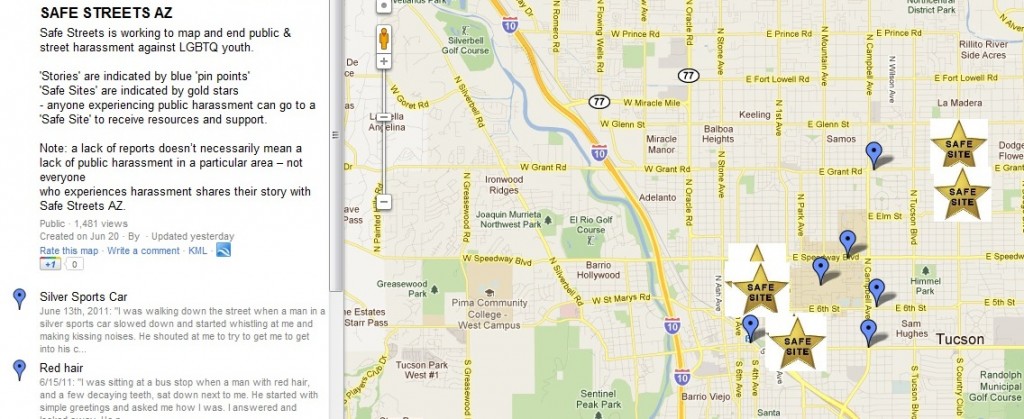
Safe Streets AZ is a program of the SACASA and funded by the Alliance Fund Queer Youth Initiative. The program is two-fold: 1) gathers information and 2) creates a network of support. Although geared towards LGBTQ youth and young adults, anyone who has experienced public harassment of any kind can share their story –publicly or anonymously—and connect to local and national resources, including crisis advocacy services.
They can also connect to Safe Sites; a growing web of partner businesses and organizations where anyone experiencing harassment can go to feel safe and get resources. Safe Sites are mapped along with reported incidents on an interactive Google map, making them readily identifiable and accessible.

SSH: Did anything particular spark/inspire the creation of Safe Streets AZ?

SA: For me, it was the surprising lack of information and data about public and street harassment that really propelled me into helping to create Safe Streets AZ. We had a lot of anecdotal information and our cursory focus groups and conversations told us that public harassment is a recurring safety issue in our community, particularly for LGBTQ and female-identified people. But when we looked at the local and state level for data and resources specific to street and public harassment we came up blank. There is little to no information that speaks to the prevalence of public harassment or its impact, particularly upon minority communities.

We knew that before we could start looking to solutions, we had to get a better understanding of what is going on in our area, and Safe Streets AZ grew out of this need. On a personal level, I am also deeply inspired by the ground-breaking work of other activists like Emily May of Hollaback! and the ability to connect to and learn from a greater, growing movement against street and public harassment.

SSH: Gathering data is always an important first step toward creating solutions. I’m intrigued by the “Safe Sites” program, can you please tell me more?

SA: In creating the program we quickly realized that gathering and mapping stories –although a key way to raise awareness and build readiness- would not be enough. Opportunities needed to be available now for community members to step up and address the issue.

We created the Safe Sites component so that local businesses, organizations, and the individuals that work in them have a hand in creating a safer community. Prior to launching the program I met with several local businesses to get their feedback, and I know that their perspectives and buy-in has really contributed to the success of this aspect of the program. The result is a web of partner sites throughout the community where someone experiencing harassment can ask for help/identify that they are being harassed, and receive resources and short-term safety. This last part is especially important for youth and young adults who are being harassed because they can access Safe Sites and wait in safety for a short period –until their ride comes, until they feel it’s safe to leave, etc- without fear of being asked to leave due to ‘loitering’.

The degree to which local businesses and organizations have not only supported but embraced Safe Streets AZ has been unexpected and completely inspiring. So far Safe Streets AZ has been endorsed by the Pima County Small Business Commission, the Southern Arizona Chambers of Commerce Alliance, Pima County Public Libraries, Friends of the Pima County Public Libraries, and several locally-owned businesses. We also have partnerships with other non-profits and agencies, including Wingspan, Tucson’s LGBT Community Center, which are critical to shaping the program.


SSH: That’s amazing! What would you say the community response has been to Safe Streets AZ overall?

SA: The response on this program has been incredibly encouraging. About two days after the first story on Safe Streets AZ aired on KOLD 13, I received the most heart-warming phone call. A parent of an openly LGBTQ middle-school student in one of our districts called just to thank me and SACASA for Safe Streets AZ. She told me about how her 12 year old daughter has been harassed on multiple occasions in and out of school –some of them because of her sexual orientation- and was happy that resources are available.

The question I do get the most from community members and some of our Safe Site partners is, “adults and people of all sexual orientations and backgrounds are harassed – is this program also for them?” And the answer is, “of course.” Women, youth, and LGBTQ-identified individuals are more frequently the targets of public harassment, but as we expand the program we also want to expand the message that Safe Streets AZ is for everyone, and anyone can share their story, connect to resources, and join the movement.

SSH: Wonderful. What aspect of Safe Streets AZ is most interesting/exciting to you?

SA: The most exciting aspect is that Safe Streets AZ connects the gaps between private and public spaces. In schools as well as the workplace, there are policies in place specifically geared towards protecting individuals from harassment. How well these are enforced varies, but similar protections are not available for most public spaces. There are no clear cut channels to address the kinds of street and public harassment that are committed on a daily basis. The Safe Sites aspect of the program brings businesses into the mix to start bridging those gaps, and allows us to incorporate available technologies from blogs to QR codes.

SSH: Where do you hope to see the program in a year?

SA: Over the next 6 months the primary plan for Safe Streets AZ is to gather as much information as we can regarding the frequency and kinds of public harassment being perpetrated in our community, and then take a really good look at what the information is telling us.

The next step is to meet with law enforcement, public officials, and service agencies and use this localized data to start developing specific ways to address public and street harassment in Arizona. I also hope to see the Safe Site aspect of the program grow to include more business partners as well as an active bystander intervention training component. The goal is to empower community members of all ages to share their experiences and to call out harassment how-and whenever possible.

SSH: Anything else you’d like to add?

SA: One of the biggest benefits of programs like Safe Streets AZ is that it helps us start making connections between street and public harassment and other forms of sexual violence. Until recently, street and public harassment have not been included in most sexual violence prevention efforts, even though the majority of street harassment is rooted in (perceived or actual) gender, sex, sexual orientation, and sexuality of the perpetrator as well as the person being harassed. By continuing to connect these issues we can make stronger cases for primary prevention programs and solutions that address violence on multiple levels.

Find Safe Streets AZ on Facebook.

Stephanie is right on about the lack of information on street harassment, the need for more data, the need for businesses and local community groups to become involved in creating solutions, and in the need for traditional sexual violence prevention efforts to include street harassment. Well done, Safe Streets AZ and Stephanie!! As they continue forward, their work has the potential for being a model other cities can use to effectively track and then address street harassment on the local level. A multi-layered, community response is the only way street harassment has any chance of ending.

Share

Filed Under: Activist Interviews Tagged With: LGBQT, safe streets az, Southern Arizona Center Against Sexual Assault, stephanie arendt, street harassment

Pakistan: Two films about street harassment

October 6, 2011 By HKearl

What does street harassment look like in Pakistan? Does wearing a burqa reduce street harassment?

Find out the answers in the two short films created by Naveen Naqvi, Executive Director of Gawaahi. In the text of the films “Stop Staring!” and “Stop Street Harassment,” she writes:

“Street Harassment is a global phenomenon that is largely overlooked, and even considered acceptable despite there being laws against it in many places including Pakistan. Street harassment includes making sexually explicit comments, ogling, whistling, following and groping.

In the making of these videos, we found that many Pakistani women, especially from the lower-middle classes began wearing burqas because they found the additional garment enabling in many ways. However, they find that the problem of street harassment has worsened, and even in burqas, they are harassed as they wait for buses, rickshas, taxis, or walk down the street. We found that this intimidation was experienced by women across class, age, religion and ethnicity.”

View the films (you can choose the “closed captions” option to read English subtitles) and stay tuned for an interview with Naqvi about her work to make public places safer for women in Pakistan!


Share

Filed Under: Activist Interviews, Resources, street harassment Tagged With: Gawaahi, Naveen Naqvi, sexual harassment, street harassment

« Previous Page
Next Page »

Share Your Story

Share your street harassment story for the blog. Donate Now

From the Blog

  • #MeToo 2024 Study Released Today
  • Join International Anti-Street Harassment Week 2022
  • Giving Tuesday – Fund the Hotline
  • Thank You – International Anti-Street Harassment Week 2021
  • Share Your Story – Safecity and Catcalls Collaboration

Buy the Book

  • Contact
  • Events
  • Join Us
  • Donate
  • Facebook
  • Instagram
  • Pinterest
  • Tumblr
  • Twitter
  • YouTube

Copyright © 2026 Stop Street Harassment · Website Design by Sarah Marie Lacy