• About Us
    • What Is Street Harassment?
    • Why Stopping Street Harassment Matters
    • Meet the Team
      • Board of Directors
      • Past Board Members
    • In The Media
  • Our Work
    • National Street Harassment Hotline
    • International Anti-Street Harassment Week
    • Blog Correspondents
      • Past SSH Correspondents
    • Safe Public Spaces Mentoring Program
    • Publications
    • National Studies
    • Campaigns against Companies
    • Washington, D.C. Activism
  • Our Books
  • Donate
  • Store

Stop Street Harassment

Making Public Spaces Safe and Welcoming

  • Facebook
  • Instagram
  • Pinterest
  • Tumblr
  • Twitter
  • YouTube
  • Home
  • Blog
    • Harassment Stories
    • Blog Correspondents
    • Street Respect Stories
  • Help & Advice
    • National Street Harassment Hotline
    • Dealing With Harassers
      • Assertive Responses
      • Reporting Harassers
      • Bystander Responses
      • Creative Responses
    • What to Do Before or After Harassment
    • Street Harassment and the Law
  • Resources
    • Definitions
    • Statistics
    • Articles & Books
    • Anti-Harassment Groups & Campaigns
    • Male Allies
      • Educating Boys & Men
      • How to Talk to Women
      • Bystander Tips
    • Video Clips
    • Images & Flyers
  • Take Community Action
  • Contact

Safe Horizon Safe Harbor Student Leaders speak out

July 4, 2011 By HKearl

Watch as the Safe Horizon Safe Harbor Student Leaders speak out about their right to feel safe on the streets, with help from Rachel Henes and Rebecca Forlenza. (Via the Hollaback Youtube Channel)

On the Stop Street Harassment website, you can access information about the events that led to the 2010 New York City Council hearing and watch portions of the testimonies given during the hearing.

Share

Filed Under: Activist Interviews, hollaback, male perspective, Stories Tagged With: NYC council hearing, Safe Horizon Safe Harbor Student Leaders, street harassment

Anti-street harassment film out of Cape Town, South Africa

May 30, 2011 By HKearl

This important new anti-street harassment video was created by filmmaker Pascale Neuschäfer. She lives in Cape Town, South Africa, and she agreed to answer a few questions about herself and the film.

Stop Street Harassment (SSH): Please tell me a bit about yourself and why you decided to make this film.

Pascale Neuschäfer (PN): I am a filmmaker and an actress and I made the promo with the help of my partner and some friends who are interested in gender rights issues and who feel comfortable speaking up about it. I became frustrated not only at the frequency with which incidence of street harassment happen, but at the fact that women are mostly told to ignore it. This included many of my friends (both women and men) who couldn’t see the inherent harm in catcalling. I think this attitude stems largely from ignorance (South Africa having one of the highest rates of gender-based violence in the world, including rape, corrective rape and murder) and from fear: the fear of a public humiliation, as well as the fear of augmented violence when confronting a harasser.

SSH: How has street harassment impacted your own life and what’s inspired your decision to speak out against it?

PN: A defining moment for me was being harassed by a 15 year old boy, who responded very aggressively when I confronted him about his behaviour (I posted this story on your blog a few months ago). Making the 30 second fictional short was an outlet for me, a woman to make the statement: women hate it when men harass us! There is nothing polite, or politically correct about it, because there is nothing polite about being harassed and I feel very strongly that women should speak up. However, I also think there are many women in the world who often cannot speak up (particularly in patriarchal societies like South Africa, where women are brutally murdered and raped, simply for being openly gay) and I think it’s important to engage in open debate about these kind of issues. I also believe that street harassment is just the tip of the iceberg to other, violent gender-based crimes.

SSH: Do you have any future plans regarding street harassment and film?

PN: I  am hoping to get funding to make full-length documentary and to start a media campaign (including Public Service Announcements which highlight how violence escalates) , because I have found that even just speaking to my friends (men and women) has had a positive effect on the way we now either DO respond (if we didn’t previously), or in the way in which we CHOOSE to respond.

SSH: Wonderful. You’re doing amazing work with your film and I look forward to seeing what you do next!

For others who are interested in filmmaking and documentaries, check out more anti-street harassment documentaries and films and find tips for making your own!

Share

Filed Under: Activist Interviews, Resources, street harassment Tagged With: cape town, south africa, street harassment

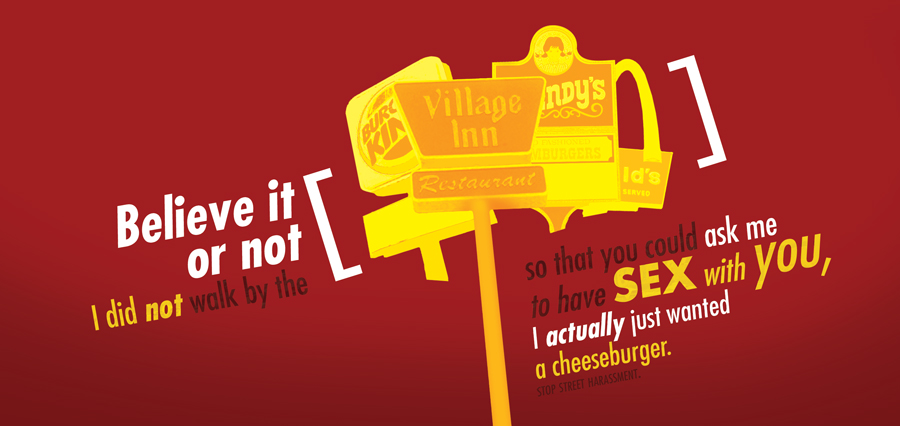
Believe it or not, I did not walk by so that you could ask me to have sex with you

March 18, 2011 By HKearl

Designer Answer Ejiasi created this graphic for a design class last year when she was a student at the University of Iowa. She recently shared it with me and said I could share it for you all to see and appreciate. I love it.

This is the thought behind the project:

“The design is based off of an experience I had at a fast food restaurant in Florida roughly two years ago on my birthday. It’s also based on a number of the experiences I had read about on this blog and other street harassment blogs.

I designed it to be similar in size to those large coupons/fliers that come with the Sunday paper. I wanted it to resemble a fast food ad in order to pull people in to reading it with the expectation of it being a coupon, and instead having them come to realize it’s for a different cause altogether, and thereby add awareness to the issue of street harassment.”

Way to go, Answer, for using your talents to raise awareness about street harassment and help work to end it!

Share

Filed Under: Activist Interviews, Stories, street harassment Tagged With: Answer Ejiasi, graphics, sexual harassment, street harassment

Power in storytelling: interview with filmmaker Nuala Cabral

March 10, 2011 By HKearl

When you search for videos about street harassment, Nuala Cabral’s film Walking Home is the second clip that comes up. Since 2009, it’s been viewed more than 23,000 times. I featured it on my blog soon after it went online and had hoped to interview Nuala for my book on street harassment. Things fell through at the time, but thanks to International Anti-Street Harassment Day planning, we’ve reconnected. This week Nuala graciously agreed to answer interview questions for my blog.

1. Stop Street Harassment (SSH): What’s a three sentence bio for you?

Nuala Cabral (NC): I’m an educator and filmmaker, currently teaching television production at Temple University, where I recently obtained my Master’s degree in Broadcasting, Telecommunications, and Mass Media. I’m the co-founder of the cooking blog Cool Cooks and co-founder of FAAN Mail, a media literacy and media activism project based in Philadelphia.

2. SSH: What inspired you to create your film Walking Home?

NC: Street harassment is a personal, political and universal issue that is often dismissed and tolerated. This is problematic and I wanted to do something about it. I’m a filmmaker– so I made a film. I like to use video and film to explore my frustrations and questions about the world.

Walking Home attempts to question and disrupt the acceptance and the pervasive silence around these everyday interactions.

3. SSH: Wonderful. I love seeing people tap into their talents to bring attention to this issue. How did you decide what to cover during the film?

NC: Walking Home is for the walkers, the talkers and those who say nothing. And thinking about these audiences shaped my decisions about my approach with this film.

I wanted to portray a diverse range of people, because street harassment is universal, just like all forms of violence. Including voices of several women explaining their names, signifies universality and solidarity. The smile “command” is something I definitely wanted to include.  Self-entitlement operates in interesting ways and I wanted to open that door for discussion.

4. SSH: It seems like you have. Since 2009, Walking Home has been viewed more than 23,000 times on YouTube and linked to on numerous websites. What kind of responses have you received from viewers?

NC: One man mentioned that unfortunately the men who need to see Walking Home will never see it.   But actually some male friends have said that the film has caused them to reconsider the way they approach women. Many of the responses come from women who have experienced street harassment; Walking Home resonates with them.  But there is one response that has stood out  (from someone I have never met). Here’s an excerpt: 

“ive been that girl (as we all have been, clearly), still am sometimes.  but that is not what this reminded me of right away.  it reminded me of walking down the street with my parents as a child, my mother looking straight ahead, my father hooting and hollering without care or regard for his wife and child, at one of those ‘nameless’ girls passing by. and he continued to do this for many years in front of my sister and i, though he implored us to respect ourselves.  how could we?

you did not ask for my life story, i do not mean to burden you with it. but your work brought to the forefront of my mind for the first time in many years that hurt, that anger which was never addressed and never healed. it really moved me, exactly what great art does

… i wanted to thank you for this piece. at this moment my heart is so heavy when i think of him doing this and the years of abuse that followed, but im grateful for it because it has reminded me that there is still a wound there. and now that i can no longer ignore it, i aim to mend it.”

5. SSH: Wow, that is powerful and something that isn’t often discussed: the pain women feel when they witness men in their lives engaging in street harassment. My next question is related, what benefits do you see in using film to work to end street harassment?

NC: There is power in storytelling. Film is a form of storytelling and it offers an opportunity to build understanding across differences, among people who may never communicate directly.  The benefit in using film is that when it’s done well, it makes people feel. And when it comes to street harassment, making people feel is a good start to helping them care about making a difference.

6. SSH: So true and every time I see your video posted, I see it accompanied by comments from people you have prompted to feel and think about this issue. Do you have plans to make any more films or other projects that address street harassment?

NC: Right now I want to concentrate on using Walking Home to support the movement. I am also excited that Hollaback is opening a chapter in Philadelphia and looking forward to supporting their efforts. We’ll see what else develops.

SSH: Great, thank you for your time and especially thank you for making such a powerful film!

If you live in Philadelphia, join Nuala and HollaBack Philly on March 20 for their International Anti-Street Harassment Day activism!

Share

Filed Under: Activist Interviews, street harassment Tagged With: filmmaking, Nual Cabral, story telling, street harassment, Walking Home

The “Don’t Call Me Baby” Project

March 1, 2011 By HKearl

Are you looking for ideas for anti-street harassment activism?  University of Southern California graduate student Lani Shotlow Rincon has plenty. In this interview, she shares what she’s been up to on her campus.

Stop Street Harassment (SSH): What’s your three sentence bio?

Lani Shotlow-Rincon (LSR): I’m a multiracial woman, navigating my way through graduate school, working towards building my knowledge of intersectionality, gender based violence, and technology. I research as much as I can, while making time to read historical romance novels. Currently, I’m searching for a way to be impactful in the world.

SSH: Tell me a about your street harassment project.

LSR: The “Don’t Call Me Baby” project was created for my class on designing public campaigns. My project outlined how an effective campaign could be created for the USC Campus area. It included both entertainment education tactics with a web series focused on 3 college women experiencing street harassment, an art exhibit (inspired from the blank noise project) with donated clothing that has inspired street harassment, a flash mob occurring during high traffic times on campus, and PSA components created to publicize and give a name to harassment most women experience in the area. Overall, my project created an action plan to address street harassment comprehensively in the USC campus area.

One of Lani's graphics

SSH: Sounds amazing!. What inspired it?

LSR: I was inspired to focus on street harassment for my project based on my personal experience with it. Culminating in the summer of 2010, I was harassed repeatedly over a few days so relentlessly that I became utterly frustrated. Exasperated I started googling my experience…and this led me to the stopstreetharassment.com website. It felt so great to finally put a name to that awful experience…street harassment. Since then, I have become increasingly focused on the subject.

SSH: Related, how has street harassment impacted your life?

LSR: Since the age of 12 I have been harassed in public. It usually occurred twice a day as I walked to elementary, jr. high and high school. When I hit puberty and began to develop, the harassment and attention I received in public became excruciatingly uncomfortable for me. I internalized the harassment and became very self-conscious about my body and my appearance. In large part, my low body self-esteem led to being diagnosed with an eating disorder a few years ago. Now, I’m currently in recovery but every time I am street harassed I struggle with it. Being an advocate against street harassment has helped me channel my hurt around it, helping me cope with its effects.

SSH: Your experiences sadly show why it’s so important for society to acknowledge and address street harassment! I’m glad you’re being able to turn personal frustration into action. What was the outcome of your campus project?

LSR: Although my project created much interest in my class and with my professors, the respondents who I showed my creative PSA advertisements did not respond strongly to the messaging. I believe that the public needs a deeper understanding and awareness of street harassment. More campaigns are needed “to name the harm” for other women.

SSH: You are so right. What do you plan to do next regarding street harassment?

LSR: I want to use my upcoming thesis to understand how violence against women can be combated through new technologies. I believe this is especially relevant to the fight against street harassment, as mobile apps like those created by ihollaback, are increasingly showing the scope of public sexual harassment.

SSH: Do you have any advice for someone dealing with street harassment and/or for someone who wants to address it in their community or campus?

LSR: I believe the best advice for someone dealing with street harassment is to take the course of action they feel most comfortable with. Whether that be cursing at the harasser or walking right on by. The important thing is to cope actively with the harassment by acknowledging its impact at some point during or after the harassment.

Thank you for your insight, Lani! I can’t wait to see what you do next.

Another one of Lani's graphics
Share

Filed Under: Activist Interviews, street harassment Tagged With: campus activism, Lani Shotlow Rincon, street harassment, USC

« Previous Page
Next Page »

Share Your Story

Share your street harassment story for the blog. Donate Now

From the Blog

  • #MeToo 2024 Study Released Today
  • Join International Anti-Street Harassment Week 2022
  • Giving Tuesday – Fund the Hotline
  • Thank You – International Anti-Street Harassment Week 2021
  • Share Your Story – Safecity and Catcalls Collaboration

Buy the Book

  • Contact
  • Events
  • Join Us
  • Donate
  • Facebook
  • Instagram
  • Pinterest
  • Tumblr
  • Twitter
  • YouTube

Copyright © 2026 Stop Street Harassment · Website Design by Sarah Marie Lacy