• About Us
    • What Is Street Harassment?
    • Why Stopping Street Harassment Matters
    • Meet the Team
      • Board of Directors
      • Past Board Members
    • In The Media
  • Our Work
    • National Street Harassment Hotline
    • International Anti-Street Harassment Week
    • Blog Correspondents
      • Past SSH Correspondents
    • Safe Public Spaces Mentoring Program
    • Publications
    • National Studies
    • Campaigns against Companies
    • Washington, D.C. Activism
  • Our Books
  • Donate
  • Store

Stop Street Harassment

Making Public Spaces Safe and Welcoming

  • Facebook
  • Instagram
  • Pinterest
  • Tumblr
  • Twitter
  • YouTube
  • Home
  • Blog
    • Harassment Stories
    • Blog Correspondents
    • Street Respect Stories
  • Help & Advice
    • National Street Harassment Hotline
    • Dealing With Harassers
      • Assertive Responses
      • Reporting Harassers
      • Bystander Responses
      • Creative Responses
    • What to Do Before or After Harassment
    • Street Harassment and the Law
  • Resources
    • Definitions
    • Statistics
    • Articles & Books
    • Anti-Harassment Groups & Campaigns
    • Male Allies
      • Educating Boys & Men
      • How to Talk to Women
      • Bystander Tips
    • Video Clips
    • Images & Flyers
  • Take Community Action
  • Contact

Say No to Street Harassment in Belfast!

April 24, 2013 By HKearl

Hollaback! Belfast is a new group in Belfast, Northern Ireland and they jump-started their chapter during International Anti-Street Harassment Week!

Chapter director Helen shares what they did (view their photo album):

“As chalk walking isn’t legal in Belfast City Centre, we came up with an alternative. We made our own chalk boards using cardboard and chalkboard paint and made portable-chalkboards.

The Student Union at Queen’s University, Belfast were kind enough to let us use their grounds to chalk and discuss with passers by the idea behind Anti Street-Harassment week.

One in particular passerby argued that we were making the place ugly with our slogans. His argument was that as a tax payer, he had a bigger say in what happened at the publicly funded Student Union. I informed him that I too was a tax payer, as well as a alum of QUB and so had also paid for the SU with my university fees. This seemed to placate him enough to allow me to be there, and while he disagreed with my method, after a long discussion, he agreed with our message.

Other local cafes and business’ around the city allowed us to take over their chalk boards and discuss street harassment with customers and passersby. Nearly everyone we spoke with recognized that street harassment is a problem, but had no idea how to solve it.

It was a really successful day as it gave us a lot of ideas on how to tackle street harassment in Belfast, and raised some awareness on the virality of the problem.”

 

Share

Filed Under: anti-street harassment week, street harassment

Five German Cities Take on Street Harassment

April 23, 2013 By HKearl

ProChange in Dortmund

Several groups in Germany participated in International Anti-Street Harassment Week!

They were organized primarily by ProChange, who told me, “We set up a FaceBook page with the title “Stop street harassment Germany.” The intention was to make the street harassment week more public in Germany, to raise awareness, to call for action and networking. We are happy that due to this many German cities got involved this year: Dortmund, Hagen, Catrop- Rauxel, Darmstadt, Berlin and Dresden.”

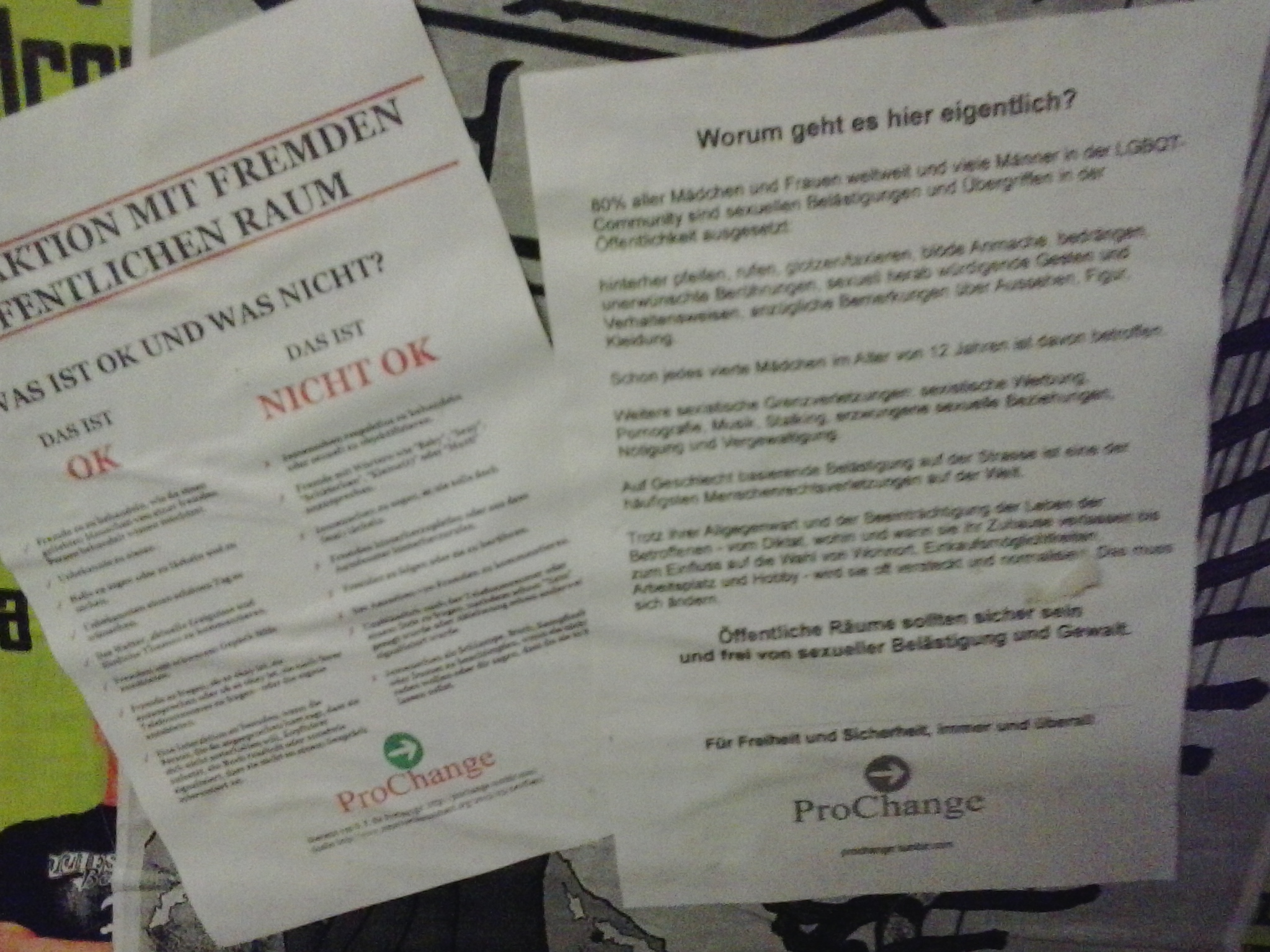
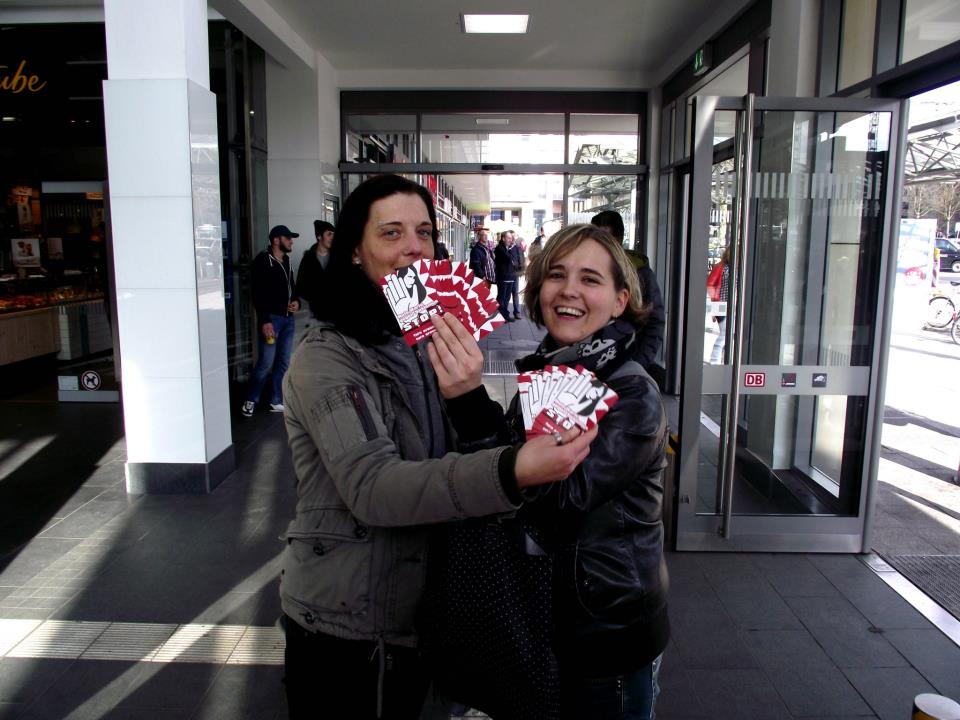
Dortmund (ProChange): During the week again we distributed our cards against sexism and homophobia as well as our beermats for sensitization. The cards are meant to be directly given to harassers to point out their misbehavior. The beermats inform about endangering situations and encourage people to take action.
Hollaback! Dresden
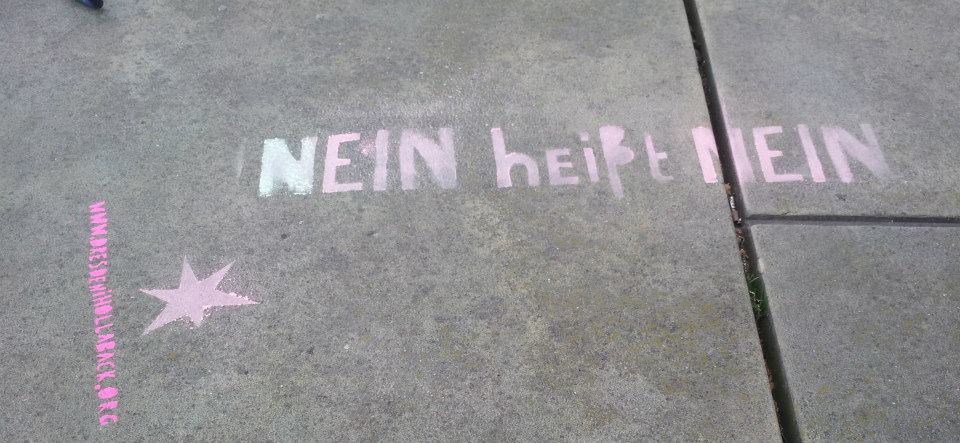
Dresden (Hollaback Dresden and outskirts): With colourful chalk and tough slogans we went for a walk together- like this we took action against sexual harassment in public on Saturday afternoon. In context of anti street harassment week we wanted to raise awareness on this problem and to “win back the streets” – because everyone should feel save and comfortable in public areas!!
Berlin
Berlin (Street harassment dresscode in Berlin): Chalk- colour- leaflets- glue- walk in Berlin.
Gender Equality Germany in Darmstadt

Darmstadt (Gender Equality Germany): “We were active everywhere in Darmstadt distributing our leaflets, starting conversations and we enjoyed it lots! Hopefully more people want to take part in our next actions- we are open for everyone!”

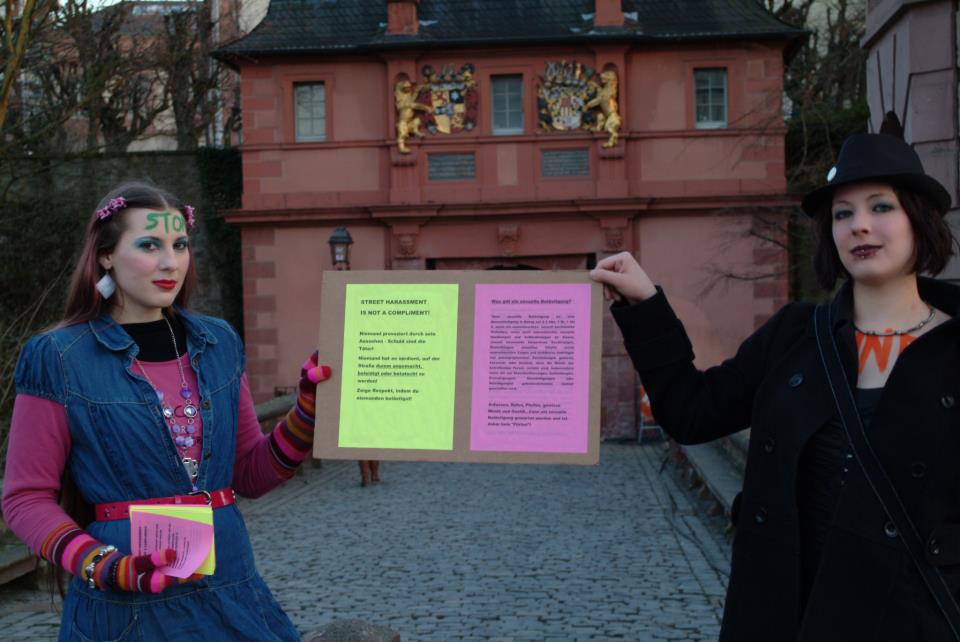
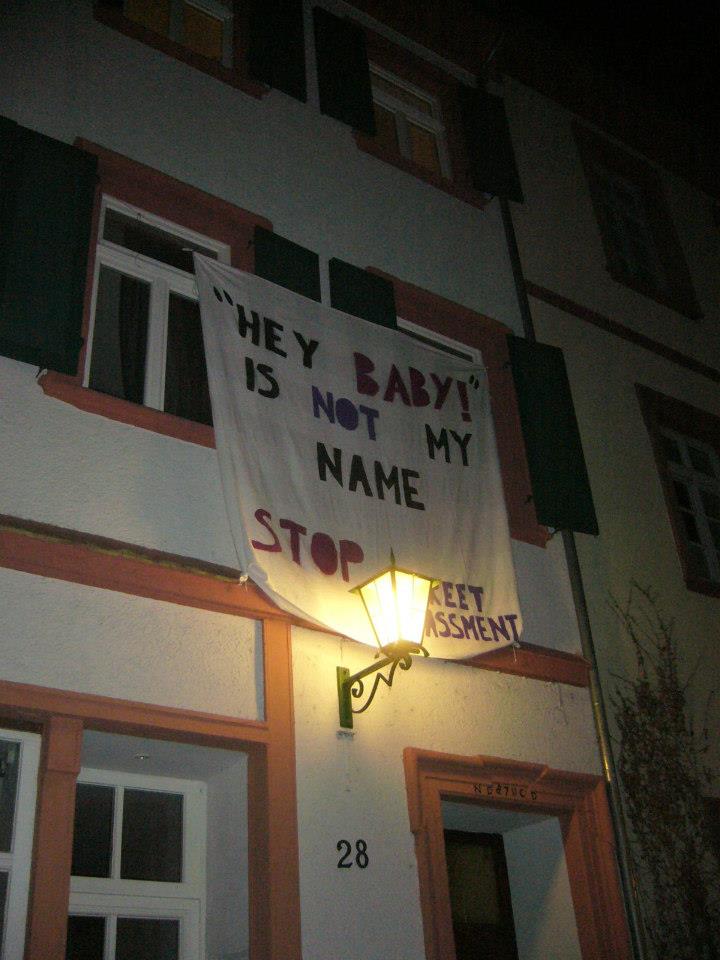
Heidelberg (AK Gender): Anti Street Harassment Action
Share

Filed Under: anti-street harassment week, street harassment

HarassMap Teams Creates Safe Areas in Egypt

April 23, 2013 By HKearl

Hussein Elshafei of Harassmap in Egypt shared what his organization did for International Anti-Street Harassment Week:

“Harassmap is an initiative with the mission to end the social acceptability of sexual harassment in Egypt.

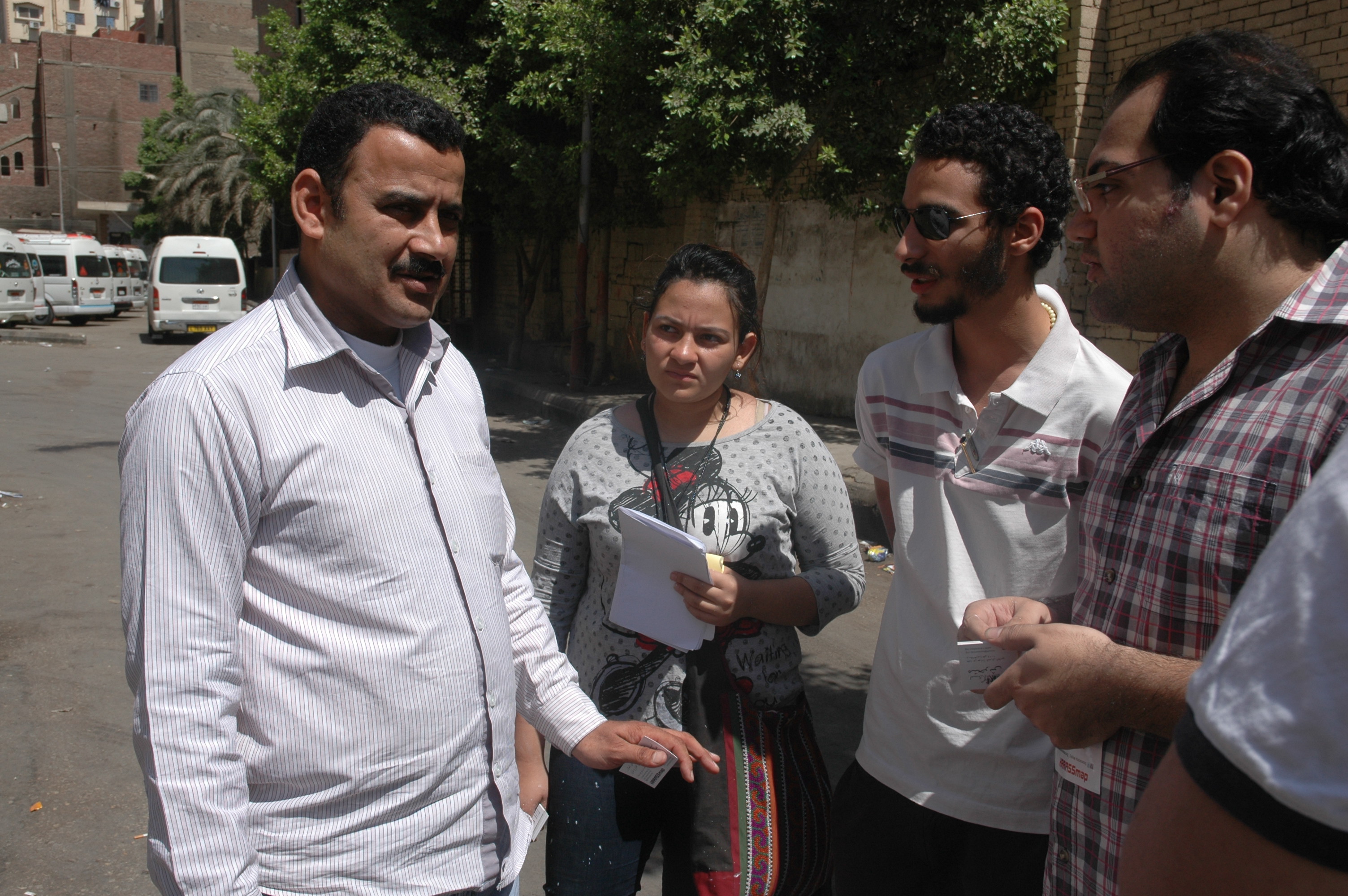
In pursuit of that mission. 2 volunteer groups were mobilized on the 5th and the 6th of April, in Giza and Alexandria respectively. They targeted bystanders on the streets, and conducted successful campaigns to turn their neighborhoods into safe areas. Safe areas are not necessarily free of sexual harassment. However, a safe area guarantees that, if harassment happens, there will be social consequences.

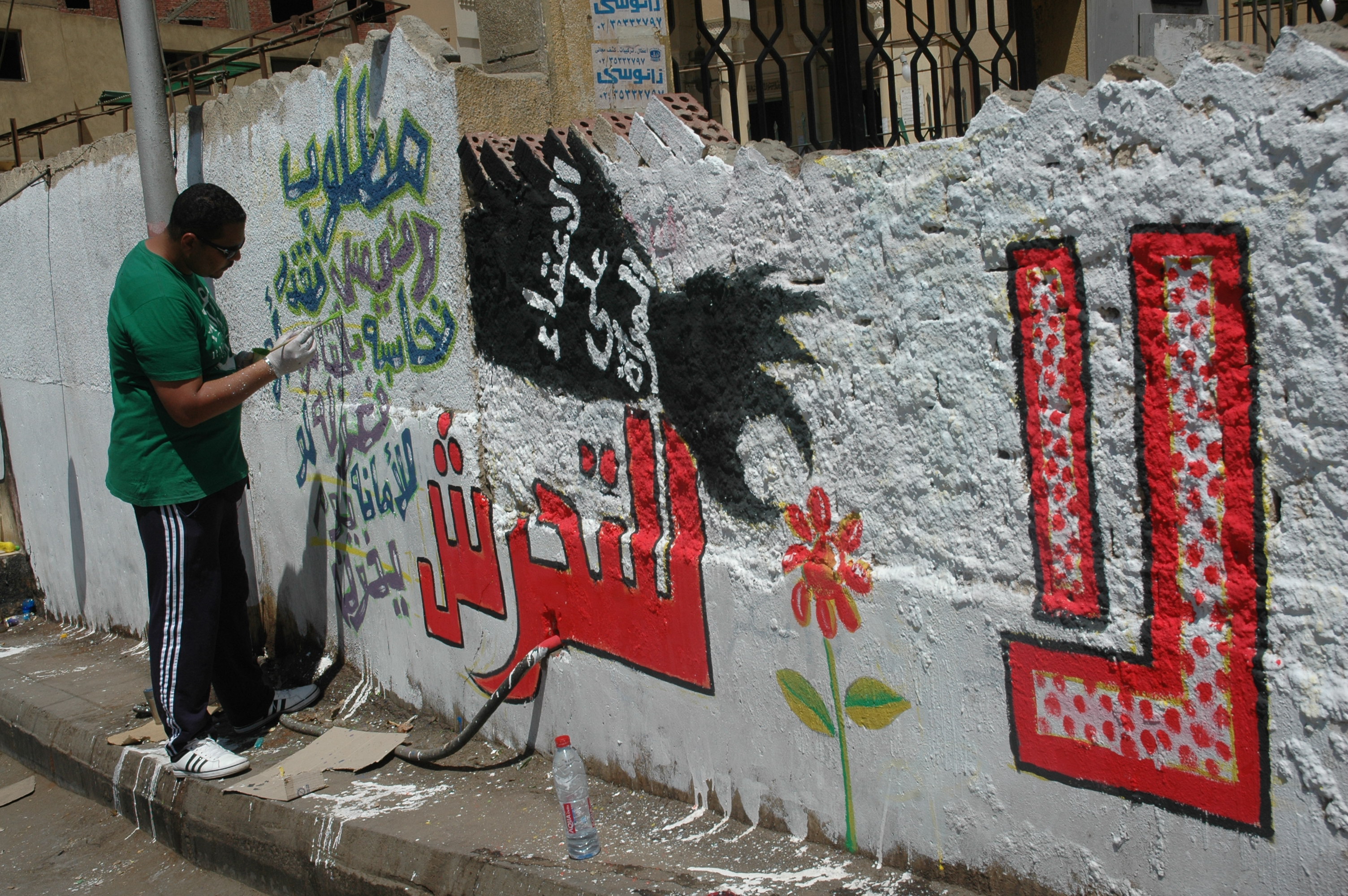
The Giza team conducted its outreach campaign at a bus stop. Reactions varied from aggression to complete understanding and changing perceptions. A graffiti message that says, “Be a man; protect her from harassment instead of harassing her” and another that says, “No to harassment,” were made during the campaign.

The Alexandria team conducted its campaign around Alexandria’s biggest shopping mall. A sexist graffiti that promotes violent harassment was erased by the volunteers and they wrote ‘Love’ instead.”

Share

Filed Under: anti-street harassment week, street harassment

Stopping Street Harassment, One Flier At A Time

April 18, 2013 By Contributor

By: Julie Mastrine, USA

Fighting street harassment doesn’t have to be difficult–sometimes it just takes bold font and a few sheets of paper.

Last October, I helped to organize a student sidewalk protest of street harassment here in State College, PA, home to Penn State University. I graduated from PSU in December, but as a social media volunteer for Stop Street Harassment, I still wanted a way to spread the anti-street harassment message on campus, particularly in light of April’s International Anti-Street Harassment Week. Transitioning away from student activism and into a full-time job has taken up a lot of my time, so I devised a way to get the message out quickly: bold fliers.

With the help of my twin sister Amy (a lady with killer InDesign skills), we created the fliers you see above. We wanted something fearless yet simple, something big and loud that would grab the attention of tired collegiate passerby. We wanted something that would truly stand out against the mass of fliers already cluttering bulletin boards on Penn State’s campus.

We came up with these simple designs, using clean fonts and bold colors to illustrate hurtful comments women often hear on the street. We made sure to couple them with fliers that spoke to our real message: “My body is not public space,” and “It’s not a compliment, it’s harassment.”

Creating fliers is perfect for spreading an anti-harassment message in the streets, in buildings, or even online. Fliers won’t hurt your wallet (just a few cents per print!) and offer an easy way to engage in anti-street harassment efforts even when you’re strapped for time.

Here’s to fliers, feminists, and a future free from harassment!

Julie Mastrine is an activist, feminist, and writer working in the PR industry. She holds a B.A. in Public Relations from Penn State University, and is a social media volunteer for Stop Street Harassment. You can follow Julie on Twitter.

Share

Filed Under: anti-street harassment week, street harassment

The F-Word: When is a compliment not a compliment?

April 15, 2013 By Contributor

This article is by Eve Livingston, a college student in Edinburgh, and is cross-posted with permission from Nanu Edinburgh.

“To understand a man”, said somebody wise once, “you must first walk a mile in his shoes.. It’s a proverb widely reused across popular culture, and often mis-attributed to To Kill A Mockingbird’s resident moral compass Atticus Finch who in actual fact talked of how “You never really understand a person until you consider things from his point of view – until you climb into his skin and walk around in it.” It’s a nice idea, and one that more people should employ in their day-to-day lives – try to see things from other points of view, but acknowledge that nobody can truly understand the problems facing someone but that person him/herself. It is in fact an idea that has much to contribute to feminist discussions of male privilege and intersectionality (the notion that all types of oppression are interconnected and can’t be examined in isolation from each other). Oh Atticus Finch, you feminist icon, you.

It’s no coincidence, though, that these classic lines are gendered in favour of men. Too often the world has worn the shoes of its male inhabitants, with the result that ‘women’s issues’ are frequently dismissed because of their invisibility to those who write the papers and the policy, those who run boardrooms and bars alike. One such issue is that of street harassment, and it’s one that International Anti Street-Harassment Week, which ended yesterday, has attempted to address. When taking street harassment generally to refer to any unwanted verbal or physical attention in a public place, 99% of women over 13 report having experienced it – and yet too often they’re met with disdain as to why they’ve over-reacted to a compliment, or the hilaaaarious joke that us lads would love it if more women pinched us on the bum in nightclubs, ho ho ho.

And maybe you would. Because street harassment is itself symbolic of a wider power relation in which men dominate and control public space. It would be totally out of order (not to mention out of character) for me to smack a man’s bum in the street, but it’s unlikely to evoke the same level of intimidation and panic for him as it does for the 14-year-old girl being followed home from school, or the woman leaving a bar alone with her heart rate raised as she clocks the men standing in a doorway, or the student who’s scared to wait for the bus because of the men in the bus stop making lewd comments. In fact, I’d probably be called a slag or a whore were I to engage in the street harassment behaviour that women experience every day. It is, of course, another signifier that men run the show when it comes to sex. They’re the ones with the desires that just can’t be suppressed and find their outlet in a wolf whistle or a sleazy comment while women find themselves the passive recipients, labelled a slut if they do and a slut if they don’t.

And street harassment doesn’t just refer to these wolfwhistles or sleazy comments. You only need to glance over Everyday Sexism’s #shoutingback hashtag, or the official Anti-Street Harassment Week one #EndSH to see that behaviours we might view as extreme are actually commonplace; women being followed is a common theme, as is the threat of violence. Far too many women report men exposing themselves and often even pleasuring themselves in front of them. Transport is a place full of potential dangers. Going for a jog isn’t safe either. Don’t even mention nightclubs or offices. Young girls aren’t free from harassment, just as harassers start young with women reporting obscene comments from groups of boys as young as 12. It doesn’t matter if they think you’re attractive or not; sometimes you’ll get sexual orders yelled at you, sometimes you’ll be called ‘an ugly dyke’ or laughed at. There is no place in the public sphere safe from harassment, and so street harassment is not a non-issue unless you’re totally fine with women staying indoors all day too afraid to leave. What is there to see outside anyway? Nothing the menfolk can’t deal with.

That men feel entitled to women’s bodies doesn’t bode well in the age of Steubenville and the New Delhi rape. That boys as young as 12 have a sense of male privilege where the sole purpose of women is for their sexual satisfaction doesn’t bode well in a culture where we routinely blame and ostracise women for their rape, while letting perpetrators off on the basis of their victims’ heel height or blood alcohol level. As long as you think that rape and sexual assault are issues, street harassment can’t be invisible. It’s the ugly undercurrent of patriarchy. It is at once a root and a symptom of rape culture.

There’s a misguided idea that it’s difficult for a man to compliment a woman without her getting on her high horse and slapping his hand away, god forbid he should speak to her like that. I’d like to counter that with the somewhat revolutionary suggestion that women, like men, are just human beings. Compliments are good, we like them too. The dictionary definition of ‘compliment’ refers to ‘politeness’. Compliment away! Some of us go out looking for compliments. Some of us go out looking for sex, much like some men do. Feel free to indulge us. The same social cues that apply to men actually apply to us too; if a man isn’t receptive and doesn’t engage with you, you probably leave him alone, right? I hope you’re catching on by now; treat women like human beings with the same respect afforded to anyone else and you’ll be just dandy. If you’re still stuck: when is a compliment not a compliment? When it’s a threat or a statement of intent.

So maybe it’s about time for minimisers of street harassment to walk a mile in a woman’s shoes, or climb into her skin and walk around inside it. See how it feels for every public space to be a potential warzone; for your workplace or place of education to be intimidating, for a night out to turn sour, for your daily run to be punctuated with shouts and whistles. For you to ignore it all only for the perpetrator to turn nasty, and sometimes physically aggressive. For you to be blamed when this is the case, because you were inviting the attention, or giving attitude in the face of a compliment. Walk a mile in a woman’s shoes, or climb into her skin and walk around inside it for you to see that it makes no difference whether the shoes are high or flat, sparkly or plain. That it doesn’t matter if the skin is covered up or on display. Women will continue to receive this unwanted attention no matter what we look like or what we’re wearing, and we’ll continue to be blamed for it. As long as this remains the case, street harassment has to be an issue for everyone. The world has long been overdue a new pair of shoes.

Share

Filed Under: anti-street harassment week, street harassment

« Previous Page
Next Page »

Share Your Story

Share your street harassment story for the blog. Donate Now

From the Blog

  • #MeToo 2024 Study Released Today
  • Join International Anti-Street Harassment Week 2022
  • Giving Tuesday – Fund the Hotline
  • Thank You – International Anti-Street Harassment Week 2021
  • Share Your Story – Safecity and Catcalls Collaboration

Buy the Book

  • Contact
  • Events
  • Join Us
  • Donate
  • Facebook
  • Instagram
  • Pinterest
  • Tumblr
  • Twitter
  • YouTube

Copyright © 2026 Stop Street Harassment · Website Design by Sarah Marie Lacy