• About Us
    • What Is Street Harassment?
    • Why Stopping Street Harassment Matters
    • Meet the Team
      • Board of Directors
      • Past Board Members
    • In The Media
  • Our Work
    • National Street Harassment Hotline
    • International Anti-Street Harassment Week
    • Blog Correspondents
      • Past SSH Correspondents
    • Safe Public Spaces Mentoring Program
    • Publications
    • National Studies
    • Campaigns against Companies
    • Washington, D.C. Activism
  • Our Books
  • Donate
  • Store

Stop Street Harassment

Making Public Spaces Safe and Welcoming

  • Facebook
  • Instagram
  • Pinterest
  • Tumblr
  • Twitter
  • YouTube
  • Home
  • Blog
    • Harassment Stories
    • Blog Correspondents
    • Street Respect Stories
  • Help & Advice
    • National Street Harassment Hotline
    • Dealing With Harassers
      • Assertive Responses
      • Reporting Harassers
      • Bystander Responses
      • Creative Responses
    • What to Do Before or After Harassment
    • Street Harassment and the Law
  • Resources
    • Definitions
    • Statistics
    • Articles & Books
    • Anti-Harassment Groups & Campaigns
    • Male Allies
      • Educating Boys & Men
      • How to Talk to Women
      • Bystander Tips
    • Video Clips
    • Images & Flyers
  • Take Community Action
  • Contact

What men need to do for women to feel safe

April 7, 2013 By Contributor

This is a guest blog post for International Anti-Street Harassment Week 2013 by Lea Goelnitz, Germany.

Street harassment is a strategy to scare women away from the public space so they do not work or go to school, earn their own money, go into politics, make decisions, claim property and take power.
I feel harassed when I receive unwanted attention in the street (for the record, basically all of it is unwanted), and the only one who decides what is unwanted is myself. When I am alone in public, I am usually going somewhere deliberately. So when strange men talk to me or stare at me, that means it is assumed that whatever I am up to do is less important than what they are doing and it is fine to interrupt me and demand my attention.

Even if that does not physically hurt me, it destroys my feeling of security and shows me that my time and me as a person is perceived as less valuable compared to others. So the message to me on a personal level is that I am made to feel uncomfortable and out of place because I dared to be in the male dominated public space, where according to them I should not be. I am being punished for participating in everyday life.

If I ask male friends what precaution they take when they step out into the street, they are confused. They do not take another way, dress differently, behave differently, try not to be too drunk and go home earlier or take a taxi instead of walking. They do not do any of these things, meaning that they feel safe enough just doing what they want.

The permanent feeling of insecurity makes women follow unwritten rules to go out in public.

They are always careful, they are made to think about what to wear (although not at all relevant as a strategy to avoid harassment), avoid going out alone, go in groups or with trustworthy male friend, avoid being out in the dark, avoid certain routes, avoid to generate attention, change their body language and attitude.

We debate on the advantages and disadvantages of pepper spray and other “weapons”, we strategize on routes to take to places and on responses we give in which situation to which men, considering what is possible to do and say in regard to the amount of men, the level of aggression and if it is daytime or night time. We applaud each other when we managed to react in a way, which did not leave us feel powerless.

For all these efforts we are neither rewarded by feeling safe, nor are these restrains publicly acknowledged.

The women-focused victim-blaming approach did NOT result in a decrease of harassment, rape, murder and other gender-based violence. More women might report more crimes. But clearly they do not feel safer.
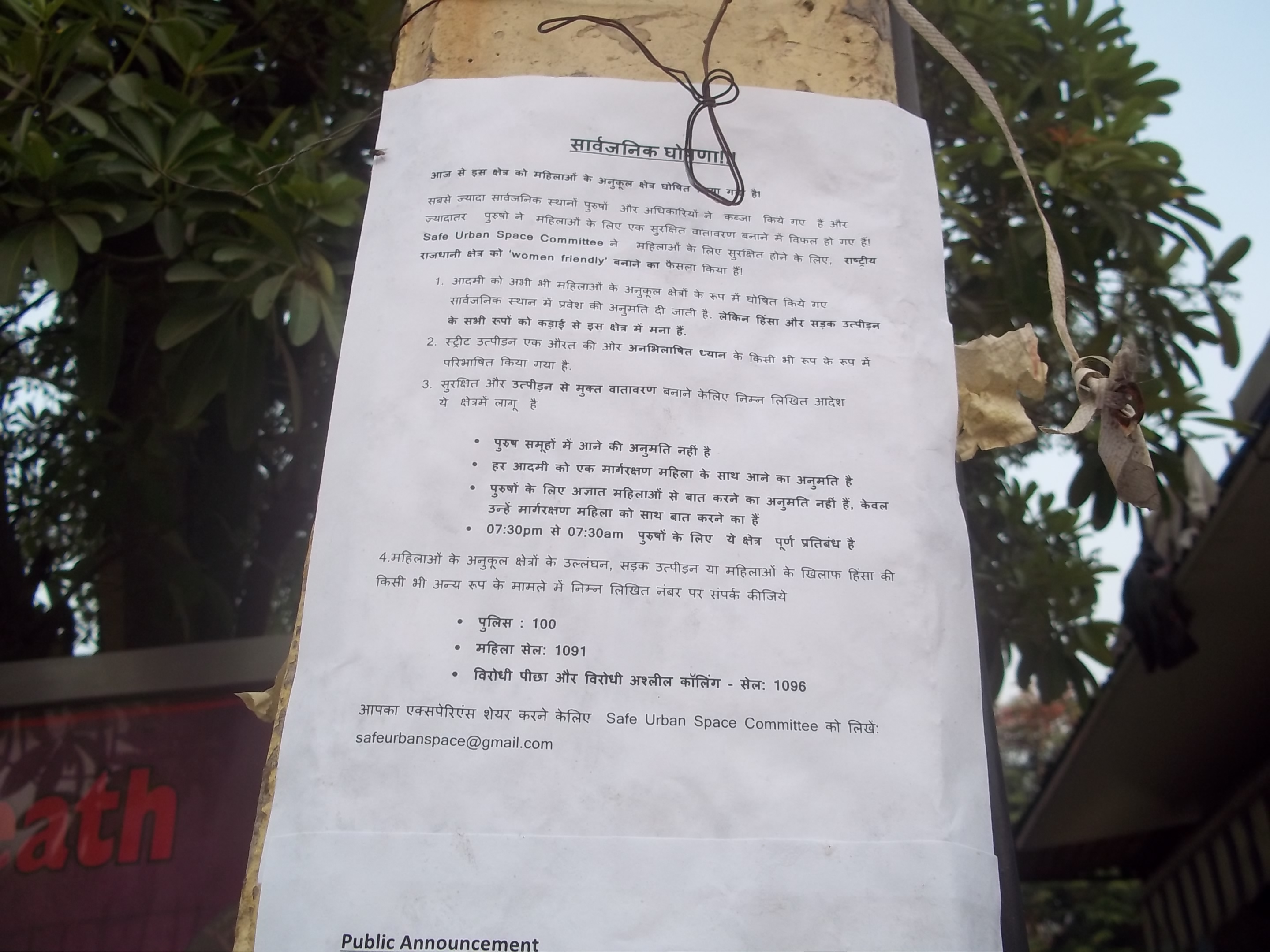
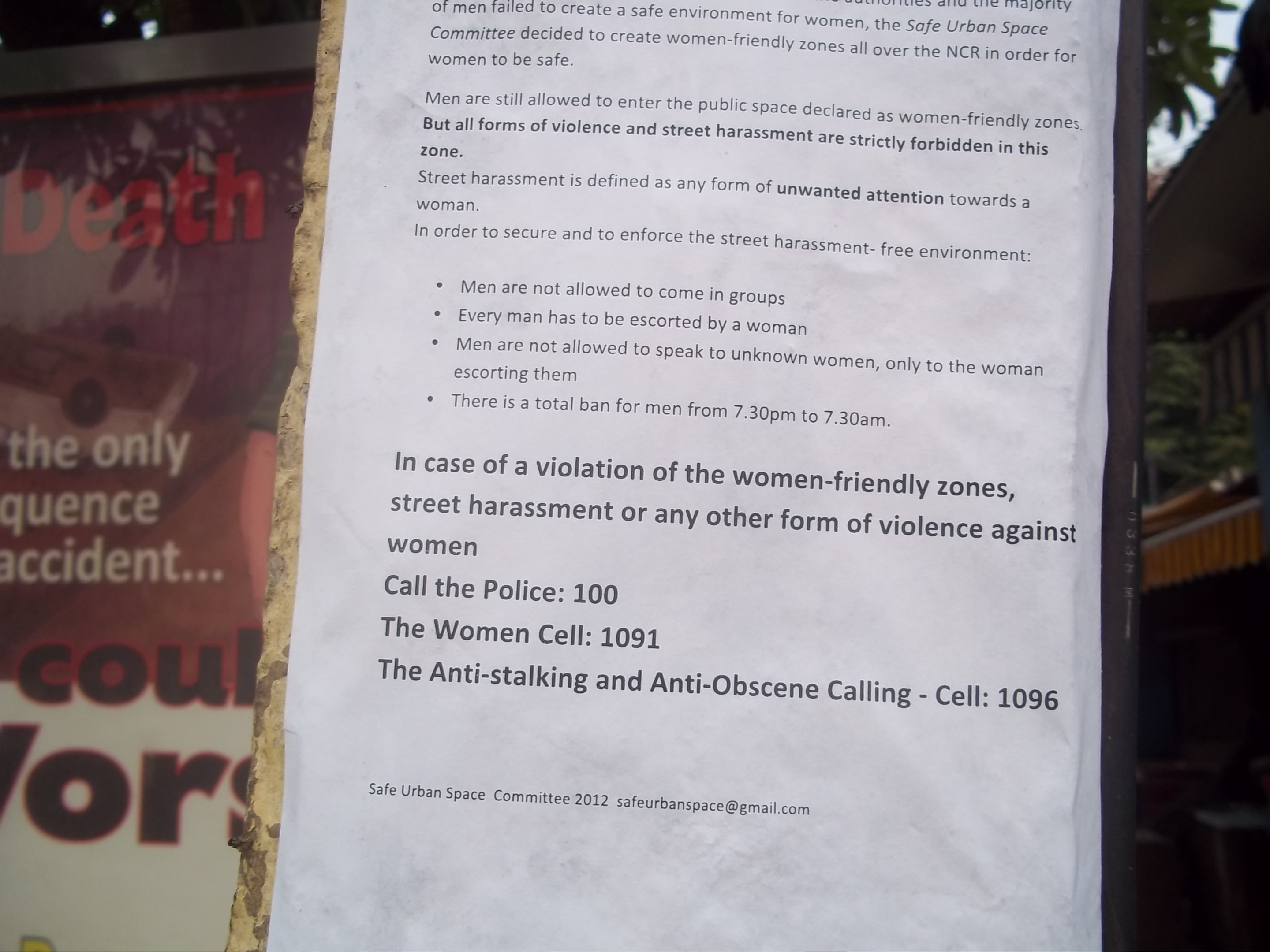
The women-only compartment in the Delhi metro inspired the Safe Urban Space Initiative I started with a friend in a Delhi neighborhood. Obviously, a women-only zone is backwards and no long-term solution. So the plan was to create women-friendly zones instead of women-only zones, in which men could enter, but in order to secure and to enforce a street harassment-free environment, these (half-seriously meant) opposite rules of what women follow in order to be safe, applied;

1. Men are not allowed to come in groups
2. Men have to be escorted by a woman, so that other women can see that he is ok.
3. Men are not allowed to approach and speak with unknown, in case there is need for communication, this can happen via the women who escorts him.
4. No cameras, no mobile phones, so that men cannot take pictures of women.
5. No staring!  If men are unsure if they are still creating an atmosphere of harassment, they have the option to be blindfolded
6. There is a total ban for men to be outside from 7.30 p.m. to 7.30 a.m.

The approach is perpetrator-based and solely focuses on what men need to do/ need to stop doing in order for women to feel safe.

Back in Germany, I got increasingly annoyed with the media coverage of gender-based violence outside of Europe. It is easier to talk about a (far away) country and portray that as barbaric and then not address the same issues at home, but instead using the same victim-blaming arguments.

This actually inspired a new initiative “There is no dress code for street harassment,” an online- exhibition of clothing. 

In order to shut down the re-occurring argument of blaming women for the way they dress, “provoking” men, the aim of the campaign is to visually demonstrate the range of clothing women are wearing when harassed.

Lea became an anti-street harassment activist when living in Delhi. Now living in Berlin, she is also involved in some anti- street harassment action.

Share

Filed Under: Activist Interviews, anti-street harassment week, street harassment

My body is NOT public space

April 6, 2013 By HKearl

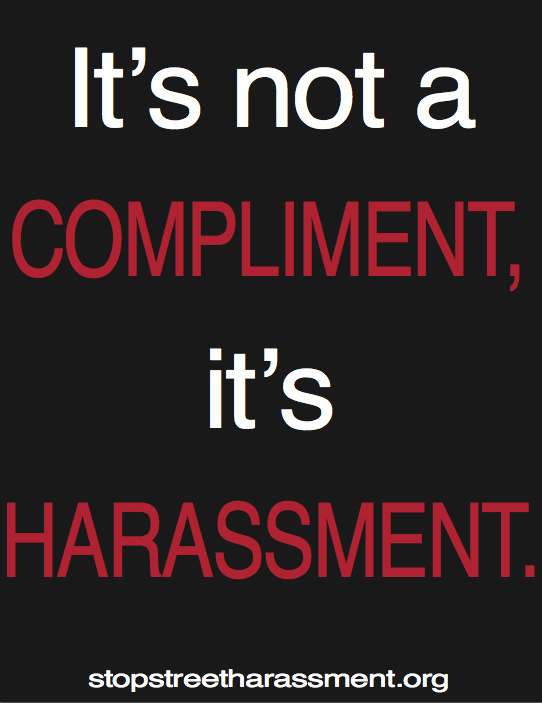
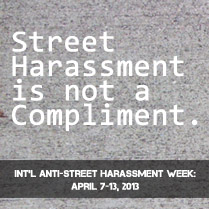
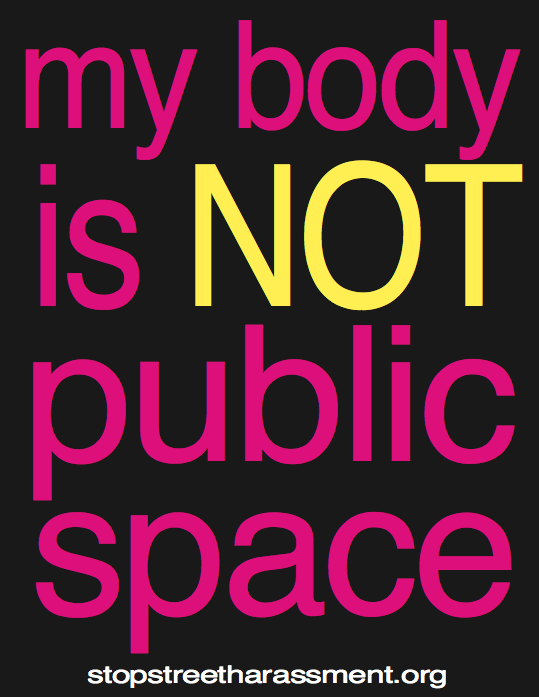
Tomorrow is the start of International Anti-Street Harassment Week! SSH media volunteer Julie Mastrine and her sister Amy created these shareable graphics for you to use!!

Share

Filed Under: anti-street harassment week, street harassment

USA: International Anti-Street Harassment Week

April 2, 2013 By Contributor

By: Erin McKelle, SSH Correspondent

Did you know that Stop Street Harassment’s founder Holly Kearl also founded International Anti-Street Harassment Week? It takes place every spring, this year from April 7-13, and is a time where you can work even MORE actively to stop street harassment. Its purpose is to raise awareness about street harassment through active engagement and amplification.

Anti-Street Harassment Week gives you the tools to do practically anything you want to commemorate this week.

Want to go to an event? On their website, they have listings of events taking place around the world. Conduct a survey on street harassment? They have tips to show you how. Not sure what you want to do? They have a whole page full of ideas from street theatre to poster campaigns to sidewalk chalk!

Participating can even be as easy as raising awareness about street harassment to your followers on Twitter or your friends on Facebook. It’s amazing how a little awareness and education can go a long, long way. If you are posting to twitter, use the tag #EndSHWeek or #EndSH ! On Facebook, you can also change your profile picture to an image related to ending street harassment which can be found here http://www.meetusonthestreet.org/tools/.

On the tools page, there is also a myriad of content you can use in your efforts during the week! There are blank fliers that you can use to write a message on, bystander posters, logos and even pre-made fliers you can give out.

You can also support Anti-Street Harassment Week by donating to the cause! It’s a great way to show your support and is always welcomed and appreciated!

Becoming a co-sponsor is another option. The only requirements are that you advertise Anti-Street Harassment Week to your networks and participate in the week! So far, there are 128 groups in 19 countries that are participating.

Here is where you can sign up to officially participate! Anti-Street Harassment Week is important for raising awareness and doing anything, big or small, to join in is a great way to be actively partake in this work. Empower yourself and others on the street and meet us on the street during Anti-Street Harassment Week!

For more information, please visit: http://www.meetusonthestreet.org

Erin is an e-activist and blogger based in Ohio. You can find more of her work here and here.

Share

Filed Under: anti-street harassment week, correspondents, Resources, street harassment

Action: Take Back Your Streets with Chalk!

March 30, 2013 By HKearl

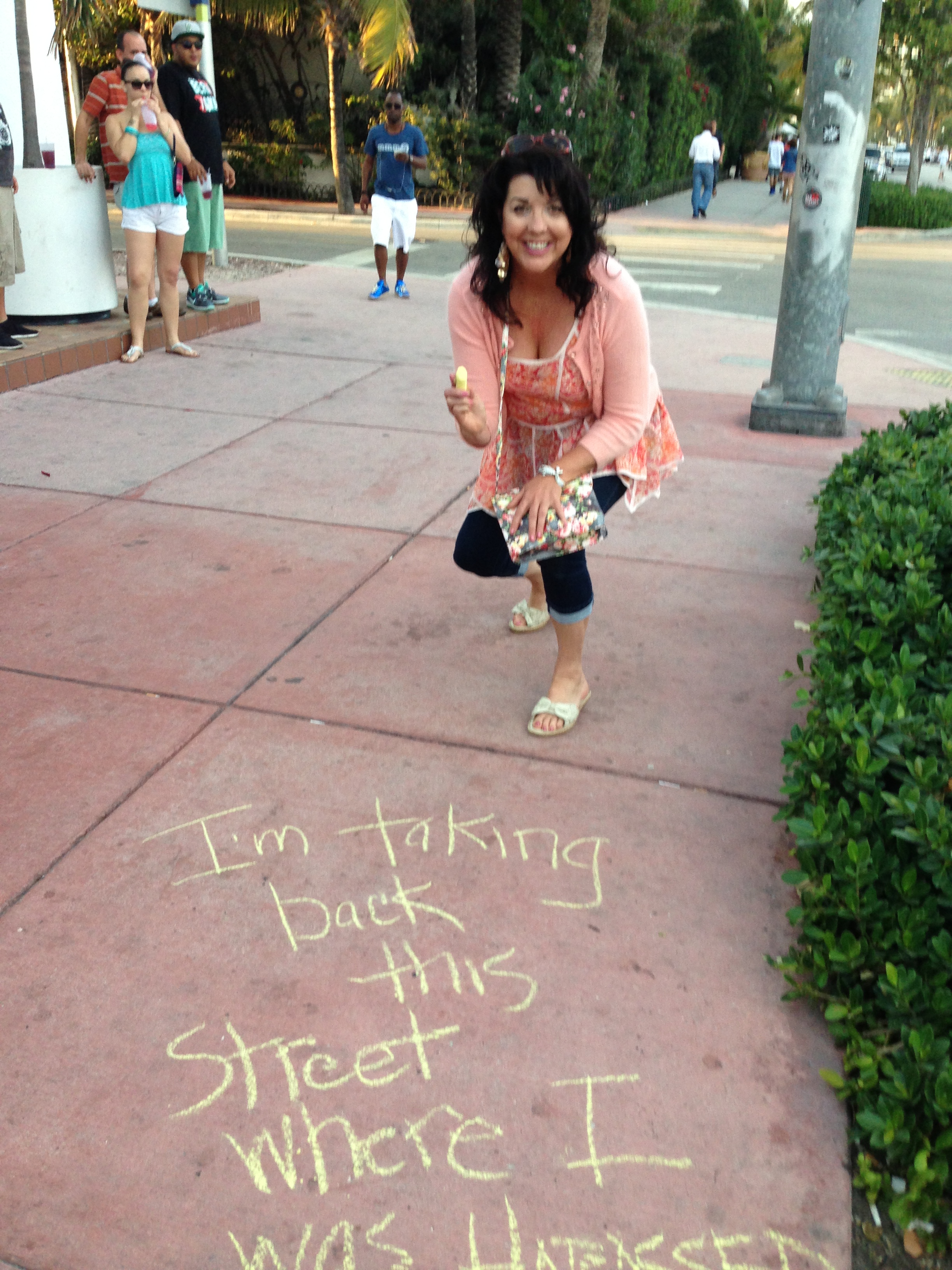
International Anti-Street Harassment Week begins in 8 days. One easy way to participate and help bring awareness to street harassment and empower yourself is by going to a place where you were harassed and reclaiming it with sidewalk chalk messaging!

My mom, Beckie Weinheimer, (pictured on the right) tried this out last night. She went to a place where she’d been harassed before in Florida and took back the sidewalk, took back the street, and reclaimed her right to be there un-harassed. She said, “It felt great!”

This act can also raise other people’s awareness about the problem. My mom said, “A lot of people stopped and two people took Stop Street Harassment stickers and said they will look your site up.”

I love how just one person can have a big impact with this method and I love that it’s easy and quick to do.

Last year, four women from Hollaback Brussels did a chalk walk to reclaim the places where they were harassed and they were able to empower themselves and generate a lot of conversations and consciousness-raising among passersby.  View their We Chalk Walk Tumblr of photos!

This year for International Anti-Street Harassment Week, End Violence Against Women Coalition, Hollaback! London, and others are asking people in London to chalk their streets with slogans, experiences and messages of solidarity throughout the week and send them to ldn@ihollaback.org to be tweeted and shared on social media.

No matter where you are for International Anti-Street Harassment Week (April 7-13), you can do the same. Take a photo of your sidewalk chalk message (either with you in the photo or just of the message) and send it to StopStreetHarassment AT yahoo DOT com and let me know where it is, and, if you feel comfortable, share the harassment story that happened to you there.

Share

Filed Under: anti-street harassment week, street harassment

Fliers: Street Harassment is…

March 27, 2013 By HKearl

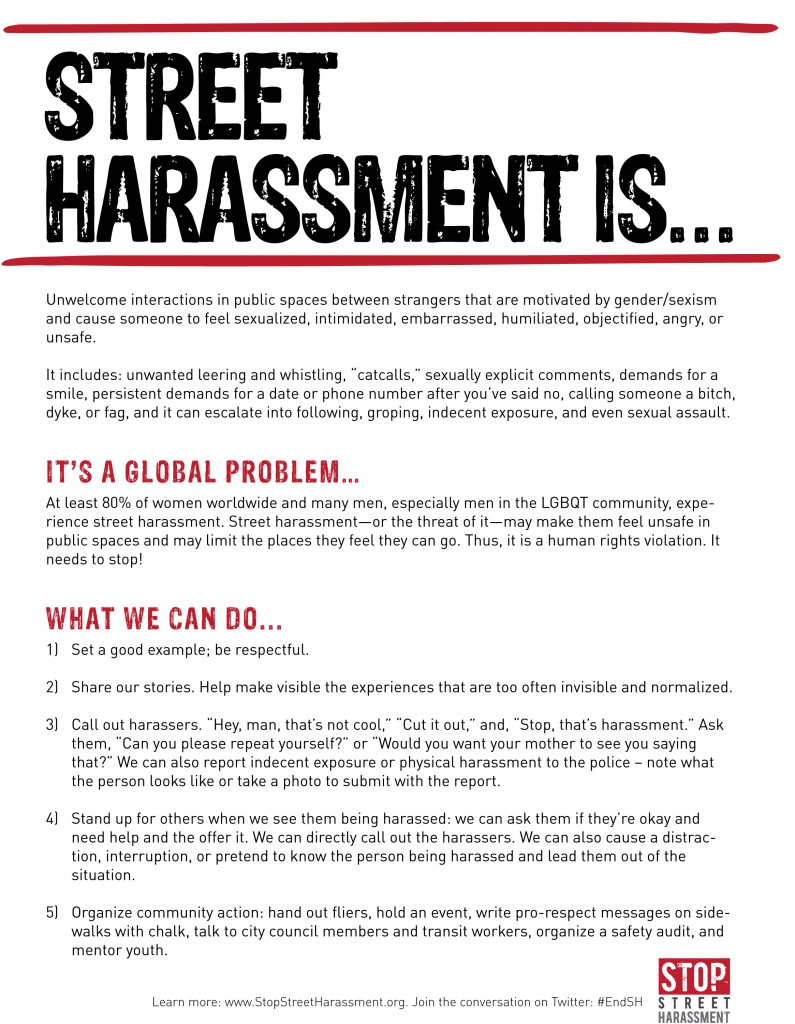
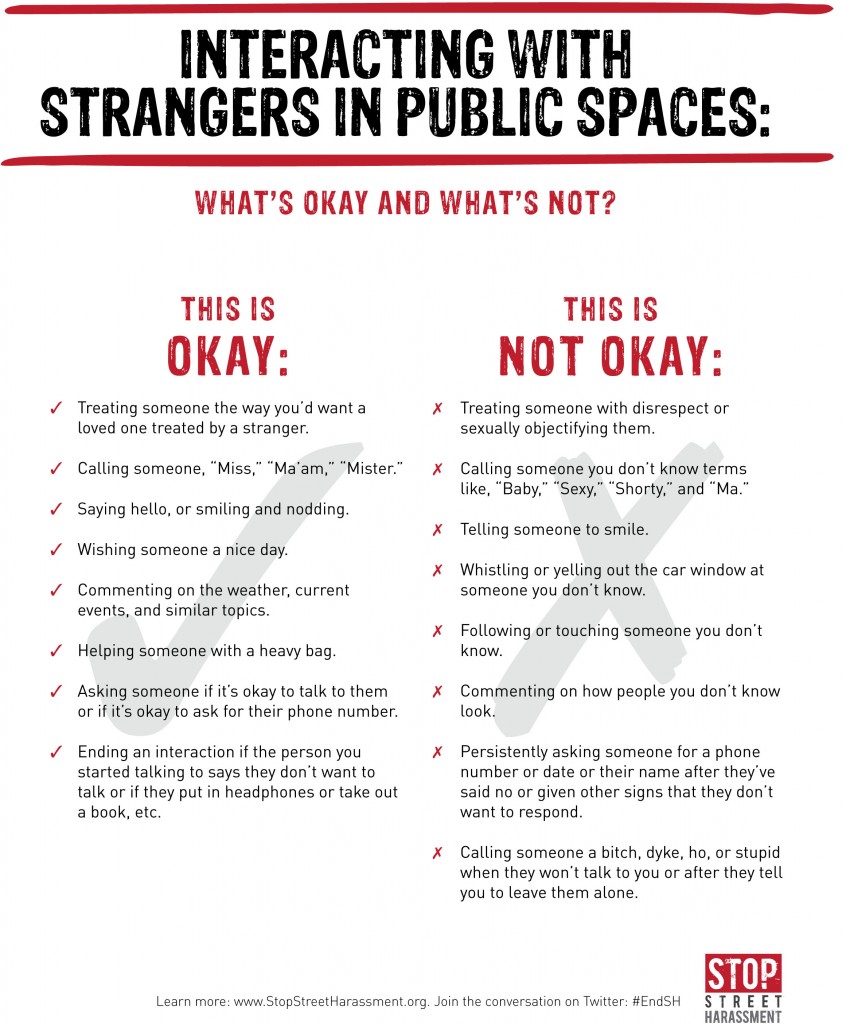
Here are new fliers you can download, print and use or share as images on social media.
Note, the second one is especially aimed at a younger audience as they may genuinely not know what are appropriate/inappropriate ways to interact with strangers in public spaces.

Thanks to my friend Alli VanKanegan for designing them.

Share

Filed Under: anti-street harassment week, Resources, street harassment

« Previous Page
Next Page »

Share Your Story

Share your street harassment story for the blog. Donate Now

From the Blog

  • #MeToo 2024 Study Released Today
  • Join International Anti-Street Harassment Week 2022
  • Giving Tuesday – Fund the Hotline
  • Thank You – International Anti-Street Harassment Week 2021
  • Share Your Story – Safecity and Catcalls Collaboration

Buy the Book

  • Contact
  • Events
  • Join Us
  • Donate
  • Facebook
  • Instagram
  • Pinterest
  • Tumblr
  • Twitter
  • YouTube

Copyright © 2026 Stop Street Harassment · Website Design by Sarah Marie Lacy