• About Us
    • What Is Street Harassment?
    • Why Stopping Street Harassment Matters
    • Meet the Team
      • Board of Directors
      • Past Board Members
    • In The Media
  • Our Work
    • National Street Harassment Hotline
    • International Anti-Street Harassment Week
    • Blog Correspondents
      • Past SSH Correspondents
    • Safe Public Spaces Mentoring Program
    • Publications
    • National Studies
    • Campaigns against Companies
    • Washington, D.C. Activism
  • Our Books
  • Donate
  • Store

Stop Street Harassment

Making Public Spaces Safe and Welcoming

  • Facebook
  • Instagram
  • Pinterest
  • Tumblr
  • Twitter
  • YouTube
  • Home
  • Blog
    • Harassment Stories
    • Blog Correspondents
    • Street Respect Stories
  • Help & Advice
    • National Street Harassment Hotline
    • Dealing With Harassers
      • Assertive Responses
      • Reporting Harassers
      • Bystander Responses
      • Creative Responses
    • What to Do Before or After Harassment
    • Street Harassment and the Law
  • Resources
    • Definitions
    • Statistics
    • Articles & Books
    • Anti-Harassment Groups & Campaigns
    • Male Allies
      • Educating Boys & Men
      • How to Talk to Women
      • Bystander Tips
    • Video Clips
    • Images & Flyers
  • Take Community Action
  • Contact

Education on street harassment in Delhi, India

March 21, 2012 By Contributor

This guest blog post is written by Parul with Jagori/Safe Delhi, in Delhi, India.
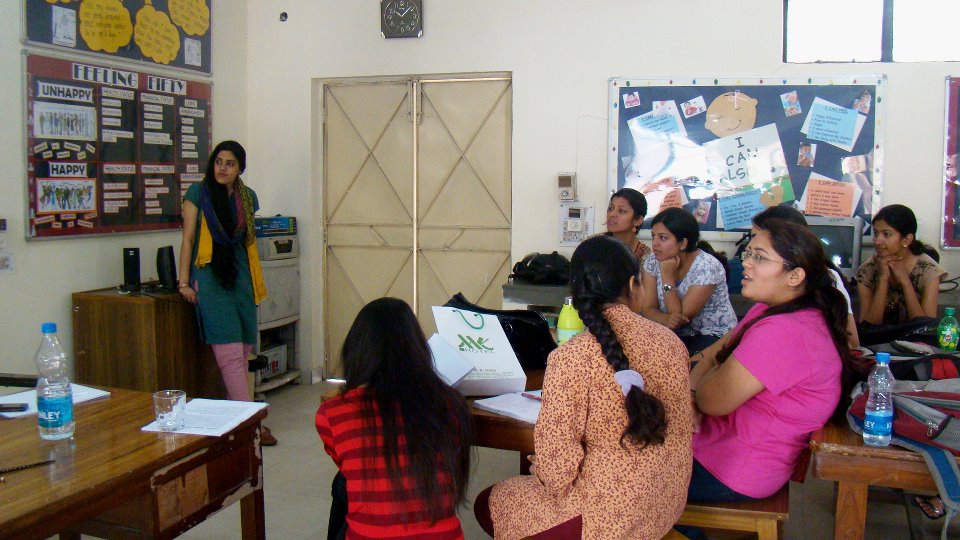
Discussion on the gendering of public spaces

The first day of The Global Anti Street Harassment Week 2012 was marked by an extensive discussion on the gendering of public spaces. Students from the Department of Human Development [at Delhi University] shared their personal experiences of ‘Gender’ as an identity that impacts their choices and opportunities to live equally in the city. The students deliberated on gaps in service provisions, like public toilets or well lit parks to also talking about the role of larger society to create an enabling environment for all.

Safe Delhi performances

With the remark that safety is a woman’s right to the city, the students undertook a ‘class to class campaign’, sharing with other students the message against sexual

harassment on streets and also sharing some emergency helpline numbers for women.

Two days later, an open lawn discussion with girls from Lady Sri Ram College for Women on ‘Reclaiming of Public Spaces’ occurred. There was an interesting discussion on the factors that make a place safe and unsafe.

A street play by the students on homosexuality marked the beginning of the discussion. The girls then shared a poster on ‘Helpline numbers’ in Delhi with their fellow students.

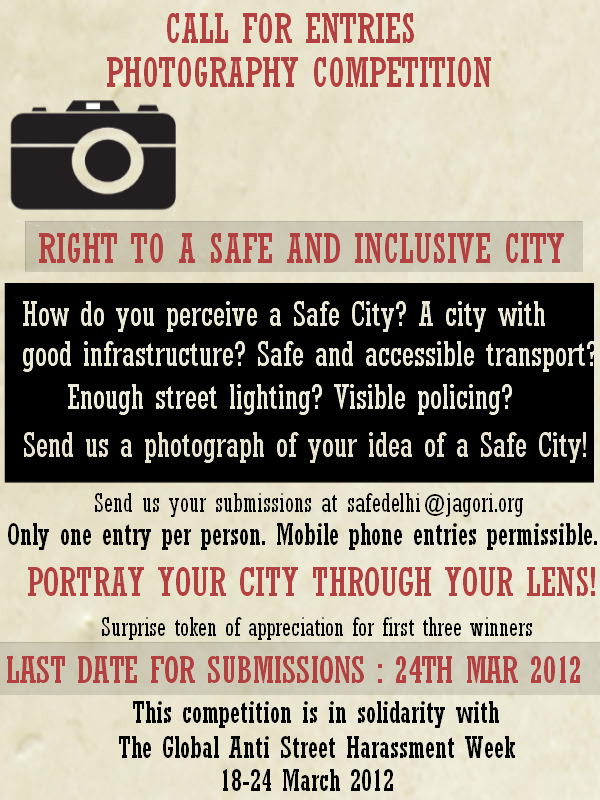
Other activities occurring so far include a photography competition on the topic the “Right to a Safe and Inclusive City” as well as online activities.

Share

Filed Under: anti-street harassment week Tagged With: delhi, Jagori, Safe Delhi

Day 4: Anti-Street Harassment Week

March 21, 2012 By HKearl

Stories, blogs and tweets are continuing to flood the Internet. check back tonight for a round-up of blog posts and join the #SheParty twitter chat from 3-5 p.m. EST today as we tweet about #StreetHarassment and #EndSHWeek.

Offline, here are examples of the events taking place today:

* In Montreal, Canada, Women in Cities International will launch their new report on gender inclusive cities, 2-4 p.m.

* In Pakistan students at university SZABIST are hosting a “How to respond to harassment” sessions and self defense class with Babar Khan Jawed.

* In San Francisco, CA, people will hand out anti-street harassment fliers outside the 16th Street Bart Station from 6-7 p.m.

* In Washington, DC, students and faculty at George Washington University will present about the street harassment LGBQT individuals face at 5 p.m.

* In Philadelphia, PA, there will be film screening and speak out, 7 p.m.

* The teenage girls with A Long Walk Home will march around their school community from 12:30-1:30 p.m., in Chicago IL.

It’s still not too late to plan something simple in your community, like handing out fliers or a sidewalk chalk party! There are still a few days left of the week and the biggest day of action will be Saturday, March 24.

Share

Filed Under: anti-street harassment week

Trayvon Martin: The streets should be safe for everyone.

March 21, 2012 By HKearl

Image via USA Today

The tragic and outrageous killing of 17-year-old Trayvon Martin by a Neighborhood Watch leader in Florida because he looked “suspicious” has become national news. Martin was unarmed, carrying snacks from a local convenience store, dressed like many teenagers dress: in a hoodie. What made him suspicious seems to be that he was black. George Zimmerman, the Neighborhood Watch leader, has not been charged with a crime because he says he was acting in self-defense, despite the mounting evidence showing Martin was not a threat at all.

Via USA Today:

“The case has resonated for many who say Martin died because of stereotypes of young black men as violent criminals. The shooting is already being compared with high-profile and historic civil rights cases — for instance, a doctored photograph has circulated throughout many social media sites that compares Martin to Emmett Till, a young man lynched by white men in 1950s Mississippi.

“It’s not about these individual acts of racism,” said Mark Neal, a professor of African and African American Studies at Duke University. “It’s about the way that black males are framed in the larger culture … as being violent, criminal and threats to safety and property.”

The tragic case played out in Sanford, population 54,000, about 30 minutes north of Orlando, when Martin left his father’s home to buy candy and iced tea for his little brother at a nearby 7-Eleven…

The fatal shooting touched a chord of community outrage in Sanford on Tuesday night. The killing was “a senseless murder as far as we are concerned,” Seminole County NAACP President Clayton Turner told a capacity crowd at the start of a town-hall-style meeting at Allen Chapel AME Church.

Clayton said the Sanford city manager and mayor were unable to attend because they had been “summoned” to Washington by Attorney General Eric Holder.

“The line has been drawn in the sand,” Clayton said. “We as people of color are going to stand our ground. We are going to do it in a non-violent way, and we are going to prevail.”

Before his son’s death, Tracy Martin warned son Trayvon that being a black man in America could be dangerous.

“I’ve always let him know we as African Americans get stereotyped,” Tracy Martin told USA TODAY. “I told him that society is cruel.”

As I often say and write, people are harassed – and killed – on the streets for all kinds of reasons: racism, homophobia, transphobia, classism, xenophobia, ablism, and sexism. And too often they are harassed for a combination of those reasons. Martin’s death is a very, very sad example of the racial harassment and profiling that still occurs.

While this site focuses on harassment motivated by gender, that harassment does not happen in isolation. The issues are complex and often inter-related. And the streets should be safe for everyone.

If you’re on twitter, join the Women’s Media Center #SheParty chat today, 3-5 p.m. EST. Martin’s death, racial profiling, harassment of men of color by police and how these topics intersect with gender-based street harassment will be one of the topics of conversation.

Share

Filed Under: anti-street harassment week, News stories Tagged With: murder, street harassment, Trayvon Martin

Day 3: Anti-Street Harassment Week

March 20, 2012 By HKearl

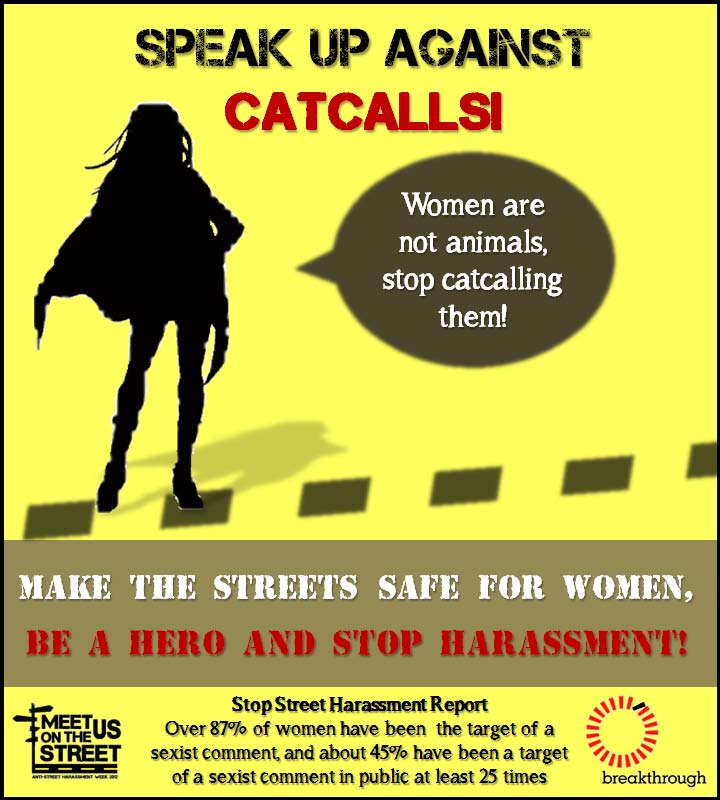
Breakthrough's bystander campaign poster

What a day!  We saw the “Shit Men Say to Men Who Say Shit to Women on the Street” video surpass 69,000 views since it’s launch yesterday (read the back-story for the video) and the Internet come alive with stories, tweets, and blog posts about street harassment.

Most offline events are taking place later in the week, but this afternoon, middle school students took a self-defense class in New York City and the event was co-sponsored by the Center for Anti-Violence Education and City Council Member Julissa Ferreras’ Office (thanks to my mom for attending and live-tweeting the event!). Throughout the whole week, many schools and groups that work with youth will be talking about street harassment during classes and in after-school programs.

Are you on twitter? Search for “street harassment,” “#streetharassment,” and “#EndSHWeek” to find a continuous conversation occurring around the street harassment (and join the #SheParty chat tomorrow at 3 p.m. EST for a dedicated chat on street harassment).

Finally, here’s a quick sampling of today’s blog posts and articles on the topic of street harassment:

Ebony:

“International Anti-Street Harassment Week is necessary because street harassment is not an isolated problem.  “Street harassment is not a ‘woman’s problem,’ [Nuala] Cabral says, “Men are a big part of the problem and they need to be a part of the solution.  This week is about standing in solidarity with people throughout the world and sending the message that street harassment is not okay.  For many of us who experience street harassment regularly, it often feels normalized because we are used to it. But street harassment is not normal and it hurts our community.  I hope [International Anti-Street Harassment] week of action makes this [fact] more clear.”

Clutch Magazine:

“Whistles, arm-grabs, flashing, random sexual comments and insults, thrown objects, or even just what pretends to be an innocent “hollla” that turns into physical assault…the list of what young women (and for that matter old women and some men) can face while simply walking down the street is endless. It’s happened to almost everyone, and anyone who’s experienced it knows that street harassment isn’t just “boys being boys.” These interactions leave victims feeling powerless, unwelcome, and wear at feelings of safety and self-esteem over time. And it happens everywhere, every day.

International Anti-Street Harassment Week aims to change that by setting aside March 18 – 24 to spread awareness, share stories, and ask men to join women in solidarity against the problem.”

Feministing.com:

“By age 12, nearly 1 in 4 girls experience unwanted sexual comments, leers, touches, and stalking in public places by strangers. Nearly 90 percent of women have that experience by age 19.

Street harassment teaches girls that public places are male territory and they are prey to male predators of all ages. The harassment restricts their access to public places and impedes gender equality. Street harassment—including scary amounts of violence—also disproportionately and negatively impacts LGBQT individuals.

This is unacceptable.”

Bust Magazine:

“While the S**t Whoever Says meme is (thankfully) on its way out, what is interesting about this video’s approach is that it puts the responsibility to end street harassment on men, rather than the all too common victim-blaming approach that shames women for wearing the wrong clothes, walking with the wrong swagger in their hips, or being in the wrong part of town. This video, starring men talking to men, rightly places the blame on who deserves it: the perpetrators, not victims, of street harassment.

“Has that ever really worked for you?”
“I don’t care if you think she’s hot, that’s not okay.”
“Misogyny… super sexy.”

So ladies, share this video with the men in your lives and remind them that it’s not a compliment. It’s street harassment, and it’s not okay.”

Gender Across Borders:

“As a woman who has suffered the indignity of street harassment with a great degree of consistency for years, believe me when I say that it is infuriating. While women attempt to break through the glass ceiling, highlight the deeply rooted cultural misogyny that functions to define our culture, and simply get to work in the morning, they are constantly reminded by the strangers they seek to avoid encountering on the street, that they are living in a society run by men who are incapable of seeing them as human beings. Globally, street harassment is a social malady that persistently robs women of the chance at living lives where they can enjoy the basic freedoms to which all human beings are entitled, and which are the cornerstone of any civilized society. As we celebrate International Anti-Street Harassment week, I find myself reflecting on actions I can further take in my daily life to resist street harassment. The question remains, what will you do?”

CALCASA:

Podcast interview with Hollaback’s Emily May about their new bystander campaign launching on Thursday.

Hello Giggles:

“Halfway through high school, I transferred to an all-girl school and for the first six months, I refused to wear the cliché girls’ school uniform skirt and sweater. I figured that, for once, I wouldn’t get catcalled from every car that drove by on my walk home, because awkwardly fitting khaki pants and oversize grey sweaters were sure to render me invisible. Turns out, you can pretty much walk around in a giant potato sack; as long as you’re a girl, creepsters will still do their thing. Whoop-de-doo.

“But it’s just harmless flattery, why do you have to be such a Feminazi about a guy trying to pay you a compliment, Julia?” Well, me, I’m glad we asked us that. It’s not flattery, actually – it’s harassment. Street harassment, to use the official term. And the thing about street harassment is that it is not meant to be a compliment, but, in fact, an aggressive assertion of male dominance by dehumanizing and hypersexualizing someone. Fun fact: street harassment is not reserved just for women! It’s now available to all members of the LGBTQ community, too! Oh, yeah, about the Feminazi thing? Me standing up for my rights and personal safety don’t warrant a label trying to arbitrarily draw a comparison between my empowerment in the face of social inequality and the German National Socialist Workers Party  responsible for the largest genocide Europe has seen since the Crusades. You do sound like an idiot when you use the term, though, so thank you for identifying yourself! I can now avoid future interaction with you.”

PolicyMic:

“It should not be OK for anyone to be sexually harassed. Street harassment is not the same as flirting; it should not be the way you try and get your next hook-up or boyfriend. I mean, does it even work? I should not have to feel uncomfortable or automatically put my guard up when I pass a group of guys on the street and you shouldn’t want your sisters or mothers to have to go through that either — and trust me, they have on many occasions.  The psychological effects of street harassment have yet to be studied. I’m sure that it would be difficult to get conclusive results anyway but I fear the negative effects street harassment can have on a young girl’s confidence or image of herself. Women should not need, and men should not assume that women need, their verbal approval on the street.

Street harassment is a manifestation of our patriarchal society. It is only one of the many ways that  women are sexually subjugated every single day. Movements like this bring awareness to the issues of street harassment but we need policymakers to continue the work. The path for effective anti-street harassment legislation will be a difficult one; it will be hard to set clear, distinct, and fair criteria and punishments, but I strongly believe that it is necessary to try.”

BitchLit:

“As I stand at the bus stop I am acutely aware of male heads turning to leer as they drive by. I wonder why they can’t keep their eyes on the road. At one point a car load of men scream and catcall out their open windows as they speed away looking for other women to harass. All at once my skirt seems too short, my legs too long and bare, my breasts too big and exposed. In an attempt to refocus, I share a disgusted look and heavily exhale with the other women at the bus stop. One woman mutters, “jerks,” under her breath. What else can we do? Welcome to Spring.”

Black Feminist UK:

“I am a bit tired of being asked told how bad things are in India – whether it is a feminist of color in the States who could never imagine herself in a place like Bombay because all the touching would just make her so mad, or the white British guy who informed me (with a pat on my back, no less…) that I should visit Scandinavia because then I’d see that patriarchy isn’t really universal. I am frustrated at attempts to hierarchize subjugation and violence; sickened by gestures that (re)position black and brown folks, men especially, as yet awaiting some form of moral enlightenment. That is the reproduction of the colonial, and I cannot stand (for) it.

It may seem odd, perhaps, that a post (by a woman) on street-harassment (primarily enacted by men) appears invested in the recuperation of the male figure. But recuperation is not the same as protection. I have no desire to ‘protect’ eve-teasers in Bombay from accusations of sexism, misogyny or patriarchy. But equally, even as I pose such critiques, I have no desire to pander to, or satisfy, a colonial/racial gaze. Thus, for me, any recuperative gesture is also, and precisely, a refusal. A thick refusal, in fact, of all that, ultimately, has been imposed upon me.”

Feminaust:

“It got me thinking about my own experiences of street-harassment. They’re fairly unusual but they certainly do happen. I’m hesitant to put their rarity down to my demeanour or dress choice as I know that street-harassment rarely has anything to do with what the individual actually looks like however, as I ramp up my bike time in preparation for a big bike tour I’m undertaking in May I’m starting to notice that the street-harassment aimed my way is also ramping up. Something about being a chick on a bike causes the male of the species to get very excited and assume our intention in such behaviour is to attract their attention and solicit all manner of observation muttered, hurled, crooned and chorused across the street/footpath/pedestrian crossing/from moving vehicle.”

La Petite Feministe Anglaise:

“Hey darling, what you reading? Good book? You shy, eh? I’m just being friendly. Are you married? Where’s your boyfriend? Don’t be so stuck-up, I just want to talk. Where you going? Oi, bitch, talk to me. Nice tits sweetheart. Get ‘em out. What you doing today? Come with me. OI, I’m trying to talk to you, slut. You just need a good shagging. She’s ugly anyway. Fucking whore.

The whistling. The leering. The cat-calling. The beeping horns. The names. The gestures. The noises. The grabbing. The innuendos. The staring. The inappropriate touching. The inability to take a hint. The invasion of personal space. The following. The chasing. The fear. So many of us have been there.

None of this is flattering.”

Reading in Skirts:

“If you hear from a ladyfriend that she’s been harassed on the street, don’t suggest to her that she take it as a compliment. That’s callous advice. What she wants to hear from you is that you will call out anyone that dares to treat her that way(Braden asked if I wanted him to you know, *gestures at throat* which made me laugh and feel a bit better). Because nothing a woman does in response to street harassment is a safe reaction: doing nothing can be just as dangerous as thrusting a middle finger in the air(which is my natural impulse to people who are driving past as they harass me).”

Higher Unlearning:

“Tuval Dinner from the White Ribbon Campaign pointed out to me last year how it is so much easier for some men to engage in aggressive, violent and harassing behaviour than to face and embrace vulnerability. Reminds me of the Tupac interview clip I use in my Higher Unlearning article on Chris Brown: I explore how at 17 Tupac’s ‘game’ was to show women nothing but respect when engaging in conversation/compliments and I explore where that lead him. This topic is Urgent for us to work with men and boys on…

We need to encourage men to reflect on everyday experiences for women, then reflect on whether they add, contribute, are complicit or are shifting that reality. This video does a great job helping to ‘normalize’ speaking out and calling friends on harassing behaviour…what we need to also talk about as men is the pressure we feel to ‘have game’ and ‘just know’ how to talk to women. We all need to work on helping men & boys see a video like this, engage in a conversation like this, then open up and discuss that being rejected does not mean you are less of a man. It means you are more of a man cause you roll with respect and honour for yourself and the sisters in your life.”

Thieving Kittens:

“Today I read another excellent article by someone named Miss Lemonade that basically lays it out for men: how to behave and how not to behave when trying to approach women. She makes excellent points and shows very clearly how something that looks harmless to men can be really scary and creepy to women. I was inspired by that post to write one of my own on this issue, and instead of talking about behavior, I’d like to talk about something a little different. Namely, these are a few questions I’d like men to ask themselves….”


Share

Filed Under: anti-street harassment week, street harassment

Sh*t Men Say to Men who Say Sh*t to Women on the Street

March 20, 2012 By Contributor

Editor’s Note: Bix Gabriel and Joe Samalin are part of the NYC team that created the new video “Shit Men Say to Men who Say Shit to Women on the Street” that’s been viewed nearly 50,000 times in less than one day and was made for International Anti-Street Harassment Week.

When it’s cold, my nose turns purple. I’m self-conscious about it. To hide the offending nose, and because I was indeed cold, I wrapped half my face in a scarf as I stood in a park recently.

A man walking towards me said, “Hey, girl. You pretty under that scarf?” I stared at him for a nanosecond, then looked away. He kept at me.

“Show me your face.”

“You pretty?”

“C’mon, look at me.”

My eyes stayed down, my ears pretended deafness. He passed me and I remained still. Then I breathed. And then it came: “Yeah, thought so. You ugly.”

The irony: At that instant, my partner Joe and other guys were 50 feet away, filming the video “Shit Men Say To Men Who Say Shit to Women on the Street”. They were saying things on-camera that I wanted someone to say in life. Right then. To that guy. They were things I could have said. But I didn’t. I hate admitting it but I was afraid. And I felt helpless. And the more I think about it, the madder I get. Because this is not my job. It’s not my job to be on guard every second; to defend myself constantly; to fight against every male gaze on me, wherever I am, whatever I wear.

Whose job is it? I understand that ending street harassment is everyone’s problem. But committing it is not everyone’s choice. So I can’t accept this equation, where some men choosing to harass = unsafe streets for all women. This is why men who don’t harass have the job and the obligation – not to protect women (we can take care of ourselves; we have loads of practice) but to hold all men accountable….

When I hear stories like the one my partner Bix shared above, I am left feeling this pain and nausea in my gut, a shitty and sad feeling I carry with me. This feeling is a gift that I struggle to hold on to and fight tooth and nail to keep present in my mind and heart. Because otherwise I will forget, I will lose it, and it will become again that much harder for me as a straight, white, heterosexual and cisgendered guy steeped in privilege to keep the struggle necessary and constant, alive and vital. That is how privilege works – it is its very nature.

I have worked to prevent violence against women for years. And yet while collaborating to create this video, I have been seeing the violence men commit against women with fresh eyes. Being 50 feet away from Bix as it happened to her brought home to me how pervasive street harassment is, and how unaware of it we as men can be.

And yet this video came about the way it did because today men – straight, gay, young, old, of all races – are asking what we can do to change things. But knowing the right words means nothing without the recognition of the violence all around us and the will to challenge and stop it consistently. Not – as Bix said – to protect women, but to hold ourselves and other men accountable for our violence and our silence. That is our responsibility.

I still fail way more often than I succeed. But the times I fail and get back up and try again (which isn’t always the case and isn’t always easy to do) that is the real work. This is what we as men NEED to do in order to be true allies to the women and girls around us, whether we know them or not.

Share

Filed Under: anti-street harassment week, male perspective, street harassment Tagged With: bix gabriel, joe samalin, shit men say, street harassment

« Previous Page
Next Page »

Share Your Story

Share your street harassment story for the blog. Donate Now

From the Blog

  • #MeToo 2024 Study Released Today
  • Join International Anti-Street Harassment Week 2022
  • Giving Tuesday – Fund the Hotline
  • Thank You – International Anti-Street Harassment Week 2021
  • Share Your Story – Safecity and Catcalls Collaboration

Buy the Book

  • Contact
  • Events
  • Join Us
  • Donate
  • Facebook
  • Instagram
  • Pinterest
  • Tumblr
  • Twitter
  • YouTube

Copyright © 2026 Stop Street Harassment · Website Design by Sarah Marie Lacy