• About Us
    • What Is Street Harassment?
    • Why Stopping Street Harassment Matters
    • Meet the Team
      • Board of Directors
      • Past Board Members
    • In The Media
  • Our Work
    • National Street Harassment Hotline
    • International Anti-Street Harassment Week
    • Blog Correspondents
      • Past SSH Correspondents
    • Safe Public Spaces Mentoring Program
    • Publications
    • National Studies
    • Campaigns against Companies
    • Washington, D.C. Activism
  • Our Books
  • Donate
  • Store

Stop Street Harassment

Making Public Spaces Safe and Welcoming

  • Facebook
  • Instagram
  • Pinterest
  • Tumblr
  • Twitter
  • YouTube
  • Home
  • Blog
    • Harassment Stories
    • Blog Correspondents
    • Street Respect Stories
  • Help & Advice
    • National Street Harassment Hotline
    • Dealing With Harassers
      • Assertive Responses
      • Reporting Harassers
      • Bystander Responses
      • Creative Responses
    • What to Do Before or After Harassment
    • Street Harassment and the Law
  • Resources
    • Definitions
    • Statistics
    • Articles & Books
    • Anti-Harassment Groups & Campaigns
    • Male Allies
      • Educating Boys & Men
      • How to Talk to Women
      • Bystander Tips
    • Video Clips
    • Images & Flyers
  • Take Community Action
  • Contact

Canada: Promoting Right to Space on University Campuses

December 11, 2016 By Correspondent

An interview with Arianne Kent and Dina Al Shawwa from Women in Cities International’s Right to Campus Campaign

Alexandra Jurecko, Montreal, Canada, SSH Blog Correspondent
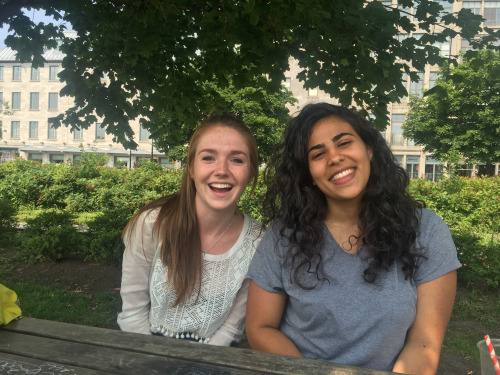
Right to Campus Team, Arianne and Dina
Right to Campus Team: Arianne and Dina

Arianne Kent and Dina Al Shawwa met this summer during their research internship at Women in Cities International. In June, they started work on their own project, Right to Campus, which brings WICI’s goals and tactics to McGill University in Montreal. Both Dina and Arianne are students at the university, with Dina being in her fifth year of Civil Engineering and Women’s Studies, and Arianne in her third year of studying Sociology and Women Studies.

“The idea is to take what Women in Cities International does and bring it onto campus,” says Arianne. “More broadly,” adds Dina, “we’re implementing the concepts of the larger Right to the City movement”. “What we want to do is to create more inclusive spaces on campus,” Arianne goes on, “Campus space should be equitable and safe for everyone. No one should have to bend and mold and make themselves uncomfortable to fit in the McGill space.”

Their first effort on campus was to incorporate the Right to Campus principles into the training for the university’s orientation week. “I was an orientation leader two years ago,” explains Arianne, “and I saw a lot of problems with this. As orientation leaders we’re kind of on the front line, we’re the first people who meet all these incoming students and we have a huge responsibility of conveying what’s acceptable behaviour as a McGill student. That covers everything from consent, respect, anti-discrimination, safety, all these complicated concepts that you’re trying to relay to these incoming students and we weren’t equipped enough to do so from our training.”

In preparation for the event, Dina and Arianne worked alongside the orientation development coordinator: “We were trying to reframe the entire training in terms of space,” says Dina. “We were working within the system to improve the training itself. We thought if we reframe it in terms of space, we can explain that excluding someone from a group is taking away their right to space within that group.” According to Arianne and Dina, it is crucial to change the space itself to be accommodating for everyone rather than asking people to fit in. “The space needs to be comfortable for everyone in order for people to even want the right to space,” they explain.
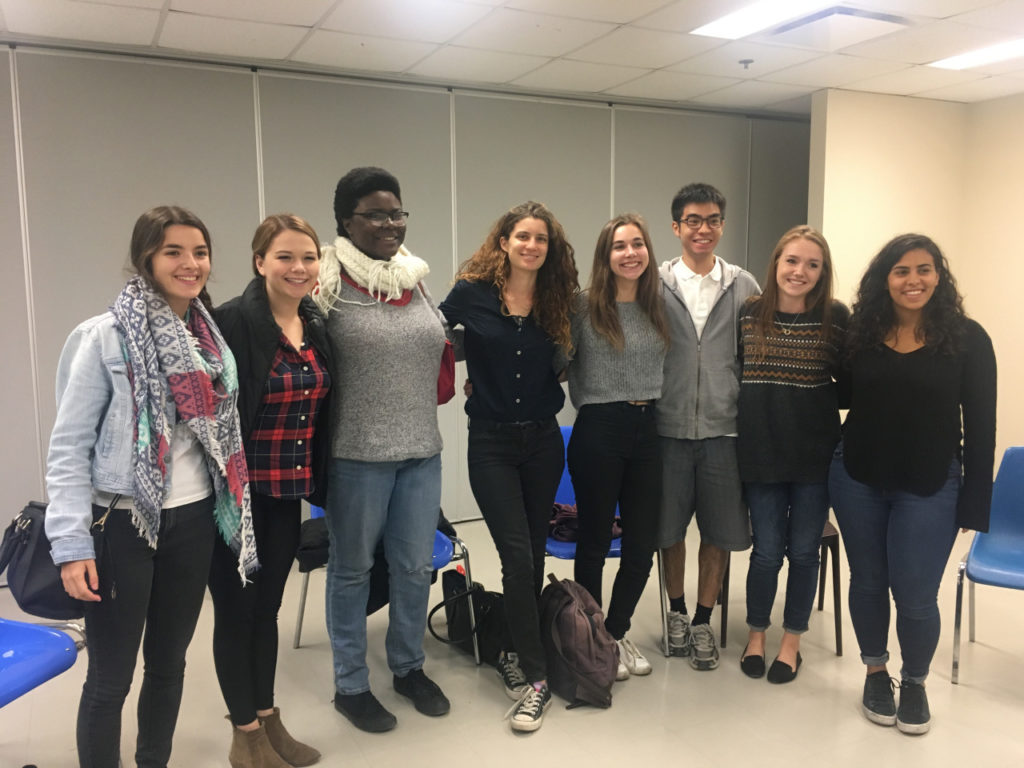
rtc_2
McGill Community Engagement Day and the safety audit Arianne and Dina organized with the help of volunteers.

For orientation week, they prepared a Frosh zine and guidelines that could be applied to different scenarios, as well as a summary of campus and Montreal resources. During Community Engagement Day in September, the team lead a series of safety audits to explore issues of security and use of space on campus. “We recruited volunteers and walked them through the process of a safety audit which involves looking at different features of the social environment and we got their feedback and opinions,” remembers Arianne. “McGill security does their own official safety audits checking whether lighting is up to par and whether everything is technically safe, but we thought it would be interesting for students to do it as well since they are the ones who primarily use the space. And, student opinions might differ vastly from those of adults and security personnel.”

The group has since been invited to join McGill campus security on their annual safety walks and they are further planning on writing up a report covering the findings from their student-led safety audits: “We’re talking to them now about perhaps using our checklist for safety audits, which is based on the principles of design for safety, on their walks.”
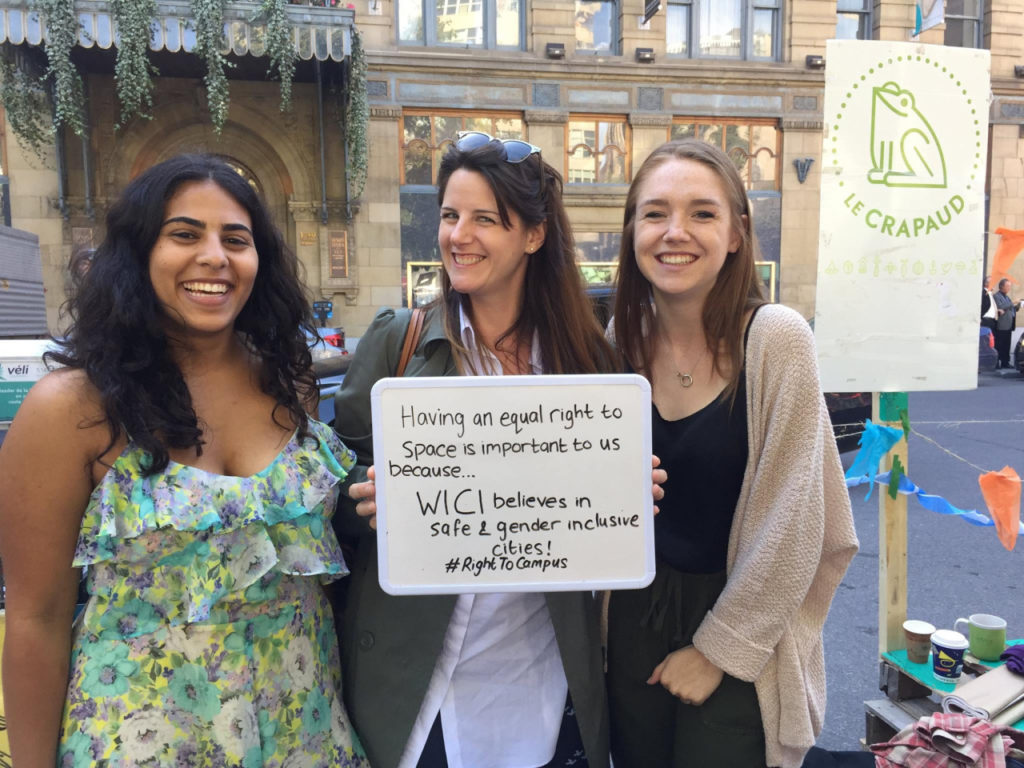
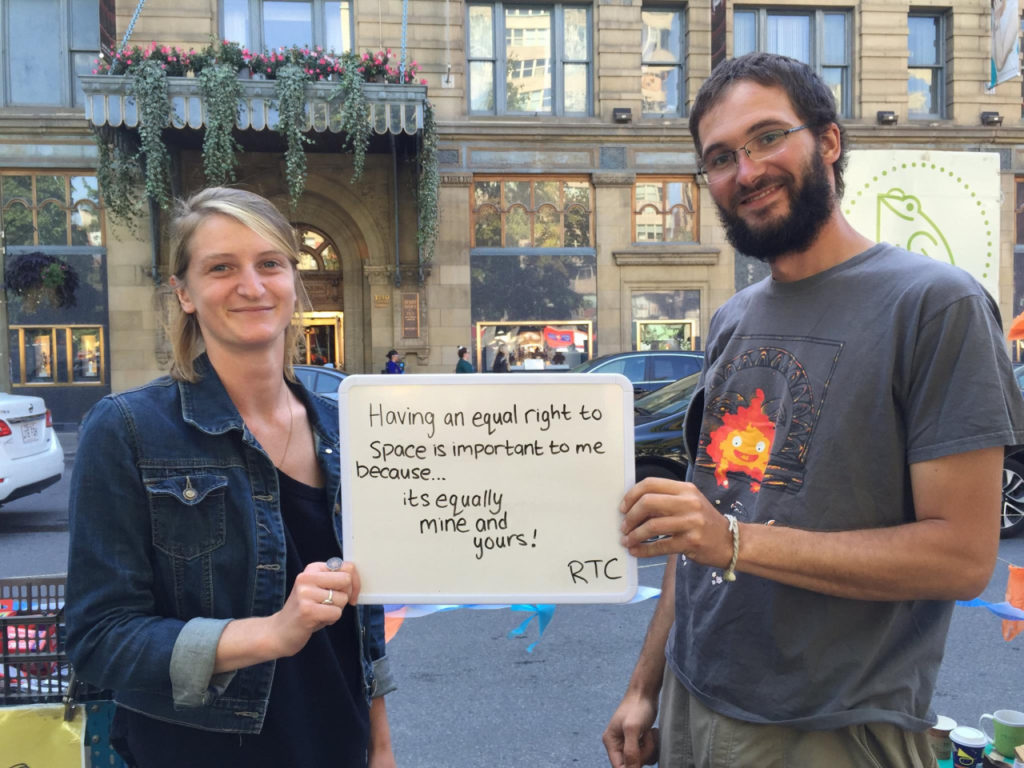
Inter-University Parking Day in Montreal. McGill students are explaining why having equal right to space is important to them.
Inter-University Parking Day in Montreal. McGill students explain why having equal right to space is important to them.

Right to Campus’ first goal is to get students involved and talking. “We want to make campus safety everyone’s responsibility and not only women’s responsibility,” stresses Arianne. “Too often the message is that it’s women’s job to make sure they are safe, but men pay an equal part in this.” Arianne and Dina hope that through starting the conversation and by engaging people through their on-campus events, they will establish their ideas for campus safety and right to space among their fellow students: “We think that’s where tangible things grow from.”

These themes occupy Dina and Arianne also in their own academic research. As a Civil Engineering student, Dina wants to explore how to implement safety in people’s minds as well as in the physical environment. “I’m especially interested in the role of Engineers in the built environment that determines people’s perception of safety,” explains Dina. “I’m using safety audits to understand how people’s identity influences how they perceive safety on campus and at the same time I’m trying to understand how identity plays a role in that perception.”
rtc_5For their next project, the Right to Campus team is planning an art show in spring next year. “We want to ask people what right to space means to them. It can be any personal interpretation of space”, says Dina, “how they feel in space, how they navigate that space.” In the long run, Dina and Arianna are hoping to expand Right to Campus from McGill University and implement the campaign on university campuses worldwide: “We want to take the Right to Campus toolkit to other universities in Montreal, Canada and across the world and make it a resource for students everywhere.”

Alexandra is a freelance writer and recent graduate of Heidelberg University in Germany, where she earned a BA in South Asian Studies and English Literature. Having moved across the pond to live and work in Montreal, she now focuses on refreshing her French skills while volunteering her time to various community-outreach programs. You can follow her on twitter @alexjurecko.

Share

Filed Under: Activist Interviews, correspondents, Resources, street harassment Tagged With: students. campaign, university

The Bahamas: Interview with Founder of #LifeInLeggings

December 7, 2016 By Correspondent

Guest post by former Blog Correspondent Alicia Wallace

Image via: https://redforgender.files.wordpress.com

From #BlackLivesMatter in the U.S. to #SupportThePuff in The Bahamas, we’ve seen the power of social media, the rise of hashtag movements, and the propensity of new media to create change. Recently, #LifeInLeggings has gained the attention of the Caribbean region, giving women the space to share their stories of sexual violence ranging from harassment to rape. Started in Barbados by Ronelle King, the hashtag made its way to Guyana, Jamaica, Trinidad and Tobago, and The Bahamas among among other countries.

King, founder of #LifeinLeggings, told me she was frustrated by her own experiences of sexual violence. “I had an idea to create a hashtag that would create a forum for Caribbean women to share their daily experiences of sexual harassment and abuse.” She recently worked with B-GLAD (Barbados Gays, Lesbians and All-Sexuals Against Discrimination), but has found social media and blogging to better suited forms of activism for her personality and schedule.

The launch of #LifeInLeggings on the first day of 16 Days of Activism against Gender-Based Violence was coincidental. “I wasn’t aware of the 16 days of activism until the hashtag took off and people starting mentioning it in correlation with the hashtag.” King noted the importance of the annual campaign, and said she is happy to have #LifeInLeggings play a role in bringing awareness to the issue of gender-based violence.

It is difficult to predict the success of a hashtag movement, whether by geographical reach or number of participants, but King was certain she would receive support from her friends and women in Barbados, knowing it’s an everyday reality for them.

“I did intend for it to spread through the Caribbean. Rape culture isn’t just a Barbadian issue; it’s a Caribbean issue as well as a global one, so I know that support would pour in from the other countries.”

Sexual violence is a pervasive issue in the Caribbean, as evidenced by statistics. In a survey conducted in nine Caribbean countries 48% of adolescent girls reported that their sexual initiation was “forced” or “somewhat forced.” The United Nations Office on Drugs and Crime and the Latin America and the Caribbean Region of the World Bank report noted, “While the worldwide average for rape was 15 per 100,000, The Bahamas had an average of 133, St. Vincent and the Grenadines 112, Jamaica 51, Dominica 34, Barbados 25 and Trinidad and Tobago 18.”

#LifeInLeggings has given Caribbean women space to put their names, faces, and stories next to those statistics, making them a visible reality for the people around them.

In Dominica, Delroy Nesta Williams and Khadijah Moore saw the effects of #LifeInLeggings and the potential to have a national conversation. The pair started #LévéDomnik to engage the country of less than 73,000, primarily on Facebook, in the discussion. Within days, they had collected over 400 stories, some of which were shared anonymously — sent to someone’s inbox and then posted on their behalf.

Williams said this is only the beginning of the conversation in Dominica. The #LévéDomnik has met with the country’s Bureau of Women’s Affairs and several NGOs, and is planning activities for 2017 that include advocacy training, yoga sessions, focus group meetings, and educational talks. “We want people to be more empathetic towards survivors, and we want to address institutional issues that act as emotional and psychological barriers to reporting sexual offenses and seeking redress through the judicial system.”

For King, #LévéDomnik is proof that #LifeInLeggings is serving its purpose. “The hashtag was created to not only show the realities of rape culture in Barbados, but in the Caribbean. It is a defiant cry for justice and a blatant refusal to be silent.”

Sexual violence is still a taboo subject, and survivors often find it difficult to talk about their experiences. In sharing our stories, we have the opportunity to sensitize people and bring attention to an issue that is often avoided in both private conversations and public discussion. Unfortunately, large numbers of people are unmoved by issues that do not directly affect them or people close to them. People participating in the #LifeInLeggings movement have commented on changes in attitudes of men around them who have been privy to the conversation. King shared that she personally received numerous messages from men who admitted they were a part of the problem, and intend to do better.

The Barbados team encourages those following #LifeInLeggings to reflect on their own experiences with sexual violence, and think of ways to keep the discussion going in family, peer, and community groups. It is also imperative that we consider the ways our words and actions contribute to women’s everyday experiences.

#LifeInLeggings started as a simple idea, and a group of dedicated women worked together to make it region-wide conversation. It caught the attention of two women in politics and Tanya Stephens among others, and is evidence of the power we all have to make a difference. In sharing our stories, women call upon men in The Bahamas and throughout the Caribbean to respect women as human beings, and take on the responsibility in engaging other men in these important conversations and holding them accountable for their actions.

We are not only responsible for what we do, but for what we allow to happen. Bystander intervention is critical to the creation of a new culture where sexual violence has not place. Bahamian women are invited to share their stories on Facebook and/or Twitter using #LifeInLeggings. Hollaback! Bahamas is accepting stories via an online form and will post on Facebook and/or Twitter for those who would like to remain anonymous.

Alicia Wallace is a women’s rights activist, public educator, and movement builder. She is the Director of Hollaback! Bahamas, produces The Culture Rush monthly newsletter, and tweets as @_AliciaAudrey. 

Share

Filed Under: Activist Interviews, correspondents, News stories, street harassment Tagged With: Bahamas, hashtag, interview, sexual violence

Ireland: Breaking the Silence and Opposing Gender-Based Violence from Square One

November 30, 2016 By Correspondent

Grace Gageby, Dublin, Ireland, SSH Blog Correspondent

Trigger Warning – Sexual assault, rape

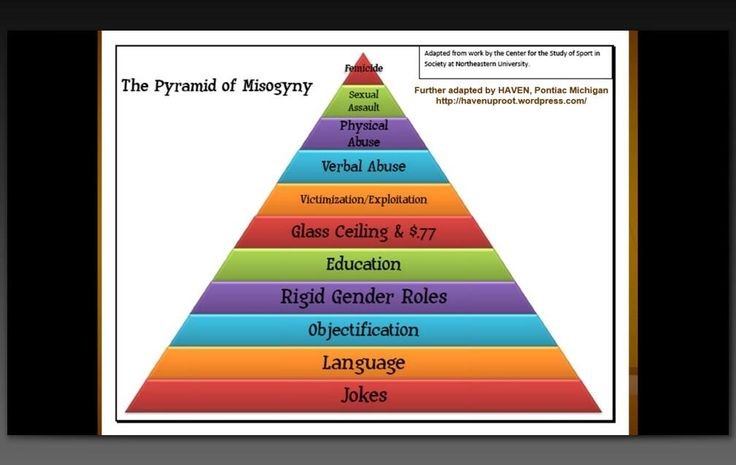
pyramidWhen gathering stories about harassment and sexual assault from my friends for my first article published on Stop Street Harassment, Beatrice told me about her first encounter:

“My uncle tried when I was four. It was only my mom who stood by me when I told my family the story. My dad and the rest of the men refused to let me speak. My great-grandmother resented my mother for speaking up”.

Sexual assault is a topic that is, of course, always difficult to talk about. Speaking up is just the start of a process that can take years, a journey through the justice system that won’t necessarily end in justice, and it can require repeated retelling of a traumatic event. Victim blaming is still rampant across the world, as is women’s fear of their claims being doubted or ignored. Speaking up about sexual assault is not only difficult because of the severe mental distress it causes, but because the abuser is often known to the victim, and a familial relationship can further hinder the victim from making their abuse known.

Too often sexual violence and harassment are  viewed as something men do out of attraction, rather than a desire to dominate and hurt women. This is seen in the use of sexual violence as a weapon of war. For example, more than 20,000 Muslim girls and women have been raped in Bosnia since the fighting began in April 1992, according to a European Community fact-finding team. More recently, Islamic State has used rape as a weapon to terrorize communities, particularly across northern Iraq. In these cases, rape is used to traumatize victims, to control, to undermine individual’s autonomy, and to spread mass distress. Combating sexual assault in a global context requires an understanding of how gendered and socially constructed the world is.

Similarly, street harassment, something too often dismissed as a ‘compliment’, is really about displaying dominance. It is about reminding women of patriarchal power structures in our society, reminding subordinated groups of their vulnerability, and sending the message that public spaces do not belong to them. Men who harass women and members of the LGBT community also bank on women remaining silent, on not asserting themselves. Harassment is not an unfortunate digression, but a manifestation and preservation of the systematic oppression and maltreatment of women.

In tolerating street harassment, we set a precedent for other acts of gender-based violence to occur, and to be condoned. It is the duty of all to stand up to harassment and smaller instances of gendered intimidation, so that more grievous violence can be opposed.

Grace is a student. She writes regularly for her school newsletter and yearbook, and has been published in Inis Magazine. Grace is currently involved with the socialist feminist group ROSA (for Reproductive rights, against Oppression, Sexism & Austerity), and their campaign for abortion rights in Ireland.

Share

Filed Under: correspondents Tagged With: sexual assault

USA: Post-Election Street Harassment in New Orleans

November 28, 2016 By Correspondent

Sequoya La Joy, Louisiana, USA, SSH Blog Correspondent

After GOP presidential candidate Donald Trump won the votes of the electoral college this November, the climate for women in New Orleans has changed. As a university student, our on-campus counseling center has been extremely busy and overbooked since after the election. As a sexual assault advocate on campus, I have received an increase number of calls from people who are scared to be assaulted and scared to go out in public.

I walk a small six block commute from my parking garage to my workplace and while on this commute have had an increase of unwanted comments on my body parts than I have even in the summer when I wear less clothing. I have died turquoise hair at the moment and have had multiple men stop me to tell me they like my hair and then ask me if the carpet matches the drapes. I also had a man walk closely behind me for 6 blocks at 2 am until I stopped to pretend to make a phone call. When I stopped, I made sure I was in a well lit place and the man stopped too. He asked if I spoke Spanish and if I had the time and could help him. I answered back in Spanish and told him the time and he told me he was visiting from Central America and then invited me to follow him and party. I told him I was on my way somewhere and waited until he walked a few blocks ahead before I turned the corner to walk towards my parking garage. I realize I feel much safer knowing that my parking garage has 3 entrances that need keycodes to be opened but I still do not feel safe on the six block walk from my work to my car that I have taken hundreds of times.

I also recently went thrift shopping with a friend of mine. A male employee of the shop stopped us several times while we were together and after we had separated. It seemed as if the man had an intellectual disorder or impairment but he still touched my shoulder and back in a way that made me uncomfortable and complimented my hair and clothing. He also told my friend multiple times that he liked her legs and how nice her legs looked in the boots. When we exited the store, he held the door for us and whispered in her ear about her killer legs and told us to both be sweet. In this situation, I knew the employee was overstepping boundaries by continuing to find us in the store and initiate conversation. I also knew by his sexual comments about my friend’s legs and his touching of my shoulder and back that this would be considered sexual harassment. However, as I read this man may have been intellectually impaired, I didn’t know how to react. I didn’t want to cause a scene or come off as mean and the friend I was with who would have normally told someone who was making her uncomfortable to get lost also didn’t know what to say to this man.

I thought a lot about this after getting home and I thought about the Republican state I live in. It made me think if I had any place to tell this man not to talk to women like that when the president elect had publicly shamed, assaulted, harassed, and insulted women. I have personally experienced more street harassment this month than in other months and now am at a crossroads about how to deal with it. Also, after the incident of being harassed by the store employee, I wonder if women will ever be able to escape being subjected to harassment. In this political climate, what are politicians and the media doing to try and reduce instances of sexual harassment and assault?

Who is responsible for educating harassers on how to treat women?

Is it the job of the harassed to constantly educate and inform their harassers that what they’re doing is wrong, uncomfortable, and scary?

I feel as a woman who has dealt with a lot of harassment in public and private spaces over the years, that it is not my responsibility to prevent my own harassment or educate my harassers. Sometimes, I am tired and cannot grapple with the mis-education our patriarchal society has given my harassers and I believe that that is okay.

It is not our job to educate our harassers.

Sequoya is a Native American and Italian woman from Chicago who fell in love with New Orleans. She’s currently a Sociology Major at Loyola University New Orleans and supports her higher education habit by slinging drinks to the masses. She aspires to attain a PhD and write a best seller. She currently operates a small blog.

Share

Filed Under: correspondents, Stories, street harassment Tagged With: harassment, new orleans, trump

Jordan: Art, Activism, and Empowerment – In conversation with Laila Ajjawi

November 26, 2016 By Correspondent

Minying Huang, Amman, Jordan, SSH Blog Correspondent

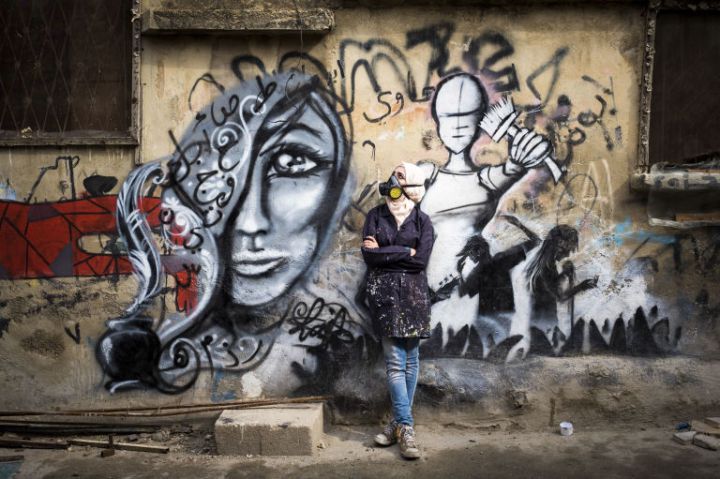
lailaajjawiLaila Ajjawi is a renowned Palestinian graffiti artist and activist living in Irbid, Jordan, working to help empower women and communities of refugees. Through her artwork, she seeks to highlight discrimination, navigate Palestinian identities, deconstruct gender ideology, and reclaim the largely male-dominated Jordanian public space. By placing women at the centre of her pieces and celebrating female potential in all facets of life, she is challenging patriarchal attitudes and changing social perceptions.
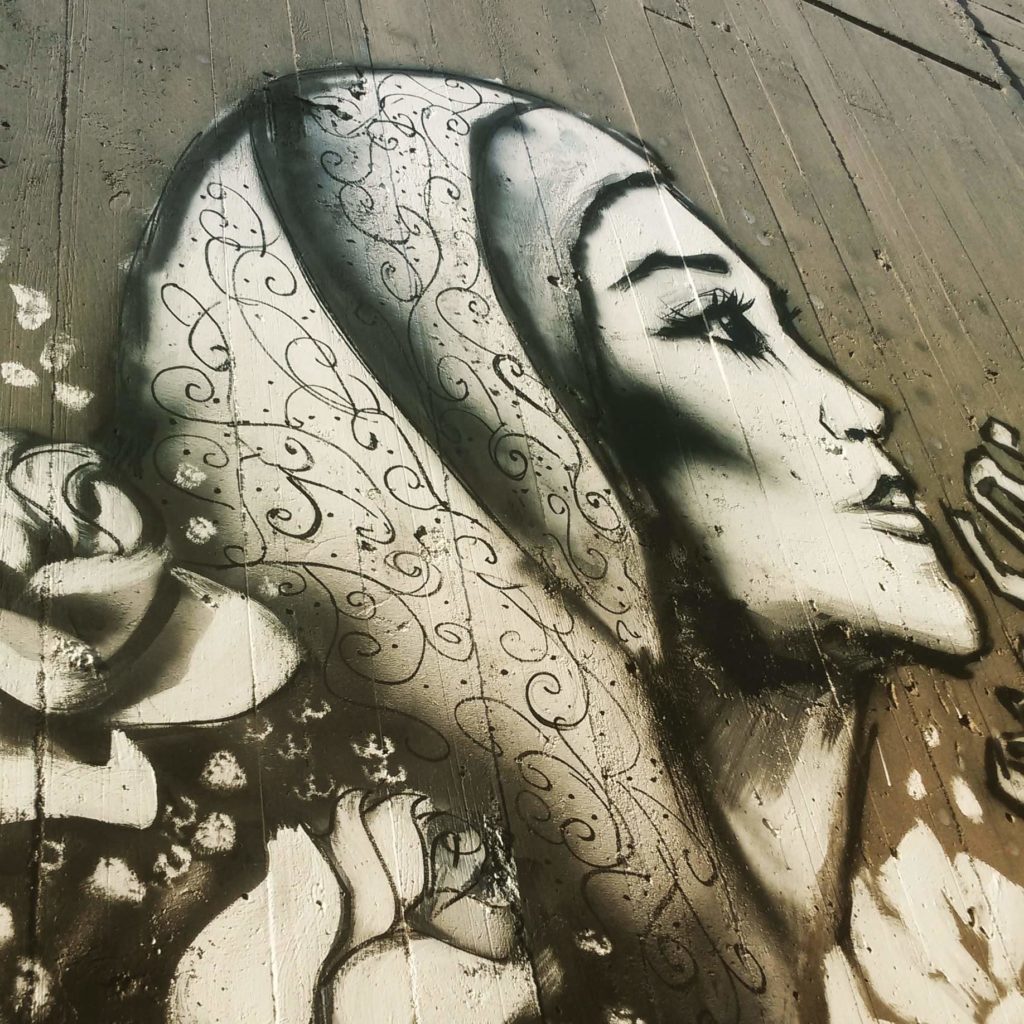
This is my interview with her.

Have there been difficulties? Have you faced any opposition or resistance, or has the feedback been overwhelmingly positive and supportive?

Sometimes I will get positive feedback, even during the painting process. Passers-by will give compliments; some try to help. A few respond negatively and there is always criticism! But I’m always friendly because I don’t need enemies, especially when there’s the constant risk that someone will take down my art, maybe within an hour of me finishing.

Common themes found in your work include: freedom and oppression, the stigmatisation of refugees, the role of women in society, cultures of silence, and humanity’s ability to transcend boundaries. Is Jordanian society responsive to the messages you are hoping to convey?

Most of it relates to how people see themselves from the inside, the invisible boundaries and stereotypes that people impose on themselves. In my country, these sorts of feelings limit your vision and, by extension, your achievements, because from a young age society is dictating what you can and can’t do, what you should and shouldn’t do, depending on your gender, your age, where you live, or where you come from… I can’t say that all of Jordanian society suffers from gender-based violence… and, to varying extents and in varying degrees, all societies suffer the same problems. But we cannot merely rely on statistics as, for example, many do not report violence. There are so many problems, so many crimes against humanity, that go unheard of, unpunished, and unseen.

lailaajjawi1Your work is bold, brave, and powerful, rich with imagery and symbolism. Can you detail your creative process? What inspires you to create?
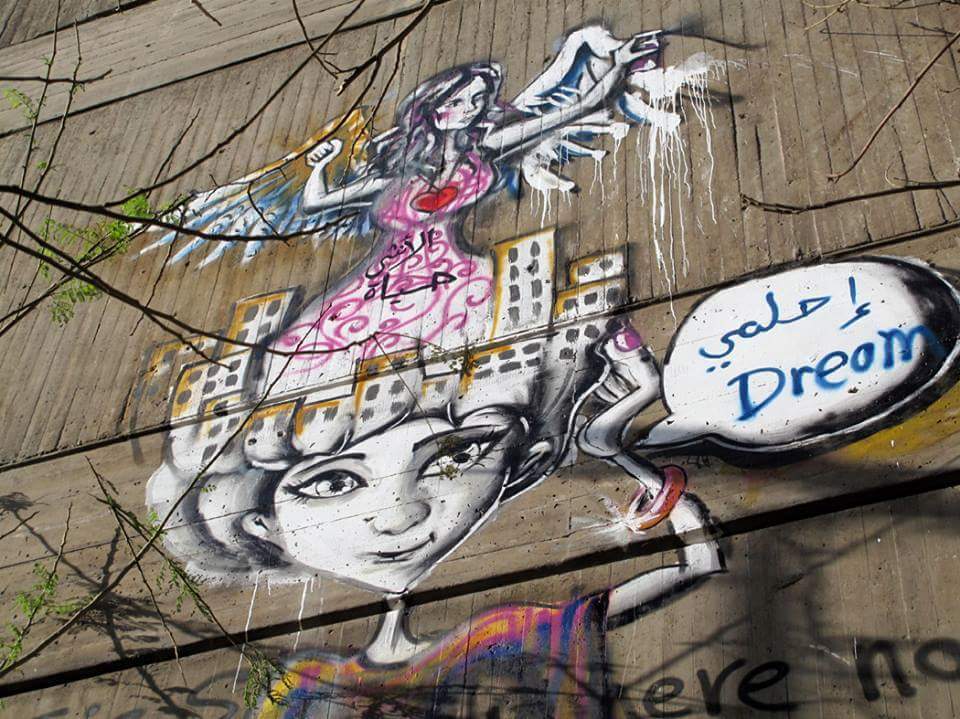
The key is always the location, no matter what my chosen subject is. I will always have a look around the surrounding area and talk to local people of all ages and genders. I call this the scouting process and it’s very important to me.Usually, I have the sketch ready in advance, completed in a moment of inspiration. I then have to scout out different locations to determine a good spot that attracts a lot of people. Once I’ve found my location, I will chat with the site owner, among others. At this point, I might rethink my original ideas and revise the sketch completely! This is followed by a quick draft on the wall after which the regular painting process begins. The finishing touches are the details.

Do you think all art is political in some capacity? Would you say that artists have a responsibility to try and effect change in their communities?

Not all art, surely. You know, cavemen used to document their hunting journeys through art… and it’s since developed into a tool to express an array of feelings and thoughts, some of which are political. As for an artist’s responsibility, it really varies from artist to artist. Factors to consider include: background, environment, level of self-education (sometimes level of formal education), level of general awareness, inherited and personal notions of responsibility, and one’s relationship with their surroundings and the wider world. Each artist sees the world from a distinctly unique perspective, and their experiences will shape – and be reflected in – their artwork. Some create art merely for fun; some view art as a means of self-expression; others believe themselves to be messengers of peace, for example.

Can you share one or two defining experiences that have shaped your values? How has your life influenced your art?

One defining moment was when I noticed how visually impactful graffiti can be, how it transforms the spaces it occupies. Graffiti is a great tactic to use when you want to convey a message, especially in social issue campaigns, as its presence in public spaces means that your thoughts will be able to reach more people and influence the public mind. The realization that graffiti perfectly combines art and activism then inspired me to take it to the next level, gain more experience, and learn more about social activism and the role art has to play. I have a very strong sense of responsibility, social and otherwise, which ties into why I do what I do.

Maybe this is because I’ve been brought up in a good family where everyone works so hard simply to be able to afford basic necessities and where getting an education was the main priority. Living in a refugee camp my entire life wasn’t easy. My family literally started from zero. My parents had no bank accounts, no land, no property. They were always working hard to keep the family afloat; and so, being the oldest, I had to take care of my younger brothers and sisters. When I graduated, I worked so many different jobs so as to become financially independent, pay back my loans, and help supplement the family income. I studied science – and I do love science – as I couldn’t afford to study art. I had to teach myself through university library visits and would go to art professors for guidance.

lailaajjawi2How did you get into graffiti? What about it speaks to you over other art forms?
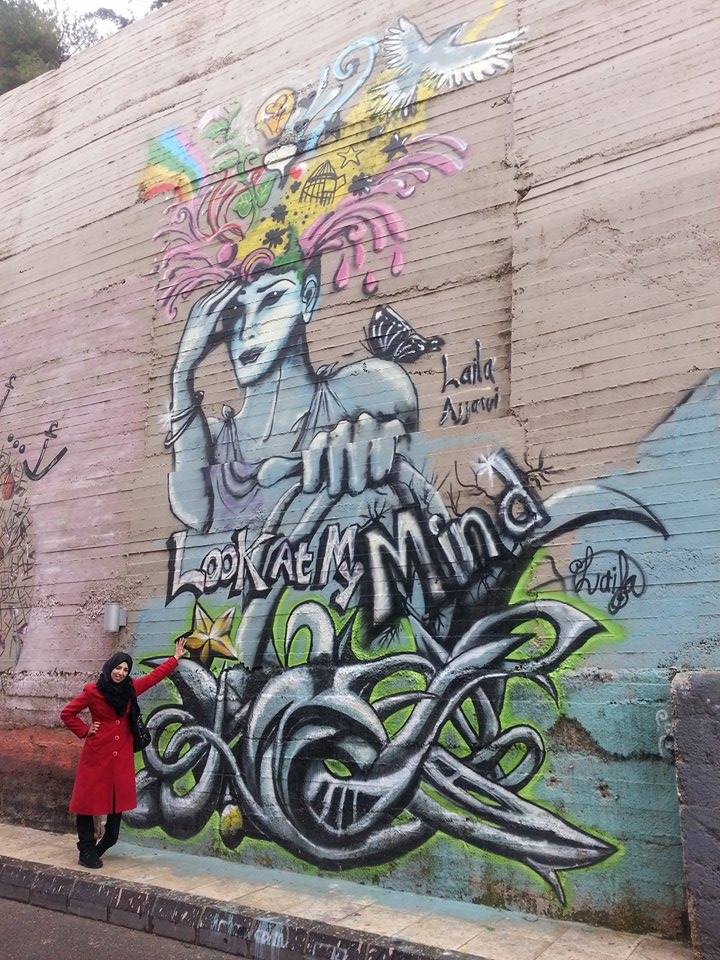
The cornerstone of my graffiti journey was participating, for the first time in my life, in a regional art festival, organized by Women on Walls (WOW). This event took place in the capital of Amman, just over an hour away from my city of Irbid, and gave me the chance to step outside my community and meet other artists who were working with different forms and materials.Prior to that, I had experimented within the walls of Irbid Refugee Camp, where I had used spray colours to depict something relating to the resistance in occupied Palestine. I wanted to build on this experience further by painting a large mural, drawing on watercolour art for inspiration. It was so challenging and I think I must have spent two days just staring at the wall before actually starting the piece.

For some reason I lost all sense of time and my surroundings; I was solely focused on the wall, the art, the steadiness of my hand. I was thrilled to discover just how fast I could work, how quick I was to adapt to this new medium. It was exciting to know I was just as capable of working to such a large scale as I was of drawing on regular A4 paper. I felt such passion in that moment. In other words, graffiti gave me such a high! And when I finished, I felt as though something within me had been set free and cast onto that wall.

Thank you for shedding light on the many challenges and injustices women encounter in their daily lives, from gender-based violence enshrined within a rigid honour code to limited access to education. What are the existing social and legal obstacles to progress here in Jordan and the Middle East where women’s issues are concerned?

Some obstacles to progress I see in this community, as in other communities, are: poverty, unemployment, social injustice, government corruption, unequal access to education, work, and decent services. I would add that these are challenges and injustices people of all genders are facing. It’s natural to expect more problems within communities that struggle to meet basic needs, in which people are unable to secure a good income (both in terms of salary and the nature of the work).Law is another crucial issue. Here in Jordan, we have some laws that divide such communities, directly and indirectly, whereby one side is given more power than another which results in more injustice for victims.

You have worked with enormously impactful organisations and initiatives such as Women on Walls, ActionAid ARI (Arab Regional Initiative), and SheFighter. Can you tell us a little bit about these projects?

All the above organizations share similar ideas as regards empowering women in society at large. They invited me to work with them, which is an honour and shows me that my work and my message have been met with recognition.

Women are breaking the silence, fighting for their rights, and striving to assume control of their own lives. Do you feel that now more than ever this region is ready for – and open to – a real shift in attitudes and behaviour?

Not all the initiatives are smart and practical. A lot of them target, and operate within, areas where women can, for the most part, do whatever they want. They don’t target the more closed communities beyond the capital city and cosmopolitan coastal areas. But it’s in these closed communities that women suffer the most. A lot of the activism is just talk, whether about the problems or the victims, but few are taking active steps to tackle the root of the problem, which is what I’m trying to do. By filling the streets with images of strong, empowered women, I’m trying to change public perceptions and attitudes.A small organisation that, in my opinion, is doing meaningful work in the field of female empowerment is IRC Jordan (International Rescue Committee).

lailaajjawi3Is feminism considered a dirty word in the Arab world?

Yes, because there are those who misunderstand the actual meaning of the word. Feminists have a reputation for hating men here. And some do act out aggressively against society, make generalisations, and talk about men as if they were monsters, wanting female superiority, and breaking with the idea that men and women each hold up half the sky. Meanwhile, there are feminists, who understand the true meaning of feminism, working to empower women in poor communities; they are setting up start-up projects, encouraging women to work, and promoting self-development. There are feminists campaigning for equality to be enshrined in law; they are campaigning for fairer salaries in the private sector, for example, and rallying against the unjust laws concerning honour killings, citizenship, and nationality.

At this point in time, what are your goals? What are your personal and professional aspirations?

I need to break down the stereotypes people around the world have of Arab girls, both Muslim and non-Muslim, and of the Arab region in general.I also want to show young people that they have the power to start something great, to effect change from within. I want them to believe in themselves.

What are you working on at the moment? Do you have any upcoming projects Stop Street Harassment readers should keep an eye out for?

I’m still undecided as I left my job and got married with a plan to leave the country and move to Saudi Arabia! Before I leave, I hope to gift a few more graffiti pieces to my community. I have so many unfinished projects that I will continue to work on in Saudi Arabia, one of which is a science-fiction novel. I’m also designing an art studio for myself, a much-needed space in which I can figure out what my next big move is.

You can keep up-to-date with Laila and her work on Facebook, Instagram @lailanajjawi, and Twitter @Laila_Ajjawi.

Minying is a 20-year-old student from Cambridge, England. She is studying for a BA in Spanish and Arabic at Oxford University and spent the last academic year living in Amman, Jordan. You can find her on Twitter @minyingh, Instagram @minyingh, and Facebook @minyinghuangpoetry.

Share

Filed Under: Activist Interviews, correspondents

« Previous Page
Next Page »

Share Your Story

Share your street harassment story for the blog. Donate Now

From the Blog

  • #MeToo 2024 Study Released Today
  • Join International Anti-Street Harassment Week 2022
  • Giving Tuesday – Fund the Hotline
  • Thank You – International Anti-Street Harassment Week 2021
  • Share Your Story – Safecity and Catcalls Collaboration

Buy the Book

  • Contact
  • Events
  • Join Us
  • Donate
  • Facebook
  • Instagram
  • Pinterest
  • Tumblr
  • Twitter
  • YouTube

Copyright © 2026 Stop Street Harassment · Website Design by Sarah Marie Lacy