• About Us
    • What Is Street Harassment?
    • Why Stopping Street Harassment Matters
    • Meet the Team
      • Board of Directors
      • Past Board Members
    • In The Media
  • Our Work
    • National Street Harassment Hotline
    • International Anti-Street Harassment Week
    • Blog Correspondents
      • Past SSH Correspondents
    • Safe Public Spaces Mentoring Program
    • Publications
    • National Studies
    • Campaigns against Companies
    • Washington, D.C. Activism
  • Our Books
  • Donate
  • Store

Stop Street Harassment

Making Public Spaces Safe and Welcoming

  • Facebook
  • Instagram
  • Pinterest
  • Tumblr
  • Twitter
  • YouTube
  • Home
  • Blog
    • Harassment Stories
    • Blog Correspondents
    • Street Respect Stories
  • Help & Advice
    • National Street Harassment Hotline
    • Dealing With Harassers
      • Assertive Responses
      • Reporting Harassers
      • Bystander Responses
      • Creative Responses
    • What to Do Before or After Harassment
    • Street Harassment and the Law
  • Resources
    • Definitions
    • Statistics
    • Articles & Books
    • Anti-Harassment Groups & Campaigns
    • Male Allies
      • Educating Boys & Men
      • How to Talk to Women
      • Bystander Tips
    • Video Clips
    • Images & Flyers
  • Take Community Action
  • Contact

Spain: Pros and Cons to Self-Defense Classes

November 25, 2016 By Correspondent

Alice C.R., Barcelona, Spain SSH Blog Correspondent

The 25th of November is the International Day for the Elimination of Violence against Women. Like every year and (almost) everywhere else, Spain and Barcelona have organized various events, from conferences to theater play and demonstrations.

I have always had mixed feelings about such a “Day”. Of course, I like the idea of focusing on violence against women. This is a good way to catch the attention of people and media and I hope this can help to rise awareness about how real it is. Statistically speaking, we all know women who have been the victim of this kind of violence.

But at the same time, I am a bit skeptical. What about the others days? Acts of violence occur every single day. Putting a focus on one day seems to me like a good deed we only do to have a clear conscience so we can forget about it until next year. And it seems even more true with the success of all these International Days. I have been quite surprised to learn about the existence of an International Underwear Day, a World Egg Day and a World Pasta Day, among hundreds of other “celebrations”.

But, if at least one person can learn more and become aware thanks to the 25th of November, it will make my day.

As I was saying, in Barcelona we have a lot of events and activities. And not only the 25th but across the whole month of November.

I made an intervention yesterday about a project I will speak about next time and I will attend a self-defense workshop next Saturday. And this is what I would like to speak about. It is not really specific to Spain nor Barcelona but it is a topic that has caught my attention for a while.

Every 25th of November and every 8th of March (International Women’s Rights Day), woman are offered self-defense classes and workshops. I think it is very important to offer specific classes to women since women are subjected to specific violence. While workshops are very well done, others are not so well prepared and I must say that some initiatives simply offend me.

Let’s start with what I think is problematic:

First of all, I am tired of the people who say, “Women should go to self-defense class to learn how to defend themselves and protect themselves from being assaulted”. Effectively, you can find in Barcelona some “anti-rape” self-defense workshop. Programs include how to use your keys, a piece of paper and how to deal with strangulation…

I do not like that:

– It tells me that if I do it, I will be able to avoid a rape or any other assault. I could say, “Hurrah! I am protected”. But we all know it does not work like that. Self defense is good, self defense can help you in some dangerous situation but self defense can’t guarantee you will be protected.

This is just another way to put the responsibility on the victim. We ask the potential victims to do an activity whether they like it or not, to take away from their free time, from their energy, from their savings (usually you have to pay for most of these classes) instead of asking potential harassers and attackers to follow workshops and classes about how not to harass and attack.

– It won’t change anything about a possible harassment or assault. I mean, if I need to defend myself that means that I am already attacked. Prevention=zero. But if we want reduce the amount of harassment and assault we need to focus on prevention. The best prevention is education. Educate people that “no” means “no”, that no one is “asking for” being harassed, assaulted. Well, you get the idea.

All this makes me feel that women’s fear for rape and assault is bankable. The offenses and crimes we can be victim of generate a business at our expense.

Then, why did I enrolled for a workshop myself?

Well, because I believe self defense can help me being more confident and develop my strength.

In fact, I am not against it, but this has to be done in good, safe conditions by instructors who know the consequences of an assault, the consequences of being harassed on your way home after a long day at work or in the bus going out with your friends. I am sure a lot of instructors try to do their best and really want help women to feel more safe and confident but from being in their class, I know this does not work.

What works is a class where you feel free to leave if you feel uncomfortable with an exercise, not were you are “forced” to participate because you need to “surpass yourself”, where you will be taught how to develop your proper strength and not standard way of defense, and where no one will tell you that every woman should practice self-defense but that every women should have the right to feel and be safe in any public space even without taking part in self defense class.

Alice likes researching, analyzing and writing about Women’s Rights, gender bias, and intersectionalism with a special focus on sexual violence, rape, rape culture, the impact of street harassment and how the media deals with these issues. She is currently working on a new project focused on how some media participate in the revictimization of victims. Follow her and her projects on her Facebook page and via Twitter @Alyselily.

Share

Filed Under: 16 days, correspondents, street harassment

India: Uber Installs Panic Buttons and Feminists Call for Freedom from Fear

November 23, 2016 By Correspondent

Lea Goelnitz, Delhi, India, Former Blog Correspondent

“When I walk down the streets I put on my death stare and scan every man´s face, I pass by. Their eyes are not on my face, but all over my body. I hold my head high and my hands make a fist. I am ready to fight anyone who comes near me. I am afraid, but more than that I am angry, really angry,” one young woman in Delhi tells me.

We actually talked about something else entirely, but when two women in Delhi meet, the conversation almost always turns to harassment and how to deal with it. Safety and freedom are the buzzwords we throw in. In the absence of both, these big words become tiny demands for dignity.

“I want to ride the metro in the middle of the night – unaccompanied and without a knot in my stomach“ a woman tells me.

Another one wants “to explore unknown neighborhoods and enjoy sights, admire their beauty and get lost in the crowds in narrow lanes.” But they say they cannot. With all the responsibility for their own safety put on them – What did you wear? Where did you go? Did you send a screenshot of your Uber ride to a friend? How late was it? Did you drink? Were you alone? What did you say? – there is little energy left to enjoy a stroll through the city.

Women are conscious about what to wear, which route to take, who to ask for directions and what mode of transport to take. Being on guard constantly is work, which drains lots of energy. This work is neither acknowledged nor rewarded. Still women are blamed if they don’t do “their part”. The regular obnoxious and very offensive rape analogies spit up by politicians and judges every now and then reinforce the idea that women are solely in charge for their safety and perpetrators cannot help themselves. It also sends a very clear message to all women: You are in this alone. Society will not change and no one will help you.

And of course this narrative is also offensive to men, dehumanizing them as out of control and overpowered by urges. Weirdly men do not seem to be bothered by that.

The focus remains on women: There are women-only compartments in metros and buses. A liquor store has a women-only section and advertises harassment-free alcohol shopping. This way men will never have to get used to the existence of women in public. Uber has safety buttons in their cars. From January 2017 onwards, all mobile phones in India are required to have a safety button. The pepper spray sold in shops and via amazon comes in a pink design. There also are plenty of apps which crowdsource safer ways home or send alerts and emergency texts and your GPS to your contacts. Technology and the market adapt to any tragedy.

While all of these may have value as short term solution, they are also distractions, adding more to the list women feel they must do for their own safety. Women´s physical and psychological well-being become collateral damage. Why don’t you have the app? Why didn’t you buy that new phone? Why did you get into the Uber without checking if it has the button already? Why didn’t you take that self-defense class? All this easily leads to: Why don’t you stay at home?

There is another way to approach safety concerns. Various feminist initiatives show victim-blaming the finger, change the discourse about responsibility and encourage fear to be turned into anger and confidence.

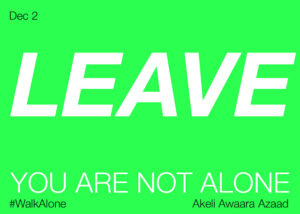
leaveThe campaign #HaveShortsWillSmoke by ”the spoilt modern Indian woman” asks women to share pictures of them wearing shorts or skirts and having a drink or smoking and share the comments they got in public. The initiative Blank Noise exhibits clothing of women, they wore when they were harassed. Of course, all kinds of clothes are represented, debunking the myth that covering up is a solution. #Walkalone and #FreeFromFear are the hashtags women use to demonstrate how they took a route, which they walked despite being afraid. Blank Noise declares them to be Sheroes, as they do not let fear influence their mobility and independence. Safecity started documenting areas that feel safe in order to encourage more women to come out and make the area even safer.

These are small steps and low-scale initiatives not having a big impact one might argue. But as opposed to the above mentioned “security measures”, which not only rely but bet on women´s fear do not even scratch the surface of the problem, but sustain the status quo, these feminist ideas provide a much-needed refreshing and creative input that inspires courage, anger and action. More please!

Lea works in journalism and women´s rights and is involved in the women´s rights NGO Discover Football, which uses football as a tool for empowerment and gender equality. Follow her on Twitter, @LeaGoelnitz.

Share

Filed Under: correspondents, street harassment Tagged With: Blank Noise, delhi, uber, women-only

Canada: How to Make Cities more Inclusive and Safe for Women (Part II)

November 19, 2016 By Correspondent

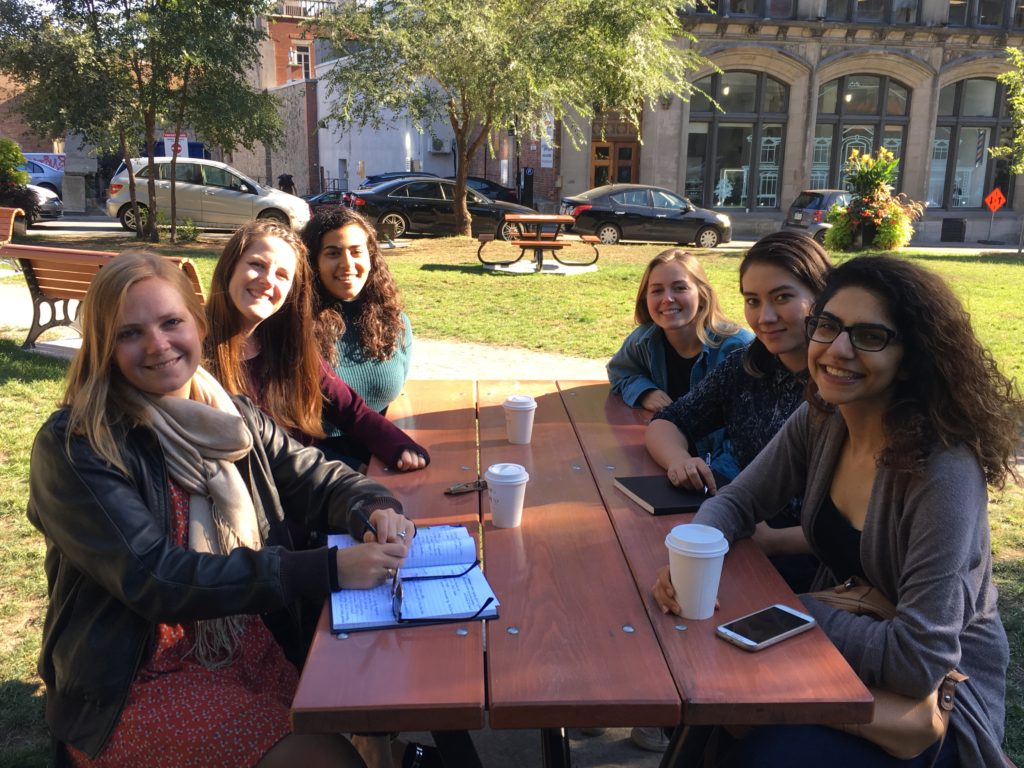
A talk with Kathryn Travers from Women in Cities International about the principles of design that shape our perception of the places we live in.

Alexandra Jurecko, Montreal, Canada, SSH Blog Correspondent

The WICI team
The WICI team

The first part of my interview with Kathryn Travers from Women in Cities International (WICI) revolved around everyday street harassment in Montreal and other urban centers and the culture that enables it. This second part sets out to explore how design influences the ways in which we perceive our surroundings and how urban development could make our cities more inclusive and safe for everyone.

Design can be a powerful factor in shaping our perception of public space. Just in thinking about my own neighbourhood in Montreal, I immediately know which places feel open and comfortable, and which routes I like to avoid at night. “There are important gender gaps that should be addressed in cities”, says Kathryn.

When it comes to implementing design principles to create safer public spaces for women, “Montreal is actually kind of a pioneering city,” Kathryn points out. Six of the seven principles of design employed by WICI to conduct women’s safety audits across the world have originated from the Femmes et Ville program conducted by the City of Montreal in the 1990s.

These principles were developed by the City of Montreal to create a standard for gender-inclusive urban planning. “One of the first applications of these principles of design were the Montreal metro station exits”, explains Kathryn. “Before, you would walk up from the metro and be in this closed brick box. You never knew what was on the other side.” By implementing the first principle of design, “See and be seen”, the city redesigned the exits to be more open, with window fronts for better visibility.

The principles furthermore include instructions on how to ensure the ability to “Hear and be heard”, to “Get away and get help”, to “Know where you are and where you are going”, to “Live in a clean and welcoming environment”, and lastly, to “Work together” through community participation and social activities. Their work on the Creating safer Communities for Marginalized Women and Everyone project (2007-2011) inspired WICI to add a seventh principle of design, the principle of “Accessibility and Inclusion”.

WICI’s approach is based on cooperation with local groups: “These groups already have an established relationship of trust with local women.” In doing so, WICI gives local groups the tools to document their experiences while allowing them to develop their own ideas and recommendations for change. “We never come with solutions. We don’t have solutions,” Kathryn stresses.

By reaching out to those who are most excluded within their own communities, WICI strives to make cities more inclusive for everyone. “If we can be more inclusive now as we are working to address these gender gaps”, Kathryn explains, “then our cities will be able to better respond to the diverse needs of women and men who live there. This is how we build more inclusive cities.”

One such project brought WICI together with women from the association of Action de femmes handicapées in Montreal. In their work together they focused on the relocation of a paratransit stop at a Montreal university. “The paratransit stop was in the loading dock in the back of the university. These women who are wheelchair-dependent had to wait in the loading zone after classes at night; it made no sense,” remembers Kathryn. Once a local group has identified a problem, WICI supports their cause by establishing channels of communications to municipal or state-level governments. “We lobbied to move the stop across the street where there was already a bus stop and a space to wait with proper lighting. It took a lot of time but we eventually got it. It was a really significant achievement.”

In focusing on gender equality and women’s participation in urban development, WICI highlights how design influences the ways in which we move through public space. Design can force us to experience exclusion, or make us feel unsafe. Or, in adhering to basic principles of design, urban planning can become a powerful tool in making our cities safer and more accessible for everyone.

Alexandra is a freelance writer and recent graduate of Heidelberg University in Germany, where she earned a BA in South Asian Studies and English Literature. Having moved across the pond to live and work in Montreal, she now focuses on refreshing her French skills while volunteering her time to various community-outreach programs. You can follow her on twitter @alexjurecko.

Share

Filed Under: Activist Interviews, correspondents, street harassment Tagged With: canada, safe city, safety audit, women in cities international

UK: UNmuted’s Vlog Part 1 – Talking Street Harassment at Young Feminists London

November 15, 2016 By Correspondent

londonNess Lyons for UNmuted Productions, UK, SSH Blog Correspondent

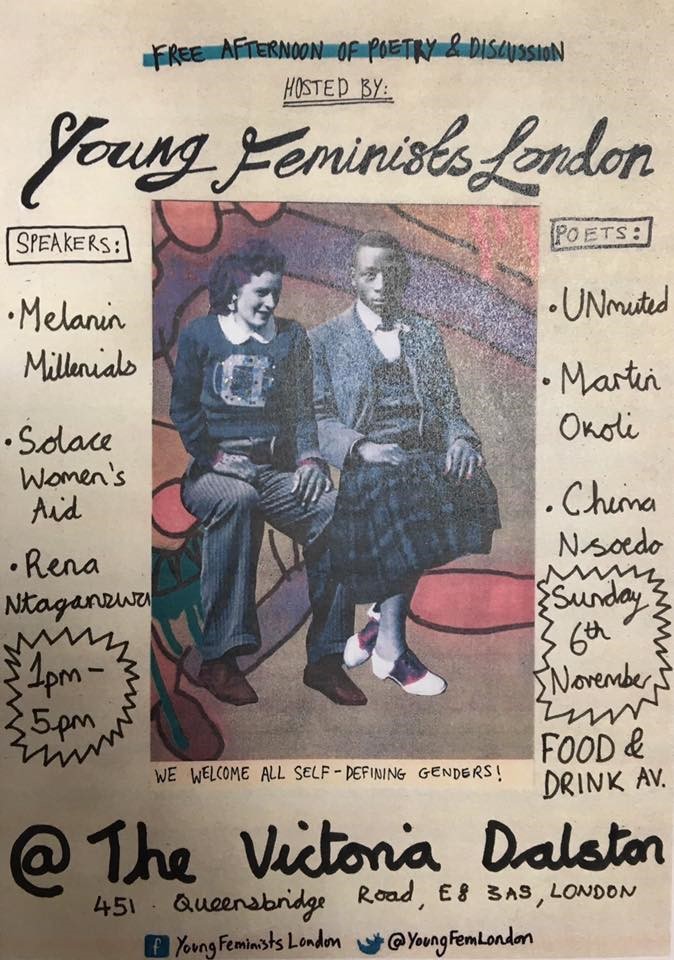
On Sunday 6th November, myself and new UNmuted Productions member Nicola Bland had the pleasure of performing poetry and leading an audience discussion at a fab event hosted by Young Feminists London. There were several wonderful other poets and speakers taking part and it was a real joy to talk feminism – and womanism – with such a great group of women and men.

After Nicola performed the full-length version of my spoken word poem “I Smile Politely“, (including sections that are not in UNmuted’s short film of the same name), we asked for volunteers from the audience to answer some questions on camera about the themes raised in the piece. We made these interviews, together with a few snippets of Nicola performing ‘I Smile Politely’, into a two-part vlog for Stop Street Harassment.

This is Part One, with funny, thoughtful and smart answers to the questions:

• What’s the most ridiculous catcall or unwanted chat-up line you’ve had?
• What does street harassment mean to you?
• When (if!) you’re ‘smiling politely’ in response to unwanted sexual attention, what are you actually thinking?

Watch here and please share!

umutedyfl

Ness Lyons is a playwright, filmmaker and spoken word poet. She runs UNmuted Productions, is a member of Soho Theatre Writers’ Lab and is currently developing a script with an award-winning production company. Follow her work at: nesslyons.net and on Twitter: @lyonsness

Share

Filed Under: correspondents, street harassment Tagged With: feminist, London, video, young women

South Africa: SA’s Dirty Laundry

November 11, 2016 By Correspondent

Nyasha Joyce Mukuwane, Johannesburg, South Africa, SSH Blog Correspondent

sadirtylaundryWith the onset of the 16 Days of Activism Against Gender-Based Violence on Nov. 25, some activists are using visual creativity to bring home the facts of rape culture in South Africa.

Rape is a widespread problem. According to a 2013 Medical Research Council (MRC) survey, up to 3,600 people could be raped in the country every day. The Institute for Security Studies (ISS) claims that only one in 13 rape cases are reported to police.  Fewer than 30 cases go through for prosecution and trial  of which only 10 result in a conviction.

Jenny Nijenhuis and Nondumiso Lwazi Msimanga are collaborating in a creative installation of artivism in order to create awareness around rape in South Africa. They are collecting 3,600 pieces of underwear to hang a washing line approximately 1.2 kilometres long displaying the underwear during the 16 Days of Activism.

The preferred route for hanging the installation is from Arts On Main on Berea Road, right into Fox Street and left into Albrecht Street to SoMa´s entrance. This route from Arts On Main to SoMa covers 400m in distance. The goal is to run the washing line down both sides of each of the streets involved, thereby covering a distance of 800m. The balance of the line and installation will continue to the gallery entrance and up into the upstairs gallery area.

Speaking about the installation, Nijenhuis says,

“We wish to curate/choreograph an activation/disruption of the space in and around the gallery for 10 of the 16 Days of Activism whilst the installation is up. The space will thus be used as a point of reflection through works dealing in this subject matter. Nondumiso Msimanga will be working on a performance art piece titled ‘On the Line.’ The performance will display a female at the different developmental stages and rites of passage of becoming a woman, in a cyclical narrative of rituals. We have also posted an open call inviting contributions towards the project from the broadest spectrum of disciplines including (but not limited to) the visual arts, performances (maximum length 15 minutes), interventions, music, dance, talks, poetry, video (maximum length 15 minutes) and theatre.

The point being for artists to show how art, when used for the purpose of socio-political activism, has the power and ability to shift the status quo. Activism aims to promote, impede, or direct social, political, economic, or environmental change – to make societal improvements and to correct social injustice. Through this call, we’re inviting artists to truly observe, reflect and comment on what the rape crisis in SA looks like. We hope to bring this message to people on the street, and not just to the audiences that frequent galleries.”

Installation Dates: 25 November to 4 December 2016
Location: SoMa Art + Space – Streets of the Maboneng Precinct in Johannesburg

In order to successfully produce the installation the artists need to collect 3600 panties. Since the project is not for profit, a donations Facebook page has been set up. The panties drive asks anyone prepared to support the project to donate their old and unwanted panties or underpants. These are being collected at various collection points across the country. Donate. | More information on this project.

Nyasha is the public awareness coordinator at the Nisaa Institute for Women’s Development in Johannesburg, South Africa, where the main goal is counselling and sheltering survivors of domestic abuse. She has edited two books by survivors that are available to download for free from the website www.nisaa.org.za.

Share

Filed Under: 16 days, correspondents, street harassment Tagged With: 16 days of activism, art, rape, south africa, underwear

« Previous Page
Next Page »

Share Your Story

Share your street harassment story for the blog. Donate Now

From the Blog

  • #MeToo 2024 Study Released Today
  • Join International Anti-Street Harassment Week 2022
  • Giving Tuesday – Fund the Hotline
  • Thank You – International Anti-Street Harassment Week 2021
  • Share Your Story – Safecity and Catcalls Collaboration

Buy the Book

  • Contact
  • Events
  • Join Us
  • Donate
  • Facebook
  • Instagram
  • Pinterest
  • Tumblr
  • Twitter
  • YouTube

Copyright © 2026 Stop Street Harassment · Website Design by Sarah Marie Lacy