• About Us
    • What Is Street Harassment?
    • Why Stopping Street Harassment Matters
    • Meet the Team
      • Board of Directors
      • Past Board Members
    • In The Media
  • Our Work
    • National Street Harassment Hotline
    • International Anti-Street Harassment Week
    • Blog Correspondents
      • Past SSH Correspondents
    • Safe Public Spaces Mentoring Program
    • Publications
    • National Studies
    • Campaigns against Companies
    • Washington, D.C. Activism
  • Our Books
  • Donate
  • Store

Stop Street Harassment

Making Public Spaces Safe and Welcoming

  • Facebook
  • Instagram
  • Pinterest
  • Tumblr
  • Twitter
  • YouTube
  • Home
  • Blog
    • Harassment Stories
    • Blog Correspondents
    • Street Respect Stories
  • Help & Advice
    • National Street Harassment Hotline
    • Dealing With Harassers
      • Assertive Responses
      • Reporting Harassers
      • Bystander Responses
      • Creative Responses
    • What to Do Before or After Harassment
    • Street Harassment and the Law
  • Resources
    • Definitions
    • Statistics
    • Articles & Books
    • Anti-Harassment Groups & Campaigns
    • Male Allies
      • Educating Boys & Men
      • How to Talk to Women
      • Bystander Tips
    • Video Clips
    • Images & Flyers
  • Take Community Action
  • Contact

India: Sanitation and Sexual Assaults

September 29, 2016 By Correspondent

Suchita Kotnala, Texas, USA / India, SSH Blog Correspondent

Trigger Warning – Rape, Murder

With the ‘World Toilet Day’ approaching on November 19th, it’s time to turn our focus on the sanitation facilities, or lack thereof, in India, especially the rural India, where it is estimated, that nearly 65% of the population defecates out in the open. The lack of good sanitation practices not only poses a grave health risk to the vast population in general, but, also adds the risk of bodily harm that women have to face and live with everyday.

Although India is modernizing and evolving rapidly today, a significant chunk of its population has been lagging behind in terms of social and economic advancements, and women have been paying the biggest price for it, with their freedom. The fact that numerous women fall prey to sexual predators while on their way to attend to the nature’s call during the silent and dark hours between sunset and sunrise in the rural areas, paints a grim picture for the developing ‘superpower’ India. Every now and then, a high profile gang-rape story shakes the nation out of its reverie, but the sad truth is, that only a fraction of the sexual assaults even get reported, due to the existing caste and gender biases within the police force. In 2014, two teenage girls were found murdered, in Uttar Pradesh, India, after they went missing on the prior night, when they had gone out to relieve themselves. It is alleged that they were raped and strangled, but the police investigation failed to offer any clear answers. More recently, on the night of 31st July this year, a 20-year-old woman was brutally gang-raped and murdered by two men, when she stepped out to answer the nature’s call, in Tamil Nadu, India.

Although strengthening the law and order and increased sensitization of the masses towards gender based violence is vital to bringing about a change for the better, the importance of providing privacy and security to the women while they perform one of the most basic rituals of life can’t be disputed. No one should have to plan their entire day around activities of daily living, fearing for their life or well being every time they stepped out of their house.

The Indian Govt. has stepped up on its efforts to build more toilets lately, spending millions. The initiative might be of greater consequence, if coupled with efforts to educate the society and change the culture and attitudes of the people towards good sanitation practices.

The Indian society cannot hope to progress and prosper if a significant portion of its population continues to struggle on a daily basis, merely to stay safe and alive every morning.

Suchita was raised in western India by loving and supportive parents who helped her and her sister to grow into strong, independent and career-oriented women. She’s a registered general practitioner in India and is currently preparing to obtain medical residency in the United States. She is passionate about women’s rights especially because she has had firsthand experiences of harassment and sexist behavior at public spaces, school and work.

Share

Filed Under: correspondents, News stories, street harassment Tagged With: India, sanitation, sexual assault

Ireland: Misogyny On The Streets And In The Schools

September 28, 2016 By Correspondent

Grace Gageby, Dublin, Ireland, SSH Blog Correspondent

Trigger warning: Sexual assault

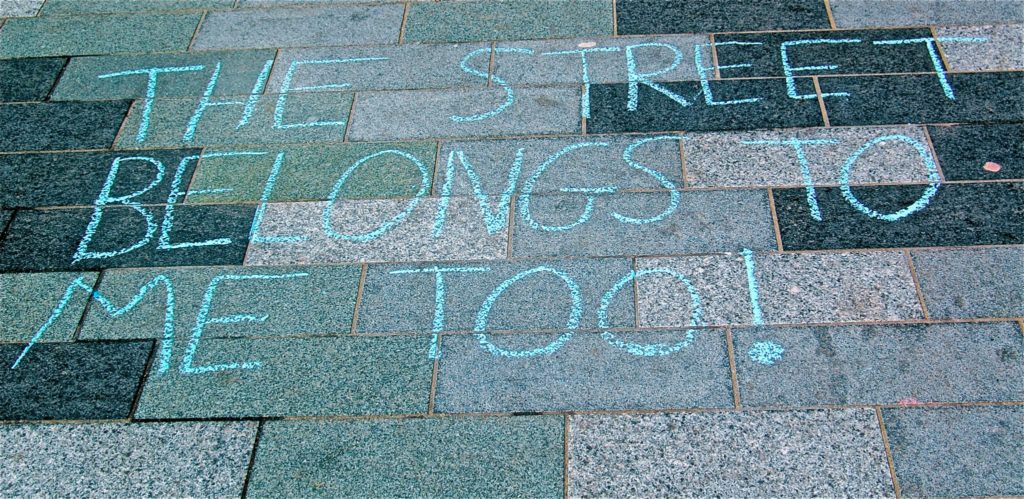
4-13-13belfastnorthernirelandStreet harassment is always an unpleasant experience. Catcalls, whistles, instances of being followed or grabbed in public places, inevitably leave victim feeling scared, threatened or embarrassed. What is perhaps even more disturbing is that most women experience street harassment for the first time as children. Young people often fall victim to a particularly malevolent form of harassment because of their increased vulnerability: they are more likely to be startled by a passing car screaming obscenities, more likely to be rattled by a sexist or degrading comment, and more likely to be coerced by a man who won’t take no for an answer.
Speaking to friends about their experiences of street harassment, a common theme appeared: the perpetrators did not care about the age of the girls they were bothering. All experiences detailed here, including my own, are from girls aged 16-17.

Dixie*: “I was on the bus, and a man aged around 50 was staring me up and down. I put earphones in and moved seats to avoid him.  He ‘coincidentally’ got off at the same stop as me. He followed me, caught up to me and asked how old I was. He said he liked my hair, and I ignored him and crossed the road. He called me a bitch and threw a plastic bottle at me. I was 15 and wearing my school uniform. “

Ada: “I was standing at an ATM and two drunk men approached me asking for oral sex. I was eleven.”

Anne spoke of being harassed by four men in their thirties while she walked home with friends younger than herself. In her own words, “It was clear we were underage. One of the men shouted ‘green hoody!’ at me, in reference to what I was wearing. He started grinning at me in a weird manner, and we kept walking. We could hear him and his friends shouting at us, and we had to run down an unlit road only to find they had followed us.”

Polly was getting the bus home from school, when an older man aggressively demanded she smile for him. “The next time I saw him, he initiated a conversation. He asked me what I was doing after school the next day. The next time I saw him he honked at me from his vehicle.”

One of my own most recent experiences of street harassment happened at a train station. I was approached by a man 30 years my senior, who would not leave me alone, even when I made it clear I did not want to speak to him. He persisted with requests for a phone number, and details of my home address and school. Upon telling him I was 16, he replied, “I don’t care. I think when you like the look of someone, age is not important”. When I contradicted this, he laughed and said, “Maybe it is important for you.” He then pulled my arm, insisting I go “for a walk” with him. He did not leave me alone until my train came ten minutes later.

Clearly these harassers were deliberately targeting minors, not in spite of their age, but because of it. I think predatory men are more inclined to proposition people who lack the confidence to assert themselves. A pivotal part of tackling street harassment is empowering young women to stand up for themselves. This is difficult, as girls are socialized from a young age to be polite, to not make a fuss, and to set aside their comfort for the egos of men.

When I discuss street harassment with girls my own age, “not wanting to be rude” recurs as a reason for not defending ourselves, which may seem ridiculous to be people who have not been in our position. However, several factors in these situations prevent women from asserting themselves. First, small instances of harassment always come with the threat of escalation. I have read countless stories of women being assaulted, or even killed, for confronting harassers. Secondly, the anxiety harassment evokes causes many women to freeze up, and thirdly, while this may mystify many men for whom it seems the obvious solution, telling a cat caller to “f**k off” is not a magical solution to harassment. While this might feel very satisfying, at the end of the day, what does it actually accomplish? It does not prevent the man from bothering another woman. Swearing at him will not suddenly make him realise his behaviour is inappropriate, as he probably knows this, and is unconcerned with the negative toll his action takes on women.

I think part of tackling street harassment is to improve sex education. Where I live, in Ireland, most schools are run by the Catholic Church. Abstinence-only education is common, and issues of consent are not really discussed. Part of stopping street harassment should be challenging the sexist and entitled attitudes which go hand in hand with the topic of consent.

Rape culture is perpetuated not only by older men who bother young women on the street, but by teenage boys who spend 8 hours a day in school where (in my experience) sexual assault, harassment and misogyny are not only trivialized and normalized, but joked about.  Again, I turned to my friends to ask about their experiences. When I shared one story of being groped and having incessant inappropriate comments directed at me for being the only girl doing running as a sports option, everybody had a similar story. The sheer quantity and normalization of harassment and assault was horrendous.

Dixie: “A boy repeatedly made fun of me for my weight and used the fact that I developed early as an insult”.

Anne tells a story of a girl being tackled to the ground, as a boy in her class tried to finger her. “We had been telling a teacher of the situation for ages, but she did absolutely nothing. She said she would have a ‘word’ with him, but the situation continued, and the same boy pulled the girl down a lane and tried to force himself on her. He would not take no for an answer.”

I was also told endless stories of drunk girls being assaulted at parties, as if these were normal and inevitable occurrences, and not criminal offences.  “Slut-shaming” and other attempts to denigrate female sexuality seem to be an epidemic also. A large contributing factor to this behaviour is the trivialization of violence against women.  Recently, a boy in my class shared a video on facebook of a woman falling to the ground after being punched hard in the face. The boy captioned the video “when she says she wants equal rights”. The video received many ‘likes’ and comments laughing at it, and at feminism in general.

Candice told me about a class discussion on feminism, in which the Brock Turner case was brought up. When the teacher remarked on his light jail sentence, one boy commented “fair play, my man!” (Irish slang for “well done” or “good job”).

Candice said “The teacher didn’t say anything. I was completely dumbfounded and the boys were all laughing”.  This same boy is extremely vocal about his hatred of feminism, and has claimed “If women in Saudi Arabia don’t complain, why should women here?”

Recently a video of Emma Watson addressing the UN about campus sexual assault went viral.


This video received the comment “dykes” from another vocal misogynist I am in school with. This is the disturbing reality of using your voice to speak about violence and rape culture: you are subjected to slurs which are merely a pathetic attempt to silence women, to make women afraid to challenge a status quo of objectification and degradation.

To the boys who make schools an unsafe space for girls I say this: girls are in school to receive an education, and not one in how to bite their tongues when assaulted, because it’s “just a laugh”, not an education in how to smile and say nothing when a life-ruining rape is joked about, not an education in how to view being sexually assaulted while incapacitated with alcohol as normal.

And to the men who harass girls and women on the street: women deserve to walk through the world with the same security men have. Public spaces belong to all of us, and women don’t exist for your entertainment. What may seem like a “laugh” to you, seriously damages women’s confidence, makes them feel threatened, and essentially creates an environment where women are viewed as objects, with which you can do what you want. When you set this example to teenage boys, think of the vicious cycle you are perpetuating, and think of the women who have their lives destroyed by sexual assault.  In essence, think before you speak.

*Names have been changed

Grace is a student. She writes regularly for her school newsletter and yearbook, and has been published in Inis Magazine. Grace is currently involved with the socialist feminist group ROSA (for Reproductive rights, against Oppression, Sexism & Austerity), and their campaign for abortion rights in Ireland.

Share

Filed Under: correspondents, Stories, street harassment

Spain: Using Festive Events to Tackle Violence Against Women

September 28, 2016 By Correspondent

Alice C.R., Barcelona, Spain SSH Blog Correspondent

Trigger Warning – Sexual assault

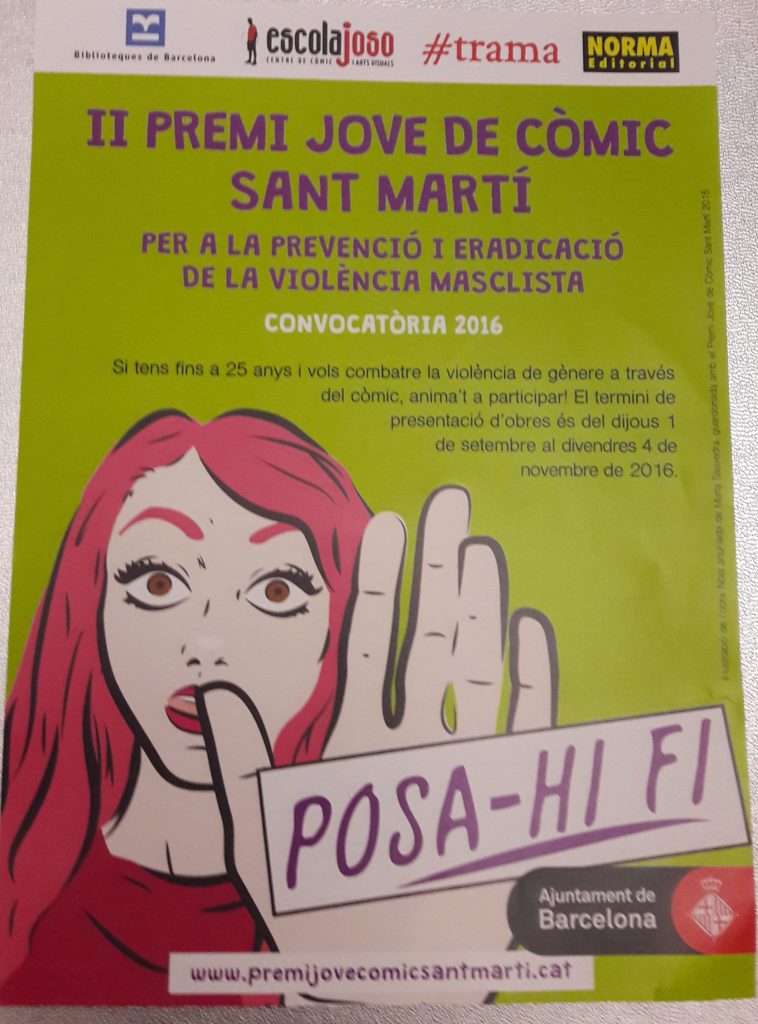
jovecomicsFor many people, Barcelona is the sunny, party city by the sea. And it is true that the city offers a large range of activities throughout the year (and not only parties and night clubs, by the way), but some events are bigger than others.
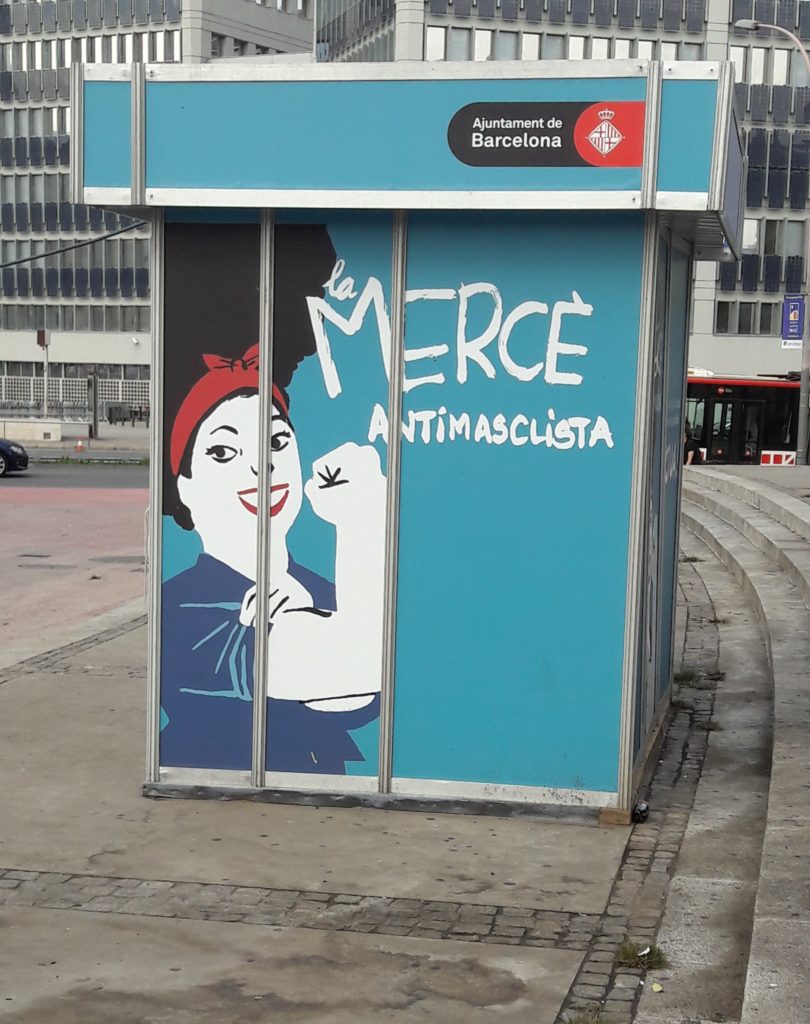
This last weekend, for instance, has been one of the most festive of the year in Barcelona. Every 24th of September the city celebrates La Mercé, the Patron Saint of Barcelona and the city holds a four days street festival in her honour. Concerts, exhibitions, street arts, dance, fireworks and the traditional Castells (human towers, catalan tradition delared Intangible Cultural Heritage in 2010 by UNESCO) attract thousands of both local people and tourists. This kind of big celebration is also a good opportunity to tackle street harassment and assaults by making people aware of these issues and their dangerousness and offer appropriate support to the victims.

This is crucial. And for good reason. Recent news remind us almost every single day how sexual assaults are shockingly common and how stereotypes and myths about them are still deeply ingrained.

We have all heard here about the San Fermin rape case and sexual assaults. Especially the one where five men gang raped a young woman. The police arrested one of them while he was sleeping in his car and the others were enjoying a street party. And this was not the first time it happened. Every year, the San Fermin counts at least with one case of rape.

Another case made the headlines recently in Barcelona — a city councilwoman reported a sexual assault attack by night in a zone where people use to go out.

la-merceThese are just two examples where one occurred during a big wild and controversial festival and the other happened at night to a public figure. And that is an issue by itself. It seems that only specific assaults are revealed and discussed, those that happen at night, during wild parties when we perfectly know that assaults can also (and mainly) occur by day, on the way to work and can be committed by an acquaintance. It is important to recognize that the stories in the media about sexual violence are only the top of iceberg.
Unfortunately, both in the articles and in the comments left by readers, there was body shaming, slut shaming, incredulity, and doubt about the facts described by the victim. We learned, for instance, that the gang rape victim might have given a kiss before being raped. How is that relevant!?

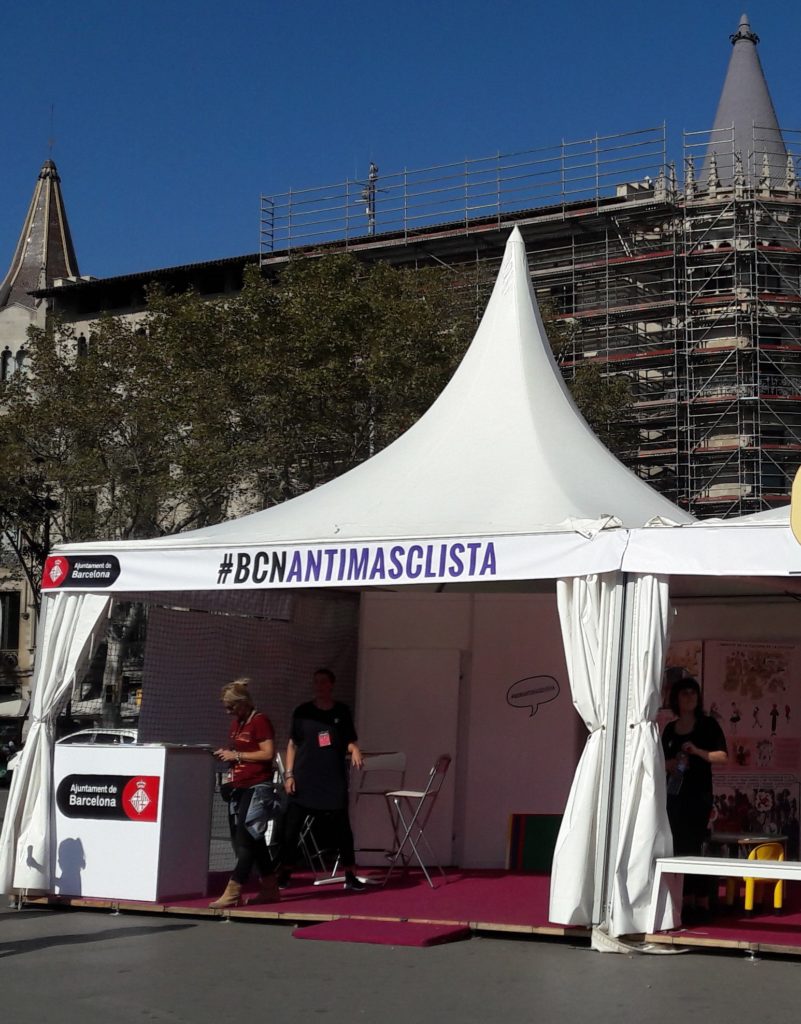
That is why initiatives like Sanfermin sin agresiones sexuales , LaMercé anti masclista and Bcn Antimasclista are vital. In a world where victims are blamed for being assaulted, where they are revictimized, information and support must be provided.

bcn-antimasclistaI was out celebrating for La Mercé and I must say it was quite comforting to see two stands where I could get information about all the different associations of the city and which one I should contact in case of sexual assault, domestic violence, physical and/or psychological abuses, where I could get a hotline number in case of emergency, where I could report any incident. When looking all the leaflets and ask for general information I could speak with someone who asked me if I needed some specific information or help and where I could make a test to see if I were in an abusive situation and which organization I should contact if so. I know these organizations and I got help from some of them. They are doing a wonderful job but not everyone knows them and this makes the issue visible and makes it easier to speak out.
There is still a long way to go. This summer, the city of Tarragona launched a campaign about consent called Respetame (respect me). Of course a man thought it would be very appropriate to write an article about how women say “no” as a game and that all they want is to get the harrasser trying harder. He compared it to the business law of market where a man’s goal is to turn a “NO” into a “yes”. The city councilwoman who has been assaulted pointed out some failures in the process of reporting an attack.

It is still very common to hear victim-blaming and victim-shaming comments.

But by using event such annual festival to give basic information about how to recognize a situation of abuse, to provide addresses and contacts to seek help, to give the opportunity to speak out, we are on a good way to tackle sexual violence. Hopefully.

Hotline Assistance 24/24 in 124 languages : 900 900 120
http://dones.gencat.cat/ca/ambits/violencia_masclista/recursos_atencio/telefon_900/  

Alice likes researching, analyzing and writing about Women’s Rights, gender bias, and intersectionalism with a special focus on sexual violence, rape, rape culture, the impact of street harassment and how the media deals with these issues. She is currently working on a new project focused on how some media participate in the revictimization of victims. Follow her and her projects on her Facebook page and via Twitter @Alyselily.

Share

Filed Under: correspondents

Croatia: Racist and Gendered Street Harassment (Part 2)

September 27, 2016 By Correspondent

Shawn Ray, Croatia, Macedonia, Greece, Turkey, Iran, SSH Blog Correspondent

[Editor’s Note: In Part 1, Shawn shares how she’s “traveled through 71 countries, and surprisingly, have recently found Split, Croatia, to be the most openly racist addition to the new EU. By openly, I mean the inhabitants have not adapted to the niceties of subversive sexual harassment. It is acceptable behavior to yell derogatory comments, to touch and even throw things at female human beings.” These are a few recent examples.]

September 1, 2016 (Croatia)

Excuse me, can I take a picture with you?

Me: Why?

Because I have never seen a Blackie before, and I want to show my friends.

Me: What are your friends’ names?

Sara and Christiana.

Me: Well, I’ll make you a deal. How about we become friends and then you can introduce me to your other friends one day and we can all take pictures together?  Because I’m not actually a Blackie.  And, I understand why you would think that, because I look like the one’s you’ve seen on TV.  But here’s how you can tell the difference, a Blackie would let you take a picture of them, without being a friend of yours.  I wont.

What are you?

Me: Well, first, I’m a child of The Creator.  Do you believe in God?

Yes, We are Christian.

Me: Well, that’s what I am.  A creation, like you.  My Ancestry and ethnicity is that of the Moor.  I am a Moor.

What is a Moor?

She sits on the bench next to me at the park. with her mother watching intently, hands on hips.

I smile to communicate I have no intention of harming her child, because as I’ve been informed, ‘Blackies’ are generally assumed to be of a violent nature in this region.  I can’t help but wander how that started, chicken or egg?

Me: Well, the Moors built the first university in the world in the 7th century and valued wisdom and cleanliness above all other things.  My ancestors taught your ancestors how to wash their hands to stop the spread of disease,  when they arrived 5 thousand years ago. Betcha never heard that before, Huh.

No.

Me: So, A Moor is a keeper of black magic, not the evil kind on tv,  but the kind that makes you want to take a picture with me, because you think  there are things I know about the universe, the earth, the water, the air, men (she smiles) … and you sense these things, but can’t see them clearly, and you’re right.

As the first people, my ancestors taught your ancestors many things, but we kept many things for ourselves.  And every once in a awhile, traveling around the world, I run into some smart beautiful young woman who can sense the world is changing, and she’s coming into mystery, like you, I think.

But I only share what I know and learn with my friends, just like you & Sara & Christiana.  So, I hope we can be friends, what do you think?

Yes, I want to be friends.

Me: Me too.

Okay, so here’s the deal.  Do you like to read?

Not really, but I have a reader.

Me: Great, There is a book we can read together, that I’ve read with many of my new friends.  You can download it, It’s called “The Isis Papers” by Dr. Frances Cress Welsing.  It’ll be easy to read, because you’ve never read anything like this before, trust me.

What is it about?

Me: The difference between a Blackie and a Moor.

You mean slavery?

Me: Not really.  More about how we can only see so much standing in one place.  This book will let you stand in a different place and see the world through the eyes of someone very different than you.  The more places we stand in life, the better we understand each other.

Eventually, you’ll be able to teach your parents and your friends how to tell the difference between a ‘blackie’ and a Moor, like an ambassador or a good  friend.

But, I promise it isn’t boring.  And some of it will make you angry, or sad, and I still have a lot of questions and I’ve read it so many times.

It’s just a good place for us to start to have a really good honest talk, like the way you’re able to talk to Sara and Christiana, truthfully and openly, like friends do.

You in?

Ok.  Wait.

She skips back to her mother says a few words and dives into her backpack as her mother strokes her hair and looks back at me.  We smile and wave.

Okay, what is the name?

Me: The Isis Papers ,by Dr. Frances Cress Welsing.   After some time, we order her a copy on my account from Amazon. (I have gifted 6 copies to date to begin relevant conversations.)

Me: So, when you get it, you call me and wherever I am in the world, I’ll  call you back, and we’ll talk about what were reading together, and before you know it we’ll be good friends.  And when we finish reading it, I’ll come back to take you and Christiana and Sara to lunch, and we will dress up and do our hair and makeup and decorate ourselves to feel beautiful and have a girls afternoon.  We can pick a new book to read together while I travel, and we’ll  take lots of pictures together, as friends   Then I can tell my friends about you too,  Is it a deal?

I offer her a fist pump, which confuses her, but delights her at the same time as if she’s received the first installment of cool.

Yes.  She hugs me.  Runs across the park to her mother and I watch her excitedly related our conversation.  They both turn back to wave and I raise a black power fist and she does too.

Her mother gestures at my hair and kisses her fingers together in approval.  She gives the thumbs up and a wink because she wants me to know she thinks I’m excellent, and she’s right.

___________________________________________________________________________

**This man followed me along the boardwalk from 10:36 when I noticed until I reached a group of officers in the park at 11:49.  He walked hurriedly away as I approached the female officer…

“Excuse me, This man has been following me for almost an hour, the man running from us, through the park,  there.”

Female Officer: ” Are you sure?”

___________________________________________________________________________

September 2, 2016

Hello, Where are you from?

Why?

Because I have friends with hair like that, from America.

Yes, I’m from America.

What City?

Los Angeles.

Are you a Crip or a blood?

___________________________________________________________________________

September 3, 2016

Oh my god, what is your name?

Why?

Because I have never kissed a Black before. Can I kiss you?

No.

Why not?

**This Young man shouted “Animal” and stood his ground when I returned to take a picture of him.  His parents must be so proud. 🙂

___________________________________________________________________________

September 4, 2016

Excuse me, are you a singer?

No.

Come on, I know you are a singer. A Jazz or Blues singer, sing something.

___________________________________________________________________________

September 4, 2016

Can you teach me how to talk Black?

I like the way they talk like that, so tough.

(Puts hands in air to simulate gang signs)

Can you teach me?


The boy to the right: “Hi, you look so good and sexy?

I am very good in bed, I can make you feel really good.

I like the Black.  Where are you from?”

___________________________________________________________________________

September 1 – 5, 2016

Can I touch your hair? (18 times)

Can I touch your skin? (5 times)

**Not sure what I was guilty of but it disgusted and angered this women so much, She wasn’t available to comment on her ignorance, when I smiled and said Hello,

Shawn Ray is an avid traveler and freelance writer/photojournalist. Also a TEFL instructor, Shawn has visited over 70 countries and lived for a year or more in several foreign communities. In 2015, Shawn followed the migration of Syrian asylum seekers from Turkey through the Netherlands. A member of GoTravelBroad, (a solo-female travel support and advocacy group) Shawn is focused on creating awareness to end violence against women worldwide, through empowering women to travel without apology.

Share

Filed Under: correspondents, race, Stories, street harassment

Croatia: Racist and Gendered Street Harassment (Part 1)

September 27, 2016 By Correspondent

Shawn Ray, Croatia, Macedonia, Greece, Turkey, Iran, SSH Blog Correspondent

What does harassment look like?  What does it feel like?  Does it start at the top of your head and glare down to your feet to measure you, less than? Does it assign itself superior judgement or an entitlement, to bodies, space, spirit? What is its intention? Does knowing its seeds are severe insecurity and self-loathing lessen the churning in your stomach, that tells you you’re not safe?

I’ve always assumed the purpose of sexual harassment was to coerce a romantic interest, but recently, I’ve decided the people who harass passersby, know on some deep level that they would never have access to authentic relationship with their victims, and so the intent is punishment. Realizing their own undesirability so intimately sows the seeds of bitterness, that are acted on. This disease is passed on to unsuspecting children who can be inadvertently guilty of epic violation.

Violence against women in the form of harassment conjures images of dirty construction workers yelling down obscenities to unsuspecting business-women crossing the street. I submit to the reader that harassment, whether sexual, racial, religious, or social is a shaded and sometimes subversive conversation, attitude or behavior, that seeks to create a hierarchy where the harassed is degraded, and the harasser feels somehow validated.

Street harassment is not strictly the domain of the male, or reduced to a sexual nature. On the contrary, I often experience more violation at the hands of Anglo women, trying to touch my skin and hair, then men collectively.

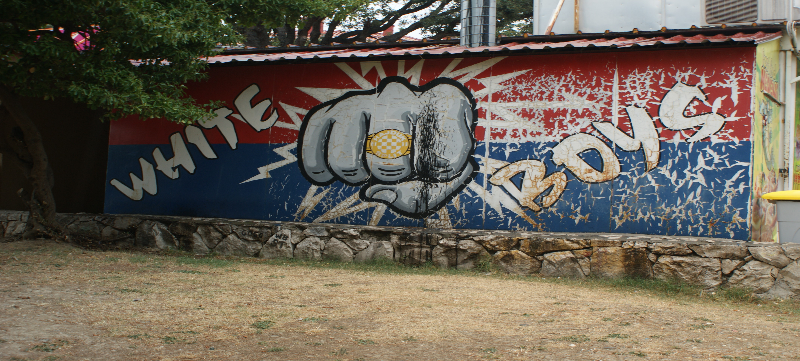
I’ve traveled through 71 countries, and surprisingly, have recently found Split, Croatia, to be the most openly racist addition to the new EU. By openly, I mean the inhabitants have not adapted to the niceties of subversive sexual harassment. It is acceptable behavior to yell derogatory comments, to touch and even throw things at female human beings.

mural

Travel and Leisure would paint Split-Croatia of the Dalmatia coast as a cosmopolitan vacationers mecca. The free shopping shuttles, $14 cheeseburgers and mega yachts distract from the discomfort of moving through this space, for a female body of color.

Much like vulgarity is in the eye of the beholder harassment is a subjective explicit experience, and we all know it when we see it. Street harassment is quite simply, Entitlement.

After discussing the difficulties I’ve endured, with a group of students, one replied, “Are you certain it’s racism, I don’t believe we have racism here, we have nationalism, they hate everybody, not just you.” – Heterosexual, Anglo-Croatian Male.

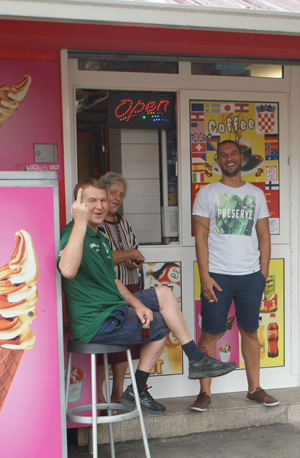
openI would warn that when a woman discusses mistreatment, asking her to qualify her experience is synonymous with the famous, “what were you wearing?”, and highly problematic. While many of the citizens here would vehemently defend the ‘intention’ of the graffiti wall, some go so far as to accuse me of misunderstanding. At a time when the people of the Balkans are struggling to find a democratic expression and recover from tyranny, it’s surprising that anyone here would admonish a victim of mistreatment, “not to believe your eyes.”  Is it possible that the vacuous space required for hostility and oppression to occur, come from the philosophy of justifying, rationalizing and explaining inappropriate behavior? Is it possible that holding people accountable to their intentions and beliefs, while ignoring their behavior and conversation is a critical component in the psychodynamics of privilege?

Just as a woman, who has been a female longer than she has been anything else, can keenly discern sexually solicitous behavior, so can a person of color clearly determine the vibration of racial hostility. I find it disturbing that these types of responses almost always come from heterosexual, Anglo males.  This is the nature of privilege, it cannot see or comprehend that which does not impact it’s survival.   

Street harassment is not a threat to the survival or prosperity of heterosexual, Anglo males, therefore one can easily be oblivious to the spiritual and sometimes physical discomfort it causes.

To give you an example, the former Yugoslavia is rife with hostility between Catholics, Orthodox and Muslims. In a similar situation, a Croatian Catholic woman related to me the mistreatment she had received at the hands of a Croatian Muslim cashier in a local market.  Though I was present, when the man passed and commented on my friends shoes, I could not perceive the subtext of the communication as harassment, because I have no frame of reference for this type of hierarchy or the intention to diminish.

But it did not occur to me to invalidate her experience, by asking if she was sure about what she had; experienced, interpreted, perceived, or if she was certain she hadn’t in some way invited the behavior.

I chose to ask questions, and offer support for her decision to let the insult pass. I also communicated that in the future should she decide not to let an insult pass, I would support that decision as well.

Interesting is the expectation that women (of color) would graciously dismiss the consistent assaults with kind stories or polite smiles, and continue to let it pass.  To plainly discuss the mistreatment scares most, and paints the victim as disgruntled, sensitive or generally bitter, and no one wants to be painted as ‘negative’.  That may be a lower designation than ‘racist’ or ‘sexual predator’ in Croatia.

In Part 2, I share some of my recent conversations and experiences to aid the reader in creating an intersectional understanding of street harassment and to process my own growing disdain and lack of compassion for Anglo entitlement. It is a labor of love not to hate, and probably the most relevant work any of us will ever do. I invite you to comment and offer perspective, suggestion and experience so that I may learn from our collective experience and continue my mission to remain unconditional, if not always gracious.

Shawn Ray is an avid traveler and freelance writer/photojournalist. Also a TEFL instructor, Shawn has visited over 70 countries and lived for a year or more in several foreign communities. In 2015, Shawn followed the migration of Syrian asylum seekers from Turkey through the Netherlands. A member of GoTravelBroad, (a solo-female travel support and advocacy group) Shawn is focused on creating awareness to end violence against women worldwide, through empowering women to travel without apology.

Share

Filed Under: correspondents, race, Stories, street harassment

« Previous Page
Next Page »

Share Your Story

Share your street harassment story for the blog. Donate Now

From the Blog

  • #MeToo 2024 Study Released Today
  • Join International Anti-Street Harassment Week 2022
  • Giving Tuesday – Fund the Hotline
  • Thank You – International Anti-Street Harassment Week 2021
  • Share Your Story – Safecity and Catcalls Collaboration

Buy the Book

  • Contact
  • Events
  • Join Us
  • Donate
  • Facebook
  • Instagram
  • Pinterest
  • Tumblr
  • Twitter
  • YouTube

Copyright © 2026 Stop Street Harassment · Website Design by Sarah Marie Lacy