• About Us
    • What Is Street Harassment?
    • Why Stopping Street Harassment Matters
    • Meet the Team
      • Board of Directors
      • Past Board Members
    • In The Media
  • Our Work
    • National Street Harassment Hotline
    • International Anti-Street Harassment Week
    • Blog Correspondents
      • Past SSH Correspondents
    • Safe Public Spaces Mentoring Program
    • Publications
    • National Studies
    • Campaigns against Companies
    • Washington, D.C. Activism
  • Our Books
  • Donate
  • Store

Stop Street Harassment

Making Public Spaces Safe and Welcoming

  • Facebook
  • Instagram
  • Pinterest
  • Tumblr
  • Twitter
  • YouTube
  • Home
  • Blog
    • Harassment Stories
    • Blog Correspondents
    • Street Respect Stories
  • Help & Advice
    • National Street Harassment Hotline
    • Dealing With Harassers
      • Assertive Responses
      • Reporting Harassers
      • Bystander Responses
      • Creative Responses
    • What to Do Before or After Harassment
    • Street Harassment and the Law
  • Resources
    • Definitions
    • Statistics
    • Articles & Books
    • Anti-Harassment Groups & Campaigns
    • Male Allies
      • Educating Boys & Men
      • How to Talk to Women
      • Bystander Tips
    • Video Clips
    • Images & Flyers
  • Take Community Action
  • Contact

India: Sanitation and Sexual Assaults

September 29, 2016 By Correspondent

Suchita Kotnala, Texas, USA / India, SSH Blog Correspondent

Trigger Warning – Rape, Murder

With the ‘World Toilet Day’ approaching on November 19th, it’s time to turn our focus on the sanitation facilities, or lack thereof, in India, especially the rural India, where it is estimated, that nearly 65% of the population defecates out in the open. The lack of good sanitation practices not only poses a grave health risk to the vast population in general, but, also adds the risk of bodily harm that women have to face and live with everyday.

Although India is modernizing and evolving rapidly today, a significant chunk of its population has been lagging behind in terms of social and economic advancements, and women have been paying the biggest price for it, with their freedom. The fact that numerous women fall prey to sexual predators while on their way to attend to the nature’s call during the silent and dark hours between sunset and sunrise in the rural areas, paints a grim picture for the developing ‘superpower’ India. Every now and then, a high profile gang-rape story shakes the nation out of its reverie, but the sad truth is, that only a fraction of the sexual assaults even get reported, due to the existing caste and gender biases within the police force. In 2014, two teenage girls were found murdered, in Uttar Pradesh, India, after they went missing on the prior night, when they had gone out to relieve themselves. It is alleged that they were raped and strangled, but the police investigation failed to offer any clear answers. More recently, on the night of 31st July this year, a 20-year-old woman was brutally gang-raped and murdered by two men, when she stepped out to answer the nature’s call, in Tamil Nadu, India.

Although strengthening the law and order and increased sensitization of the masses towards gender based violence is vital to bringing about a change for the better, the importance of providing privacy and security to the women while they perform one of the most basic rituals of life can’t be disputed. No one should have to plan their entire day around activities of daily living, fearing for their life or well being every time they stepped out of their house.

The Indian Govt. has stepped up on its efforts to build more toilets lately, spending millions. The initiative might be of greater consequence, if coupled with efforts to educate the society and change the culture and attitudes of the people towards good sanitation practices.

The Indian society cannot hope to progress and prosper if a significant portion of its population continues to struggle on a daily basis, merely to stay safe and alive every morning.

Suchita was raised in western India by loving and supportive parents who helped her and her sister to grow into strong, independent and career-oriented women. She’s a registered general practitioner in India and is currently preparing to obtain medical residency in the United States. She is passionate about women’s rights especially because she has had firsthand experiences of harassment and sexist behavior at public spaces, school and work.

Share

Filed Under: correspondents, News stories, street harassment Tagged With: India, sanitation, sexual assault

Ireland: Misogyny On The Streets And In The Schools

September 28, 2016 By Correspondent

Grace Gageby, Dublin, Ireland, SSH Blog Correspondent

Trigger warning: Sexual assault

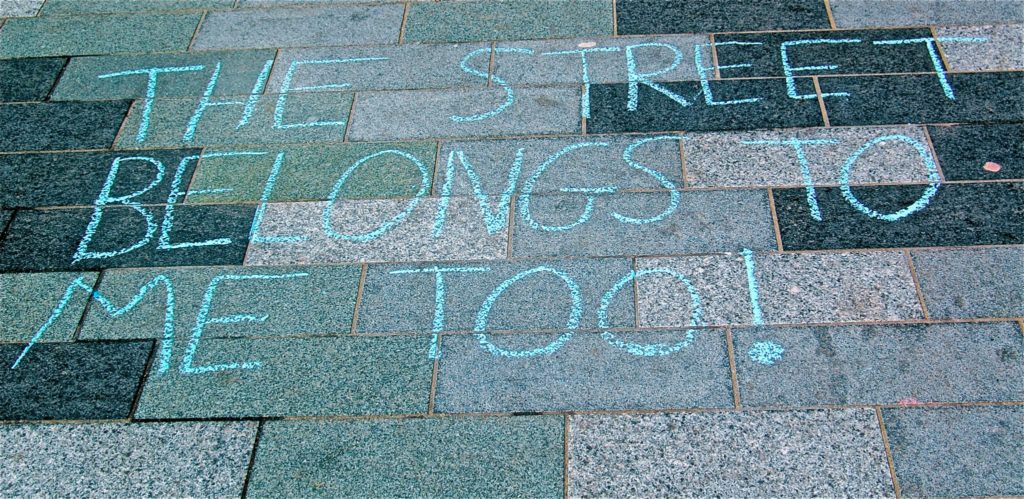
4-13-13belfastnorthernirelandStreet harassment is always an unpleasant experience. Catcalls, whistles, instances of being followed or grabbed in public places, inevitably leave victim feeling scared, threatened or embarrassed. What is perhaps even more disturbing is that most women experience street harassment for the first time as children. Young people often fall victim to a particularly malevolent form of harassment because of their increased vulnerability: they are more likely to be startled by a passing car screaming obscenities, more likely to be rattled by a sexist or degrading comment, and more likely to be coerced by a man who won’t take no for an answer.
Speaking to friends about their experiences of street harassment, a common theme appeared: the perpetrators did not care about the age of the girls they were bothering. All experiences detailed here, including my own, are from girls aged 16-17.

Dixie*: “I was on the bus, and a man aged around 50 was staring me up and down. I put earphones in and moved seats to avoid him.  He ‘coincidentally’ got off at the same stop as me. He followed me, caught up to me and asked how old I was. He said he liked my hair, and I ignored him and crossed the road. He called me a bitch and threw a plastic bottle at me. I was 15 and wearing my school uniform. “

Ada: “I was standing at an ATM and two drunk men approached me asking for oral sex. I was eleven.”

Anne spoke of being harassed by four men in their thirties while she walked home with friends younger than herself. In her own words, “It was clear we were underage. One of the men shouted ‘green hoody!’ at me, in reference to what I was wearing. He started grinning at me in a weird manner, and we kept walking. We could hear him and his friends shouting at us, and we had to run down an unlit road only to find they had followed us.”

Polly was getting the bus home from school, when an older man aggressively demanded she smile for him. “The next time I saw him, he initiated a conversation. He asked me what I was doing after school the next day. The next time I saw him he honked at me from his vehicle.”

One of my own most recent experiences of street harassment happened at a train station. I was approached by a man 30 years my senior, who would not leave me alone, even when I made it clear I did not want to speak to him. He persisted with requests for a phone number, and details of my home address and school. Upon telling him I was 16, he replied, “I don’t care. I think when you like the look of someone, age is not important”. When I contradicted this, he laughed and said, “Maybe it is important for you.” He then pulled my arm, insisting I go “for a walk” with him. He did not leave me alone until my train came ten minutes later.

Clearly these harassers were deliberately targeting minors, not in spite of their age, but because of it. I think predatory men are more inclined to proposition people who lack the confidence to assert themselves. A pivotal part of tackling street harassment is empowering young women to stand up for themselves. This is difficult, as girls are socialized from a young age to be polite, to not make a fuss, and to set aside their comfort for the egos of men.

When I discuss street harassment with girls my own age, “not wanting to be rude” recurs as a reason for not defending ourselves, which may seem ridiculous to be people who have not been in our position. However, several factors in these situations prevent women from asserting themselves. First, small instances of harassment always come with the threat of escalation. I have read countless stories of women being assaulted, or even killed, for confronting harassers. Secondly, the anxiety harassment evokes causes many women to freeze up, and thirdly, while this may mystify many men for whom it seems the obvious solution, telling a cat caller to “f**k off” is not a magical solution to harassment. While this might feel very satisfying, at the end of the day, what does it actually accomplish? It does not prevent the man from bothering another woman. Swearing at him will not suddenly make him realise his behaviour is inappropriate, as he probably knows this, and is unconcerned with the negative toll his action takes on women.

I think part of tackling street harassment is to improve sex education. Where I live, in Ireland, most schools are run by the Catholic Church. Abstinence-only education is common, and issues of consent are not really discussed. Part of stopping street harassment should be challenging the sexist and entitled attitudes which go hand in hand with the topic of consent.

Rape culture is perpetuated not only by older men who bother young women on the street, but by teenage boys who spend 8 hours a day in school where (in my experience) sexual assault, harassment and misogyny are not only trivialized and normalized, but joked about.  Again, I turned to my friends to ask about their experiences. When I shared one story of being groped and having incessant inappropriate comments directed at me for being the only girl doing running as a sports option, everybody had a similar story. The sheer quantity and normalization of harassment and assault was horrendous.

Dixie: “A boy repeatedly made fun of me for my weight and used the fact that I developed early as an insult”.

Anne tells a story of a girl being tackled to the ground, as a boy in her class tried to finger her. “We had been telling a teacher of the situation for ages, but she did absolutely nothing. She said she would have a ‘word’ with him, but the situation continued, and the same boy pulled the girl down a lane and tried to force himself on her. He would not take no for an answer.”

I was also told endless stories of drunk girls being assaulted at parties, as if these were normal and inevitable occurrences, and not criminal offences.  “Slut-shaming” and other attempts to denigrate female sexuality seem to be an epidemic also. A large contributing factor to this behaviour is the trivialization of violence against women.  Recently, a boy in my class shared a video on facebook of a woman falling to the ground after being punched hard in the face. The boy captioned the video “when she says she wants equal rights”. The video received many ‘likes’ and comments laughing at it, and at feminism in general.

Candice told me about a class discussion on feminism, in which the Brock Turner case was brought up. When the teacher remarked on his light jail sentence, one boy commented “fair play, my man!” (Irish slang for “well done” or “good job”).

Candice said “The teacher didn’t say anything. I was completely dumbfounded and the boys were all laughing”.  This same boy is extremely vocal about his hatred of feminism, and has claimed “If women in Saudi Arabia don’t complain, why should women here?”

Recently a video of Emma Watson addressing the UN about campus sexual assault went viral.


This video received the comment “dykes” from another vocal misogynist I am in school with. This is the disturbing reality of using your voice to speak about violence and rape culture: you are subjected to slurs which are merely a pathetic attempt to silence women, to make women afraid to challenge a status quo of objectification and degradation.

To the boys who make schools an unsafe space for girls I say this: girls are in school to receive an education, and not one in how to bite their tongues when assaulted, because it’s “just a laugh”, not an education in how to smile and say nothing when a life-ruining rape is joked about, not an education in how to view being sexually assaulted while incapacitated with alcohol as normal.

And to the men who harass girls and women on the street: women deserve to walk through the world with the same security men have. Public spaces belong to all of us, and women don’t exist for your entertainment. What may seem like a “laugh” to you, seriously damages women’s confidence, makes them feel threatened, and essentially creates an environment where women are viewed as objects, with which you can do what you want. When you set this example to teenage boys, think of the vicious cycle you are perpetuating, and think of the women who have their lives destroyed by sexual assault.  In essence, think before you speak.

*Names have been changed

Grace is a student. She writes regularly for her school newsletter and yearbook, and has been published in Inis Magazine. Grace is currently involved with the socialist feminist group ROSA (for Reproductive rights, against Oppression, Sexism & Austerity), and their campaign for abortion rights in Ireland.

Share

Filed Under: correspondents, Stories, street harassment

Spain: Using Festive Events to Tackle Violence Against Women

September 28, 2016 By Correspondent

Alice C.R., Barcelona, Spain SSH Blog Correspondent

Trigger Warning – Sexual assault

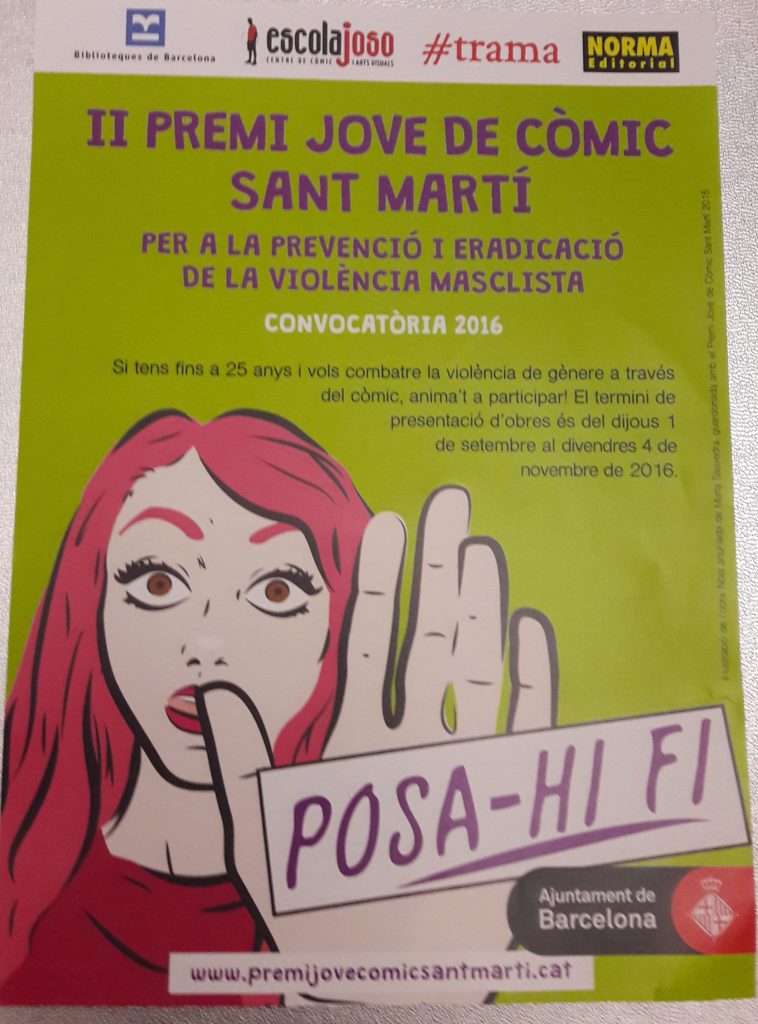
jovecomicsFor many people, Barcelona is the sunny, party city by the sea. And it is true that the city offers a large range of activities throughout the year (and not only parties and night clubs, by the way), but some events are bigger than others.
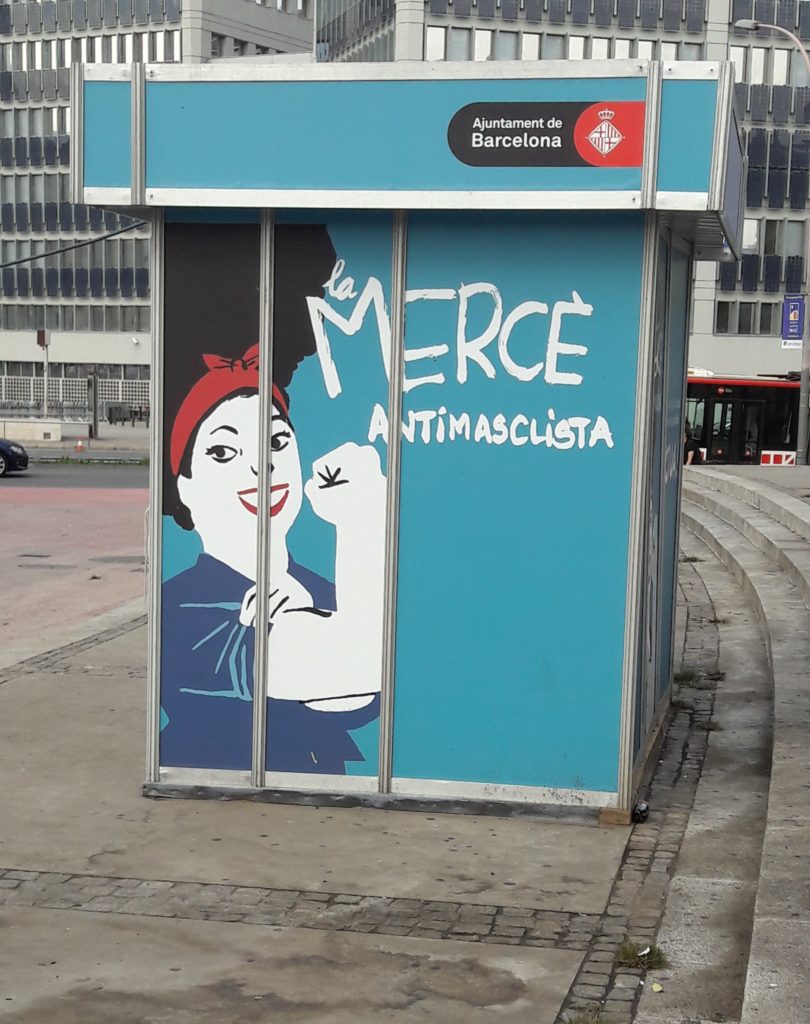
This last weekend, for instance, has been one of the most festive of the year in Barcelona. Every 24th of September the city celebrates La Mercé, the Patron Saint of Barcelona and the city holds a four days street festival in her honour. Concerts, exhibitions, street arts, dance, fireworks and the traditional Castells (human towers, catalan tradition delared Intangible Cultural Heritage in 2010 by UNESCO) attract thousands of both local people and tourists. This kind of big celebration is also a good opportunity to tackle street harassment and assaults by making people aware of these issues and their dangerousness and offer appropriate support to the victims.

This is crucial. And for good reason. Recent news remind us almost every single day how sexual assaults are shockingly common and how stereotypes and myths about them are still deeply ingrained.

We have all heard here about the San Fermin rape case and sexual assaults. Especially the one where five men gang raped a young woman. The police arrested one of them while he was sleeping in his car and the others were enjoying a street party. And this was not the first time it happened. Every year, the San Fermin counts at least with one case of rape.

Another case made the headlines recently in Barcelona — a city councilwoman reported a sexual assault attack by night in a zone where people use to go out.

la-merceThese are just two examples where one occurred during a big wild and controversial festival and the other happened at night to a public figure. And that is an issue by itself. It seems that only specific assaults are revealed and discussed, those that happen at night, during wild parties when we perfectly know that assaults can also (and mainly) occur by day, on the way to work and can be committed by an acquaintance. It is important to recognize that the stories in the media about sexual violence are only the top of iceberg.

Unfortunately, both in the articles and in the comments left by readers, there was body shaming, slut shaming, incredulity, and doubt about the facts described by the victim. We learned, for instance, that the gang rape victim might have given a kiss before being raped. How is that relevant!?

That is why initiatives like Sanfermin sin agresiones sexuales , LaMercé anti masclista and Bcn Antimasclista are vital. In a world where victims are blamed for being assaulted, where they are revictimized, information and support must be provided.

bcn-antimasclistaI was out celebrating for La Mercé and I must say it was quite comforting to see two stands where I could get information about all the different associations of the city and which one I should contact in case of sexual assault, domestic violence, physical and/or psychological abuses, where I could get a hotline number in case of emergency, where I could report any incident. When looking all the leaflets and ask for general information I could speak with someone who asked me if I needed some specific information or help and where I could make a test to see if I were in an abusive situation and which organization I should contact if so. I know these organizations and I got help from some of them. They are doing a wonderful job but not everyone knows them and this makes the issue visible and makes it easier to speak out.
There is still a long way to go. This summer, the city of Tarragona launched a campaign about consent called Respetame (respect me). Of course a man thought it would be very appropriate to write an article about how women say “no” as a game and that all they want is to get the harrasser trying harder. He compared it to the business law of market where a man’s goal is to turn a “NO” into a “yes”. The city councilwoman who has been assaulted pointed out some failures in the process of reporting an attack.

It is still very common to hear victim-blaming and victim-shaming comments.

But by using event such annual festival to give basic information about how to recognize a situation of abuse, to provide addresses and contacts to seek help, to give the opportunity to speak out, we are on a good way to tackle sexual violence. Hopefully.

Hotline Assistance 24/24 in 124 languages : 900 900 120
http://dones.gencat.cat/ca/ambits/violencia_masclista/recursos_atencio/telefon_900/  

Alice likes researching, analyzing and writing about Women’s Rights, gender bias, and intersectionalism with a special focus on sexual violence, rape, rape culture, the impact of street harassment and how the media deals with these issues. She is currently working on a new project focused on how some media participate in the revictimization of victims. Follow her and her projects on her Facebook page and via Twitter @Alyselily.

Share

Filed Under: correspondents

Canada: Sexual Harassment in Montreal and Efforts against It

September 25, 2016 By Correspondent

Alexandra Jurecko, Montreal, Canada, SSH Blog Correspondent

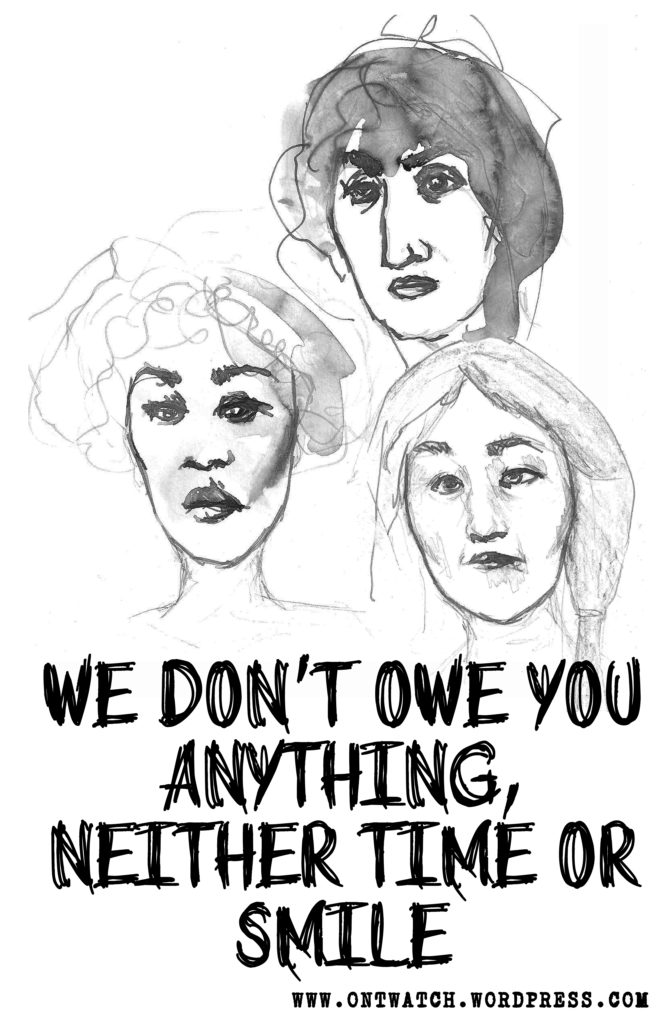
In 2014, a poster campaign on Montreal streets proclaimed “We don’t owe you anything, neither time or smile”. The posters were circulated by a wordpress blog called ontwatch, and are still available for download on their site.

Montreal is often praised for its efforts in promoting women’s safety in the city’s public spaces, and examples of such programmes include the creation of glass-walled metro exits for greater visibility, or the between stops drop off-services provided to women travelling on city buses at night. While Montreal has taken steps to increase the safety and mobility of women, this does not mean that gender-based harassment is a thing of the past. Not even close.

Sexual assault, cat calling, groping, sexist slurs, and all the other forms of gender-based harassment are still a daily fare for many women, members of the LGBTQ community and even men across the city. As accusations of violent sexual assaults frequently find their way into the local news, experiences of street harassment or non-violent assault are often only shared on social media.

During this year’s International Anti-Street Harassment Week, Women in Cities International in partnership with Lucie Pagès and Noémie Bourbannais, took to the streets to raise awareness for street harassment issues in Montreal. In the resulting video, many of those interviewed shared their personal stories of street harassment, describing their experiences as “uncomfortable”, “demeaning” and even “threatening” at times.

After this year’s Osheaga festival, a well-known music and arts event held every summer in Montreal, a concert-goer took to social media to share her experience of sexual assault and to criticize the festival staff for their lack of support: “Getting drugged at a festival against your will and without your knowledge, with the premise of potentially taking advantage of your vulnerability is NO JOKE, and should never be brushed off as it is a serious security concern and a violation of someone’s body”.

Earlier this year, after recording an ever-increasing number of sexual harassment complaints on public transport, Montreal police have launched a campaign calling on transit users to report all such incidents to the police. According to a report published by the Montreal public transport agency, Société de transport de Montréal, 30 accounts of sexual touching and 35 complaints of exhibitionism have been reported by metro users in 2015. However, reading through the hundreds of entries on Montreal HollaBack, a blog mapping accounts of street harassment across the city, it becomes painfully clear that this is just the tip of the iceberg.

As numerous as the stories of sexual assault are, as great are also the efforts of those who work to end gender-based harassment in the city. Non-profit networks such as Women in Cities International with the support of local activist groups lead the way in raising awareness for sexual violence issues in Montreal. As Kathryn Travers from Women in Cities International says, “Once you open your eyes to this, you can’t close them again”.

In the following weeks, I would like to take this opportunity to talk about street harassment in Montreal by sharing the stories of Montrealers who have experienced gender-based assaults and who are speaking out against it.

Alexandra is a freelance writer and recent graduate of Heidelberg University in Germany, where she earned a BA in South Asian Studies and English Literature. Having moved across the pond to live and work in Montreal, she now focuses on refreshing her French skills while volunteering her time to various community-outreach programs. You can follow her on twitter @alexjurecko.

Share

Filed Under: correspondents, street harassment

South Africa: How Johannesburg Infrastructure and Transport Systems Contribute to Street Harassment

September 20, 2016 By Correspondent

Nyasha Joyce Mukuwane, Johannesburg, South Africa, SSH Blog Correspondent

Johannesburg is marketed as a world-class African city. In many ways it is, with a burgeoning middle class population and tourist and cultural attractions. High rise buildings in Sandton have turned it into a millionaire’s playground and it has been named Africa’s richest square mile. Precincts such as Maboneng are where the hipsters and the creative go to play and the nightlife extends very late via restaurants, pubs and clubs all over Johannesburg.

However, what is not world-class is the treatment of women on the streets who are running, walking, and going about their daily lives. What the tourist bureaus don’t show is the vulnerability of women and children in poorer areas who have to travel a long distance to school, the clinic and to places of employment. The average under-privileged woman experiences constant street harassment and threats of potential violence against her.

Johannesburg has been identified as a disorderly city with the worst instance of urban sprawl in South Africa, therefore a car is a necessity. It is a necessity as a 90 minute commute is halved with a car. Simple daily tasks such as school runs, grocery shopping and attending classes are completed easily. Owning a car in Johannesburg helps you keep up with the fast pace of the city, allowing you to enjoy what the city has to offer and most importantly, a woman’s  exposure to harassment on the streets is reduced. Urban sprawl and the public transport system leave women vulnerable to street harassment.

Public transport system

Owning a car is simply out of reach for women who are lowly paid without steady streams of income. The majority of people who need to commute around Johannesburg make use of mini buses which are called taxis. These taxis transport people from farm holdings, informal settlements, townships and urban areas. They are convenient and relatively inexpensive. However many women have been harassed, humiliated, groped and assaulted by taxi drivers and other male passengers.

The train can also be another harrowing experience. The most horrifying tale I heard is a woman realizing that a stranger had ejaculated on her skirt in a packed train ride. Personal space does not exist aboard a Metrorail train. In stark contrast to the sleek, smooth running Gautrain, most disadvantaged women use the Metrorail to get around. The Gautrain has stops at 10 stations where only privileged people would find it convenient, like heading to financial hubs or the airport.

The typical work day of a woman in a township called Orange Farm would have her wake up before dawn to get a taxi. The majority of Orange Farm doesn’t have streetlights. The first taxi of the day that will drop her off at the Metrorail station as it is too far to walk. Besides that, there is long grass along the road. The train takes her to the CBD where she takes another taxi to get to her place of employment in Sandton. All modes of transportation will pose their own potential threats of harassment and sexual violence against her. It will take at least two hours for her to get to work in the morning if there are no incidents with the train schedule or  traffic. Then she has to travel another two hours again after work, in the dark, 6 days a week, every month – all the time.

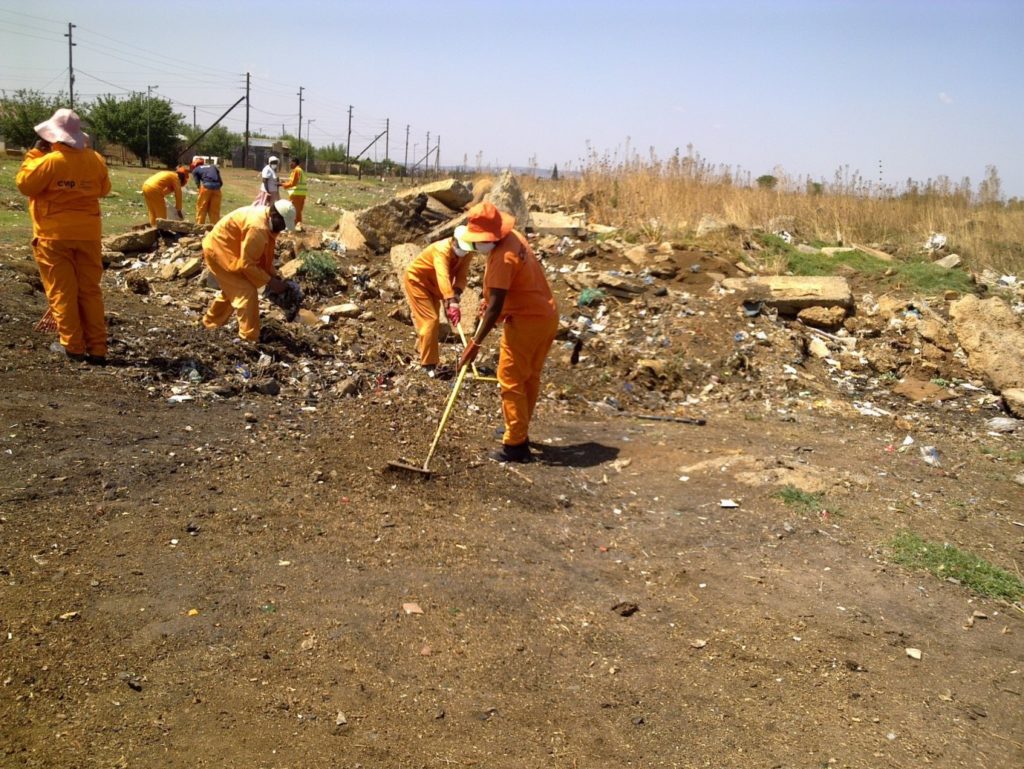
Street harassment is not necessarily seen as an issue to be dealt with by authorities and often law enforcement is not proactive but rather reactionary to incidences of escalated street harassment, such as assault or rape. The Nisaa Institute for Women’s Development works in Orange Farm where community members identified a stretch of veld with dumped garbage and long grass where men are raping and mugging women and a woman’s dead body had been found previously. With Nisaa’s support, community members mobilized themselves and cleared the area of debris and long grass. City officials and the local councillor promised that a park w0uld be put in place to make the area safer. That was in 2013 and they are still waiting. The community members have since become demoralized.

nisaainstitute

Picture courtesy of Nisaa Institute for Women’s Development

Disadvantaged women face street harassment everyday because of the spaces they occupy and the modes of transport they use. Townships were deliberately placed in inconvenient areas to keep people of colour from spaces of privilege by the apartheid government. A privileged woman is not completely immune to street harassment but her material possessions such as a car and the exclusive spaces in which she moves around in create a buffer against street harassment — whether real or imagined. She has the luxury of letting her guard down once in a while. In a literal tale of two cities, I ask again: Is Johannesburg truly a world-class African city?

Nyasha is the public awareness coordinator at the Nisaa Institute for Women’s Development in Johannesburg, South Africa, where the main goal is counselling and sheltering survivors of domestic abuse. She has edited two books by survivors that are available to download for free from the website www.nisaa.org.za.

Share

Filed Under: correspondents, street harassment Tagged With: public transit, south africa, taxi, train, walk

« Previous Page
Next Page »

Share Your Story

Share your street harassment story for the blog. Donate Now

From the Blog

  • #MeToo 2024 Study Released Today
  • Join International Anti-Street Harassment Week 2022
  • Giving Tuesday – Fund the Hotline
  • Thank You – International Anti-Street Harassment Week 2021
  • Share Your Story – Safecity and Catcalls Collaboration

Buy the Book

  • Contact
  • Events
  • Join Us
  • Donate
  • Facebook
  • Instagram
  • Pinterest
  • Tumblr
  • Twitter
  • YouTube

Copyright © 2026 Stop Street Harassment · Website Design by Sarah Marie Lacy