• About Us
    • What Is Street Harassment?
    • Why Stopping Street Harassment Matters
    • Meet the Team
      • Board of Directors
      • Past Board Members
    • In The Media
  • Our Work
    • National Street Harassment Hotline
    • International Anti-Street Harassment Week
    • Blog Correspondents
      • Past SSH Correspondents
    • Safe Public Spaces Mentoring Program
    • Publications
    • National Studies
    • Campaigns against Companies
    • Washington, D.C. Activism
  • Our Books
  • Donate
  • Store

Stop Street Harassment

Making Public Spaces Safe and Welcoming

  • Facebook
  • Instagram
  • Pinterest
  • Tumblr
  • Twitter
  • YouTube
  • Home
  • Blog
    • Harassment Stories
    • Blog Correspondents
    • Street Respect Stories
  • Help & Advice
    • National Street Harassment Hotline
    • Dealing With Harassers
      • Assertive Responses
      • Reporting Harassers
      • Bystander Responses
      • Creative Responses
    • What to Do Before or After Harassment
    • Street Harassment and the Law
  • Resources
    • Definitions
    • Statistics
    • Articles & Books
    • Anti-Harassment Groups & Campaigns
    • Male Allies
      • Educating Boys & Men
      • How to Talk to Women
      • Bystander Tips
    • Video Clips
    • Images & Flyers
  • Take Community Action
  • Contact

USA: “Holding a man accountable for street harassment can be a dangerous game”

May 27, 2015 By Correspondent

Shyeta Williams, California, USA, SSH Blog Correspondent

Despite the raising awareness of street harassment, it is so unbelievably prominent in this urban jungle I call home. One contributing factor could be the striation of wealth, with many homeless and impoverished people being on the street at all times of the day. This is also an area with plenty of options for public transport, so many of us are walking at some point en route to our destinations. Between BART, Ac Transit, MUNI, Lyft, Uber, Leap, there is no shortage of opportunities for a catcaller to come into contact with anyone who dare cross them on the street. This is not to say that the area is any more prone than any other, but to illustrate the ways in which we are vulnerable to street harassment.

I’ve had this conversation many times with many friends and colleagues. Recently, a friend of mine, whom I’ll call Rona, decided for one week she would pull out her phone and take a photo of every man who catcalled her. She was interested to find out how men would react to her taking photos of them as they were harassing her. I had read about women doing this, to varied responses. Rona employed this technique for one week and was shocked at how quickly men attempted to remove themselves from the situation. She described men peeling out in their cars, and hiding behind friends.  Essentially after having the gall to harass her in public places, men were quick to retreat at the threat of being photographed.

Rona expressed that this caused a palpable shift in dynamics. It made her feel powerful. Her description was vivid and revealing. “Well it’s a pretty conscious effort, keeping your phone in hand to ward off creeps, so I don’t do it all the time, [but] it’s so noticeable how different you feel. When I’m doing it I walk taller. When I don’t I’m so scared of men walking past me. It’s only words but it’s so violating.”

Despite how powerful she felt, Rona was aware that this reaction was problematic. These men weren’t leaving her alone out of some sudden respect or realization of her personhood. They were doing it out of what she described as, “fear of repercussion, or fear of humiliation.” These men were looking to cover their own asses, removing themselves as a precaution not out of a sense of humanity. In fact it had very little to do with Rona as a person. They are much more concerned with their image being soiled, no matter how justly, than how they are treating another human.

After Rona told me the story, I called her a superhero. Holding a man accountable for street harassment can be a dangerous game. I’ve experienced and heard many stories about what can happen if dare to confront a man who is harassing you or someone in your vicinity. It is downright dangerous thing to do. It often shifts the focus to you, your vulnerability, and personally I’ve been completely verbally berated for it, only to have no one stand up for me for fear of the same. It’s saddening but this is part of why Rona had to try this tactic to begin with.

Women are being forced to come up with imaginative ways to combat their own harassment, and really just having to hope for the best in terms of outcomes. As often as we are on the sidewalk, our safety may be encroached upon, otherwise easy targets at their discretion.

Shyeta discovered her voice loud and clear amid the redwoods and fog at UC Santa Cruz, where she earned her BA in Politics. She’s currently enjoying the sound her pen makes against the wind chill in Oakland, CA.


Share

Filed Under: correspondents, street harassment

Spain: On Travelling Alone

May 26, 2015 By Correspondent

Lisbon, by Rebecca Smyth

Rebecca Smyth, Spain, SSH Blog Correspondent

It is an immense pleasure and privilege to be able to travel, and it was all the more so in a country as wonderful as Portugal. I don’t know why everyone doesn’t bang on about Portugal all the time. I’m probably going to be That Person now. Sorry.

Travelling alone, and travelling alone as a woman, provides ample opportunity to think, untangle and unravel all sorts. So let’s dive in, shall we?

Street harassment seems to exist in a delightful array of regional variations. In Ireland I’ve found it’s mostly the drunken yelling, in Paris it was the stalking and propositioning on traffic islands, in Italy it’s, well, it’s pretty much everything you can think of – maybe they invented it? – and in Barcelona it’s mostly the good old-fashioned wolf whistle. In Portugal they seemed to be big fans of the lip smacking. LIP SMACKING. I wonder if they realise it makes them look like especially creepy orang-utans. I doubt they care. Their aim, whether they are conscious of it or not, is to re-assert their dominance of public space and of women moving through it.

Speaking of, I don’t think I’ll ever fully know just how much I limit myself and my movements because of my gender. I’ll never forget having a chat with a lovely guy I met on Erasmus. We were talking about how much we loved to wander the city. This is something that has a historical precedent, if you can believe it: flânerie. The French would have a word for it, wouldn’t they? I like to translate it to ‘flanning’ because it makes me imagine a flan happily bobbing about, probably humming to itself. And it totally wears a top hat and monocle.

But I digress. Flânerie became a thing in 19th-century Paris and it’s bound up with the birth of the modern city and capitalism and stuff. Well worth reading about, honest. Significantly, those who flanned, les flâneurs, were wealthy young white men. What was their female counterpart? La flâneuse? Nope, the prostitute. Because a woman loitering or wandering aimlessly in public must be sexually available.

This is something I often reflect on as I flan about. And if there’s one thing I love to do, it’s to flan. For one thing, I keep moving as much as I can. I love to walk, and I love to walk about a new place and discover as much of it as I can, but that’s only part of it. The other, possibly bigger part of it is an awareness that I need to keep moving, because as soon as I sit down for whatever reason there is a significant likelihood that I will be on the receiving end of Unwanted Male Attention. Do any of you feel like that too?

One of the easier ways to combat this is to always have a book handy, although it is certainly not a failsafe measure. It worked really well in a restaurant my first evening in Porto though. I felt kind of bad about it – “Is this seat taken?” “Nope” *sits down expectantly* *I keep reading* *he shuffles on* *I eat my delicious dinner* *I leave*

This probably makes me sound like a big ol’ grump – Ah here Rebecca, what’s the harm in having a chat? Chats are great! Oh I know, I know. Striking up conversations, making small talk, bit of chit chat – I am a fan. Apparently as a toddler one of my catch phrases was, “What’ll we talk about now?” So interacting with other humans is not the issue.

The issue is I clearly want to be left alone but because I am out and about in public there is an assumption that I am desirous of your company, that you are entitled to my energy and focus and attention. And I’m not. Nothing personal, just having some alone time with a good book and a delicious pastry. Go away.

So that’s the first limit – I can’t loiter quite as much as perhaps I might like to. And when I do loiter, I need to at least look like I’m busy.

The second limit is the space itself. I am far from being alone in being safety-conscious, and I am acutely aware that as a straight, white, fully-able cisgender individual I don’t face half the limits far too many other people do in negotiating public space and their place in it. I probably don’t feel anywhere near as hemmed in and unsafe. But I have felt both those things when travelling. And it angers me that that’s the case, and that it’s exponentially worse for so many others.

The final limit, and in some ways the one that gets to me most and I don’t know why, is time.   Back to Rémi (sound lad, hello if you’re reading) and our chat about wandering Paris. I can’t remember it word for word because it was three years ago, but I think we were talking about our favourite parts of Paris to wander about. He mentioned how atmospheric it is around Notre Dame at night.

“At night?!” I exclaimed. “Around what time?”
“Three, four in the morning.”
“And you’re not scared?”
“No, why would I be scared?”

I would be bricking it. Maybe I’m just especially nervy, but there is no way I would even wander my hometown alone at three in the morning. And I can’t tell you how much I yearn, how much I ACHE, to wander a big city late at night. But I know it’s just not a good idea. Because I’ve been told it and witnessed it enough to know that.

And look, I know in the great scheme of things there are much MUCH worse challenges facing women and other minority groups. And I care about those too, a great deal. But until the day any of us can walk out the door without feeling the need to take just those extra few precautions, even just in our heads, I don’t think we’ll ever really be free.

Rebecca is currently living, working and stumbling through ballet classes in Barcelona. Originally from Kilkenny, she has a degree in European Studies and a Master’s in Gender and Women’s Studies from Trinity College Dublin, and will be doing an LLM in Human Rights Law in Edinburgh this fall.

Share

Filed Under: correspondents, Stories

The Netherlands: Female Hitchhikers Defy Highway Harassment (Part 1)

May 21, 2015 By Correspondent

Julka Szymańska, the Netherlands, SSH Blog Correspondent

Hitchhiking: it’s as old as the road itself, but not everyone feels comfortable with the idea of hopping into a stranger’s vehicle for a ride. This may especially be true for women who are warned about the possibility of harassment or assault while hitchhiking. Yet hitchhiking still has its popularity and plenty of women are hitting the road with their thumb or a sign. So who are these women and why are they getting into a car with complete strangers?

Paulina.

Paulina is a brave 21 year old, born in Poland and currently living in Denmark. Two years ago she embarked on her first hitchhiking journey and ever since that first trip she has used most of her time off school to travel, contributing to her 20.000 kilometers on the road with her thumb. She wanted to see more of Europe’s many different cultures, but didn’t have much money, so hitchhiking was the perfect solution for this desire to explore.

Out of many positive experiences, she did encountered one negative situation: while hitchhiking with her friend in Georgia she was groped by a man after accepting his apparent hospitality. Fortunately they could get away by excusing themselves.

“Hitchhiking is more dangerous for women, women aren’t as physically strong and we risk rape too of course”, Paulina explains. “But i have pepper spray to keep myself safe and I use the ring my grandmother gave me as a fake engagement ring to communicate that I’m not looking for sex. ”She takes pride in being a rule breaker and doesn’t think too deeply about harassment: “If I start worrying about this, I could as well just stop hitchhiking and I don’t want that.”

Paulina’s golden tip for hitchhiking as a woman: “Be careful, but don’t stop traveling. Take a friend with you and you’ll gather memories you will never forget.”

Marjan.

Founder of Dutch hitchhiking foundation Nederland Lift, 36 year old Marjan is a mother of two and hitchhikes to work every Wednesday. She writes about these weekly 15-minute trips on her Dutch-language blog LiftGeluk.nl. After 124 rides in one and a half years Marjan is still hopelessly addicted to hitchhiking and the spontaneous, fun, and sometimes touching encounters she has along the way.

Marjan has never personally encountered any harassment during hitchhiking, but attributes this to the time of day and the short drive to her destination. She also acknowledges that there’s a world of difference between a confident 36 year old woman with plenty of experience and –for example– an unprepared 18 year old.

“An interesting aspect of hitchhiking is the anonymous, yet very real contact you make with people who you would otherwise not have a conversation with, this is unique,” Marjan proclaims. “Hitchhiking negates prejudice: you share a car with people of all walks of life. I believe this brings people closer together.”

Marjan speaks out against the bad reputation hitchhiking has due to harassment by explaining that people often blame hitchhiking, but not trains or buses, where it happens too. The harasser is responsible, not the method of transportation.

“Hitchhiking is a lot like life itself: you never know what comes your way, but it sure is beautiful”, is her motto.

Elisa.

Spanish Audio-Visual Communication student, feminist and acting aficionado Elisa just returned from traveling around the USA by finding rides through word of mouth networking and the Internet. This 23 year old, armed with her camera, overcame her insecurity of traveling alone by deciding to ‘just do it’ and isn’t planning on stopping any time soon.

Elisa is very clear in her convictions: “I believe that discouraging women to travel alone for fear of harassment can lead to victim-blaming. We live in a sexist society where women are told that we cannot do the same things a man can do without hearing ‘I told you so’ if something bad happens.” She wants to disprove that point by doing exactly what people say she can’t do: hitchhike and travel alone, regardless of harassment. “We should do something about harassment and empower women to not be stopped by fear, because otherwise it will paralyze us. I think the solution is to put tools (such as feminism) in the hands of both women and men to prevent harassment.”

Harassment happens in your own neighbourhood too, Elisa calls this ‘the enemy at home’, an enemy women are less prepared for when crossing their own street. “Being scared all the time is no way to live, but during hitchhiking it is something you have more control over.” Elisa carefully selects who to accept a ride from and writes down license plates: she’s aware of the risks and has trust in herself and others.

Stay tuned for the second part of this series next month.

Julka is a 25-year-old feminist activist and soon-to-be Cultural Science student with a generous amount of life experiences -including street harassment – and even more passion for social justice.

Share

Filed Under: correspondents, Stories, street harassment Tagged With: hitchhiking, travel

USA: School is a (un)safe place

May 20, 2015 By Correspondent

Laura Voth, USA, SSH Blog Correspondent

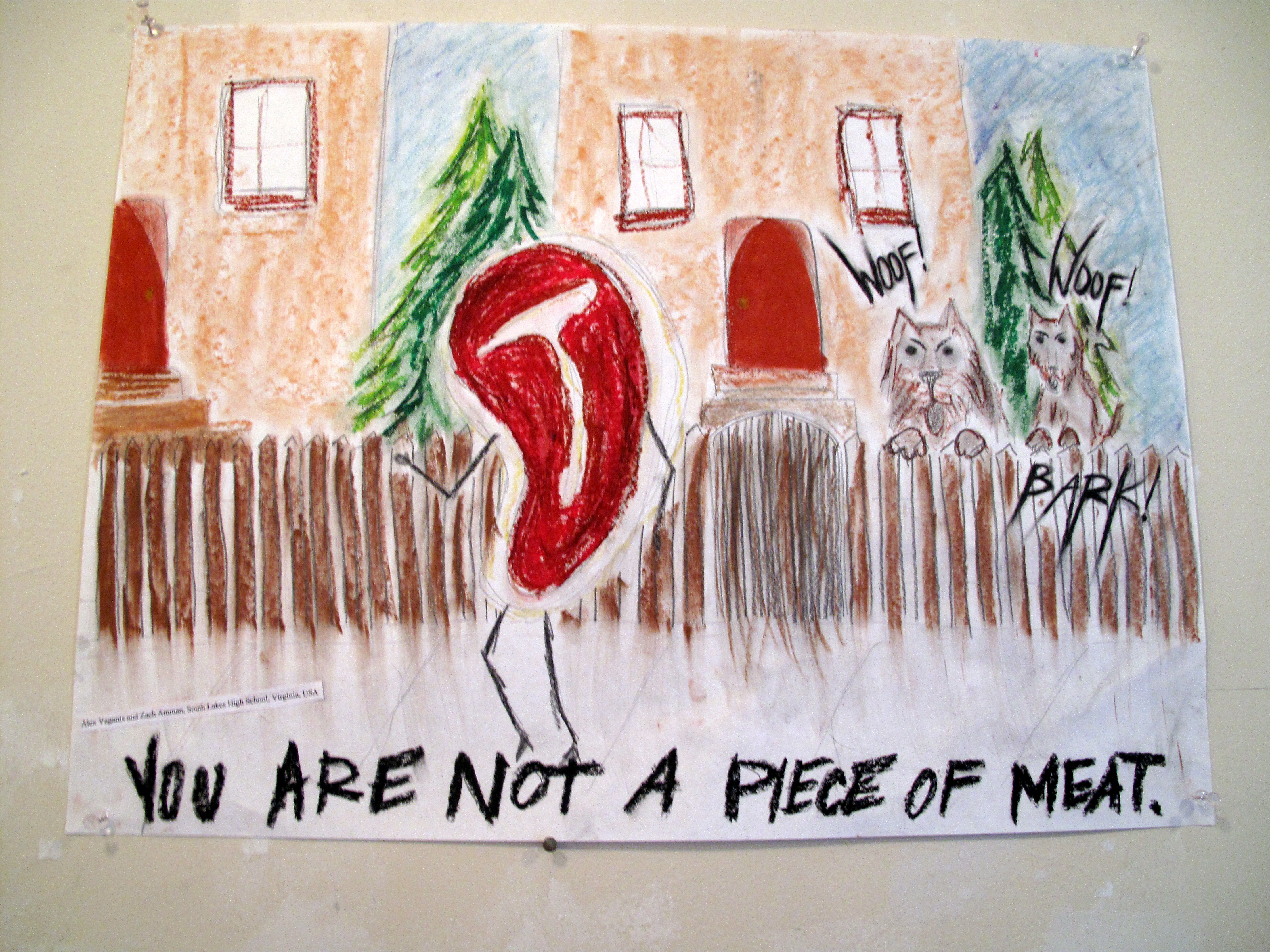
Artwork by a high school student in Virginia.

I am twelve years old, walking down the locker-lined hallway of my middle school on the way to the bathroom. The corridor is empty but for two or three eighth-graders loitering outside of a classroom. As I walk by, one of the boys, a red-head, calls out “where you going, pretty girl?” He bares his teeth and narrows his eyes at me, giving a poor imitation of a smile.

I give the boy my fiercest glare and continue on to the bathroom, looking back once to make sure he isn’t following me. As I wash my hands and return to class—taking care to go a different route to avoid running in to the redhead—I think about what has just happened. Surely I shouldn’t feel so upset; a boy called me pretty. Isn’t that a compliment?

At the time, I couldn’t describe why I felt dirty and disgusted by what had happened, and for years afterwards I was still confused. Why did such a seemingly-innocent phrase make my stomach turn? Why did I feel nervous every time I saw that boy in the hallway or at an assembly? I didn’t even know his name—and to this day I still don’t—but that boy made me feel unsafe in an environment that ought to have been something of a haven. More than that, his words made me feel as though I didn’t deserve to be comfortable at school.

I still wonder today what that boy was thinking—why he would choose to make that comment and why it would even occur to him to say it. It’s true that fourteen-year-olds aren’t great at making wise decisions, but this wasn’t an impersonal, largely harmless action. I still remember the look in his eyes and the timbre of his voice—I believe that he knew the impact of what he was saying.

I wonder where that boy learned to call upon women in passing as though he had a right to comment on them. I wonder whether he saw his father or brothers doing it. Maybe he saw it in a music video or a TV show. Maybe he legitimately thought that his comment was a good way to get some positive attention from a girl.

When I tell this story of the first time I experienced street harassment, the listener sometimes indicates that I’ve made a mountain out of a molehill, that the boy’s comment was harmless, and that I ought to let it go (although perhaps I should). But how can someone forget the first time they felt that their personal safety was in immediate danger? I remember that moment as the point when I realized that those around me considered my body fair game for public scrutiny; that my body was not truly my own.

For many women, street harassment starts around puberty, with 90% of women experiencing it before the age of nineteen. Harassment sends a message that the victim doesn’t deserve to feel safe in her environment and that she is not worthy of simply moving through her world without a crude comment tossed her way.

It’s no wonder that girls’ confidence seems to drain away as they emerge into adolescence. With men and boys harassing them at school and in their very own neighborhoods, how can girls be expected to assert themselves in other situations? After all, if they can’t feel safe even moving through their world, venturing outside of their comfort zone—socially, academically, emotionally—becomes an even greater risk. If a thirteen-year-old isn’t able to walk down the street without being catcalled, she won’t explore avenues unfamiliar to her.

Those of us who began experiencing harassment at young ages—and I know there are many who were first harassed younger than I was—need to nurture the girl who still believes she is undeserving of safety and respect. Explain what happened like you would to a niece or a daughter: remind yourself that you are worthy of feeling comfortable in your environment and that nobody has the right to take away your peace of mind.

If I could go back to that day in the middle school hallway as an adult, I’d ask the red-headed boy what he thought gave him the right to accost a girl who was doing nothing more than existing in a public space. I would tell him the impact that his comments can have on a woman—that the women he harasses will likely remember his words for years to come (and may even write articles describing their negative experiences with him).

I would tell that red-headed boy that his actions are neither respectful nor attractive and that no woman has ever thought “damn, I’d love to go out with that guy who catcalled me today.” I’d tell him that the words he says to women in the street are not indicative of his power, but rather of his inability to see women as human beings.

I’d tell him that, while the girl he just catcalled has no idea what to say to him and only knows that she feels confused and violated, he is the one that should be ashamed.

I’d ask him whether his comment was worth the momentary swagger; whether he truly deserved the brief ego-boost more than I deserved to feel safe at school—safe to walk through the halls, safe to make my voice heard, safe to explore my world.

Laura is an emerging adult-slash-college student studying to enter a healthcare profession. In addition to studying and writing, Laura works at her university’s women’s center where she helps design and implement programs on all things lady. 

Share

Filed Under: correspondents

USA: Poetry and Street Harassment

May 19, 2015 By Correspondent

Michelle Marie Ryder, USA, SSH Blog Correspondent

Slyvia Plath, via BrainPickings

Despite her themes of feminism, there is no Sylvia Plath poem about street harassment. If you type “street harassment” into the search bar at two of the largest poetry databases (The Poetry Foundation and poets.org) you’ll get zero results. Type in “trees” or “love” and you’ll find hundreds or thousands of matching results.

It appears as if street harassment is not the subject of poetry. Which isn’t surprising, considering how historically male-dominated the literary world has been. Just like public space, cultural circles and high centers of learning are long-established male domains. Only within recent memory have women experienced some success in forcing the doors open, demanding a ‘room of their own’ in the literary world.

Still, I don’t think I ever expected to find a poem about street harassment by Sylvia Plath, despite the regularity in which her name surfaced when I talked to people about the subject. As both a literary giant and a feminist icon, I understood why Plath came to mind. But the dots, easy to connect, were still too few.

In truth, only very recently are enough dots beginning to appear and fuse intelligibly to bring the bigger picture into view. Thanks to our ability to disseminate our stories through modern technology, women from all ranks of society are speaking up and being heard, exposing the bigger picture of street harassment for what it really is: “a pattern of violence that constitutes a genuine social crisis,” writes Rebecca Solnit.

Despite the lack of search results at some popular websites, the poetic imagination is alive and flourishing. Survivors of street harassment are fighting back and sharing their experiences through the poetic medium. They are using poetry as a powerful tool to develop a vocabulary of dissent against gendered oppression in the public sphere. Surging with raw poetic insight and justified rage, these poets are transforming the streets by changing minds.

Being the digital age, this conversation is happening mostly online, on personal websites and social media platforms, among career artists and activists and ordinary folks alike. And because of its grassroots nature, it is expanding beyond the limited reaches of the white, cis, middle class female experience in order to embrace the experiences of the LGBTQIA community, lower-income people, people of color, and people with disabilities. Anyone who is not a wealthy, straight, white man is likely to endure public harassment at some point in their life.

Perhaps what’s most fascinating about this burgeoning genre of poetry is that it is dominated by spoken word: “performance-based poetry that focuses on the aesthetics of word-play and storytelling” (Wikipedia). This is in part because the literary establishment has yet to take street harassment as a subject of poetry seriously, but also – and more importantly – because spoken word is a natural fit.

Rooted in the oral tradition, spoken word has long served as a powerful vehicle for voicing dissent and agitating for social change. Poetry about street harassment is about moving beyond the individualistic poetic pursuit. It is about translating painful, self-aware moments into something larger, pushing poetic self-expression to answer to larger political realities in order to create a wider community consciousness – i.e. a movement.

It is about practicing freedom, even if we don’t have it yet. Change can and does start with a poem, even if your voice trembles. And now is the time to speak up. Visibility of the issue is at an all time high. The term “street harassment” has finally entered the popular lexicon thanks to the hard work of countless organizations and individuals.

Sylvia Plath may never have written a poem about street harassment, but it would be disingenuous of me to leave you with the impression that she was silent on the issue. She wasn’t. She suffered too, as much from the problem itself as from her own radical understanding of it, writing in her journal:

“My consuming desire is to mingle with road crews, sailors and soldiers, barroom regulars — to be a part of a scene… all this is spoiled by the fact that I am a girl, a female always supposedly in danger of assault and battery. My consuming interest in men and their lives is often misconstrued as a desire to seduce them, or as an invitation to intimacy. Yes, God, I want to talk to everybody as deeply as I can. I want to be able to sleep in an open field, to travel west, to walk freely at night…”

The limitations patriarchy placed on Plath’s life were obvious and unwelcome; catcalls, sexual solicitations and the underlying threat of assault policed her existence.

If street harassment is the shrinking of one’s world, poetry is its opposite.

Michelle is a freelance writer and community activist. She has written for Infita7.com, Bluestockings Magazine, and The New Verse News on a range of social justice issues, and shares her poetry regularly at poetrywho.blogspot.com.

Share

Filed Under: correspondents, street harassment

« Previous Page
Next Page »

Share Your Story

Share your street harassment story for the blog. Donate Now

From the Blog

  • #MeToo 2024 Study Released Today
  • Join International Anti-Street Harassment Week 2022
  • Giving Tuesday – Fund the Hotline
  • Thank You – International Anti-Street Harassment Week 2021
  • Share Your Story – Safecity and Catcalls Collaboration

Buy the Book

  • Contact
  • Events
  • Join Us
  • Donate
  • Facebook
  • Instagram
  • Pinterest
  • Tumblr
  • Twitter
  • YouTube

Copyright © 2026 Stop Street Harassment · Website Design by Sarah Marie Lacy