• About Us
    • What Is Street Harassment?
    • Why Stopping Street Harassment Matters
    • Meet the Team
      • Board of Directors
      • Past Board Members
    • In The Media
  • Our Work
    • National Street Harassment Hotline
    • International Anti-Street Harassment Week
    • Blog Correspondents
      • Past SSH Correspondents
    • Safe Public Spaces Mentoring Program
    • Publications
    • National Studies
    • Campaigns against Companies
    • Washington, D.C. Activism
  • Our Books
  • Donate
  • Store

Stop Street Harassment

Making Public Spaces Safe and Welcoming

  • Facebook
  • Instagram
  • Pinterest
  • Tumblr
  • Twitter
  • YouTube
  • Home
  • Blog
    • Harassment Stories
    • Blog Correspondents
    • Street Respect Stories
  • Help & Advice
    • National Street Harassment Hotline
    • Dealing With Harassers
      • Assertive Responses
      • Reporting Harassers
      • Bystander Responses
      • Creative Responses
    • What to Do Before or After Harassment
    • Street Harassment and the Law
  • Resources
    • Definitions
    • Statistics
    • Articles & Books
    • Anti-Harassment Groups & Campaigns
    • Male Allies
      • Educating Boys & Men
      • How to Talk to Women
      • Bystander Tips
    • Video Clips
    • Images & Flyers
  • Take Community Action
  • Contact

Germany: One Billion Rising and Documenting Murder

February 13, 2015 By Correspondent

Lea Goelnitz, Berlin, Germany, Blog Correspondent

TRIGGER WARNING

“Men are afraid that women will laugh at them. Women are afraid that men will kill them.”

UK Women killed through suspected male violence in 2014, via Smith’s website

This quote by Margaret Atwood might seem extreme, but there is some truth to it. For example, in the U.S., at least one-third of all female homicide victims were killed by male loved ones, and nationally, one woman per 100,000 is killed by a man.

In the UK, two women per week are killed by a current or former intimate male partner. Ingala Smith started counting Britain´s murdered women three years ago to make the government pay attention. February 12 was the official launch of the Femicide Census in London, a database of every woman who is killed by a man. The project is designed to “force a recognition of the scale and significance of male violence against women.” Smith told the Guardian, “I want us to stop seeing the killings of women by men as isolated incidents: to put them together and to see the connections and patterns; to highlight what a big issue it is; and to make it feel real for people.”

Of course, homicide is relatively rare, but men’s violence against women and girls is quite prevalent. It differs from violence against men because it is based in the structural inequality between men and women. A recent European Union-wide study revealed that one in three women has experienced physical and/or sexual violence since the age of 15 and 75% of women experienced sexual harassment in the work place. The UN notes that at least 35% of women worldwide have experienced physical and/or sexual violence and some national studies place this at 70% of women.

Although there is increased awareness of gender-based violence (GBV) as a public health concern and an obstacle to development, there is still a lack of data to explain it and document it. This leads to a lack of awareness among the general public and an overall lack of visibility of violence against women. Further, some forms of GBV are considered normal or are even institutionalized as cultural practices, such as female genital mutilation. Street harassment is another example and is usually seen as acceptable, or at least not bad enough to be recognized as a form of violence.

But a recent article published in the Guardian reports that a new study found “that some of the sexism women face – from catcalling and sexual harassment to sexual objectification and violence – makes women generally more fearful and anxious. The researchers from the University of Missouri-Kansas and Georgia State University found a substantive ‘link between physical safety concerns and psychological distress”.”

It does matter.

This year´s Valentine´s Day marks the 4th time Eve Ensler’s One Billion Rising raises awareness about violence against women and GBV. We can join in by striving to call out every incident of street harassment, collect stories and explain to people that street harassment is a form of GVB too. As street harassment is sometimes a gateway crime to other forms of VAW like sexual assault and even murder, it is worth it and very necessary to do so.

Lea works in journalism and women´s rights and is involved in the women´s rights NGO Discover Football, which uses football as a tool for empowerment and gender equality. Follow her on Twitter, @LeaGoelnitz.

Share

Filed Under: correspondents, News stories, street harassment

USA: Street Harassment- Not Just for City Slickers

February 13, 2015 By Correspondent

Emily Gillingham, Washington, DC, USA, Blog Correspondent

A lot of the conversation around street harassment focuses on harassment in cities. But this post is about street harassment in rural America, from three people who grew up there.

I grew up in a rural, conservative Michigan town. When I say “rural,” I mean that my township’s claim to fame is that it is the self-proclaimed “Kohlrabi Capital of the World.” And when I say “conservative,” I mean that when I knocked doors for Obama in 2008, a guy showed me his gun to emphasize that 1) he supported gun rights, and 2) I needed to get off his property immediately.

I remember the first time I experienced street harassment. I was fourteen years old. My mother and I had just moved closer to my high school. It was the first time I had lived in a place with sidewalks in my neighborhood, and I got in the habit of taking a bike ride downtown after school. “Downtown” consisted of a dozen or so shops, offices, and restaurants and a park. One day, I was biking home and a pickup truck headed towards me suddenly gunned it. Instinctively, I looked up- just in time to see the boy a few years my senior in the passenger seat lean out the window, make a ring with the fingers of his right hand, and vigorously stab his left index finger through it, screaming wildly.

I asked two young men who grew up in rural America, Chris and Tyler, what that was all about. Chris, who is originally from rural southeastern North Carolina, said, “Either he was crudely trying to hit on you, or he was mocking you with a douchey high school boy gesture.”

Why would someone take their time to do something like that? Chris pointed out that in the middle of nowhere, there’s nothing better to do. He told me about the form that street harassment took where he grew up- cruising. Chris said, “You take your pimped out car, and you cruise through town at slow speeds, just circling around. If you see an attractive female, you say something to her, like ‘hey, baby.’” I asked Chris if this something people do with friends, and he said, “Yeah, it would be creepy if someone was alone.”

I asked Chris if he had ever catcalled anyone or gone cruising. He said no, since he’s scared to talk to women in general. He also said it’s “disrespectful” and “weird” to talk to strangers on the street.

Tyler grew up in rural Maryland. I asked him what sort of catcalling he saw growing up. He explained that he never saw any, and when I pressed him as to why, he said that a lot of the places he went growing up were nicer, “family kinds of places where you didn’t do that kind of stuff.” I asked Tyler if he had ever catcalled someone, and he said, “I don’t even like people when I talk to them normally. I think you need to have a bit of an ego to think you’re the star and everyone needs to be looking at you.”

So what are the lessons here? First of all, I think it’s worth saying, explicitly, that street harassment isn’t just a city problem. It’s something that happens everywhere, between all kinds of people. But it definitely takes different forms in different places. I think that Chris was on to something when he said street harassment in rural America is just a way to pass the time. And after spending a few weeks asking my friends if they’ve ever catcalled someone and not getting a single “yes,” I think that there is a social element to it, too. People who catcall, particularly in rural areas, hang out with other people who catcall. And there seems to be a different social group that doesn’t catcall. And somehow, having a bachelor’s degree in Women’s and Gender Studies, I’m not surprised that I would up with a bunch of friends who say they’ve never catcalled anyone.

Emily is a 3L at Michigan State University College of Law, and the president of her school’s chapter of LSRJ. Follow her on Twitter @emgillingham.

Share

Filed Under: correspondents, Stories, street harassment

USA: What To Do When What We’re Doing Isn’t Working

January 31, 2015 By Correspondent

Emily Gillingham, Washington, DC, USA, Blog Correspondent

If you’re reading this, we’re probably on the same page that street harassment is awful. You’ve probably read about the toll that street harassment has on victims. If you study street harassment in the United States, you understand that there are a slew of laws covering every inch of the country designed to protect people from things like threatening language, upskirt photos, unwanted touching, being followed, obscene language, indecent exposure, and more. Penalties for violating those laws can include large fines or jail or prison time. But you also know that street harassment persists. It is pervasive. It directs where we go, what we do, the company we keep, and the clothes we wear.

As a law student hoping to spend my career advocating for women, I think often about what public policy changes could address street harassment. Clearly, there are laws meant to protect victims of street harassment on the books. But I can say that I have no confidence that those laws would protect me from the run-of-the-mill sexual and harassing remarks hurled at me as I commute to and from work, even if a man hissed “hey baby” at me in earshot of a police officer. If I were to videotape an incident of street harassment I’d put my physical safety, personal property, and others around me at risk, with little expectation that the police would take my report seriously or bring the harasser to justice. If I were groped on the Metro, I would not expect bystanders to assist me and logistically could not fathom how I would ensure the perpetrator’s arrest and prosecution short of taping the incident and then cold-cocking him. Make no mistake: this is why these things continue to happen.

I don’t think that stopping street harassment can be solved by legislating against harassing behaviors. But I do think that progress lies in stressing the importance and attainability of street harassment reform to policymakers. If politicians, public health advocates, and nonprofits were to zealously pursue the following package of reforms, real progress will be made in eradicating street harassment.

Legislative, Legal, and Judicial Reforms

Laws should be comprehensive designed to keep up with new technology. Legislatures should pass well-drafted laws barring upskirt photos and other harassment with technology. State and federal evidentiary rules should be updated to ensure that electronic evidence of stalking and recordings made with digital recorders and cell phones are admissible into evidence when vetted properly. State bar associations should continue to expand training offered to attorneys and judges about how to obtain and preserve electronic evidence of stalking and street harassment in an admissible format.

Education

Education about street harassment is crucial; it can prevent people from becoming street harassers, better equip stakeholders to respond effectively to street harassment incidents, and change cultural attitudes that treat street harassment as a minor problem or no problem at all. School curricula should include age-appropriate education about respect for others, scientifically-rooted information about how being harassed is harmful to mental health, and safe means of responding to street harassment incidents they witness. School honor codes should explicitly state the school’s opposition to street harassment and describe penalties for students who engage in street harassment. College and university honor codes should reflect the same, and new student orientation should emphasize why street harassment is unacceptable and that harassment on-campus will not be tolerated.

Police officers and transit employees should be trained about street harassment laws and encouraged to take incidents reported to them seriously. Efforts should be made to teach the public how to report officials who fail to respond effectively to reports of street harassment.

Most importantly, nationwide movements encouraging bystander awareness in other areas should be built upon in the street harassment context. PSAs and other means of educating the public should be engaged to encourage bystanders to intervene when they witness street harassment incidents. They should stress why bystander intervention is important and describe effective strategies that bystanders can employ.

Funding

This is the most critical piece. Funding is why many reports of street harassment cannot be properly addressed and why public education about street harassment is so lacking. Funds should be allocated to build cybercrime units to take seriously the taking and distribution of upskirt photos- both to remove the content and to identify perpetrators and hold them accountable. Lawmakers need to earmark funds for street harassment prevention and prosecution, and tie funding for public safety, public health, and public transit to meeting benchmarks for street harassment training, education, and enforcement efforts. These proposals aren’t costly, but they won’t work without clearly defined benchmarks and penalties for failure to meet them.

Street harassment is a cultural problem and public health issue worthy of being prioritized in our public policy in these ways. Let’s hope that our policymakers start to see it this way too, to make our streets and public transportation safe and welcoming for everyone.

Emily is a 3L at Michigan State University College of Law, and the president of her school’s chapter of LSRJ. Follow her on Twitter @emgillingham.

Share

Filed Under: correspondents, street harassment

USA: Yik Yak Messages Promote a Culture of Harassment

January 30, 2015 By Correspondent

Tyler Bradley, Michigan, USA Blog Correspondent

Up until a year ago or so, I hadn’t considered street harassment as being as prevalent in small communities like the one I live in. I’m enrolled at Saginaw Valley State University, a mid-sized public institution in Mid-Michigan with a student population of about 9,800. I always considered it being more so a problem in large cities, where harassers assume they won’t run into their victims again. The shroud of anonymity I think is a large prerequisite that prompts an environment of harassment. Harassers act when they may feel they cannot be identified nor judged for the actions they perform.

That’s why, at my institution, harassment does not often take the form of sidewalk catcalling incidents. The institution is just too small to provide anonymity. But new outlets enable individuals at the institution to take on the shroud of anonymity, which has prompted a culture of harassment.

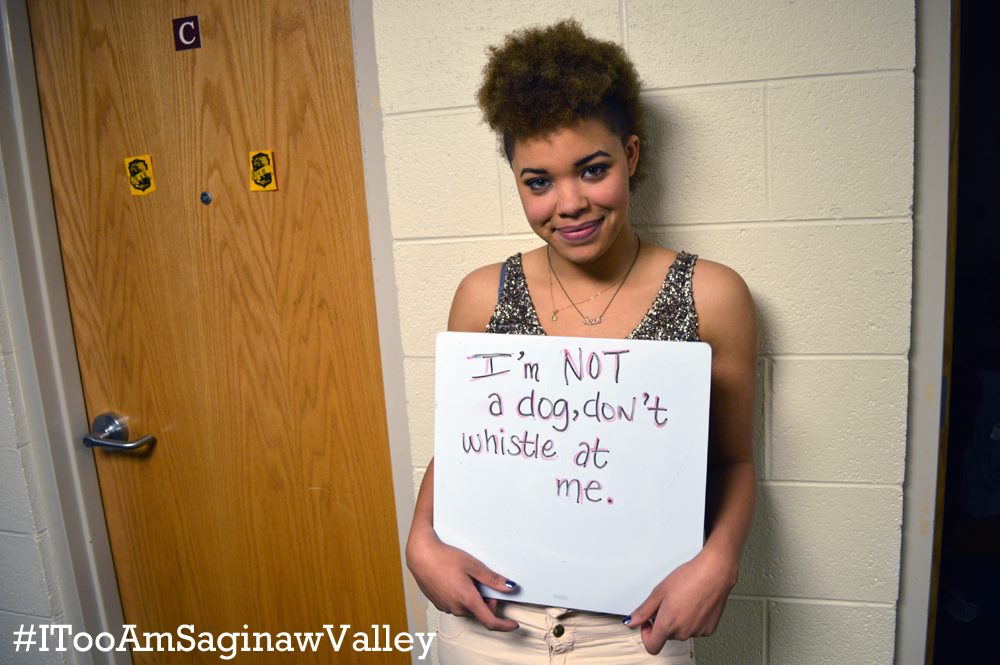
I first took a more critical look at harassment after a launching an “I, Too, Am Saginaw Valley” campaign, similar to “I, Too, Am Harvard” that highlights the voices and faces of black students, but opening it too all identities — mostly to get a more positive reception within the community. One of my participants wrote on her board, “I’m NOT a dog, don’t whistle at me,” after perpetually being catcalled from others shouting out their residence hall windows. After this, I began seeing the other methods students utilize to victimize others.

Yik Yak, a popular college app where users post anonymous messages that are then voted up or down by their peers, has stormed through the campus community, and brought harassment issues to light. While many of the posts can take on humorous perspectives of campus life, many of them venture on to defaming women, treating them as objects, and other forms of harassment.

It’s been an issue at many campuses, and Boston College even made a video to address some of the Yaks from their students, although it received much backlash from its student body.

Here are a few Yaks that have appeared on our campus:

“If her bra matches her panties when you take off her clothes, it wasn’t you who decided to have sex.”

“You probably shouldn’t be at college if you can’t tell a guy “stop.”

“To the girl who posted about sexual harassment… there’s no way you get sexually harassed, if you catch my drift.”

“Do you ever sit in class and look at this cute girl and think, I would love to bang you after class!”

“You ever just look at a girl and think ‘she could probably suck a mean dick.'”

I shouldn’t need explanation on why each of these posts contribute to a negative campus climate, but they perpetuate myths that “she was asking for it” and that there’s a standard of beauty required to be sexually harassed.

I usually feel more comfortable seeing these posts down-voted to the point where they are removed, which requires a total down-vote of a -5 before it vanishes from the app. But nearly all of these posts registered as positive messages within the campus community and became some of the most popular Yaks on the feed at the time.

While the app usually refrains from targeting individuals, it can justify beliefs that lead to a culture with highly sexualized and objectified women.

Further perpetuating this culture, in March of 2013, we had a Twitter page go rampant among our community. Dubbed “Dbags of the Valley” students submitted passive aggressive complaints about the university, faculty, students, or really whatever they felt like complaining about through Ask.fm, and then the posts would be re-posted on a now-disbanded Twitter account.

Full of hate speech, posts ventured into areas such as “To the girl wearing those tight, see-thru leggings in the library; stop wearing that shit, or I’ll rape you. #DressForSuccess #SVSUdbags.”

By September 2013, assumedly, the manager of the page promptly shut the page down after complaints. The university eventually identified the student behind the page, but decided to not release the name to the public.

Yik Yak and this page are not the only perpetrators of harassment on campus.

Sitting in at 4,585 followers and counting, is the ever-so-popular @SVSUCrushes2. It has a stronger social media following than any university-affiliated accounts, with the exception of the main SVSU social media pages.  It takes the same approach as the “Dbags” page, getting submissions from Ask.fm then posting on Twitter. Independently-operated pages began ravaging college campuses for the past couple of years. This account has racked up more than 14,000 crushes tweeted in its two-year lifetime. Most students see this page as harmless, despite relative agreement that some tweets that include “She can sit on my face anytime though..” cross the line. That tweet, by the way, is within the top fifteen favorited and retweeted posts by the page.

Despite becoming temporarily unavailable when the “Dbags” account went under heavy scrutiny, the account still holds a strong presence on campus. The operators of the page reported in an anonymous interview “We know for sure that we know how to handle Crushes in a responsible way,” but it enables a culture of window shopping and objectification on physical appearance.

Through these contributors of harassment, I’ve learned changing a culture is easier said than done, but not doing anything about this would be a greater injustice than the injustice itself. I only have a few more months left at this institution, but I remain hopeful that education will advance the environment here.

Tyler is a senior majoring in graphic design at Saginaw Valley State University and plans to undertake a graduate program in higher education in the fall. Follow Tyler on Twitter, @MysteriousLuigi.

Share

Filed Under: correspondents, male perspective, street harassment

USA: Stopping Street Harassment in Houston

January 29, 2015 By Correspondent

Madison Ford, Texas, USA, Blog Correspondent

Although the fight against street harassment has been gaining strength over the past few years, some areas are only beginning to get organized. Metropolitan regions in the upper east coast of the United States receive a lot of attention in regard to this issue and most data on street harassment has been collected in such areas. Regions of the world and the United States without a lot of foot traffic or public transportation may overall have fewer instances of street harassment, but they are just as damaging.

My first personal experience with street harassment happened in a town with less than 40,000 people. Ever since then, I’ve been trying to bring the fight against street harassment to Texas. I gained a Texan ally when I spoke with Hermie Escamilla of Hollaback Houston and learned about transportation, social media, and building a community of people to get organized.

Transportation

Transportation is a big part of street harassment in Houston, the fourth largest city in the United States. Cars and trucks are popular in Harris County with about 80% of county residents driving to work. Just under 3% of Harris County’s population uses public transportation to get to work and less than half a percent ride their bikes. Compare this with approximately 28% of New York City commuters driving a car, 56% using public transportation, and .8% riding their bicycles. Hermie tells me about her experience as a Houston cyclist:

“Since 2006 I’ve just commuted by bike. For me, being part of that subset of cyclists – you can get the feeling of what it means to be an irritation – everyone is supposed to be in a car or a truck, why are you in my way on your bike? For cyclists it’s sort of a twofold harassment; people are run off the road, intimidated, add in being a woman and that’s when the sexual comments show up. The stalking.”

Hollaback Houston’s website, where those who have experienced street harassment can report the incident to the community, is filled with tales of pedestrians and cyclists being harassed by people in cars.

“In Texas, less people have a stake in this issue because of the high number of motorists that aren’t experiencing [street harassment] as frequently.”

Social Media

Connecting with cycling organizations would help in the fight against street harassment not just in Texas; for Hermie, it was the Facebook page of a cycling group in LA that got her involved in Hollaback in the first place. Like many of us, Hermie got involved in the movement through social media.

“When I was looking down at the comments on a photo someone had posted about the LA chapter of Hollaback. Coming across Hollaback is what allowed me to have the language to speak about street harassment; that was a term I didn’t use until I started visiting their website. I didn’t have a word for it or a means to reach out or read about other people’s experiences with it. Having the reach that the internet allows us is what really helps us spread the message far and wide to anyone that wants to see it or maybe doesn’t want to see it.”

In a huge state like Texas without a large number of vocal activists against street harassment, connecting over the Internet is vital to increasing awareness. I would never have found Hermie were it not for my own use of social media.

Community

But the value of social media goes far beyond the boundaries of the Lone Star State; people around the country and the world have been connecting over the web in activist efforts. There’s a strong foundation, but those who hope to end street harassment need to continue building community as the issue receives more public attention. When I asked Hermie what her short and long term goals were for Hollaback Houston, she told me her first priority was being able to grow her team.

“I think that’s both a short term and long term goal. For me that was the most daunting thing – I was the only chapter in Texas and this is a huge state. There’s a chapter in Lubbock and I reached out to them but I’ve never really been alone in this – I have the network to reach out to. I would hope to see more sites pop up in Texas. I want to get more people so there’s more variety in our message. That’s all we want to do – empower and provide support. And prove that this is a problem.”

Whether you’re in Texas or halfway across the world, there are always people you can connect with. Learn from other members of the street harassment network and figure out what makes your community unique. The movement is growing – get involved!

“Any contribution is important. It could be a share on Facebook, writing a piece on your blog or creating a video – take inventory of your personal skills and know that anything you do matters so much. All of these little things add up and increase awareness.”

Madison is a soon-to-be graduate of the University of Texas at Austin studying literature and sociology. Follow her on Twitter, @madiford222.

Share

Filed Under: correspondents, hollaback, street harassment

« Previous Page
Next Page »

Share Your Story

Share your street harassment story for the blog. Donate Now

From the Blog

  • #MeToo 2024 Study Released Today
  • Join International Anti-Street Harassment Week 2022
  • Giving Tuesday – Fund the Hotline
  • Thank You – International Anti-Street Harassment Week 2021
  • Share Your Story – Safecity and Catcalls Collaboration

Buy the Book

  • Contact
  • Events
  • Join Us
  • Donate
  • Facebook
  • Instagram
  • Pinterest
  • Tumblr
  • Twitter
  • YouTube

Copyright © 2026 Stop Street Harassment · Website Design by Sarah Marie Lacy