• About Us
    • What Is Street Harassment?
    • Why Stopping Street Harassment Matters
    • Meet the Team
      • Board of Directors
      • Past Board Members
    • In The Media
  • Our Work
    • National Street Harassment Hotline
    • International Anti-Street Harassment Week
    • Blog Correspondents
      • Past SSH Correspondents
    • Safe Public Spaces Mentoring Program
    • Publications
    • National Studies
    • Campaigns against Companies
    • Washington, D.C. Activism
  • Our Books
  • Donate
  • Store

Stop Street Harassment

Making Public Spaces Safe and Welcoming

  • Facebook
  • Instagram
  • Pinterest
  • Tumblr
  • Twitter
  • YouTube
  • Home
  • Blog
    • Harassment Stories
    • Blog Correspondents
    • Street Respect Stories
  • Help & Advice
    • National Street Harassment Hotline
    • Dealing With Harassers
      • Assertive Responses
      • Reporting Harassers
      • Bystander Responses
      • Creative Responses
    • What to Do Before or After Harassment
    • Street Harassment and the Law
  • Resources
    • Definitions
    • Statistics
    • Articles & Books
    • Anti-Harassment Groups & Campaigns
    • Male Allies
      • Educating Boys & Men
      • How to Talk to Women
      • Bystander Tips
    • Video Clips
    • Images & Flyers
  • Take Community Action
  • Contact

Indonesia: Psychological Effects of Street Harassment

August 18, 2017 By Correspondent

Astrid Nikijuluw, Serpong, Banten, Indonesia SSH Blog Correspondent

Street harassment or other kinds of harassment can cause psychological harm. Unfortunately not many people realize that simple things such as ‘whistling’ or ‘catcalling’ can be the beginning stages of further harassment.

Image courtesy of Reynitta Poerwito Muthalib. Dressed by @oenomel.id

In this article, I interview Indonesian Psychologist Reynitta Poerwito Muthalib about her views on the topic.

She works as a Clinical Psychologist in the Eka Hospital and does free online counseling.  She occasionally appears on the Indonesia Morning Show from Net TV.  She also actively shares her knowledge through seminars and school visits. She has a bachelor’s degree in Psychology from Queensland University of Technology in Brisbane, Australia, and a master’s degree in Psychology with a focus on Clinical Psychology from the University of Indonesia.

Astrid Nikijuluw (AN): How do you define the street harassment according to your terms?

Reynitta Poerwito Muthalib (RPM): For me, street harassment, just like other harassment, has the straight line of what people do (verbal or non verbal) that makes other people feel threatened/uncomfortable/afraid/disgraced, both implicitly and explicitly. This happens, unfortunately, to a wide range of ages of people, from the very young to the old.

AN: What street harassment experience irritates you the most?

RPM: When I was about 13 or 14 years old, I went to a traditional market by myself. While I was passing a crowd of men, they whistled at me. I ignored them and tried to walk as fast as possible. Suddenly, one of those men came to me and walked by my side and made fun of me. I was so afraid and at that point I could not think of anything else but to just get away from that place as soon as possible. Yes, I was very young but the memory still vividly haunted me sometimes.  That kind of behavior is not acceptable at all.

AN: How did you cope after that happened to you?

RPM: The first thing I did was to increase my self-awareness. Because that market was part of my everyday route of going to school, I chose to take a longer route to try to avoid it occurring again by half circling the market instead of taking a direct route which went past the area where I had my incident. Sometimes I felt anger about this and just wanted to fight back but I felt it was no use. It was so frustrating to feel helpless about it.

AN: Can you explain, based on your expertise, the psychological effect of street harassment?

RPM: I would say there are three major factors:

1. First is the personality of the victim.  If the victim tends to face a distressing situation more often or has a better self-managing strategy for stress then the effect would not as bigger as it is on others who are vulnerable. Both sides can feel the thread, the disgrace, the scare, but to those who are –what people usually say- stronger would not be as affected as the others who are not as strong.

2. Second is the type of harassment itself. The deeper the harassment then the greater level of effect on the victim.  For example, if the harassment is whistling or cat calling, the victim might just ignore it and walk away or maybe in some cases, fight back. But on the other hand, if the harassment reaches the levels of threatening words, such as, “I’ll be watching you”, then the psychological effect for the victim is deeper.

3. Third is the victim’s history. If the victims had other harassment experiences before, then they may be more traumatized compared with others who have not yet experienced other types of harassment before street harassment. For example a young girl who used to be bullied at school or have abusive parents at home might be more affected just by hearing a whistle on the street than someone who was just a happy young girl.

In my experience, street harassment and other forms of harassment such as bullying and abusive treatment can impact victims several ways. They may feel depression, have high levels of anxiety and experience low self esteem.

AN: How, in your opinion, can we prevent street harassment?

RPM: The first thing to bear in mind is that how you dress is not directly proportional to street harassment. Do not put blame on the dress you wear because you should be free to wear anything you want.

The first phrase that comes to my mind answering your question is the phrase that our president uses in every situation: “MENTAL REVOLUTION”.  I use this phrase because harassers are threatening the victim’s private rights and acting on low-morality. They do not consider other people’s feeling and tend to act oppressive to the victim. Their conscience is not honed enough to bring empathy toward others.

People are born with enough conscience to feel compassion and love for each other. The lack of those factors brings us back to parenting. It starts at home and how parents raise their kids to accept differences are crucial. We in Indonesia live under patriarchal rule, therefore the understanding of how to appreciate women while still being a good patriarch is very important.

Therefore the mental revolution should start from the very beginning since it is easier to design moral obligation for children than those who are already teenagers or older. Technology awareness nowadays also is a challenge for parents because it is accessible for children.  Accompany your child in watching movies so they will not get the wrong moral lesson.

The last one for me is the appropriate law. I still find the law is not enough to protect the victim.  And not just for street harassment, but also for other types of harassment such as sexual harassment in schools or workplaces and bullying. Hopefully our government will put more attention to this matter in the future and make a breakthrough for protecting its citizen.

AN: Last question, any message for those who experience street harassment?

RPM: Don’t let them destroy your self esteem.

Today, 17th August 2017, my country Indonesia is celebrating its independence day. On this special day we always shout ‘FREEDOM’.  Well, for me freedom means to also feel free walking along the street. To be free from feeling afraid in public places. To be free to wear anything you want without getting scared of being harassed. Freedom is for every citizen, every human being, and every individual.

Happy 72th Independence Day to my fellow Indonesians.

Astrid received her Bachelors of Business at Queensland University of Technology Brisbane Australia. She finished her Master’s Degree at Gadjah Mada University Yogyakarta where she majored in Human Resource Development. Follow her on Twitter at @AstridNiki or on Facebook.


Share

Filed Under: Activist Interviews, correspondents, street harassment

Apply to be a SSH Blog Correspondent | Sept. to Dec. 2017

August 15, 2017 By HKearl

Apply to become part of the third 2017 SSH Blog Correspondents cohort from September to December 2017!

During these four months, correspondents must commit to writing one blog post per month about street harassment issues in their community, region or country. This means four posts total. The topics could include incidents of street harassment in the news, activism to stop it, interviews with activists, and street harassment in popular culture, traditions or the news.

We aim to have geographic diversity among our cohort members and people of all genders, ages, backgrounds and locations can apply. You do not have to apply in English (or write your blog posts in English) if another language is more comfortable for you.

Deadline is Aug. 30. Position begins Sept. 5, 2017.

This is an unpaid, volunteer position. Our blog receives around 30,000 unique visitors per month. The Facebook page, where many of your articles will be posted, has nearly 40,000 likes.

Share

Filed Under: correspondents, SSH programs

USA: How do we prevent street harassment?

August 7, 2017 By Correspondent

Dee Rodriguez, Reading, PA, USA, SSH Blog Correspondent

Source: pixabay.com

You may have read some of the countless stories of street harassment being written about lately or been harassed yourself. Each time I read one of these stories, I get angry. I’m glad people are speaking up because it lets us know we are not alone, but I’m angry because no one should feel unsafe walking down the street.  Stop Street Harassment has some great resources on how to address harassers.

But what if we could prevent street harassment? I believe there’s a way: primary prevention.

What is primary prevention? It is programming (ongoing activities and groups) aimed at preventing violence from happening in the first place. According to the Centers for Disease Control & Prevention, primary prevention is “approaches that take place before sexual violence has occurred to prevent initial perpetration or victimization.”

As I have written previously, street harassment is part of the sexual violence continuum. Prevention programming placed in schools, youth centers, or churches could reduce not only sexual violence, but dating violence as well by creating a community where equity and respect are norms.

There a few primary prevention programs that have shown success such as Shifting Boundaries, Safe Dates and RealConsent. Safe Dates is aimed at 8th and 9th grade students to prevent dating violence while RealConsent is geared towards men in college to reduce sexual violence perpetration. While Safe Dates and RealConsent have shown success, I would argue that Shifting Boundaries is the best program in primary prevention. Firstly, it is geared towards 6th and 7th graders. I am a firm believer that the earlier we start prevention, the better. Out the three programs, it is the one with the youngest audience. Secondly, Shifting Boundaries is aimed at diminishing dating violence and sexual harassment. While it is not intended to decrease street harassment specifically, Shifting Boundaries is aimed at decreasing sexual harassment which, which could ultimately impact street harassment.

Before taking my current role as a Database and Resource Assistant at the National Sexual Violence Resource Center, I was an advocate at a county domestic violence and sexual assault agency in my state. My position at the local program came out of its education and outreach department. One of the biggest efforts for that department was primary prevention, and we were able to carry that out by using the Shifting Boundaries program in local schools. The curriculum is six sessions and the facilitators lead exercises such as coloring in safe and unsafe areas on a school map (also known as hot spot mapping) and a boundary exercise where participants use a tape measure to show personal space. At the end of the sessions, information about what areas of the school are considered safe and unsafe is presented to the administration by the students and facilitators and then a plan is formed to address unsafe areas of the school. In addition, there are pre-tests and post-tests conducted to measure if students’ attitudes have changed after the program and if violence diminished in the school.

If we’re going to end sexual violence, including street harassment, we have to educate people. If we teach young people early on about boundaries, they realize that they have autonomy over their bodies and that it is not okay for people to harass, touch them inappropriately, or make them feel unsafe. Primary prevention is about changing the culture so this type of violence doesn’t occur. If a person thinks it is okay to harass a stranger in the street, what kind of violence are they inflicting on people they know personally? I don’t think every person that engages in street harassment is going to rape someone but the normalization of street harassment perpetuates rape culture and it has to stop. We all deserve to be safe.

Dee is a volunteer coordinator and domestic violence/sexual assault advocate for a non-profit social services agency and works on a project to better serve Latinx women survivors. She has a bachelor’s degree in Global Studies with a focus on Latin American Culture from Penn State University. She originally hails from New York City and is a proud daughter of immigrant parents from the Dominican Republic. You can follow Dee on Instagram at @missdeerodriguez.

Share

Filed Under: correspondents, street harassment

Indonesia: Is Women-Only Transport Effective?

July 26, 2017 By Correspondent

Astrid Nikijuluw, Serpong, Banten, Indonesia SSH Blog Correspondent

English version below.

AREA KHUSUS WANITA PADA TRANSPORTASI UMUM: EFEKTIF?

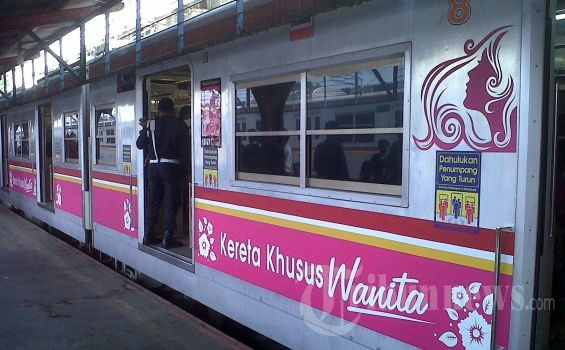
Image courtesy of: Tribunnews.com

Kereta pagi meluncur dari stasiun Manggarai menuju stasiun tanah abang.  Di dalam penumpang kereta yang berdesak-desakkan, terdapat Agnes yang hendak berangkat menuju kantor.  Tiba-tiba dari arah belakang dia merasakan sesuatu yang aneh.  Sontak ia segera berbalik badan dan dengan lantang berteriak ke muka pria yang tepat berdiri di belakangnya,”Heh! Kamu sengaja ya gesek-gesek?!” Pria tersebut tidak bisa mengelak dan di stasiun berikutnya dia pun diturunkan oleh petugas dan dilaporkan pada pihak berwenenang.

Kisah diatas merupakan ilustrasi dari kejadian pelecehan seksual yang kerap terjadi di transportasi umum di Indonesia.  Banyaknya pengguna kereta di pagi hari mengakibatkan hal-hal seperti ini terkadang sulit dihindari.  Kejadian pelecehan seksual seperti yang terjadi pada KRL juga terjadi pada penumpang wanita Bis Trans Jakarta.    Beruntung pemerintah cukup peduli dengan hal tersebut.  PT Kereta Api Indonesia melalui PT KAI Commuter Jabodetabek (KCJ) terhitung sejak tanggal 1 Oktober 2012 meresmikan kereta khusus wanita.  Gerbong khusus ini biasanya terdapat pada gerbong pertama dan gerbong terakhir dari rangkaian KRL.  Selain pada transportasi kereta api, transportasi umum lainnya yang juga terdapat area khusus wanita adalah Bis Trans Jakarta.  Bis Trans Jakarta juga merupakan sarana umum yang kerap digunakan oleh para pekerja setiap harinya.  Dengan adanya area-area khusus wanita tersebut dapat pemerintah Indonesia melalui PT KCJ  seperti yang diungkapkan oleh Eva Chairunissa selaku VP Communications PT KCJ dapat mengakomodasi permintaan para pengguna KRL yang merasa risih harus berdempet-dempetan dengan lawan jenis.  Selain itu ia juga mengharapkan agar dengan adanya gerbong khusus wanita dapat menghindari kejadian-kejadian yang tidak diharapkan yang korbannya lebih sering perempuan. (https://news.detik.com/berita/d-3504057/sejarah-gerbong-krl-khusus-wanita-di-indonesia-dan-negara-lain)

Saya sebagai salah satu pengguna reguler KRL sangat mengapresiasi tindakan pemerintah dalam mengurangi pelecehan seksual terhadap pengguna wanita baik di kereta maupun di Bis.  Kejadian seperti ilustrasi kisah diatas memang sangat mengganggu bahkan cenderung menjadi terror yang cukup menakutkan bagi sebagian wanita terutama para korban dari tindakan asusila tersebut.  Saya merasa cukup beruntung tidak pernah mengalami kejadian ini.  Dalam pengamatan saya membaca berita-berita, semenjak diadakannya area khusus wanita baik pada kereta api maupun bis trans Jakarta, kasus pelecehan seksual pada transportasi umum tidak sebanyak sebelumnya. Namun apakah hal ini bisa dibilang efektif untuk menanggulangi kasus-kasus pelecehan seksual yang terjadi pada sarana transporasi umum?  Saya rasa hal ini masih harus dikaji lebih dalam.  Coba sama-sama kita bayangkan.  Untuk merasa lebih aman, pengguna kereta wanita yang jumlahnya bisa mencapai puluhan bahkan ratusan ribu per harinya harus rela berdesak-desakkan dalam 2 gerbong yang tersedia.  Berita-berita terakhir bahkan menunjukkan kejadian tidak mengenakkan di gerbong wanita seperti adu mulut berebut tempat duduk.  Sehingga akhirnya sebagian dari mereka tetap menggunakan gerbong biasa dengan resiko bisa mengalami kejadian pelecehan seksual.  Dan apabila memang terjadi, akankah mereka disalahkan karena ‘memilih dengan sengaja’ gerbong yang bukan dikhususkan untuk wanita?

Buat saya kejelasan hukum juga menjadi poin penting dalam rangka pencegahan kasus pelecehan seksual tersebut.  Dari penelitian singkat saya mengenai kasus-kasus pelecehan seksual yang terjadi di transportasi umum, pelaku tidak mendapat hukum yang setimpal, bahkan dalam beberapa kasus dibebaskan karena dianggap ‘hanya’ melakukan percobaan.  Bukankah segala sesuatu itu berawal dari ‘mencoba’?  Kalau berhasil diteruskan.  Justru titik krusial menurut saya adalah pada saat mencoba ini.  Jika dari hal ini saja sudah ‘dibolehkan’ secara hukum maka jangan heran kalau kasus pelecehan seksual masih akan dan terus berlangsung di transportasi umum.  Sejauh ini saya belum menemukan hukuman yang dapat memberikan efek jera kepada para pelaku kejahatan seksual tersebut.  Sekali lagi seperti yang pernah saya tulis sebelumnya, hal ini masih belum dianggap serius.  Padahal efek yang ditimbulkan kepada para korban sangat dalam.  Berdasarkan laman resmi dari Komnas Perempuan (komnasperempuan.go.id) pelecehan seksual dikategorikan ‘hanya’ sebagai perbuatan yang tidak menyenangkan dalam hukum Indonesia.  Hal inilah menurut saya yang masih perlu perbaikan.

Upaya pemerintah dengan mengadakan area khusus wanita pada transportasi umum patut kita hargai.  Setidaknya pemerintah masih peduli terhadap kasus-kasus pelecehan seksual yang kerap terjadi pada pengguna wanita.  Namun alangkah baiknya apabila langkah yang sudah baik ini diikuti pula dengan payung hukum yang sepadan.  Kita semua juga tahu tidak mungkin semua penumpang wanita berada di area khusus wanita.  Sebagian akan tetap berada di area umum.  Dengan hukum yang jelas dan bisa menimbulkan efek jera, akan sangat menunjang usaha pengurangan tingkat pelecehan seksual di area publik dan transportasi umum.  Jika tidak maka jangan heran apabila kejadian seperti akan tetap berlangsung tanpa dapat dicegah.

Astrid received her Bachelors of Business at Queensland University of Technology Brisbane Australia. She finished her Master’s Degree at Gadjah Mada University Yogyakarta where she majored in Human Resource Development. Follow her on Twitter at @AstridNiki or on Facebook.
The morning train is on its way from Manggarai station to Tanah Abang station.  Among those many people, there was Agnes who is on her way to the office.  Suddenly she feels something disturbing.  She quickly turns her body angrily and yells at the man standing behind her, “Hei! Are you intentionally touching my back with your p***s?! The man cannot avoid the accusation and in the next station he is brought to the post for further process.

The above story is an illustration of how the sexual harassment happens on public transportation in Indonesia. The crowds of people using the trains and buses in their daily morning makes that behavior seems unavoidable.

Luckily the government has shown their concern towards this matter. Since October 1, 2012, PT Kereta Api Indonesia (Indonesian Train Company) through PT KAI COMMUTER JABODETABEK (KCJ) has run women-only transit carriages in the front and back of the train.  In addition to the train, the trans-Jakarta bus, which is also a common mode of transportation, has a special area for women, the first few rows behind the driver.

Eva Chairunissa, the VP Communications of PT KCJ, said the women-only areas are meant to help women riders feel more comfortable. The government hopes that the women-only areas are decreasing the levels of sexual harassment and that people are more comfortable using the public transportation.

I, as one of the public transportation user, really appreciate what the government has done in order to reduce the level of sexual harassment in public transportation. I am lucky enough to never have experienced such an incident, but based on what I’ve read in the news, the sexual harassment cases have gone down since the launch of the women-only areas.

However is it really effective at decreasing the level of sexual harassment in public transportation?  I think it still needs to be reviewed.  Let’s imagine.  To feel more comfortable and safe, women passengers, who are up to hundreds of thousands in number each day have to use only two carriages on the train or the first few rows on the trans-Jakarta bus.  There is simply not enough space for all women and there are often arguments over seating. Thus, many women still use the regular area in the public transportation and face the risk of experiencing sexual harassment there.  And of course if and when that happens, some may blame them for choosing the “wrong” area.

In my opinion, women-only options are not enough. The clarity of the law is also very important in order to prevent sexual harassment.  From my own research of news stories, the punishment for the perpetrators are not worth it, even in some cases they are not being punished because they were ‘only’ just ‘trying’ to sexually harass the victim…. But doesn’t everything start from trying? If they succeed, they may do it again. The crucial moment for me is at the stage of ‘trying’. If this stage is ‘allowed’ according to law, then no wonder sexual harassment cases in public transportation still occur.  Thus far, I haven’t found any punishment that would realistically act as a deterrent to the perpetrators.  Once again, as my two last articles had stated, this kind of behavior has not yet been taken seriously.

Based on the KOMNAS PEREMPUAN (National Commission On Violence Against Women) website, by law, sexual harassment is categorized only as a “disturbing behavior” that is on the same level as other behavior, such as cheating. This is what needs to be improved.  The current sexual harassment law is not at all adequate to accommodate the range of every day behaviors.

The government’s plan for preventing sexual harassment in public transportation by creating women-only areas is well-respected.  At least the government has done something.  However, it would be much better if this action was accompanied with a decent law, especially as many women still use the regular sections of public transportation. Therefore a stronger law will help reduce the sexual harassment cases on a larger scale in public spaces, including public transportation.  Otherwise, we can’t be surprised when sexual harassment incidents continue to occur.

Share

Filed Under: correspondents, News stories, public harassment Tagged With: indonesia, laws, public transit, women-only

USA: Latinx Women: Our Experiences with Street Harassment

July 13, 2017 By Correspondent

Dee Rodriguez, Reading, PA, USA, SSH Blog Correspondent

I like to walk and when the warmer weather hits, I go for walks as part of my self-care routine.  I also walk to work and during work. As a domestic violence and sexual assault advocate, I sometimes have to respond to calls at our local services center or hospitals so I usually walk to these places to avoid wasting time looking for parking.
Being an advocate does not protect me from being harassed. In fact, I’ve been harassed literally walking out of work by a group of men driving by in a vehicle. Another time, I was walking back from a medical facility to my job and a guy said to me, “Why don’t you smile, ma?”

On both occasions, I did not respond. I’m actually less inclined to engage when harassed now that I am an advocate because of the violence I see every day. Many of the survivors that come through our doors are women. While the violence they experience is typically at the hands of an intimate partner, I know that women experience many forms of violence; I don’t respond to harassment due to the fear of what might happen if I do.

When I returned to the offices after being at the medical center, my coworkers asked me how my time there went. I cannot go without mentioning that many of my coworkers are women and women of color, particularly Latinx, and our organization is located in a city with a high Latinx population. While I told my colleagues about my work that day, I couldn’t stop talking about the guy that harassed me on my way back. It bothered me. My coworkers’ reactions were pretty blasé and that’s probably because they too have had their share of experiences with street harassment. When I think back to how I’ve reacted when women tell me of their experiences with street harassment, I was not shocked either.

So the day I was listening to Locatora Radio’s Capitulo 004: Femme Defense, where hosts Mala Muñoz and Diosa Femme discuss their experiences with street harassment and how they use femme defense to deal with it, I was blown away. I was blown away because never in all the times I’ve discussed street harassment did anyone talk about how to respond. Locatora Radio “is a Radiophonic Novela …. Las Locatoras make space for the exploration and celebration of the experiences, brilliance, creativity, and legacies of femmes and womxn of color. Each Capitulo of Locatora Radio is made with love and brujeria, a moment in time made by brown girls, for brown girls.”

As Mala states, femme defense is not just defending oneself but one’s community and you can be any gender and be femme.

The discussion between Mala (who is a fellow domestic violence and sexual assault advocate) and Diosa (who advocates for immigrant women) really struck a chord with me. They discussed having their bodies policed by their family (as way to prevent being harassed), being aware of their surroundings, and using techniques such as the eye gouge if one must engage in physical defense. One particular piece of the discussion that really resonated with me is the “Fuchi face.” The Fuchi face is your mean face, bitch face, mean mug, or whatever you call it, that you put on when you don’t want to be approached or messed with.  I used to call it my “train face” while growing up in NYC so I wouldn’t get bothered while taking public transit.

It’s funny that while out with my “Fuchi face” I was still harassed but I felt less angry about it after listening to the Locatoras because I am not alone and learned useful tips for what do in situations of street harassment.

While we are 3,000 miles apart, we share many of the same experiences. To know that there are other Latinx women out there dealing with this and talking about it, makes me feel like I have a community.

Editor’s Note: Here are suggestions for dealing with street harassment from the SSH site, in Spanish and English.

Dee is a volunteer coordinator and domestic violence/sexual assault advocate for a non-profit social services agency and works on a project to better serve Latinx women survivors. She has a bachelor’s degree in Global Studies with a focus on Latin American Culture from Penn State University. She originally hails from New York City and is a proud daughter of immigrant parents from the Dominican Republic. You can follow Dee on Instagram at @missdeerodriguez.

Share

Filed Under: correspondents, race, Resources, street harassment

« Previous Page
Next Page »

Share Your Story

Share your street harassment story for the blog. Donate Now

From the Blog

  • #MeToo 2024 Study Released Today
  • Join International Anti-Street Harassment Week 2022
  • Giving Tuesday – Fund the Hotline
  • Thank You – International Anti-Street Harassment Week 2021
  • Share Your Story – Safecity and Catcalls Collaboration

Buy the Book

  • Contact
  • Events
  • Join Us
  • Donate
  • Facebook
  • Instagram
  • Pinterest
  • Tumblr
  • Twitter
  • YouTube

Copyright © 2026 Stop Street Harassment · Website Design by Sarah Marie Lacy