• About Us
    • What Is Street Harassment?
    • Why Stopping Street Harassment Matters
    • Meet the Team
      • Board of Directors
      • Past Board Members
    • In The Media
  • Our Work
    • National Street Harassment Hotline
    • International Anti-Street Harassment Week
    • Blog Correspondents
      • Past SSH Correspondents
    • Safe Public Spaces Mentoring Program
    • Publications
    • National Studies
    • Campaigns against Companies
    • Washington, D.C. Activism
  • Our Books
  • Donate
  • Store

Stop Street Harassment

Making Public Spaces Safe and Welcoming

  • Facebook
  • Instagram
  • Pinterest
  • Tumblr
  • Twitter
  • YouTube
  • Home
  • Blog
    • Harassment Stories
    • Blog Correspondents
    • Street Respect Stories
  • Help & Advice
    • National Street Harassment Hotline
    • Dealing With Harassers
      • Assertive Responses
      • Reporting Harassers
      • Bystander Responses
      • Creative Responses
    • What to Do Before or After Harassment
    • Street Harassment and the Law
  • Resources
    • Definitions
    • Statistics
    • Articles & Books
    • Anti-Harassment Groups & Campaigns
    • Male Allies
      • Educating Boys & Men
      • How to Talk to Women
      • Bystander Tips
    • Video Clips
    • Images & Flyers
  • Take Community Action
  • Contact

Australia: How “That Girl” turned into #YesAllWomen!

August 4, 2014 By Correspondent

Corina Thorose, Melbourne, Australia, SSH Blog Correspondent

The first time I got a proper look at bona fide sexual harassment, I was about fifteen years old. Out with a group of friends, we had somehow gotten into a club, where we were enjoying being grown ups in our finest heels, skirts and halter tops. We looked like smouldering adults, but we were careful never to cross the line into Trashy.

Which is more than we could say for That Girl.

She was in a boob tube and a micro-miniskirt. Her eyes were heavily painted, and she had sex-me boots on. She was Trashy. She was Asking For It.

We observed her as our evening went on. She was groped by several guys, and she was getting angry with all of them, yelling at them all and even aggressively shoving a few of them away. We shook our heads and tsked, wondering why she was dressed like that if she wasn’t interested in men touching her. Didn’t she know clothes like that Invited Certain Attention?

It wasn’t until later in life when the groping started happening to me that I started to reassess things. I was not doing anything to Provoke it. There was no discernible pattern – it was occurring when I was drunk, sober, with friends, alone, in jeans, in a skirt, daytime, nighttime, in heels, in flats. I had become That Girl – and I had no idea how.

The answer has come to me over a lifetime of fighting these cretins off. I took the question to some of my girlfriends, and yes, even a male friend, and they were kind enough to share their own experiences of being That Girl.

Jane

“I was in Argentina with a girlfriend, and we were catching the train into the city. The carriage was packed, so we had to stand up, and the guy behind me was standing way too close to me. He was holding a briefcase and he slowly put it under my skirt and was started pushing it up. At first I thought it was an accident so just I stepped away from him, but he stepped close again and kept doing it. I pushed him away but that didn’t stop him either so I looked him straight in the eye and told him to fuck off, but that didn’t work either. In the end, I was so upset that my friend and I just got off at the next stop to get away from him. She flipped him off and yelled ‘Fuck you!’ at him, but he was totally unfazed by it.”

Kate

“I was on my way to work, so it would have been about 8:30am. I got off the train and Parliament station and a guy on the carriage got off behind me. I didn’t think anything of it until it became clear that he was following me. I kept looking back at him, making it clear that I knew he was there, but he didn’t seem to care, he just kept staring at me really intensely. He followed me all the way to the office and into the building. When I got in the elevator he followed me in and I pushed him out as hard as I could. The doors closed and I got up to our floor safely, but he waited for me in the foyer all morning. I told my boss and we called the police and they moved him on, but as he hadn’t done anything to me, there was nothing they could charge him with. He came back and waited for me again a few times, but I always gave him the slip. He gave up eventually, but I still look for him everywhere I go.”

Natalie

“I was working at a festival, and I was in charge of the set up and shut down of our stall. At the end when I was packing up, I knelt down to pick up some of our equipment and an old man who was sitting next to me says, ‘That’s what I like, a woman on her knees.’ I was so shocked I couldn’t even respond. You’d think someone of his generation would be a little classier!”

Tess

“I’m a big chested woman, and I cannot walk down the street without being gawked at. It’s not like when someone checks you out and you feel a bit chuffed about it, it’s outright staring, enough to make me really uncomfortable. One time I was out with some girlfriends and I had a pash with this guy who seemed really nice. He asked for my number and I gave it to him, and the first thing he did was text me a picture of his dick and then ask for a picture of my breasts.”

Jules

“I was eighteen and at a nightclub. This guy asked if he could have a kiss and I said no. When he asked why not, I said I had a boyfriend. He said no one would ever know and he’d make it worth my while. I was too young to know what to say or how to deal with it, so I just thanked him politely and walked away. I was really mad though, why did he feel so entitled to me?”

Hayley

“I was at the casino with a big group of friends, but I went off to go to the bathroom. When I walked in, I thought it was empty, but there was a man in one of the cubicles and he jumped out and grabbed me. I started screaming and fought him off, but I was drunk and lost my balance. He scratched up my neck really badly but luckily security got there and he ran off.”

Tom

“I was on a plane flying to Adelaide and one of the stewards was flirting with me. I thought he was cute, but I wasn’t really interested, so I was relieved when he didn’t ask for my number. He must have checked the flight registry though, because he got my last name and looked me up on Facebook! What a violation of my privacy.”

Erin

“I tried online dating and this guy who seemed perfectly nice at first told me he was going to bed to masturbate over me.”

Olivia

“I was a first time mum and I was walking my baby in her pram down the street. A boy of about sixteen rode past on his bicycle and pinched my bum. I punched him in the back and chased him down the street yelling at him.”

Jen

“My friend and I were travelling and we’d just gotten to Ottawa. We’d been out clubbing one night and on our way home stopped by the McDonald’s. We walked through the drive through but the sensor didn’t know we were there, so we waved at the car behind us to come up. It turned out to be a carful of young guys who thought, I dunno, that we were summoning them for sex. When they pulled up next to us they started saying the most revolting things, calling us cunts and telling us to suck their dicks.”

Sarah

“My girlfriend and I were trying to flag a cab down. A random car drove past and yelled ‘Sluts!’ out the window.”

Rebecca

“It was early in the morning, about 6:00 I think. I was on my way to the gym before work but on the way there, this car stopped beside me and the guy said something to me, but I just ignored him. He got out of the car and started following me. He was being really aggressive so I started to run. He caught up with me and grabbed my arm and I started screaming, but because it was so early, there was no one around. He kept telling me to shut up but I kept screaming and finally this couple turned up and started yelling at him. He got back in his car and drove off, but before he did he looked at me and said, “I’m going to remember your face.’ Thankfully, I’ve never seen him again.”

After speaking to my friends, I came to a conclusion I should have that day when I was fifteen. It doesn’t matter what you wear, where you are, or how much you’ve had to drink. We can all, at any time, be That Girl. Our bodies belong to us, and no one is entitled to objectify or touch them without our consent. Period.

I don’t mind being That Girl. What I can’t stand is That Guy.

That Guy is the one who won’t look away, who invades your personal space, or yells something out the window of his car as he drives past. That Guy is the reason I walk home from work with my keys in my fist and my phone in my hand instead of my bag. That Guy is the reason I go to the bathroom in groups, and why I don’t go jogging at night. That Guy has sent me home in tears many times, feeling ashamed of what I am wearing and making me believe that I am Asking For It.

Don’t be That Guy.

#YesAllWomen.

Corina is a journalist who is currently in a Masters’ program in Professional Writing. Follow her work on social media: @BrandosBride, www.facebook.com/theirownbells, instagram.com/theirownbells

Share

Filed Under: correspondents, Stories, street harassment

Puerto Rico: World Cup Sexism

July 24, 2014 By HKearl

Cristina del Mar Quiles, Puerto Rico, SSH Blog Correspondent

El resultado de un juego de fútbol como pretexto para el acoso callejero

En el primer juego de la semifinal de la Copa del Mundo que se celebró desde junio en Brasil, el equipo de Alemania sacó al anfitrión de su propia cancha: siete goles por uno. Como decimos en Puerto Rico, Alemania le dio senda pela a Brasil, le dio duro, eso fue una saaaaalsa.

Por supuesto que los memes no se hicieron esperar. Las redes sociales explotaron. Que si Alemania estaba vengando a Colombia, la selección a la que Brasil había eliminado días antes, que si era una humillación a la selección que más copas había ganado…

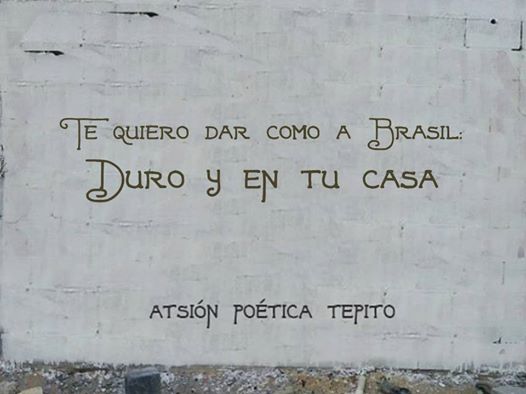
Entonces la frase, “Te quiero dar como a Brasil, duro y en tu casa” se regó como un chiste en redes sociales. Apareció como una de esas fotos de frases bonitas pintadas en paredes a la vista de todos que publican con frecuencia las distintas locales del movimiento Acción Poética. Si una anda por la calle y se topa con un muro que lee “Te quiero dar como a Brasil, duro y en tu casa”, estará experimentando el acoso callejero.

Ahora voy a hacer un paréntesis.

Para entender esto hay que partir de la premisa de que el Mundial de Fútbol es un evento hipermasculino, y que su tratamiento mediático es además machista y homofóbico. Notemos que la participación de las mujeres en la cobertura se limitó a poses en traje de baños, ropa interior y “bodypainting”. Los artículos resaltados en los medios sociales por los periódicos en Puerto Rico: mujeres que ofrecen sexo gratis si su equipo gana, mujeres que “pelarán pa’ bajo” si pierde el contrincante de su favorito. Como siempre ellos ejecutan, ellas satisfarán.

Cierro paréntesis.

Ya establecido el contexto del Mundial de Fútbol, debemos recordar que arrastramos toda una historia de chistes misóginos que connotan la agresión sexual a las mujeres como motivo de risa y de burla hacia los perdedores, los débiles, los diferentes. Entonces, no podemos pensar otra cosa que una frase como “Voy a darte como a Brasil, duro y en tu casa” es otro tipo de “piropo chistoso” en el que el emisor es un hombre y en el que la receptora debe ser una mujer.

La imagen que circuló por las redes sociales con la frase “Voy a darte como a Brasil duro y en tu casa” aparecía firmada por “Atsión Poética Tepito”. Evidentemente, no es un mural real, sino una composición digital. Aún así, desde la página de “Atsión Poética Tepito” ha sido compartida 7,000 veces y aprobada con un “like” por casi 6,000.

No sé si Atsión Poética Tepito es endosado por el movimiento original de Acción Poética, una iniciativa noble, que nació en 1996 para llevar la poesía a las calles, a espacios públicos, a la vista de todos y que según se establece en el portal www.accionpoetica.com, “el contenido de las frases son generalmente pensamientos de amor y frases optimistas, citas de poetas, escritores, músicos… Firmadas con el sello y formato de Acción Poética”. Lo que sí sé es que el contenido de Atsión Poética Tepito dista mucho de “pensamientos de amor y frases optimistas, citas de poetas, escritores, músicos…” Es más una retahíla de sandeces, de chistes machistas, sexistas y que de optimista tienen muy poco.

Vayamos al contenido. En el deporte “dar una pela”, “dar duro” o “dar una salsa” al contrincante es ganarle con gran ventaja. En las relaciones, “darle duro” a una mujer puede significar una de dos cosas, agredirla físicamente o tener una relación sexual intensa con ella con la ideología de que el hombre asume una posición activa y ella una de receptora pasiva. En ambos casos, se trata de una cuestión bastante machista. Y si relacionamos el resultado del juego según lo reportaron múltiples medios con la frase en cuestión, estamos hablando de que la persona que quiere “darle duro” a la otra, como lo hizo Alemania con Brasil, realmente lo que quiere es humillarla. Implica una amenaza de intromisión al el espacio privado.

La frase resulta ser el reflejo de una sociedad en la que el “macho” expresa su deseo carnal sobre “la hembra” y en la que poco importa lo que ella piensa.

Entonces, ¿qué tal si dejamos de estar compartiendo chistecitos machistas a nombre del deporte que en realidad son un atentado a costa de la mujer? Ya está bueno.

Cristina es una periodista y productora de noticias de San Juan, Puerto Rico. Posee un bachillerato de la Universidad de Puerto Rico, Recinto de Río Piedras, donde también completa su maestría en Consejería. Puedes seguirla en Twitter en @cristinadelmarq

__________________________________________________________

The is how the outcome of a football [soccer] game was used as an excuse for street harassment…

In the first semifinal match of the World Cup held in Brazil, the German team took the host out of his own court: seven goals to one. As we say in Puerto Rico, Germany “le dio una pela” to Brazil, hit Brazi hard, that was a saaaaalsa.

Of course social networks exploded. Some said that Germany was avenging Colombia, the selection Brazil had eliminated days ago. Some others said that it was a humiliation to the team that had won more titles.

Then, an image of the phrase “Te quiero dar como a Brasil, duro y en tu casa” was spread all over Facebook and Twitter.  “Te quiero dar como a Brasil, duro y en tu casa” can be translated as “I want to fuck you like Germany fucked Brazil, hard and in your own house” or “I want to give it to you like Germany to Brazil, hard and in your own house”

It looked like a picture of a graffiti that could have been taken in any street. If someone walks down the street and runs into a wall that reads “I want to give it to you like Germany to Brazil, hard and in your own house” that person will be experiencing a form of street harassment.

Let’s break down why this is a problem.

To understand this, we must establish first that the World Cup is a hypermasculine event and its media coverage is also sexist and homophobic. Note that the participation of women in the coverage was reduced to merely poses in bathing suits, underwear and “bodypainting”. -Items highlighted in social media for newspapers in Puerto Rico: “This woman offers free sex if her team wins” or “This woman will strip if the challenger loses to her favorite”.

For the context of the World Cup, we can remember that we carry a history of misogynist jokes connoting sexual assault to ridicule the losers, the weak, the different. So we can easily imagine that a phrase like “I want to fuck you as Germany fucked Brazil, hard and in your own house” is another type of “humorous wink” in which the issuer is a man and that the recipient must be a woman. It involves an intrusion into the private sphere.

The picture circulated on social network with the phrase appeared signed by “Acción Poética Tepito”. It’s obvious the image is not a photograph of an actual mural, but a digital composition. Still, it has been shared 7,000 times and liked 6,000.

I do not know if Acción Poética Tepito is endorsed by the original Acción Poética, a noble initiative born in 1996 to take poetry to the streets and public spaces. As it is stated in the website www.accionpoetica.com, “the content of the sentences are generally optimistic thoughts of love and phrases, quotes of poets, writers, musicians … Signed with the stamp format of Acción Poética.” What I do know is that the content of Atsion Poética Tepito is far from “love thoughts and optimistic phrases, quotations from poets, writers, musicians …” It’s a string of gibberish, of sexist jokes.

Let’s go to content. In sports “dar una pela”, “dar duro” o “dar una salsa”  is to beat the opponent with great advantage. In relationships, “darle duro” to a woman can mean one of two things, physical assault or an intense sexual relationship in which the man takes an active position and she is only passive recipient. In both cases, it is a pretty sexist saying. The phrase appears to be the reflection of a society in which the “male” expresses his carnal desire for the “female” no matter what she thinks.

So, what would happen if we stop sharing and liking images and sexual jokes that are clearly an offense to women?

We’ve had enough!

Share

Filed Under: correspondents, street harassment

USA: Anti-women trolls try to hijack #YouOkSis Twitter discussion

July 17, 2014 By Correspondent

Brittany Oliver, Baltimore, MD, USA, SSH Blog Correspondent

Fighting street harassment was never an easy job.

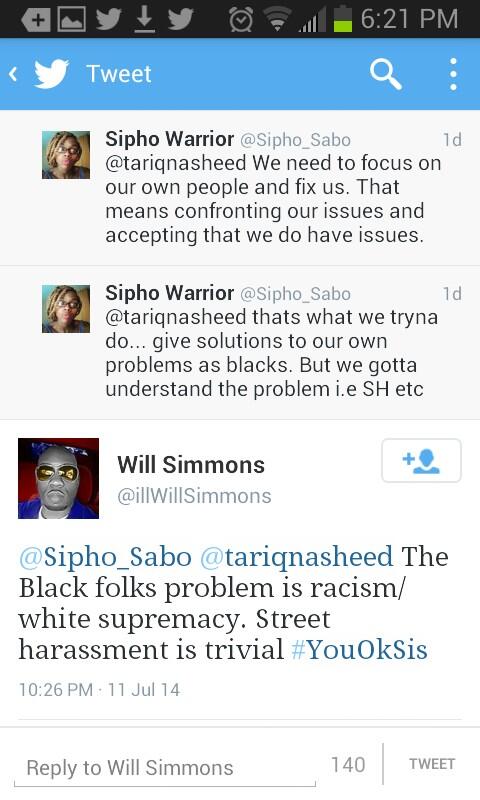
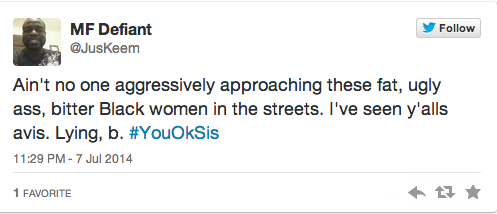
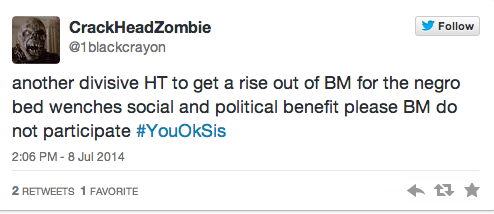
In case you missed it, Feminista Jones, a popular blogger, Black feminist and creator of the #YouOkSis hashtag, faced harsh backlash from Internet trolls for starting a discussion on how Black men should support Black women to combat street harassment. As motivating as this sounds, some people just couldn’t handle women speaking out and it took a turn for the worst.

With what was supposed to be a virtual space to express our frustrations to create dialogue, men immediately attacked Black women and their allies. At some point, I decided to join in on the conversation and the same thing happened to me.

How bad was it? You be the judge.

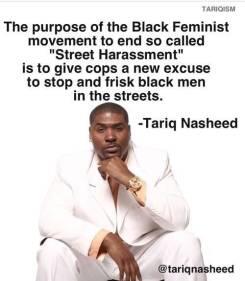
In defense of the movement, I tweeted back at trolls and was called an “angry Black feminist” who was on a mission to help organizations like Stop Street Harassment (SSH) put Black men in jail.

Really? Is that the best they could come up with? The work I do during the day consists of upholding racial equality and combating racism in all forms, especially within the criminal justice system. And believe me, the LAST thing I want is for the prison population to increase. That made absolutely no sense and is a cop out from the real problem: men not taking responsibilities for their actions.

This debate made me think about a film I saw in college called “Tough Guise: Violence, Media & the Crisis in Masculinity,” which is headlined by activist and educator Jackson Katz. Katz argues that the epidemic of male violence that plagues American society needs to be understood and addressed as part of a much larger cultural crisis in masculinity and I couldn’t agree more.

We live in a society that tells women and girls to dress a certain way to avoid unwanted attention and abuse. It blames victims first and asks questions later. It teaches men that they are entitled to women’s bodies and showing aggression is the “American” way.

Because the hashtag #YouOkSis wasn’t about the trolls, they were determined to ruin a time of solidarity. What people need to realize is that Stop Street Harassment has given me more support than any man ever has. Now, let that sink in for a minute.

If street harassment didn’t exist, why are organizations like SSH and Hollaback! Baltimore doing work on these issues? Why is visual artist Tatyana Fazlalizadeh traveling around the country to wheat paste portraits quoting things women want to say to their harassers? Street harassment is not an illusion and these are real issues and challenges we face every day.

In 2014, SSH commissioned a 2,000-person national survey in the USA and found that 65% of all women had experienced street harassment, while 25% of men were harassed. With all of the research it took to get these results, why would anybody make this stuff up?

Instead of Black men supporting Black women on this issue, sadly some of them let us down once again. When was the last time you heard a woman deny a man’s experience of being stop and frisked by the police? Most likely never.

And although anti-women trolls hijacked the #YouOkSis hashtag, they proved exactly why the fight to ending street harassment continues.

So, what’s next? Continue to stress the importance of ending street harassment among your family, friends and allies in your community because as you can clearly see, the work is far from over.

Brittany Oliver is a recent graduate of Towson University and works in the non-profit communications sector and supports local anti-street harassment advocacy through Hollaback! Baltimore. She blogs at http://btiarao.wordpress.comand publicly rants on Twitter, @btiarao.

Share

Filed Under: correspondents, Stories, street harassment

USA: #YouOkSis Street Harassment Tweet Chat

July 14, 2014 By Correspondent

Kirstin Kelly, Monterey, California, USA, SSH Blog Correspondent

As an editor for The Women’s International Perspective, I often find myself involved in Twitter chats and campaigns that deal with social issues, especially issues pertaining to the treatment of women around the world.  On July 11, I participated in one such chat using #YouOKSis (here is the recap). It quickly became clear that this was not your ordinary Twitter chat.

The sheer numbers of trolls and naysayers making themselves heard was truly astounding.  The #YouOKSis chat was intended to be a discussion about street harassment faced by Black women.  In particular, it called for men of color to engage in bystander intervention when they witness women of color being harassed.  These kinds of conversations are important.  Stop Street Harassment’s recent National Street Harassment Report demonstrated that persons of color face harassment at higher rates than their white counterparts and that overwhelmingly it is men who do the harassing, regardless of the victims’ gender.

The #YouOKSis chat aimed to address this problem on two fronts.  It first and foremost provided a space for women of color to share their experiences.  #YesAllWomen, a campaign in which I also took part, similarly invited women to share their experiences.  However, it did not address how race plays a role in a person’s experience with street harassment the way #YouOKSis did.  The second critical component of the #YouOKSis chat which is largely absent from other similar conversations is that it attempted to educate men on how they can actively become part of the solution by intervening on behalf of people facing harassment.

Participating in both of these conversations provided me with a tiny window into the complexities of issues that are both racial and gendered.  #YouOKSis drew a level of harassment I could not have expected.  Not only were people complaining in the usual manner that women sharing their experiences were creating problems where previously there hadn’t been any, being whiny, or failing to recognize that not everyone is guilty of harassment, but many of them were critiquing participants for turning on their own race.

The viciousness of these attacks is exactly why campaigns like #YouOKSis are important.  We need to do more to create safe spaces for people to share their stories about how race, sexism, and classism affect their lives because without fostering a better dialogue, any attempt made to solve these problems will be limited by the experiences of the organizers.

Furthermore, a lot of the criticism was coming from men who felt attacked, pointing out that not all men are guilty.  To me, it seemed the larger point of the conversation was not to hate on men for harassing women, but rather to help educate men that are not allies yet and to further empower those that already are by giving them more to go on than simply “don’t harass people.”  For social issues that are gendered, engaging the entire population, those with group identities most common to aggressors is critical.  Male allies are just as important to changing the norms of acceptable behavior as women; they do make up half the population after all!

My guess is that allies both from within and outside of racial groups are similarly critical in creating the changes that are so desperately needed.

Kirstin is a Master’s Student in Nonproliferation and Terrorism Studies at the Monterey Institute of International Studies and a news editor at the Women’s International Perspective (The WIP). You can follower her on Twitter at @KirstinKelley1, where she regularly posts about human rights issues around the world.

Share

Filed Under: correspondents, Stories, street harassment

Belgium: Interview with Ingrid of Hollaback! Brussels

July 14, 2014 By Correspondent

Dearbhla Quinn, Dublin Ireland/Brussels, Belgium, SSH Blog Correspondent

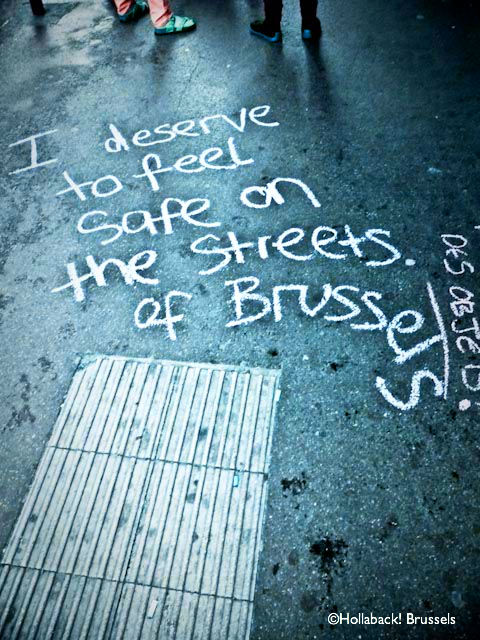
ChalkWalk N°2: @night, June 2012. Credit: Ingrid Vanderhoeven / Hollaback! Brussels

Street harassment is a fact of life for women and LGBQTIA people living in cities all over the world, however, since arriving in Brussels, I have experienced more street harassment than ever before and it was my frustration with this that inspired me to volunteer to contribute to this blog.

Hollaback! an international organisation of activists dedicated to combatting street harassment, works to empower those who are harassed, and Ingrid Vanderhoeven, one of the four founders of the Brussels branch, kindly agreed to discuss their work with me.

Ingrid explains that while Hollaback! is “an international movement with local volunteers and activists”, it is also a method “to respond to street harassment. It’s responding in a way that suits you and it started out as a blog, but now it’s turned into an international movement …Through the internet, but also through on the ground activism, through street actions and yeh, stuff like that.”

Ingrid was born in Brussels, grew up in Flanders and speaks Dutch, and it was only upon arriving back Brussels for university that she first encountered consistent street harassment.

“I had one particularly bad incident in which a group of men followed me and one grabbed my eh… vagina,” she said. After this and other incidents, Ingrid began to change her own behaviour in an attempt to avoid these unpleasant encounters. However, upon returning to Brussels after some time away, her perspective changed.

“(I realised) how much I’d given up my freedom and it was only just coming back into Brussels (that) I decided to do something about it.”

When Ingrid attended the Brussels ‘Slutwalk’ in 2011, she discovered a like-minded community both on and off-line. On the Slutwalk Facebook group “there was a German girl (Angelika Hild) that posted something about Hollaback, and we started a conversation and there with two other girls I didn’t know…one was American (Anna Whaley) and another one was also Belgian (Julie Richel), like me, but from the French speaking part…we just came together in a café and we just discussed if we could start one in Brussels, and that’s how Hollaback Brussels started.”

Inspired by their experience at the ‘Slutwalk’, which Ingrid described as an “empowering… demonstration against rape culture”, these four girls were ambitious in their desire to make Hollaback more than just an online platform.

“When we started we had these ideas of creating empowering experiences for women by sharing our stories of street harassment together, like our experiences, in a sort of sharing circle, and then going back to the spot where it happened. And we started doing and then writing in chalk on the pavement that this was the place where I was street harassed, but also leaving a message for their harasser,” she said.

“Chalk Walks” have become something of a Hollaback! Institution, and hearing these same methods and sentiments from Ingrid as I’d heard from Vanessa of the Dublin branch, I got a strong sense of the unity existing within this network of feminist activists and like Vanessa, Ingrid is confident in her identity as a feminist. “There seems to be a reluctance to identify with the word ‘femme’ in feminist, people want to be called humanists… But I do consider myself a feminist,” she stated.

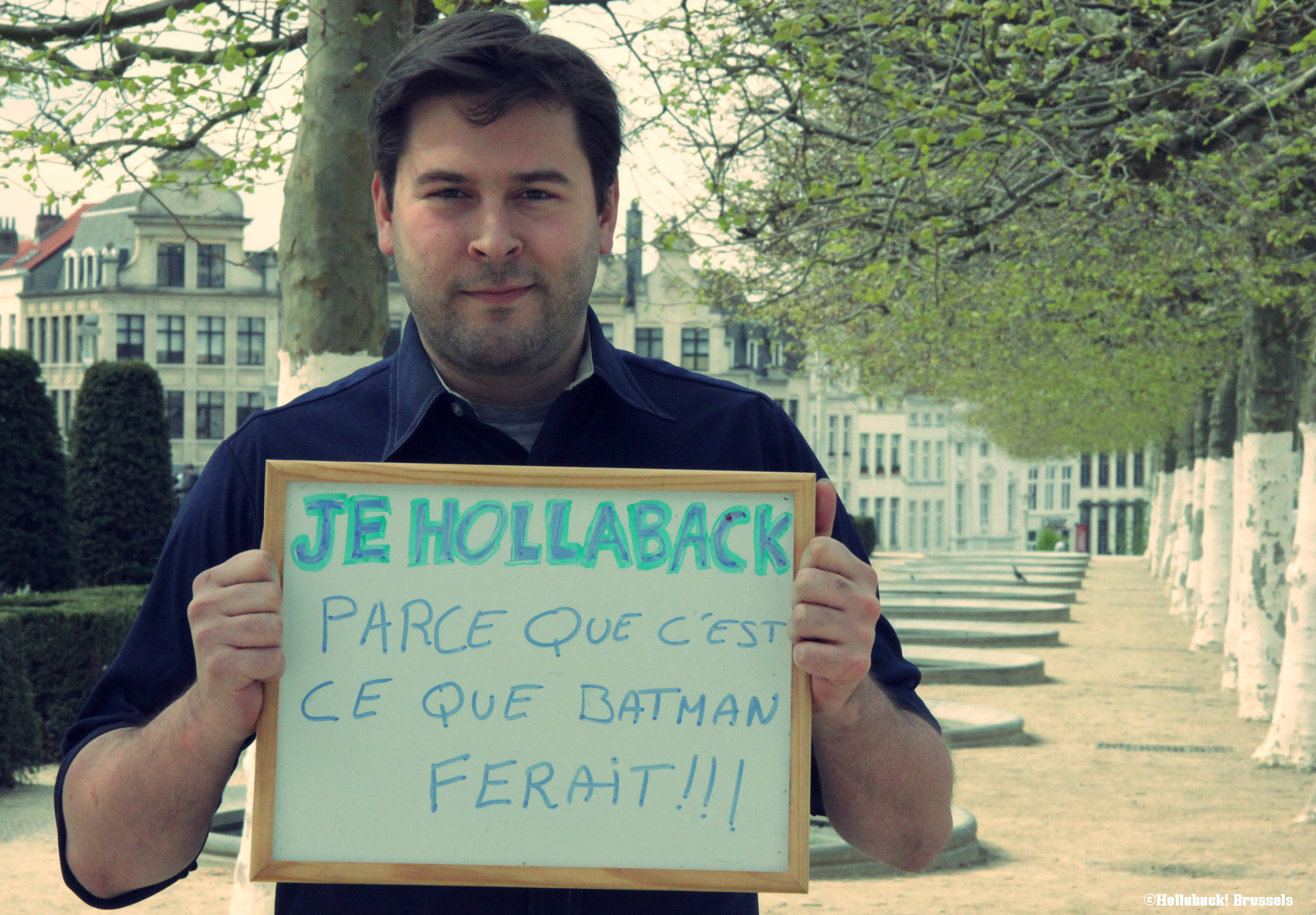
Quentin Daspremont : Hollaback! Brussels’ current Co-Director and French Coordinator. Credit: Ingride Vanderhoeven

Hollaback! Brussels is currently in a stage of renewal as Ingrid is the only remaining original member still living in Brussels. This renewal makes it clear that feminism is not just for femmes. “There’s now a guy that joined, which is nice. So it’s just me and Quentin at the moment and there’s three new people joining, so I think we’ll be going through a change, because when they join they will have new ideas, new plans.”

Ingrid and her team seem to have no shortage of new ideas, from branching out from collecting stories, to using this experience to conduct a research, to visiting schools. “We have a little creative project for school, that when we find the funds, that we would like to do” as well as “developing a box with cards that can be given to harassers…we wanted to provide people with a sort of reacting kit.” It is no exaggeration when Ingrid concludes, “We have a lot of ideas.”

Dearbhla graduated from BESS (Business and Sociology), in Trinity College Dublin, last year. She currently lives in Brussels, Belgium, where she has a think-tank internship working in the areas of gender, equality, and employment. Follow her on Twitter @imoshedinheels and her blogs.

TRANSLATION BY SENNA REES:

Straatintimidatie maak deel uit van het dagelijkse leven van vrouwen en LGBTQIA mensen over de hele wereld. Maar sinds mijn aankomst in Brussel heb ik meer straatintimidatie moeten ondergaan dan ooit, en dit vormde de bron van mijn inspiratie om een bijdrage aan deze blog te leveren.

Hollaback, een internationale organisatie toegewijd aan de bestrijding van straatintimidatie,  streeft ernaar de slachtoffers een stem te geven, en Ingrid Vanderhoeven, een van de vier oprichters van de Brusselse afdeling, was zo vriendelijk om hun werk toe te lichten.

Ingrid leg uit dat hoewel Hollaback! “een internationale beweging met plaatselijke vrijwilligers en activisten” is, het ook een manier is om ‘om te gaan en te reageren op straatintimidatie’. “Het is een reactie geven op je eigen manier die jou het beste past, en het begon allemaal als een blog, maar nu is het een internationale beweging geworden… Dankzij het internet, maar ook door plaatselijke acties en acties op straat, en jah, zulke dingen.” Ingrid groeide op in Brussel en leerde straatintimidatie te aanvaarden als een constante van het leven, totdat ze op een dag een zeer nare ervaring meemaakte. “Het was voornamelijk door een zeer ongewenst voorval, waarin een groep mannen me volgde en een ervan graaide naar mijn…euhm… vagina.” Na deze en andere ervaringen, begon Ingrid haar gedrag te veranderen in de hoop deze onaangename confrontaties te vermijden. Maar bij haar terugkeer in Brussel na een tijdje weg te zijn, begon haar perspectief te veranderen: “ik besefte hoeveel vrijheid ik had opgegeven en het was bij mijn terugkeer naar Brussel dat ik besloot om er iets aan te doen”.

Toen Ingrid de Brusselse versie van de “Slutwalk” in 2011 bijwoonde, ontdekte ze een gelijkgestemde gemeenschap zowel on-line als offline. “En zo deed ik mee in die Slutwalk en was er een Facebook event en een Facebook groep en daarin zat een Duits meisje (Angelike Hild) die iets poste over Hollaback, en we begonnen een discussie en er waren twee andere meisjes die ik niet kende… eentje was een Amerikaans (Anna Whaley) en de andere een Belgische (Julie Richel) zoals ik, maar uit het Franstalige gedeelte. We ontmoetten elkaar in een café en we besproken of we eentje in Brussel zouden kunnen oprichten, en zo begon Hollaback Brussels.”

Geinspireerd door haar ervaring tijden de “Slutwalk”, die Ingrid beschrijft als een krachtige demonstratie tegen de rape culture, waren deze vier dames ambitieus om Hollaback om te vormen tot meer dan een online platform. “Toen we begonnen hadden we enkele ideeën om daadkrachtige ervaringen te creëren voor vrouwen, door het delen van onze eigen verhalen van straatintimidatie, in een soort van kring, en dan terug te gaan naar de plaats van het voorval. En dat deden we en dan schreven we ook in krijt op de stoep ‘dit was de plek waar ik werd lastig gevallen op straat”, en lieten we ook een boodschap na voor de dader.’

‘Chalk Walks’ zijn zowat een Hollaback! gebruik geworden, en toen ik dezelfde methodes en opvattingen hoorde van Ingrid zoals die van Vanessa van de Dublin afdeling, kreeg ik een zeer sterke indruk van eendracht binnen dit netwerk van geëmancipeerde activisten. En net zoals Vanessa is Ingrid overtuigd van haar identiteit als feministe. “Er lijkt wel een afkeer te zijn om geïdentificeerd te worden met het woord ‘femme’ in feminist, mensen worden liever humanisten genoemd… Maar ik beschouw mezelf als feminist.’ Hollaback! Brussel doorgaat in feite een stadium van hernieuwing, want Ingrid is de laatste van de vier stichtende leden die nog in Brussel woont. Die hernieuwing maakt duidelijk dat feminisme niet enkel voor ‘femmes’ is: “er is dus nu een man die erbij is gekomen, wat leuk is. Het is dus nu enkel ik en Quentin op dit moment, en er zijn drie nieuwe leden, dus ik denk dat er verandering op til is, want met hun erbij zullen er ook nieuwe ideeën en nieuwe plannen ontstaan.” Hollaback! Brussel en hun associatie met holebi verenigingen zijn een goed voorbeeld van hoe feministische organisaties partneren met andere verenigingen om steun te bieden aan de slachtoffers van gendergerelateerd geweld.

Ingrid en haar team hebben geen tekort aan nieuwe ideeën, gaande van het inzamelen van verhalen, het gebruiken van die ervaringen om onderzoek te verrichten, tot het bezoeken van scholen. “We hebben een creatief projecteren voor op school dat we zouden willen gebruiken als we de fondsen ervoor verwerven” “We willen ook een doos met kaarten ontwikkelen om die te geven aan de daders… We willen mensen een soort van ‘reactie kit’ geven. Het is niet overdreven wanneer Ingrid besluit dat ze “heel veel ideeën” hebben.

Share

Filed Under: Activist Interviews, correspondents, street harassment

« Previous Page
Next Page »

Share Your Story

Share your street harassment story for the blog. Donate Now

From the Blog

  • #MeToo 2024 Study Released Today
  • Join International Anti-Street Harassment Week 2022
  • Giving Tuesday – Fund the Hotline
  • Thank You – International Anti-Street Harassment Week 2021
  • Share Your Story – Safecity and Catcalls Collaboration

Buy the Book

  • Contact
  • Events
  • Join Us
  • Donate
  • Facebook
  • Instagram
  • Pinterest
  • Tumblr
  • Twitter
  • YouTube

Copyright © 2026 Stop Street Harassment · Website Design by Sarah Marie Lacy