• About Us
    • What Is Street Harassment?
    • Why Stopping Street Harassment Matters
    • Meet the Team
      • Board of Directors
      • Past Board Members
    • In The Media
  • Our Work
    • National Street Harassment Hotline
    • International Anti-Street Harassment Week
    • Blog Correspondents
      • Past SSH Correspondents
    • Safe Public Spaces Mentoring Program
    • Publications
    • National Studies
    • Campaigns against Companies
    • Washington, D.C. Activism
  • Our Books
  • Donate
  • Store

Stop Street Harassment

Making Public Spaces Safe and Welcoming

  • Facebook
  • Instagram
  • Pinterest
  • Tumblr
  • Twitter
  • YouTube
  • Home
  • Blog
    • Harassment Stories
    • Blog Correspondents
    • Street Respect Stories
  • Help & Advice
    • National Street Harassment Hotline
    • Dealing With Harassers
      • Assertive Responses
      • Reporting Harassers
      • Bystander Responses
      • Creative Responses
    • What to Do Before or After Harassment
    • Street Harassment and the Law
  • Resources
    • Definitions
    • Statistics
    • Articles & Books
    • Anti-Harassment Groups & Campaigns
    • Male Allies
      • Educating Boys & Men
      • How to Talk to Women
      • Bystander Tips
    • Video Clips
    • Images & Flyers
  • Take Community Action
  • Contact

USA: A Public Showing of Solidarity

March 12, 2014 By Correspondent

Brittany Oliver, Baltimore, MD, USA, SSH Blog Correspondent

Hollaback! Bmore Event

Last Friday, Hollaback! Baltimore celebrated their third year of fighting street harassment by collaborating with Luminous Intervention to reach more people in Baltimore. They gathered to share stories and raise awareness at the corner of The Windup Space in Station North; it was a time to let harassers know about our strong presence.

Yesterday, I interviewed a 27-year-old female supporter of Hollaback! Baltimore who was at the event to get her thoughts on street harassment and what it means to her. Note: For this interview, she preferred to remain anonymous until.

Me: What does “street harassment” mean to you?

Supporter: I assume it means any non-wanted sexual advances or attention from strangers on the street.

Me:  Have you ever been street harassed or do you know someone who has?

Supporter: I’ve experienced street harassment quite a few times and I also have friends that have as well. It’s happened to me on campus and most of the time it happens in the city.

Me: What happened and how did it make you feel?

Supporter: One time I was walking to my car at night in Fells Point from a yoga class and two guys in a truck pulled over to ask if I needed a ride home. I rejected their offer, but the more I rejected it the more they continued to follow me down the street. After being silent and not saying anything, the driver called me a “bitch” and sped off down the street.

I’ve experienced street harassment so much in Baltimore that I’ve become numb to it. At first it used to get to me, but I’ve completely trained myself to not react because some men are just stupid and there’s not much I can do anyway.

Me: Did you report it or tell someone about it?

Supporter: No, I didn’t want to report it at all.

Me: Why not?

Supporter: I’m really shy and I didn’t see how reporting it would have made a difference at the time. I was alone and outnumbered; I thought the most important thing to do was to get away from them. Even if I had reported it, I don’t think anything would have been done about it.

Me: Were you familiar with Hollaback! Baltimore before or after that incident? Do you find it helpful?

Supporter: Before this incident, I was not familiar. Ending street harassment is not going to happen over night. I think the organization is doing a great job, but I think the key is education. The more people who know about street harassment the better. And by being involved with the movement, I’ve learned to not be silent about my experiences. I’ve also been able to let other people know that is serious and not to be taken lightly.

Me: Before learning about street harassment, did you have any assumptions about it?

Supporter: Before I used to think street harassment was a compliment, but I know differently now. I used to think the way a person dressed was to blame for being harassed on the streets. I have a lot of friends who think it’s flirting and should be expected when walking down the street. I never blamed myself for being street harassed, but I used to think that was just the way of the world.

Me: What change do you wish to see?

Supporter: I want the streets of Baltimore to be safer for women. I want to be able to walk down any street and not feel like it’s a dangerous space. I want more men to become aware of their behavior and develop ways to be more approachable. No one should ever have to be harassed when they are on the street, because it’s supposed to be a public space for everyone.

Me: Any words of advice for someone who experience street harassment?

Supporter: Don’t be afraid to share your story. Kissing noises, sexual comments or sexual touching is not a compliment. Try documenting your experiences by taking photos and recordings. I would also recommend taking experiences. I’ve also been able to let other people know that is serious and not to be taken lightly.

Me: What change do you wish to see?

Supporter: I want the streets of Baltimore to be safer for women. I want to be able to walk down any street and not feel like it’s a dangerous space. I want more men to become aware of their behavior and develop ways to be more approachable. No one should ever have to be harassed when they are on the street, because it’s supposed to be a public space for everyone.

Me: Any words of advice for someone who experience street harassment?

Supporter: Don’t be afraid to share your story. Kissing noises, sexual comments or sexual touching is not a compliment. Try documenting your experiences by taking photos and recordings. I would also recommend taking self-defense classes to learn how to physically protect yourself.

Brittany Oliver is a recent graduate of Towson University and works in the non-profit communications sector and supports local anti-street harassment advocacy through Hollaback! Baltimore. She blogs at brittuniverse.wordpress.com and publicly rants on Twitter, @btiara3.

Share

Filed Under: Activist Interviews, correspondents, street harassment

USA: Silent Allies

March 6, 2014 By Correspondent

Joe Samalin, New York City, NY, USA, SSH Blog Correspondent

(Content Notice for sexist language used in street harassment)

I have worked in their neighborhood for almost two years now and still don’t understand them. Their culture, dress, and mannerisms are so different from my own I’m uncomfortable around them. When I leave work to grab lunch they are often outside, too.

Young, white men in power suits, hair slicked back, smoking cigars. I don’t know if they are traders, bankers, or hedge fund managers, but the first time I noticed them it was like scene out of ‘Wall Street’ (which makes sense since I work around the corner from the New York Stock Exchange).

I first really noticed them about a year ago. A young woman left their side of the street and walked towards me as I crossed past her to go buy some peanut M&M’s. As she crossed the street their loud, sexually graphic comments about what they would like to do to her followed her as she walked on. The comments weren’t necessarily for the woman’s benefit – they were for each other and any other men around.

This is one truth of street harassment – it’s often done to “prove” our masculinity publicly – to ourselves and to other men (and women).

I don’t harass women in public or anywhere else. Most of the men that I know don’t either. As a straight, white, cisgender male I also have the privilege of not being harassed regularly in public. No brutality of a stop-and-frisk, no homophobic or transphobic bullying and violence. None of the pervasive and daily harassment of women and girls in public spaces touches me. In fact, I have never been harassed in public as far as I can remember. And I know writing that sentence is a slap in the face to the many women, folks of color, and LGBTQI friends and family I am blessed to have in my life.

However while I choose not to commit street harassment and am not harassed myself, I have been involved in street harassment a lot. Men harassing women in public seek me out in the moment to join in with them as they ogle, motion to, or catcall women. Or to defend them and have their back the (rare) times when they get called out by the women they target.

It’s (almost) unbelievable. Strangers (men) assume I will have their backs and support their violent (yes, violent) behavior towards women and girls in public. They expect me at least to turn a blind eye, and at best to stand right by their side.

Why?

Because most men ignore it. We excuse it, minimize it, and defend it. With a miniscule amount of effort we could acknowledge the reality of street harassment around us. From Wall Street to any street, street harassment is everywhere. And every one of us who chooses to ignore it or stays silent is complicit in it.

If I don’t speak up and out against street harassment my silence gives men who do it tacit approval to keep on keeping on. I give them my voice and allow them to speak for me.

I recently asked a few guy friends of mine if they knew any ‘hotspots’ of street harassment, areas where it happens not once, but was unrelenting.

Albery Abreu, a friend from the Bronx who has been addressing men’s violence against women since he was in high school told me about neighborhood parks. “Throughout the years I’ve witnessed an absurd amount of street harassment occurring when women/girls walk down the block where the basketball courts are. Boys stand behind the gate and whistle/holler/bark/shout/etc. at girls walking past. Some even leave the courts to run up to women to get their attention. I recall my sister telling me that she dreaded (and avoided as much as possible) walking on the same blocks as the baseball fields and basketball courts, even if there are only a few men and boys playing there.”

Dan Wald, a former board member of Students Active For Ending Rape is finishing up a degree in public health at an Ivy League school and told me “Our school has a break between the main campus and the medical campus, where there are some stores and people hang out. I remember last fall [a female friend] texting me that they wished I was with them” as they walked between campuses.

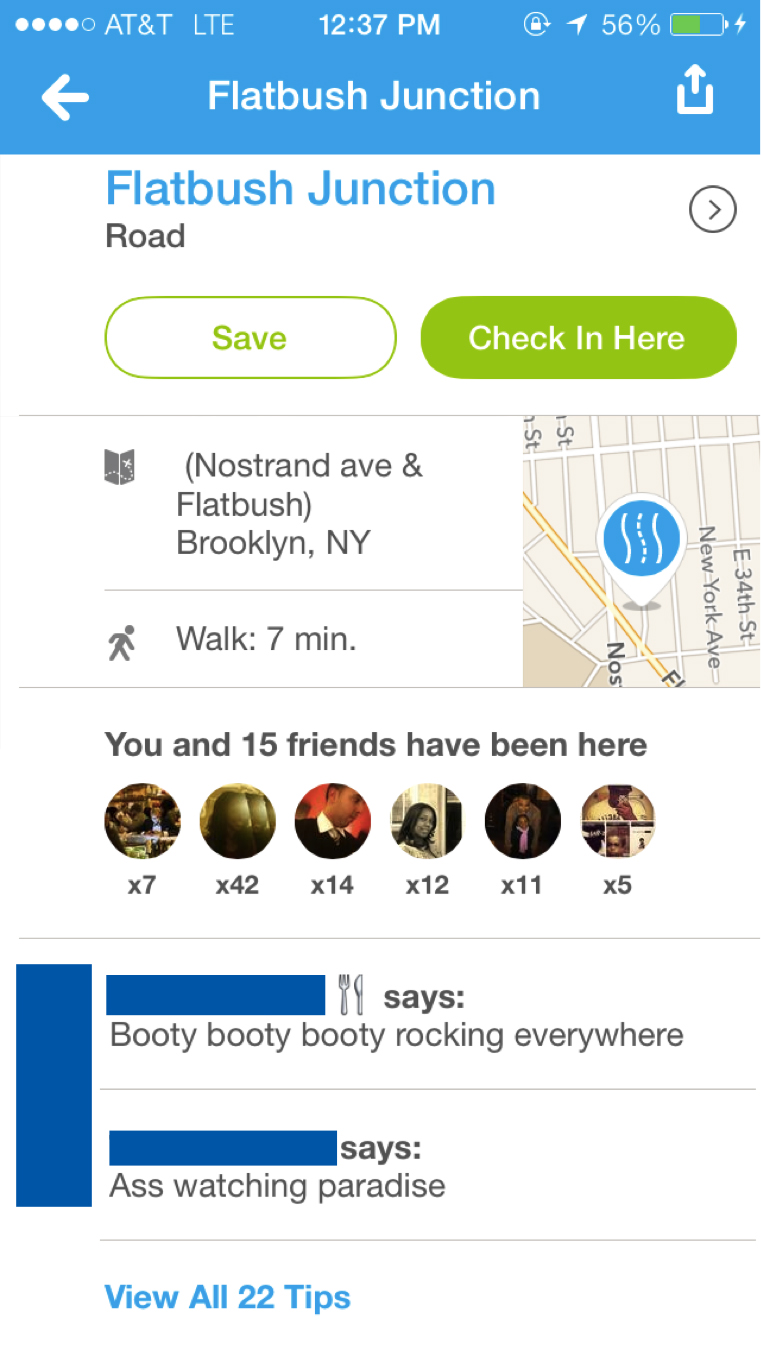
Gene A. Johnson, Jr. a professional mediator and facilitator of educational classes on masculinity blew my mind with this 4Square screen capture. Gene did not even need to leave his house to find street harassment.

These guys and others helped me better see how much energy we as men put into the lies of ‘it doesn’t happen (that often)’, ‘it doesn’t happen in this neighborhood’, ‘it’s not that serious’, etc.

Street harassment of women and girls happens everywhere men are present. Not because we all do it, but because we aren’t doing enough to challenge it.

Back to Wall Street. That day those men harassed the young woman, I turned around and hollered at them to cut it out. Their reaction? Straight confusion. They did not seem to understand the situation, couldn’t grasp the concept that I – one of them – was calling them out. They assumed I was an ally. And when we as men stay silent in the face of street harassment, that silence sends the message that we are allies of those who commit it.

Copyright: Joseph Samalin. All rights reserved. Reprints or reposts with the permission of the author and Stop Street Harassment.

Joe Samalin has been addressing gender-based violence for over 15 years, including as the Training and Technical Assistance Coordinator for Men Can Stop Rape. He is currently the Outreach and Training Manager for the Disaster Distress Helpline and is examining among other things gender-based violence in the aftermath of disasters. Follow him on Twitter, @joesamalin.

Share

Filed Under: correspondents, male perspective, Stories, street harassment

USA: Reflections on a Women Bike PHL Street Harassment Focus Group

March 1, 2014 By Correspondent

Katie Monroe, Philadelphia, PA, USA, SSH Blog Correspondent

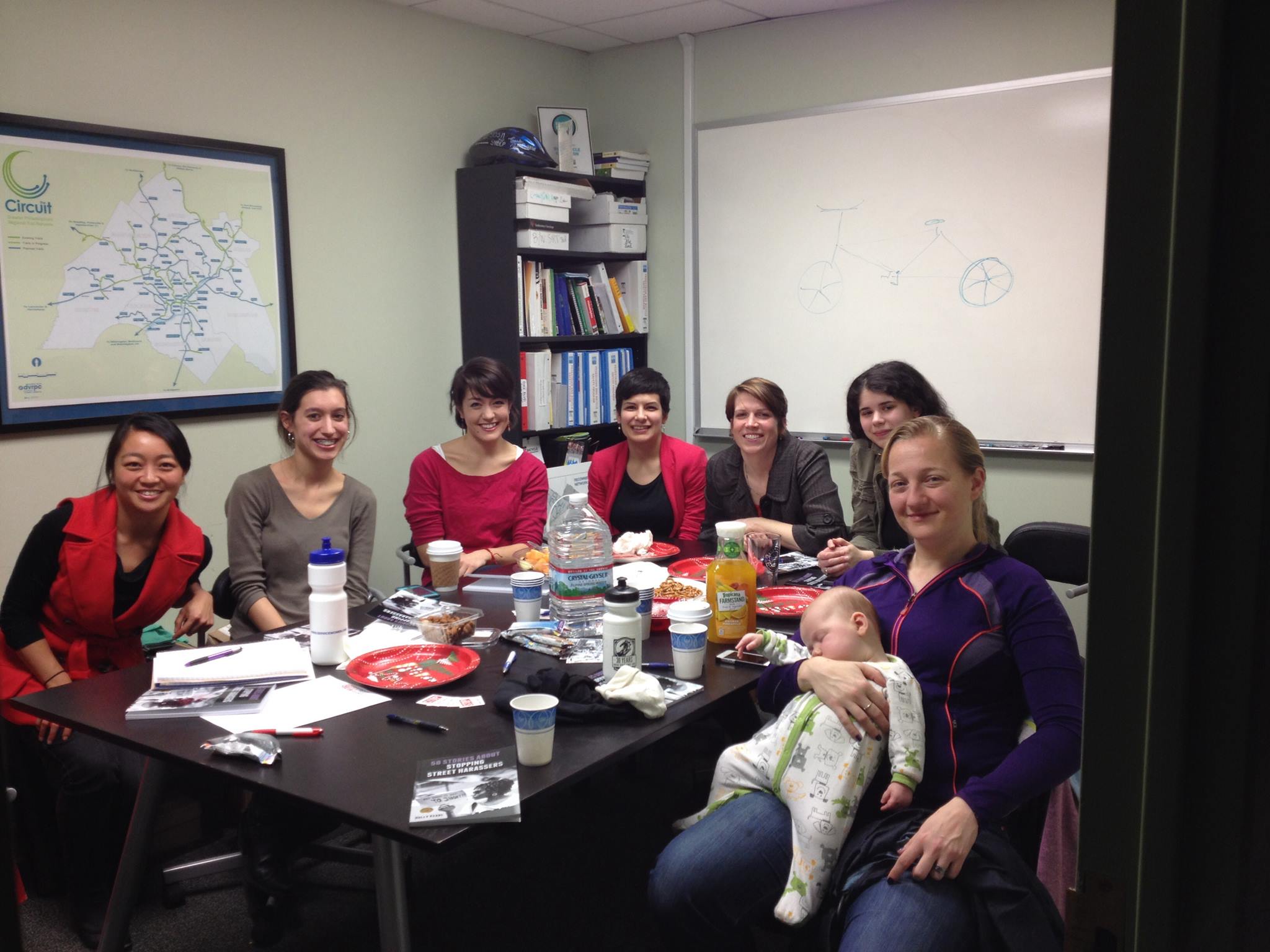
Philly focus group. 2.25.14

This past week I had the opportunity to help orchestrate a focus group for the national study on street harassment currently being conducted by Stop Street Harassment. When Holly asked if I thought Philly bicyclists might make a good “group” for her study, I wasn’t completely sure if I could pull enough interested folks together on short notice. But I sent out a quick email to a small group of women bicyclists I know through Women Bike PHL (the women’s bicycling program I run at the BCGP) – and got an overwhelming response. At 6 p.m. this past Tuesday, almost everyone I emailed showed up to the Bicycle Coalition of Greater Philadelphia office to take part in the focus group – the first of its kind, as far as I am aware. The hour that followed was full of insights that are still bouncing around on my brain, but here are three reflections I felt most compelled to share:

1) While I took care to distinguish between gender-based and transportation-based harassment in my last post, the focus group reintroduced some gray areas to my thinking. Car-on-bike harassment can and does certainly take place with every combination of genders of driver and cyclist, and there can be situations of car-on-bike harassment that simply involve an assertion of power over lane space and nothing more. However, I got the sense in the focus group that for women, harassment because they’re riding a bike can often become increasingly gendered as a situation escalates – for instance, getting called a cunt or bitch by an aggressive driver was a common theme. In addition, it was pointed out that while there may be important distinctions between the two types of harassment, the “gut feeling” women get from being sexually street harassed is a very similar “gut feeling” to the one they get from an aggressive driver. Good food for thought.

2) A great point resurfaced in the focus group that I remember a few women mentioning in the Women Bike PHL Facebook page last fall. That is, the fact that harassment is a reason that people (particularly women) might choose to run a red light rather than waiting for the green at an intersection, even if they generally abide by traffic laws. When we talk in the bike community about following the rules, I don’t think we often acknowledge the different ways that folks of different gender and sexual presentations experience being still versus in motion on our streets and sidewalks. A woman standing with her bicycle waiting for a green light is a sitting duck when it comes to harassment – and when the choice is between standing and taking it or looking both ways and pedaling through the red, it’s hardly surprising that some women would choose to pedal on! I think this aspect of the experience of biking isn’t always understood widely within the bike and bike advocacy community, and it seems important to me.

3) In that vein, the whole conversation just made me realize even more deeply how much street harassment and transportation choices are fundamentally linked. I saw a lot of light bulb moments happen during the focus group – for me and for the rest of the attendees. It was fascinating to hear the stories of how bicyclists – who have made a very particular and still relatively rare transportation choice, to ride a bicycle – perceive their experiences of street harassment. A few of the varied perspectives: biking as a means to escape the harassment that walking entails, biking creating safer ways to interact with strangers because of increased speed, or biking entailing sacrificing the opportunity to tell off street harassers in a satisfying manner. And I’m sure that’s only the beginning!

I’m excited to read the report and hear what resonated with Holly about our discussions on Tuesday, and to read the report as a whole with questions of transportation in mind. I’m so glad I could contribute to this study in my own way and so grateful to the group who came out to discuss this topic – thank you!

Katie Monroe founded the Women Bike PHL campaign at the Bicycle Coalition of Greater Philadelphia and she works at the Philly nonprofit Gearing Up, which gives some of Philadelphia’s most marginalized women – those in transition from incarceration, addiction, and/or abuse – the opportunity to ride bicycles for exercise, transportation, and personal growth. Follow her on Twitter, @cmon_roe.

Share

Filed Under: correspondents, SSH programs, Stories, street harassment

Nepal: “Public transportation, a hesitation to women”

February 26, 2014 By Correspondent

Kriti Khatri, Nepal, SSH Blog Correspondent

Street safety and its relation to women’s independence is connected, from the perspective of women’s mobility. However, rarely has there been an effort to create Safe Streets precisely from the perspective of concerns about women’s mobility. Our street is symbolic of free spirit and freedom itself, but for women the street remains a place to get victimized from various kinds of harassment activities and women have to go through traumatizing experiences of sexual and emotional harassment. A woman being more vulnerable towards various kinds of harassing activities their safety during travel is important.

While we raise voices against street harassment, one important aspect to concentrate on is harassment activities on public transportation. Reports showcase that harassment on public transportation on buses, trains, etc is more frequent for women than on the streets.

Horrendous acts of physically and mentally harassing women via gesture, touch, grabbing, verbal abuses or even constant gazes make taking public transportation a big hesitation for women. In thickly stuffed buses or other means of transportation like trains and metros, women get easily victimized from physical touching, grabbing etc. And since the crowd is a good excuse, it rarely get noticed or exposed. Sexual harassment activities make women feel emotionally left out and drained. As a consequence, women can develop negative attitudes towards their relationships with their male partners and family ties as well. Psychologists says harassment activities not only make women feel raged with the male genre, but also go through mental irritation concerning their body image and social behavior which in the long run can cause depression and other emotional issues.

A report conducted by Astitwa foundation shows that about 90 % of women has been suffered from street  harassment activities among which harassment in public vehicles is the most encountered in Kathmandu. Such harassment activities have been found occurring on school buses, by bus staff, public buses and other travel means. As per the report, most women have been found to experience uncomfortable touching and sexually explicit behavior. While women share their stories of harassment activities, in terms of response, most of them seemed silent. Respondents to the topic of harassment in public vehicles were hesitant about reacting to such activities. Many women seem to remain quiet about this issue by either adjusting in the crowd or dropping in nearby bus stop as their immediate self protection act.

“As for talking we can say I will take immediate action but when such incident happens, we go through emotional hold back, I felt raged but helpless and disgusted when the fellow passenger make uncomfortable gestured towards me, here I can say I wanted to slap him but at that time all I wanted was to get out of the bus.” — a 25 year old school teacher from Kathmandu.

Sexual harassment in public vehicles has been an issue raised by many social organizations in international level. With ever raising incident of harassment activities which has even lead to cases like gang rape and murder of women in public vehicles, this issue has been a concerned area in relation to women safe mobility and independence.

Concerned with the growing number of harassment activities, Nepal Police has initiated strict monitoring of the public transportation system. As per the Nepal police, travel safety of citizen and especially women is on their top priority after getting multiple reports filed against sexual harassment in public bus. According to the information of the Nepal Police, cases regarding public bus harassment are registered more than any other kinds of street harassment cases. As of now, women police are allocated in various bus stations to check inside bus which at least give a chance for victim to complain or make people aware of their act. In future Nepal police aims to monitor bus activities via closed caption cameras. There has also been initiation from nongovernmental sectors to make legal reformation against harassment activities collectively under violence against women in which there should essentially be strict provisions regarding street harassment.

Apart from the legal provisions, effort should also be from bus-driver, conductors and fellow passengers to discourage such activities in the vehicles.  Their effort can demoralize the doer, at the same time make women feel safe and comfortable.

“I was standing on the bus and a guy happen to stand right beside me with his hand around my shoulder from backside, the bus driver saw that and ask the conductor to make him step out of the bus saying that such cheap activities won’t be tolerated in his vehicle, It really felt so nice to find  bus drivers with such attitude towards activities going on his vehicles.” — 23 old employee who make 14 km of bus travel every day for her job in Kathmandu

The act of harassment and violence against women is more of a moral matter than legal. Unless individual understands that harassment activities against women are immoral, eliminating such acts won’t be easy with just legal threats. Women free conduct in the street or elsewhere is only possible when there is assurance of Safe travel and such safety can only be assured in morally governed society and justice run state system.

Kriti Khatri is student of MSc chemistry. She is engaged in different social organization in Nepal and currently she is working on anti-street harassment issues with the Astitwa Foundation. Find more of her writing on her blog.

Share

Filed Under: correspondents, Stories, street harassment

USA: Winter Street Harassment

February 20, 2014 By Contributor

By: Delia Harrington, Massachusetts, USA, Former SSH Correspondent

Delia Harrington

“What were you wearing?”

It’s one of the most common questions people ask me after I tell a story of experiencing street harassment.  Some people seem to genuinely believe that there is a combination of precautions that will protect us from street harassment.  Go out at the correct time of day, in the right part of town, wearing certain clothes, taking specific modes of transportation, and accompanied by the precise number and gender of companions, and all will be well.  They see my stories as parable, and want to know how they can avoid a similar fate.  If we focus on the clothing of the person who was harassed, it makes the solution seem simple: don’t wear that skirt/tight clothes/short hemlines/pants/leggings as pants/fill in the blank, and you will be safe.

Unfortunately, this common line of thought (even amongst otherwise-progressive, well-meaning people) excuses the bad behavior of the harasser,  unfairly labels men as incapable of resisting the allure of certain articles of clothing, puts the responsibility to stop street harassment on the victim, and ignores the reality of the situation.  It shouldn’t matter what any of us wear, we still have the right to move through public spaces safely and in peace.  We shouldn’t spend time on the regressive excuse that “boys will be boys.”  Men and boys are capable of being kind and respectful individuals, but this logic assumes that’s not true when it expects so little of them.  Changing what we wear is an individual solution for a collective problem.  It may keep you from being hollered at, but will it help anyone else?  And how safe do you really feel when you see someone else harassed, even if you are left alone?  Finally, as many of you who have been harassed in a  variety of outfits know, street harassment happens no matter what we wear, so why should we attempt to conform to an ever-moving standard of what clothing is the kind that will keep us safe.

In Boston it has been extremely cold this winter, and the Polar Vortex has brought snow not just to us, but to Washington DC, Texas, Alabama, and many other areas that do not generally experience such a harsh winter.  With this bitter cold, many of us have taken to wearing big puffy hats, long coats that resemble sleeping bags with arms, fluffy scarves, and other cold weather gear.  It’s not uncommon to see people walking around with not much skin showing other than a little red nose.  How then do we explain street harassment in cold weather?  Surely there is nothing suggestive about my utilitarian boots and shapeless coat.

If street harassment were really a product of what we wear and how sexually appealing our clothing is, winter in New England would be a harassment-free zone.  No one would ever bother me when I’m sick and wearing ratty sweats, and I wouldn’t hear so many stories of people wearing work-appropriate outfits or jeans and t-shirts when they were harassed.  But the posts over at Hollaback! Boston (as well as NYC and Chicago) show that even cold winters, when people are bundled from head to toe, are not immune to street harassment.  Women wearing abayas, niqabs, hijabs and burqas are victims of street harassment and even assault.  How much looser could their clothing have been?  How much more covered could they be?  The only plausible answer is that they could have simply never left the house.  If you listen to people who attempt to police women’s clothing in the guise of concern for their safety and well-being, you will soon realize that no article of clothing will ever be modest enough, because the real goal of street harassment is to exercise power.  Power to make women and LGBTQ folks conform to the desires of the harasser, feel unsafe, and feel like disappearing from public spaces is the only safe option.

Unfortunately, it is simply not that easy to escape street harassment.  We cannot simply check off the right boxes and proceed to walk around without bother.  It is important that we continue to speak up when we hear this faulty logic, and remind our communities that people are harassed in all kinds of outfits, at all times of day or night, by all kinds of people, all over the world.

The next time someone asks you what you were wearing when you were harassed, ask them why that matters.  Remind them that people are subject to street harassment no matter what they wear, and that harassers are the only people responsible for their behavior.

Delia Harrington is a recent graduate of Northeastern University and calls Boston home. In recent years, she has found herself studying, working, and volunteering in Egypt, Cuba, France, Benin, the Dominican Republic, Turkey, Germany, and Greece.  You can read more of her writing on her blog, or follow her on Facebook and Twitter, @deliamary.

Share

Filed Under: correspondents, Stories, street harassment

« Previous Page
Next Page »

Share Your Story

Share your street harassment story for the blog. Donate Now

From the Blog

  • #MeToo 2024 Study Released Today
  • Join International Anti-Street Harassment Week 2022
  • Giving Tuesday – Fund the Hotline
  • Thank You – International Anti-Street Harassment Week 2021
  • Share Your Story – Safecity and Catcalls Collaboration

Buy the Book

  • Contact
  • Events
  • Join Us
  • Donate
  • Facebook
  • Instagram
  • Pinterest
  • Tumblr
  • Twitter
  • YouTube

Copyright © 2026 Stop Street Harassment · Website Design by Sarah Marie Lacy