• About Us
    • What Is Street Harassment?
    • Why Stopping Street Harassment Matters
    • Meet the Team
      • Board of Directors
      • Past Board Members
    • In The Media
  • Our Work
    • National Street Harassment Hotline
    • International Anti-Street Harassment Week
    • Blog Correspondents
      • Past SSH Correspondents
    • Safe Public Spaces Mentoring Program
    • Publications
    • National Studies
    • Campaigns against Companies
    • Washington, D.C. Activism
  • Our Books
  • Donate
  • Store

Stop Street Harassment

Making Public Spaces Safe and Welcoming

  • Facebook
  • Instagram
  • Pinterest
  • Tumblr
  • Twitter
  • YouTube
  • Home
  • Blog
    • Harassment Stories
    • Blog Correspondents
    • Street Respect Stories
  • Help & Advice
    • National Street Harassment Hotline
    • Dealing With Harassers
      • Assertive Responses
      • Reporting Harassers
      • Bystander Responses
      • Creative Responses
    • What to Do Before or After Harassment
    • Street Harassment and the Law
  • Resources
    • Definitions
    • Statistics
    • Articles & Books
    • Anti-Harassment Groups & Campaigns
    • Male Allies
      • Educating Boys & Men
      • How to Talk to Women
      • Bystander Tips
    • Video Clips
    • Images & Flyers
  • Take Community Action
  • Contact

USA: Strong Women and Harassment

December 16, 2013 By Correspondent

By Sara Schwartzkopf, Colorado, USA, SSH Correspondent

As cold weather draws ever more present, I’m relieved. I’m relieved for the reprieve from shaving my legs every day, the ability to wear large comfy sweaters, cool-looking boots, and the drop in street harassment tales, both personal and otherwise. Not that they stop by any means. Maybe it’s just as simple as fewer people taking their time when walking the streets. Less public interaction means less opportunity for street harassment.

Instead we spend more time inside. More time is spent reading, watching movies, and getting caught up on television series. More time spent absorbing pop culture and common narratives about women.  I bet some of you can see where I’m going with this. But I have neither the time or space to go through all the things that can be upsetting about media depictions of women. From catty and mindless reality tv shows to romantic comedies and “chick lit,” there’s a pretty common theme that women are horrible, or spend all their time worrying about guys. Or that they’re horrible because of a guy. It seems the antithesis to this is to seek out female lead characters, and make women be as perfect as a heroine can be.

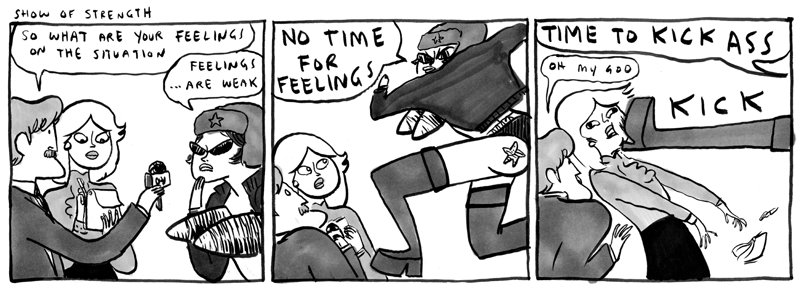
This doesn’t work for me. There’s more than one reason for why we need diverse and well-rounded characters. It seems to me that women leads in media, especially women in sci fi/fantasy and action flicks, have a requirement to be strong (let alone a good many of them aren’t strong characters so much as just strong). They become a Mary Sue of a sort, where they react to challenging situations as we wish women could. So when we find ourselves faced with a similar situation or challenge, we often expect ourselves to be just as flawless. Media creates unrealistic depictions, and then we hold ourselves to these unrealistic expectations.

The problem is we are flawed. Everyone is. Yet when we have an issue with say, harassment, it’s natural to judge ourselves on what we’ve had modeled for us. So what’s the natural outcome when every time we see a woman in a male-dominated environment who responds to harassment by physically or verbally beating up her antagonist? I think it reinforces that we should be able to do this for ourselves. It’s incredibly satisfying to watch, but when it’s the only narrative out there we act as though it’s the woman’s job to overpower their aggressors.  It ignores consequences, forgets the possibility of continued contact, and it plays into this idea that men only need to respect women who are physically stronger than them.

It’s one solution to the Damsel in Distress trope, but it’s also one that puts responsibility squarely on the victims. If the heroine of the story can’t stop what’s going on then it becomes her fault, rather than the aggressor’s.  It doesn’t really challenge rape culture, it just shifts how women are supposed to deal with it.

Maybe that’s why we judge passive reaction more harshlythan we should. We think that if we were confronted with harassment of any sort we would stand up for ourselves and give a verbal equivalent of a beat down. Instead, a lot of us feel threatened, ignore comments, and try to leave as quickly as possible. That doesn’t keep up from blaming victims though. We forget that we need to place the blame solely on the harasser. After all it was their decision to shout things, to grab, to make obscene gestures, or do sexually explicit things that were never asked for in the first place.
By Kate Beaton

Sara is a recent graduate of the University of Denver where she majored in Sociology, International Studies, and minored in Japanese. She has previously written on issues relevant to the Native American community at Le Prestige Du Monde, pulling heavily on her experiences as a mixed-race Kiowa and Chickasaw.

Share

Filed Under: correspondents, street harassment

South Africa: The Role of Men during #16Days

November 29, 2013 By Correspondent

By: Gcobani Qambela, South Africa, SSH Correspondent

Trigger Warning

I was shocked to see a tweet by controversial South African blogger, Sentletse Diakanyo on the first day of 16 Days of Activism Against Gender Based Violence in South Africa. In the tweet, Diakanyo says that: “We must not ignore the slaughter of unborn babies during this 16 Days of Activism.” He went on to have more tirades about how “life begins at conception” and that even if women conceived children under “violent circumstances” it’s still unacceptable for women to “slaughter” ‘innocent life’. His main premise being that during 16 Days women should not look at gender-based violence but also at murder women commit to “unborn babies”. He further likens abortion to rape and says both should be “equally condemned” as they are criminal.

What triggered me as I read these tweets was not the inaccuracy of the statements made by Diakanyo, but the extent to which he successfully managed to derail the conversation from 16 Days to a conversation where many people had to move from sharing about gender-based violence to correcting this misinformation he was sharing. Yes, scientific evidence indicates that life does begin at conception, but personhood/humanness only begins after birth so women are not slaughtering babies when they terminate pregnancy. Yet, Diakanyo concludes “We will condemn criminal acts [of abortion] regardless of what feminists think.” This is despite the fact that abortion is legal in South Africa.

Many people have noted that Diakanyo gets some self-pleasure for triggering and making others angry, especially if they respond to his ignorance. This appears to make him happy and satisfied with himself. This is what has made writing this post difficult as I wondered: how do I respond to this bigotry without giving so much meaning to patriarchal garbage spewed by Diakanyo? I further thought: what is my role as a man living in a violently patriarchal society like South Africa? And lastly I wondered: what is my role during this 16 Days?

In the chapter “Is Paris Burning” bell hooks notes that many heterosexual identifying black men living in white supremacist cultures like the United States (and South Africa I would argue) always behave as if the primary “evil” of racism is the “refusal of the dominant culture to allow them full access to patriarchal power” and hence they continue to exhibit “a phallic misogynist masculinity [that is] rooted in contempt for the female.” This is the way I choose to read Diakanyo. In many of his writings, Diakanyo appears to challenges white supremacy and white capitalistic forces in South Africa and globally, and yet instances like these show us that he is not driven by an attachment to justice and overcoming global systems of oppression but a concern with having what white patriarchal men have in South Africa. This is not only in reference to economic power and material ownership, but also the full patriarchal dividend that will allow him full ownership and control of the female body.

Diakanyo’s remarks in South Africa are a part of larger societal project of patriarchal men who want to demonstrate their phallic power by waging war on the bodies of women and all that is “feminine”, which as hooks notes includes also gay men (and the larger LGBTIQA community). It is not a coincidence that Diakanyo chose the 16 Days to express his misinformed opinion on abortion, rape and the bodies of women. It is his way of derailing a conversation from discussing patriarchal male violence into one that not only blames women for exercising their constitutionally given right to bodily integrity and reproductive choice but one that places women’s bodies at the centre of the patriarchal male gaze.

So what should be the role of men during 16 Days? There are many well documented problems with the concept of 16 Days because many argue that it should be throughout the year and not just 16 days and I agree. However, this does not mean that I do not recognise its importance. I live in a country a country where a woman has more chances of being raped than learning to read, so if women get 16 Days in a year where they can tell their stories and activism without threat of violence our responsibility as men should be to listen. When we talk it should be to help elevate the voices and agency of women, and not derailing like Diakanyo.

I really think Diakanyo’s tweets are worth reporting to the South African human rights commission. In South Africa while freedom of expression is also a constitutional right too, this right is limited in that it should not be exercised in a manner that unjustifiably limits the rights of others. Diakanyo is limiting the rights of women by intentionally spreading incomplete information to limit women’s right to bodily integrity during a time when women are meant to enjoy freedom from patriarchal male body policing. It’s just unacceptable!

Gcobani is completing his Masters in Medical Anthropology through Rhodes University, Grahamstown, South Africa. His research centres around issues of risk, responsibility and vulnerability amongst Xhosa men (and women) in a rural town in South Africa living in the context of HIV/AIDS. Follow him on Twitter, @GcobaniQambela.

Share

Filed Under: correspondents, male perspective

USA: “What is this Crap?” Media and Messaging

November 1, 2013 By Correspondent

Equinox

By Sara Schwartzkopf, Colorado, USA, SSH Correspondent

I’ve been thinking a lot lately about the relationship between women and the media. There are the unavoidable Halloween ads and subsequent discussions on costumes for girls and women. Then there’s the fact that I recently re-watched Miss Representation (if you haven’t yet, it’s up on Netflix now and has some great interviews and points). Oh, and then I got online today and came across this headline about Equinox replacing photographer Terry Richardson for their campaigns. If you’re not familiar with Equinox, guess what they’re promoting with the following ad.

Did you guess fitness? No? Well that’s unfortunate, because Equinox is actually a high-end gym.

Now ad campaigns like this are par for the course – tall, thin, scantily clad, posing for men, often missing their faces. It’s so much that we often just accept it as part of the landscape of our existence. Maybe if we never absorbed much media, or weren’t affected by it, this wouldn’t be such a huge issue. Thing is we do. The average teen is exposed to about 10 hours and 45 minutes of media per day. That’s TV, music, movies, magazines, and Internet. Media is culture transmission, teaching us how to act and informing our viewpoints. If it had no effect, then there would be no point to either advertisements or a Federal Communications Commission.

I used the example of the Equinox ads because they strike me as a perfect example of not only promoting sex over a product, but also of established gender roles. The women in the ads are performing (quite literally) for the pleasure of men. Especially in the first ad, the man is the more powerful one.

It’s worth noting that media promotes these roles. Men’s masculinity revolves around having women. Not loving them or connecting with them, but obtaining them and getting them to do what they want. Women in films are frequently seen as having their lives revolve around men. Despite how ridiculously simple the Bechdel Test is, it’s still estimated that 75% of films fail it. Meanwhile men are rarely shown as depicting emotions that deviate from anger, competition or humor.  Even in romantic comedies, there’s still a trope of women liking men who come off as jerks. So while women’s lives are seen as being about satisfying men, men aren’t supposed to cater to women’s needs.

I find it hard to believe that these overriding cultural messages don’t trickle down to the street level. Men are taught that powerful men get women. Women are taught to cater to men, and that men care about their appearances. It’s not such a surprise then that men think of catcalling as a method to get dates and assert themselves. It’s also not a surprise that women find such behavior to be a compliment, or something that they should just let slide.

There’re a lot of cultural narratives that try to simplify men and women down to basic creatures. The thing is, we’re incredibly complex. The beauty of culture is that it can change. It changes when we speak up, when we act in way that we want to see and when we hold others accountable to higher standards. Expect more out of your media, and expect more out of the people in your life.

Sara is a recent graduate of the University of Denver where she majored in Sociology, International Studies, and minored in Japanese. She has previously written on issues relevant to the Native American community at Le Prestige Du Monde, pulling heavily on her experiences as a mixed-race Kiowa and Chickasaw.

Share

Filed Under: correspondents, street harassment

USA: Halloween Costume Review

October 31, 2013 By Correspondent

By Angela Della Porta, SSH Correspondent

Deciding on a Halloween costume is a pretty arduous task – you want to be original, and of course you want people to get it. Well, that task is especially hard for women! We have to balance having a great costume with not “asking for it.” I mean, I want to get trick-or-treat fun, not harassment or assault! So, I went to iParty to find the perfect costume, but I had a bit of a hard time finding an outfit. I thought I’d share a couple of my final contenders.

Going as Someone Else’s Culture


It’s a classic, right? Go as a Native American. The year before, I went as an African American and next year I’ll go as Latino. That makes complete sense!

If Native American didn’t work, I could always try wearing this flowy nightie that no one in India wears as clothing. Ooh, and you’ve got to love the double entendre of “Taj”ing one’s “Hall,” whatever that means.

The Criminal Justice System

I’m pretty sure this is what women have to wear in prison. I mean, it fits – since women in prison are pretty much sentenced to sexual assault from guards and medical officials the moment they enter the prison industrial complex, this outfit will be perfect.


I’m sure an outfit like that makes it easy to run after criminals and protect society. I wonder, though, where does the costume designer think she should put her gun?

Childhood Fun

Now, I remember Spongebob as a harmless cartoon, but it takes a lot of work to sexualize a woman by making her a sponge. You’ll see in the bottom right-hand corner that Nickelodeon, a children’s TV station, is the company selling this. Cute.

This is an ACTUAL children’s costume. It’s a children’s size 4/6, but it’s a cropped-top spandex devil outfit called “Red Hot” where the model in the photo is wearing platform stilettos  You can see in the photo that it says, “Children’s Size Costume.” They tell you it’s for children so many times because you can’t believe that six year olds, the average wearer of a children’s size 4/6, want to be sexy devil for Halloween. But they do, or it wouldn’t be there.

—

Now, don’t get me wrong. I don’t do this review because I think there is something inherently wrong with sexy women’s costumes (well, I’m not a fan of the cultural appropriation in the first two, but that’s another post). I’m just not sure what women are supposed to do. If they buy any of these costumes, the only ones on the shelves for adult women, then they are left to be scrutinized and judged for “asking for harassment or assault.” If something were to happen when in this costume, they would be blamed.

Women, wear whatever you want on Halloween, and on every other day of the year, for that matter. But it’s a catch 22 – want to wear something sexy? Get harassed. Want to wear something not-sexy? If you can find something, you still face judgment for not ascribing to someone else’s idea of femininity. So what do we do?

You can let people know their comments and judgments aren’t okay. You can call out rape culture and sexism in your own life.

Angela Della Porta is a recent graduate of Clark University in Worcester, MA. She will join with Teach for America in Detroit in the fall. Until then, she’s spending her time in rural Maine. Follow her on Twitter: @angelassoapbox

Share

Filed Under: correspondents, street harassment

USA: Placing the Shame Back on the Harasser

October 31, 2013 By Correspondent

By Lauren McEwen, Washington, D.C., USA, SSH Correspondent

In my months as a Stop Street Harassment correspondent, I’ve focused heavily on different ways I respond street harassment (harassment from elderly men and intra-racial street harassment, et cetera), but today, in my final, official post as a blog correspondent, I want to focus on a time when I failed to shout back loud enough. A time that I continue to look back on, disappointed at my own inability to thoroughly stand up for myself.

First, let me begin by saying that there is no “correct” way to respond to street harassment. I think we should always try to respond in a manner that 1) keeps us safe and 2) keeps our dignity and self-esteem intact, but there will always be those moments in which we, personally, feel that we could have done a better job. Those moments that we mull over long afterward, cursing ourselves for not saying the right thing, or failing to report the harassment to the proper authorities. This is probably one of the most damaging effects of street harassment – the guilt, shame and helplessness it can make us feel.

For example, once a teenage boy threw a full bottle of water at my back because I refused to stop and give him my phone number. It did not matter that I am an adult who wouldn’t have been interested even if he were of age, or that I was on the phone with my mother when he decided to loudly describe what he thought of my breasts in my top. I’d rejected him in front of his friends, so he threw the bottle at me. I doubled over from the force of the hit, and he and his friends ran from the corner, laughing.

I almost called the police, but stopped short because I hadn’t seen the boy’s face, and I knew that if the police helped at all, they would most likely round up every black boy within a five-block radius and frisk them. Of course, he got away with assault, and my back ached for days, but I wasn’t complicit in having innocent boys treated like criminals. I could live with that…after a while.

But I still cannot fully forgive myself for how I responded to being groped while leaving the train station in June. I was headed to the grocery store to pick up a few things for my then-boyfriend’s birthday. It was boiling out, so I was wearing a thin, cotton dress. I’m not describing what I was wearing because of internalized acceptance of rape culture, or anything like that. It’s important to understand how little actual clothing I was wearing to understand how violated I felt.

As I’m scrolling through the shopping list on my phone, I suddenly feel something press against my backside. It takes me about seven, sickening seconds before I fully realize what it is: an erect penis. I whip around, and come to face-to-face with a stranger: a middle-aged man wearing a white button down and khakis and carrying a leather briefcase.

For a millisecond, I consider that he may have been standing so close to me because the escalator was crowded, but that hope quickly crumbles when I realize that not only is the escalator nowhere near full, but that he had to lean forward in order to press against my behind.

I’m shocked and disgusted and furious, and I start cursing and shouting at him to get away from me – to never touch me. And that is when he did something that infuriated me even more than the groping: he shook his head and walked away, trying to signal to anyone within earshot that I was mentally unstable, and not worth listening to. The other people on the escalator began looking uncomfortable, and moved quickly aside as I stormed up the remaining steps, shaking, afraid that he would follow me.

No matter how many times I tell myself that I did respond, albeit not as effectively as I would have liked (that I was alone and things could have easily escalated if I’d continued to press the issue, that I reacted in the moment and cannot blame myself for being startled) I still wish I’d reported it to the transit police, at least, if not to teach him a lesson, then to prevent him from doing it to someone else.

By the time I made it to the grocery store, I could barely focus on getting my shopping done, taking an hour longer than necessary to gather everything I needed. Eventually, I called my boyfriend to pick me up, and he spent the car ride home feeling guilty for not driving me in the first place.

But I shouldn’t need a male escort to shepherd me around in order to avoid being groped by strangers. Not only is it demeaning, but it’s also impractical, and that kind of thinking places the weight of preventing street harassment back on its victims.

I write all of this to say, no matter how long you have been speaking up about street harassment, how many other people you have helped fight back against it, how many articles you’ve shared or retweeted – none of us are immune to that feeling of helplessness. None of us react the “right” way…at least, not each and every time.

And even though I am still trying to force myself to believe this, I’m saying it now…those moments do not make you weak. They do not make you coward. They make you a person who was too shocked or hurt or disgusted by another human being’s behavior to follow whatever anti-street harassment protocol you had planned. I just hope there isn’t a next time, and if there is, I want to place the shame back on my harasser, not carry it with me for months afterward.

Lauren is a recent graduate of Howard University where she majored in print journalism with a minor in photography. You can check out more of her work at laurenmcewen.weebly.com and follow her on Twitter at @angrywritergirl.

Share

Filed Under: correspondents, Stories, street harassment

« Previous Page
Next Page »

Share Your Story

Share your street harassment story for the blog. Donate Now

From the Blog

  • #MeToo 2024 Study Released Today
  • Join International Anti-Street Harassment Week 2022
  • Giving Tuesday – Fund the Hotline
  • Thank You – International Anti-Street Harassment Week 2021
  • Share Your Story – Safecity and Catcalls Collaboration

Buy the Book

  • Contact
  • Events
  • Join Us
  • Donate
  • Facebook
  • Instagram
  • Pinterest
  • Tumblr
  • Twitter
  • YouTube

Copyright © 2026 Stop Street Harassment · Website Design by Sarah Marie Lacy