• About Us
    • What Is Street Harassment?
    • Why Stopping Street Harassment Matters
    • Meet the Team
      • Board of Directors
      • Past Board Members
    • In The Media
  • Our Work
    • National Street Harassment Hotline
    • International Anti-Street Harassment Week
    • Blog Correspondents
      • Past SSH Correspondents
    • Safe Public Spaces Mentoring Program
    • Publications
    • National Studies
    • Campaigns against Companies
    • Washington, D.C. Activism
  • Our Books
  • Donate
  • Store

Stop Street Harassment

Making Public Spaces Safe and Welcoming

  • Facebook
  • Instagram
  • Pinterest
  • Tumblr
  • Twitter
  • YouTube
  • Home
  • Blog
    • Harassment Stories
    • Blog Correspondents
    • Street Respect Stories
  • Help & Advice
    • National Street Harassment Hotline
    • Dealing With Harassers
      • Assertive Responses
      • Reporting Harassers
      • Bystander Responses
      • Creative Responses
    • What to Do Before or After Harassment
    • Street Harassment and the Law
  • Resources
    • Definitions
    • Statistics
    • Articles & Books
    • Anti-Harassment Groups & Campaigns
    • Male Allies
      • Educating Boys & Men
      • How to Talk to Women
      • Bystander Tips
    • Video Clips
    • Images & Flyers
  • Take Community Action
  • Contact

Indonesia: Street Harassment: Prilaku “sehari-hari” yang tidak dapat ditoleransi.

May 31, 2017 By Correspondent

Astrid Nikijuluw, Serpong, Banten, Indonesia SSH Blog Correspondent

(English version below)
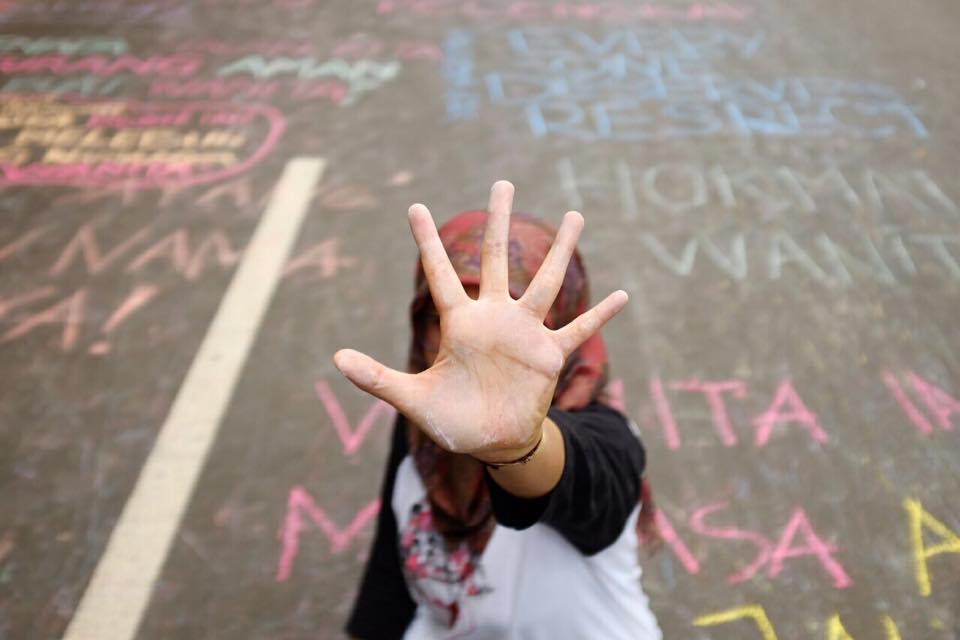
Credit: Hollaback! Indonesia

Catcalling di negara saya merupakan hal yang ‘biasa’ terjadi sehari-hari.  Saking biasanya sampai terkadang menjadi hal yang ‘dimaklumi’.  Terlepas dari apa yang dirasakan para korban yang kebanyakan adalah wanita.   Dulu saya suka berpikir bahwa hal itu terjadi karena hal-hal yang disebabkan oleh kita sendiri seperti misalnya cara berpakaian.  Namun ternyata tidak peduli gaya berpakaian kita, catcalling tetap saja berlaku.

Buat saya pribadi, perlakuan seperti catcalling atau street harassment adalah perlakuan yang sangat mengintimidasi.  Dari merasa terintimidasi akan berkembang menjadi rasa takut.  Padahal semua orang berhak untuk merasa aman apabila berjalan di jalan-jalan umum dan juga tempat-tempat umum lainnya.  Sayangnya hal ini belum terjadi.  Masih banyak para wanita yang merasa risih atau takut apabila harus berjalan melewati kerumunan para lelaki.  Yang akhirnya membuat mereka mengurungkan niatnya ataupun mengambil jalan lain yang lebih jauh namun dianggap lebih aman.

Ada cerita tentang seorang anak perempuan yang selalu diminta oleh ibunya ke pasar untuk membelikan keperluan kakak perempuannya.  Sang ibu merasa tidak aman kalau sang kakak ke pasar sendirian karena banyaknya perlakuan yang tidak menyenangkan dari para lelaki di seputar pasar tersebut.  Anak perempuan ini memang memiliki postur seperti lelaki dengan rambutnya yang dipotong pendek dan gaya berpakaian ala lelaki dengan kaos longgar dan celana pendek atau celana panjang jeans.  Sedangkan kakaknya adalah sosok feminine dengan rambut panjang dan wajah manis yang bisa sangat mungkin untuk di goda.  Setelah dewasa dia pun mengakui bahwa alasan dia bergaya seperti lelaki itu adalah untuk menghindari perlakuan street harassment. Sedangkan sang kakak justru merasa bahwa dia tidak perlu harus ‘dilindungi’, dia bisa melakukannya sendiri.  Rasanya seperti sesuatu yang bagus bukan?  Tetapi sayangnya tidak.  Sang kakak merasa begitu karena menurut dia hal seperti street harassment adalah hal umum atau wajar terjadi apabila pergi ke tempat-tempat umum seperti pasar tradisional. Sehingga timbul pemikiran “cuekin aja”.   Padahal mereka berdua sama-sama tidak setuju dan menentang perlakuan tersebut.

Berdasarkan cerita diatas, saya merasa bahwa mereka berdua sama-sama mengalami psychological effect dari perlakuan street harassment tersebut.  Hanya dengan reaksi yang berbeda.  Apapun itu, adalah satu hal yang jelas bahwa perlakuan seperti ini tidak dapat diterima.  Efek yang ditimbulkan kepada para korban mungkin tidak terlalu ketara dan hal inilah yang membuat catcalling masih merajalela dari sejak jaman dahulu sampai generasi milenial saat ini.  Apakah untuk menghindari perlakuan ini kita harus bergaya seperti lelaki?  Mensugesti diri bahwa ini biasa sehingga “cuekin aja”? Atau mengambil jalan lain yang lebih aman walaupun jauh?

Sayangnya hal seperti street harassment ini masih kurang mendapat perhatian masyarakat.  Isunya belum seramai dibicarakan seperti LGBT, KDRT (Kekerasan Dalam Rumah Tangga) dan kasus sexual harassment lainnya.  Padahal hal ini lebih sering terjadi dan bisa dibilang kejadian sehari-hari.  Saya ingat ada satu ungkapan yang berbunyi kira-kira seperti ini “dosa apabila sudah sering dilakukan akan terasa bukan lagi dosa”.  Saya rasa ungkapan ini sangat tepat menggambarkan perlakuan street harassment.  Terlalu sering dilakukan sehingga seolah-olah sudah diterima menjadi bagian dari kejadian sehari-hari.  Padahal tidak.  Perlakuan ini sangat mengganggu dan menimbulkan efek psikologis bagi korban.  Pertanyaannya adalah sampai kapan kita akan membiarkan hal ini berlangsung? Pemikiran sederhana yang masih sulit untuk dijawab saat ini.

Astrid received her Bachelors of Business at Queensland University of Technology Brisbane Australia. She finished her Master’s Degree at Gadjah Mada University Yogyakarta where she majored in Human Resource Development. Follow her on Twitter at @AstridNiki or on Facebook.

In my country, catcalling is considered a ‘usual’ daily thing, so usual, in fact, that it is seen as ‘ok’ to do even though the victims, usually women, do not like it.  I used to think that this thing happened because of the way we dressed. But in fact, no matter how you try to dress yourself, catcalling can still happen to you.

To me, catcalling, or street harassment, is intimidating and that intimidation can even turn into fear.  Even though every single individual should have the right to feel safe while walking on the street and public places, unfortunately this kind of thing has not yet happened. Many women still feel uncomfortable or scared if they have to walk past some crowd of men. This fear may cause them to not walk past them or prompt them to take another way which is further, but is considered safer for them.

There is a story about a young girl who was always asked by her mother to go to the traditional market and to accompany her sister. The mother felt it was too unsafe for the sister to go to the market by herself because of the inappropriate behavior from some men who hang-out in the market. This young girl had a very masculine appearance, such as having short hair and wearing loose t-shirts and jeans, but her sister presented in a feminine way, like with long straight hair. Later when this young girl had become an adult, she admitted that the reason she dressed like a boy was to avoid street harassment, while her sister felt that she did not need any ‘protection’, and she could do it on her own. In her opinion, street harassment is a common thing that happens, especially in public places such as traditional markets. This leads to a thought of “I don’t give a damn”, while in fact both of them are disagree and against this kind of behavior.

Based on the story above, I feel that both of them are having a psychological response to street harassment, just different ones. Whatever it is, it is still very clear that these kinds of actions are not acceptable. In order to avoid such disturbing behavior, do we have to change our style like a man? Or just accept it and say, “I don’t give a damn? Or go out of our way to take safer though further routes?

Unfortunately, there is a lack of attention in our society to street harassment. The issue does not receive as much attention as LGBT rights, domestic violence, and other types of sexual harassment even though it often happens in our everyday life. I remember a phrase that says, “a sin if constantly repeated is not considered as a sin anymore”.  I think this phrase fits the street harassment behavior. Too often it is repeated as if it is ‘accepted’ as a ‘usual’ everyday behavior. Frankly no! This behavior can have a negative psychological effect on the victim.  The question is, for how long will we allow this street harassment to occur? This is a simple thought yet currently it still is difficult to answer.

Share

Filed Under: correspondents

Nepal: Humor or Encouraging Harassment?

May 23, 2017 By Correspondent

Pritha Khanal, Kathmandu, Nepal, SSH Blog Correspondent

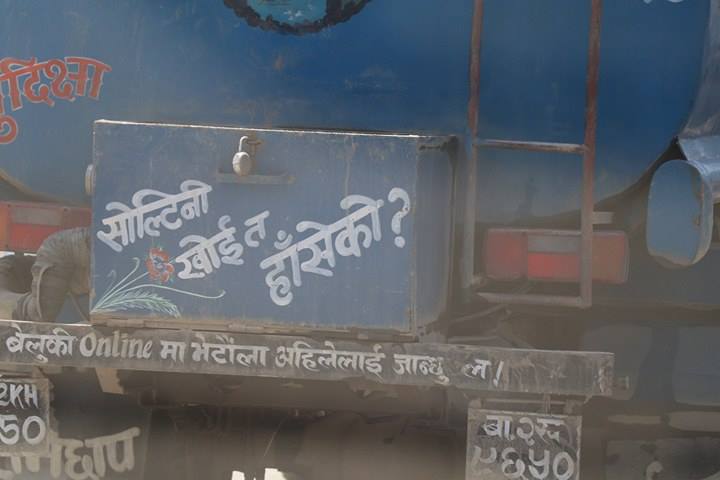
“Darling, Why not smiling?”

There is a common practice of writing slogans or pieces of poems on the back of trucks in Nepal, often called “truck literature”, and it has been making us laugh long before online “memes” became popular. Most of the literature hilariously imitates the native tongues and is filled with sarcasm, while some lines succeed in touching your heart in case you are going through some emotional turmoil.

On the other hand, some lines provoke rage and make you wonder why it is acceptable to write these words which have a clear motivation of mocking women and girls. Are the inappropriate comments the drivers pass not enough — they also have to write these things in huge letters on the back of the tanker? What is it that they want to prove and what message is that they want to convey?

As I was travelling with my family last weekend, I came across this water tanker with these words written with the usual purpose of making everyone laugh (“Darling, Why not smiling?”). I don’t know which part of the line was supposed to be humorous but my instant response was: What the hell is funny in these lines? Why should any “Soltini” (a kinship term where sister of a bride is Soltini to the brother of a groom) smile just because it reads so on the truck?

Things like these which are so common and ignored sometimes really depict what is inherently wrong in the society. In the name of humor and healthy flirting, there are often wrong messages spreading in society. In fact, some Nepalese culture actually cherishes the healthy flirting among their kins and community just like Solti-Soltini, which is good because it keeps the charm in the family alive and it happens with the consent of two adults along with their family. But when the behaviour is done to other girls with the motive of mocking them and making them uncomfortable, it becomes a form of harassment. Just like these lines sound very casual, it is one of the worst comments a girl has to face in the street. It feels creepy and makes us insecure when we hear the words in the street, in the market by a passerby or the groups of guys hanging around the teashops. What makes people think that writing such lines in the public vehicle is appropriate or creative?

Street harassment is part of the chronic form of violence against women. When a boy finds it comfortable and “cool” to tease a girl in the street, he may feel it is okay to grope her or inappropriately touch her in the street.

So how is this “truck literature” related here? It’s because they are written by the ones who are used to passing such comments in the street. They are written by the same drivers/ assistant drivers who laugh with each other when a girl they intentionally harassed frowns her brows but is helpless to react anyway. The same individuals who believe a girl wearing tight shirt is asking for an eagle’s eyes in her cleavage and those wearing short pants are calling for harassment. These lines are the work of harassers and for the harassers.  They are funny to those who find i’ts okay to tease in the cheesiest tone and expect that the girl finds it funny too. Some would laugh hard at the lines and replicate the same to other girls while some would just casually shrug it off. But, rarely one would realize that it may be words of encouragement for fellow harassers and one more girl in the street would be hearing the words.

So what are the measures? Not everyone can stop the vehicles in the heavy flow of traffic and rant against the lines to the driver. But one can discourage such acts. Let us condemn such lines. Let us not promote messages which give the impression of harassment but rather encourage drivers to use such widely visible and effective space for delivering better messages.

Pritha is doing her Master’s degree in Anthropology and her thesis is on the menstruation practice issues among rural teenagers in Nepal. She received a Bachelor’s degree in Social Work. She works in a non-governmental organization focused on women empowerment. Follow her blog www.prithakhanal.com and my Facebook account: @pritha.khanal.

Share

Filed Under: correspondents

USA: Street Harassment is Not a Joke

May 16, 2017 By Correspondent

Dee Rodriguez, Reading, PA, USA, SSH Blog Correspondent

It seems like memes have really taken off in the past few years. Whether it’s making fun of celebrities and pop culture or addressing social justice issues, memes have become a way to communicate with friends and social media followers. What’s the first thing we do when we come across a funny or relate-able meme? The instinct is to share it or tag a friend.

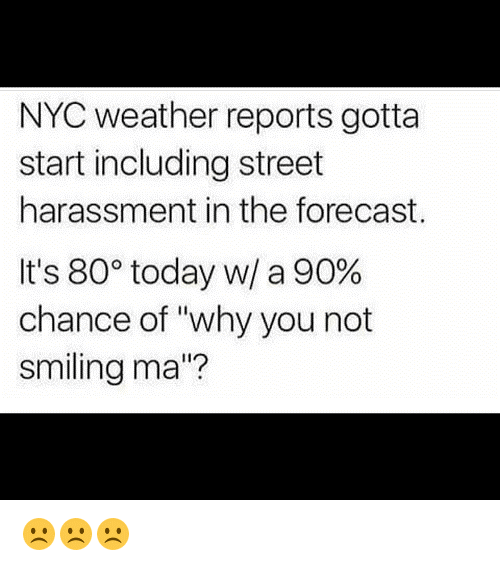
Whenever warmer weather starts to approach, one particular meme seems to pop up:

I would always chuckle when I came across this because not only was the “why you not smiling ma” scenario my experience growing up in New York City, but a street harassment report would be super helpful! I wanted to share this picture with friends but I hesitated. The meme is funny, but it’s funny in the way we joke about tragedy.

Street harassment is part of the sexual violence continuum. The continuum includes everything from rape jokes to sexual assault and anything in between. Making jokes about rape or street harassment may not seem like a big deal, but it is part of rape culture which normalizes rape and the different types of sexual violence. Joking about these issues contributes to rape culture as well. Some folks defend these jokes as being a way to deal with how normalized sexual violence has become or that it’s just humor and it doesn’t mean anything, but it’s not funny to those that may have experienced sexual assault.

It’s certainly not funny to those of us who are advocates. When you’ve had to sit through a rape kit, rape is not funny. As a sexual assault advocate, I’ve sat with victims during their examinations. I’ve talked to parents whose children have been sexually abused. When you fear walking down the street alone because you may be harassed and killed, street harassment isn’t funny. Sexual violence is not a joke.

The meme may have been created as a way to make fun of the street harassment that many folks face each day and as a way to cope but we shouldn’t have to cope. The fact that street harassment has become so pervasive that people can now joke about it is a tragedy. While a street harassment report would be helpful, you know what would be more helpful? If we didn’t get harassed in the first place.

Dee is a volunteer coordinator and domestic violence/sexual assault advocate for a non-profit social services agency and works on a project to better serve Latinx women survivors. She has a bachelor’s degree in Global Studies with a focus on Latin American Culture from Penn State University. She originally hails from New York City and is a proud daughter of immigrant parents from the Dominican Republic. You can follow Dee on Instagram at @missdeerodriguez.

Share

Filed Under: correspondents, street harassment

Brazil: Women’s Issues are Absent from Public Policy in Rio de Janeiro

May 15, 2017 By Correspondent

Yasmin Curzi, Rio de Janeiro, Brazil, SSH Blog Correspondent

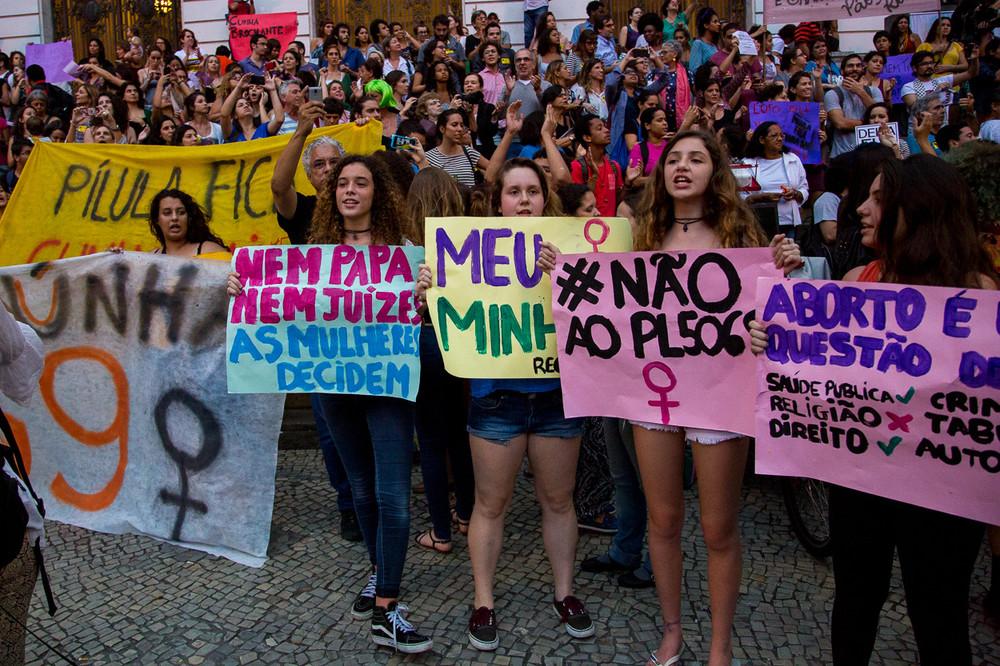
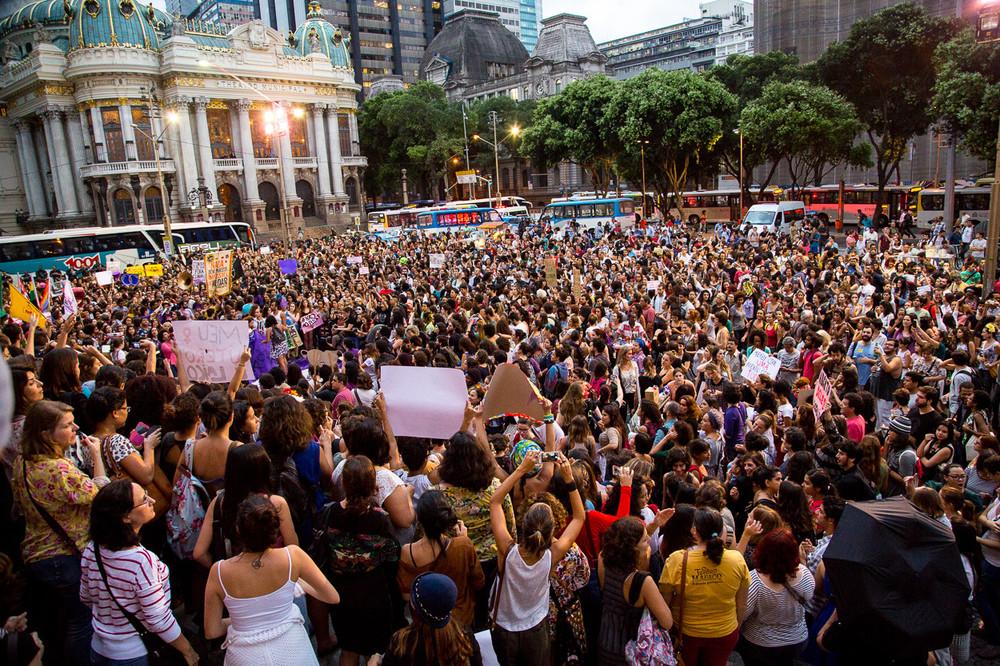
An Oct. 2016 protest against a series of legislative initiatives passed by male deputies that reduced women’s rights. Credit:  Matias Maxx.

Rio de Janeiro is the second largest city in Brazil with over 6 million inhabitants and while more than half are women, there is not much incorporation of gender in the public policy.

Democracy in Brazil is a delicate theme. In short, we have been under several dictatorships in our recent history and the political system is mostly formed by oligarchies. After the struggles of democratic transition in the late 1980’s, our modern Federal Constitution – also known as “Civic Constitution” – reflected a lot of social movement’s concerns and intended to amplify decision-making procedures to the civil society. Still, the Civic Constitution is not effective enough to change the concentration of political and economical power held in the hands of a few rich white men, men who still predominantly run the public institutions.

Photo Credit: Matias Maxx.

As a result of Brazil’s historical exclusion of women (they are misrepresented in the legislature and the decision making processes are failing to consider popular agendas), the main public institutions neglect women’s issues. This challenging scenario of gender inequality in politics inherently affects the public policy choices of the country.

In the past two decades, the Federal Government took important measures observing the platform that was defined at the World Conference on Women held in Beijing in 1995. Significantly, Beijing’s agenda observes the necessity of women’s empowerment by the opening of decision-making processes to their participation and the incorporation of gender’s perspective in all public policies. In order to attend these directions, the Brazilian Federal Secretariat for Women’s Policies was created in 2013. It plays a key role encouraging states and municipal administrations to create and implement public policies that reduce inequalities between women and men. The “National Plan of Women’s Policies” formulated by this Federal Secretariat serves as an orientation guide to others federal entities that should, in turn, create more specific measures aiming to attend women’s particular needs in their locations. However, until today, Rio de Janeiro doesn’t have a Municipal Plan.

In Rio, gender inequality is mostly perceived by cases of material violence. According to the “Women Dossier”[1], women registered 56.031 occurrences of physical injuries in the year of 2014, and the estimate of domestic abuse is almost 80 daily cases. In cases of attempted murder, 33,8% of the defendants are the victim’s partners or ex-partners and 3,8% are the victim’s fathers or stepfathers. Even with these significant numbers, in the whole city there are only five attention houses for victims of domestic abuse. In this same year, 4.725 women registered occurrence for rape. And we can say that these data are under-representative, as there are a lot of constraints that inhibit women from seeking institutional help. In cases of sexual harassment, rape or abuse, the institutions are often unwelcoming to the victims: police officers commonly question the victim’s behavior and even the creation of Rio de Janeiro’s Women Protection Police Precinct[2] isn’t effective to mitigate this scenario.

When it comes to street harassment, an online survey[3] of nearly 8,000 people conducted by the journalist Karin Hueck, a member of the NGO “Fiu Fiu Enough”, discovered that 99,6% of theses women had suffered some kind of harassment in public spaces at some point of their lives. They said it limits their freedoms, like clothing and mobility choices. 90% had said they changed their way of dressing because they feared suffering with harassment and 81% gave up the idea of going somewhere alone. Just 17% had said they liked the catcalls. Other research[4], conducted by the NGO ActionAid, interviewed 503 women[5] and 86% said they had experienced street harassment. Even with this clear evidence of a problem, there’s no public policy against street harassment.

In conclusion, the invisibility of women’s issues and the lack of appropriate treatment of their concerns stems from women’s under-representation in political institutions. Women need to be heard in the formulation and implementation of policies and programs that concern them. The fact that the city of Rio de Janeiro doesn’t have any public policy plan directed at women’s issues is a dramatic sign of the persistent situation of our exclusion from the public sphere. The oligarchies that constitute political power in Rio de Janeiro nowadays treat female matters as irrelevant and, apparently, don’t intend to expand the civil society channels. To overcome this scenario, women need to fight for their fair distribution of political power and occupy institutions of public life.

[1] A public research that reunites data about violence against women, published in 2015.

[2] This type of Precinct was created to give specialized attention to women. Although, there’re only 300 unities in a country that has 5.561 cities. The infrastructure of these precincts is also a questionable theme: mostly doesn’t have social assistants, neither psychologies, or orientation of women toward their rights.

[3] You can access the partial results from this survey in this link: http://thinkolga.com/2013/09/09/chega-de-fiu-fiu-resultado-da-pesquisa/

[4] You can access an article about this research in this link: http://agenciabrasil.ebc.com.br/en/direitos-humanos/noticia/2016-05/survey-shows-86-brazilian-women-have-experienced-street-harassment

[5] The sample was constructed trying to reflect the Brazilian demographics, as exposed in the last census from Brazilian Institute of Geography and Statistics (IBGE).

References:

CURZI, Yasmin and RADD, Carolina. “Política para Mulheres” in: “O Rio que Queremos: propostas para uma cidade inclusiva”. Disponible at: <http://www.grabois.org.br/uploads/arquivos/1484084673.pdf>

PINTO, Andréia Soares, MONTEIRO, Joana e MORAES, Orlinda Claudia R. “Dossiê Mulher”. Instituto de Segurança Pública – Rio de Janeiro, 2015. Available at: <http://arquivos.proderj.rj.gov.br/isp_imagens/uploads/DossieMulher2015.pdf>

Yasmin is a Research Assistant at the Center for Research on Law and Economics at FGV-Rio. She has a BA in Social Sciences from FGV-Rio and a Master Degree in Social Sciences from PUC-Rio, where she wrote her thesis on street harassment and feminists’ struggles for recognition.

Share

Filed Under: correspondents, street harassment

Welcome New Blog Correspondents of 2017!

May 8, 2017 By HKearl

Since 2013, cohorts of people from around the world write monthly articles about street harassment and activism efforts in their communities. Read their articles.

Meet the Blog Correspondents of the Second Cohort of 2017

Yasmin Curzi, Rio de Janeiro, Brazil

Yasmin is a Research Assistant at the Center for Research on Law and Economics at FGV-Rio. She has a BA in Social Sciences from FGV-Rio and a Master Degree in Social Sciences from PUC-Rio, where she wrote her thesis on street harassment and feminists’ struggles for recognition. She received a second degree in the Law at FGV-Rio. She is interested in studies about social movements in Brazil, theories of justice, feminist constitutionalism and the strategic use of Law by feminists.


Pritha Khanal, Kathmandu, Nepal

Pritha is doing her Master’s degree in Anthropology and her thesis is on the menstruation practice issues among rural teenagers in Nepal. She received a Bachelor’s degree in Social Work. She works in a non-governmental organization focused on women empowerment. She is passionate about working on and writing about various women’s, and she is also fond of travel writing. Follow her blog www.prithakhanal.com and my Facebook account: @pritha.khanal.


Astrid Nikijuluw, Serpong, Banten, Indonesia

Astrid received her Bachelors of Business at Queensland University of Technology Brisbane Australia on July 2000. She majored in Banking and Finance. She finished her Masters Degree at Gadjah Mada University Yogyakarta on August 2003 where she majored in Human Resource Development. Although her educational backgrounds are economics and social science, she volunteers with many types of organizations and people. She is really concerned about street harassment and aims to help spread information about it for the benefit of her fellow women so that they can walk on the street in peace. Besides writing, she also enjoys reading her favorite books, swimming, watching movies and playing games. Follow her on Twitter at @AstridNiki or on Facebook.


Dee Rodriguez, Reading, PA, USA

Dee is a volunteer coordinator and domestic violence/sexual assault advocate for a non-profit social services agency. She is currently involved in a project to better serve Latinx women survivors of sexual assault in her community. Dee received a bachelor’s degree in Global Studies with a focus on Latin American Culture from Penn State University. Dee originally hails from New York City and is a proud daughter of immigrant parents from the Dominican Republic. Dee is also particularly interested in the intersection between sexual violence and race as well as how street harassment contributes to rape culture. In her spare time, Dee enjoys cooking, reading, and going for walks. You can follow Dee on Instagram at @missdeerodriguez.

Share

Filed Under: correspondents, SSH programs, street harassment

« Previous Page
Next Page »

Share Your Story

Share your street harassment story for the blog. Donate Now

From the Blog

  • #MeToo 2024 Study Released Today
  • Join International Anti-Street Harassment Week 2022
  • Giving Tuesday – Fund the Hotline
  • Thank You – International Anti-Street Harassment Week 2021
  • Share Your Story – Safecity and Catcalls Collaboration

Buy the Book

  • Contact
  • Events
  • Join Us
  • Donate
  • Facebook
  • Instagram
  • Pinterest
  • Tumblr
  • Twitter
  • YouTube

Copyright © 2026 Stop Street Harassment · Website Design by Sarah Marie Lacy