• About Us
    • What Is Street Harassment?
    • Why Stopping Street Harassment Matters
    • Meet the Team
      • Board of Directors
      • Past Board Members
    • In The Media
  • Our Work
    • National Street Harassment Hotline
    • International Anti-Street Harassment Week
    • Blog Correspondents
      • Past SSH Correspondents
    • Safe Public Spaces Mentoring Program
    • Publications
    • National Studies
    • Campaigns against Companies
    • Washington, D.C. Activism
  • Our Books
  • Donate
  • Store

Stop Street Harassment

Making Public Spaces Safe and Welcoming

  • Facebook
  • Instagram
  • Pinterest
  • Tumblr
  • Twitter
  • YouTube
  • Home
  • Blog
    • Harassment Stories
    • Blog Correspondents
    • Street Respect Stories
  • Help & Advice
    • National Street Harassment Hotline
    • Dealing With Harassers
      • Assertive Responses
      • Reporting Harassers
      • Bystander Responses
      • Creative Responses
    • What to Do Before or After Harassment
    • Street Harassment and the Law
  • Resources
    • Definitions
    • Statistics
    • Articles & Books
    • Anti-Harassment Groups & Campaigns
    • Male Allies
      • Educating Boys & Men
      • How to Talk to Women
      • Bystander Tips
    • Video Clips
    • Images & Flyers
  • Take Community Action
  • Contact

USA: Street Harassment is an Important Problem

July 12, 2013 By Correspondent

By Britnae Purdy, SSH Correspondent

I have a thing for coincidences. The very same day that I accepted this role as a correspondent for SSH, my local newspaper posted a Facebook status asking for commentary from women who have experienced street harassment in the Fredericksburg, VA, area, to be used for an upcoming story. I was excited – until I read the quickly-accumulating comments below the status. The most-repeated sentiment was, “Don’t we have more important things to worry about than catcalling?” closely followed by “Why can’t women stop being so uptight and just take it as a compliment?”

It upset me, especially because equal amounts of these comments were coming from women as from men. I admit to being an overly sensitive person at times, and these comments bothered me, to the point where I briefly considered re-thinking this whole feminist-writing thing and staying in bed all day instead –I was having a bad hair day already, after all (thank you, Virginia humidity). But I couldn’t help thinking it through a little.

Start. Don’t we have more important to things to worry about than cat-calling? Let’s see – violent crime, corrupt governance, prime time television…Yes, it would appear that we, the collective, faceless “we” that make up our sense of modern society, do indeed have bigger things to worry about.

But let me ask you this – do I have bigger things to worry about than my own personal safety and well-being? No. I do not. As an individual being, keeping myself safe is my own top priority, and that is what is threatened when I am yelled at, followed by, or touched by strangers in a public place.

Expand. As an active member of my community, I am similarly concerned with the safety and well-being of my friends, family members, coworkers, and the super-friendly Starbucks barista who made my much-needed latte this morning. And as a contributing (financially and otherwise) member of my community, I expect my safety, health, and concerns to be just as respected and adequately addressed of those of my non-harassed male counterparts.

As for “taking it as a compliment” and “not being so uptight?” If you, as a self-assured, intelligent, confident woman can take a whistle or sexually-explicit comment and use it as fuel to brighten your day, then all the more power to you. I cannot. There are times when a “compliment” is actually the indicator of more aggressive behavior to come, and I need to be scared in order to stay safe – if I act a little too “uptight” about a whistle, it is because I am remembering that time I was followed home at night.

Regardless of threat level, a lewd, unwelcome comment is indicative of a patriarchal society that grants men verbal, visual, and physical access to my body with or without my consent. I fear that saying anything you want about a woman’s body with no consequences is only a few steps away from feeling like you can do whatever you want with a woman’s body. A society that does not equally value the safety of its women cannot be trusted to ensure the safety of any of its members that are not white, privileged, heterosexual males. Cue violent crime. Cue corruption and lack of morals. Cue media that perpetuates the image of women as weak, sexualized commodities meant for consumption.

Conclusion. We don’t have bigger problems because the mentality behind street harassment provides the basis for most of society’s “bigger” problems. I cannot just take it as a compliment because that would mean accepting a second-class version of myself, and even on the worst of bad hair days, that is not something I can bring myself to do.

Britnae is a graduate student at George Mason University, in Virginia, where she is pursuing a Master of Arts in Global Affairs with a specialization in Security and Conflict Studies. She also writes for First Peoples Worldwide and you can read more of her writing on their blog and follow her on Twitter.

Share

Filed Under: correspondents, Stories, street harassment

USA: Why I Tolerated Harassment in High School

July 8, 2013 By Correspondent

By Natasha Vianna, Jan. – June 2013 SSH Blog Correspondents

For a chunk of my adolescence, I genuinely believed that sexual and street harassment were the ultimate forms of flattery. If a guy was willing to whistle, call out nicknames, or harass me, then hey… that must mean I am attractive. And heck, for most of my life, I was told to always appreciate a compliment; so I did.

At the time, part of me enjoyed the harassment because it meant I was sexy or pretty to someone else. In high school, there was an overwhelming pressure to look good, dress well, and “bring all the boys to my yard.”  There was jealousy, bitterness, lust, innocence, naivety, and tons of harassment. In fact, by the time I finished my freshmen year of high school, I already believed that if I wasn’t getting attention in the hallways of my school, I was boring and unattractive and needed to do something about it.

The guys in my school were so easily predictable. I knew that if I wore tighter pants or a shorter skirt, I may get a compliment here and there or a stare from the hot football player from across the room. It all seemed like a fun game and I liked having that type of power.

It wasn’t until the harassment quickly shifted from “Hey, you look cute in that shirt” to “You have a fat ass” to “Hey, come and suck my dick bitch,” that I realized I wasn’t enjoying this game anymore. The harassment began to escalate, quickly, and I began to hate walking through the hallways of my high school.

The hot football player would approach me regularly now to see if I wanted to have sex with him. And just like that, he would ask. I’d uncomfortably say no, but it didn’t matter anymore. “So why have you been eyef***ing me from across the room in that short skirt?”

Instead of standing up and shouting, “Because I can wear whatever the f***I want and stare at whomever the f*** I want without wanting to ever f***.” like I would today, I adopted this false belief that what I wear, how I behave, and what I say ultimately determines the treatment I deserve from men. And for years, I worshipped this idealogy.

School became uncomfortable but there was nothing I felt I could do about it anymore. Sexual harassment is rarely addressed in schools the right way. Instead of telling boys to keep their hands to themselves and respect women, girls were told to wear longer skirts and looser clothing. We were blamed when we were mistreated. We were asking for it or just begging for attention.

Here’s an example: My teacher once sent me to the office because my middrift was slightly showing and it was a distraction to the boys in the class. Pissed, I pulled my shirt down and walked down the hallway to meet with the principal. Standing uncomfortably in front of the male principal, who was now looking up and down at me, told to put on a sweater from my locker. For the rest of the day, I covered my 15 year old body in school so the boys could focus on their schoolwork.

When I graduated high school and walked away from those horrible hallways, it didn’t end. The voices of, “Hey baby” and echoes of whistling followed me down many streets… literally. But based on what I endured and learned in high school, I believed this was just normal treatment and how women were supposed to be treated. I trekked on and just tolerated the street harassment never once thinking I was a victim but believing that this is how I would eventually meet my husband.

Thanks to friends and social networking, I was able to talk about (and blog) about my experiences to people who could really help me understand the complexities of harassment. It was an eye-opening, and sometimes painful, experience but one that has changed my life for the better.

Natasha Vianna, a fearless activist and young feminist, is a freelance writer and blogger based out of Boston, MA. Follow her on twitter!

Share

Filed Under: correspondents, Stories, street harassment

USA: Interview with the Director of Hollaback!PHILLY

July 7, 2013 By Correspondent

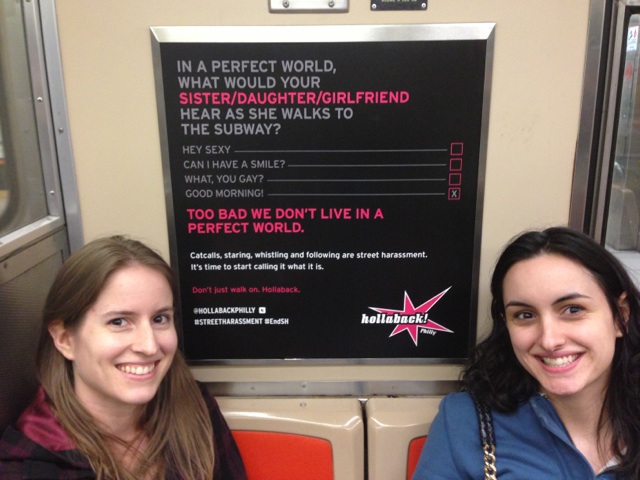
Anna Kegler & Rochelle Keyhan with one of their SETPA ads.

By: Erin McKelle, Jan. – June 2013 SSH Blog Correspondents

Rochelle Keyhan is the Director of Hollaback!PHILLY, lawyer, activist and writer. She started working on anti-street harassment non-profit Hollaback! in 2010 when she incorporated the organization as a non-profit 501(c) (3) pro-bono. She’s been an active feminist since her undergraduate years at UCLA, where she was the Editor in Chief of the university’s feminist magazine. She’s truly remarkable and I wanted to get her take on street harassment, working as a feminist activist and her work with Hollaback!

Erin: Can you tell me a little about yourself and your work both with Hollaback! and outside of it?

Rochelle: My passion is fighting gender-based violence and inequity. My day job is as a criminal lawyer, and I do all of my work on Hollaback! in my free time outside of work. I first became aware of Hollaback! while working with a different non profit, running their social media pages. Hollaback! posted a request for assistance with filing their 501(c)(3) application, which I had just learned how to do. In filling out that application you learn everything there is to know about the organization, and the more I learned, the more I became enamored with the movement. Soon after completing the application I joined Hollaback!’s Board of Directors and am currently the Treasurer on the Board. A year later in April 2011 I started HollabackPHILLY and have been the director ever since.

Erin: I saw that you first got involved with Hollaback! by volunteering to incorporate them as a non-profit. What drew you to the organization and what led you to start a chapter in your city?

Rochelle: At the time I discovered Hollaback! I was already a pretty outspoken and passionate feminist, but had been so desensitized to street harassment that it was an epiphany for me that I deserved to be angry about street harassment. The fact that it was such a new, less-explored issue, got me excited to be a part of it almost immediately. After a year on the board, I was more familiar with the organization and its long term activist goals, and I just knew that I needed to bring the movement to Philadelphia, which has its own serious street harassment problem. By raising awareness about street harassment, we’re expanding the reach of the fight against gender-based violence by going after the behaviors across the spectrum, instead of just focusing on the most physical forms of the violence.

Erin: Street harassment is obviously a huge problem and it is often not taken seriously by the police. How do you think that the laws around street harassment can be written to better serve women and LGBT folks? How can we better educate law enforcement to make them aware of the problem?

Rochelle: I don’t think that laws are the solution, so I actually wouldn’t suggest any form of legal revision. The focus now should be on education and mindset change. A big part of that is bringing in men and law enforcement, recruiting them as allies and equipping them with the knowledge and skills necessary to spread the message. I wrote an article for COPS, a department out of the USDOJ on how law enforcement can help the cause, which is pretty responsive to this question.

Erin: Hollaback Philly’s SEPTA Subway Advertisement PSA Campaign has gotten a lot of press this spring. Have you seen any changes that have happened because of it? Did you see an increase in public awareness?

Rochelle: The ads had a significant local impact, putting our efforts on the radar of the larger feminist organizations in the city. They also got the attention of City Council, which opened the door for conversations about potential partnerships. We also have had a large outpouring of local support via email and social media, thanking us for our effort and commending our transit authority for extending the advertisements. The ads helped people start conversations by providing an ice breaker. They also encouraged people to think through the issues on their own, and in their own ways, by giving them the freedom to process the ideas individually, without forcing conversations. Beyond the impact in Philadelphia, the ads went viral online, with over 500,000 Facebook impressions and 100,000 Tumblr re-blogs, expanding the conversation to a global dialogue about what cities can do to help spread the word about making our streets and transit systems safer for women and LGBTQ folks.

Erin: Do you see street harassment as being a potential defining issue of 4th wave feminism? Do you think it’s important that it be?

Rochelle: It’s already a large part of the fourth wave narrative, with organizations all over the world organizing around and marching against street harassment, while openly condemning the behavior online. People rising up to regain their rights to safe access to public spaces, fighting discrimination based on their gender, and holding their communities accountable, is of course an important part of any wave of feminism, so the 4th wave is no exception.

Erin: Street harassment comes from the difference in power and acts as an oppressor and reminder for oppressed groups that they are such. It’s a way for the dominant group to assert power. Do you think it will take ending sexism to end street harassment?

Rochelle: I actually think street harassment can end before sexism does, because it’s easier to be angry about violence and disrespect than it is to redefine masculine roles and claims to power by doing things like evening out salaries, sharing household duties, and electing more women into political power. Basically, it’s “giving up” less to eliminate street harassment than to eliminate sexism.

Erin: There has obviously been an increase in recent years in the feminist movement to end street harassment and the movement has been gaining ground. In your opinion, what is the best approach we can take to end street harassment both as activists and everyday citizens?

Rochelle: That’s a difficult question to answer. The “best” way to approach street harassment varies by situation and individual. But what I’ve learned over the past few years is that the most productive and effective conversations I’ve had with men and non believers happens when I come from a place of love and understanding. Curbing the anger goes a long way in creating the conversations as safe spaces for people to voice questions they might be embarrassed to ask, allowing for deeper, more nuanced conversations about the issue and how it impacts people differently. Hopefully the more conversations we have, the more people will join in the effort and the less careful the conversations will have to be to avoid isolating people from the movement.

Erin is an e-activist and blogger based in Ohio. You can find more of her work here and here.

Share

Filed Under: correspondents, hollaback, street harassment

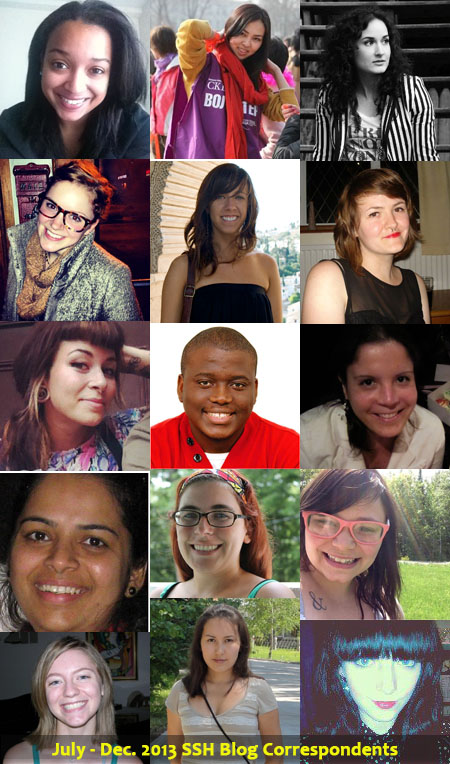
Meet Our 15 New Blog Correspondents!

July 3, 2013 By HKearl

The SSH Blog has been growing by leaps and bounds (we had a record number of story submissions last month!). Contributing to that growth, today, the second cohort of SSH Blog Correspondents begins.

Meet the new correspondents by reading their bios.

They will each write monthly articles through December 2013 to discuss street harassment issues and activism in their communities.

This blog is all about documenting street harassment, sharing ideas for how to end it, and bringing more attention to this human rights issue and I’m grateful to the correspondents for being willing to share their time and talents to these ends.

I also want to give a huge THANK YOU to the first cohort of SSH Blog Correspondents who contributed monthly articles between January and June 2013. They wrote compelling articles about street harassment from Pakistan to Colombia and all across the USA. They were the pilot program and were patient with me as I figured out the process and system! I thank them for their stellar articles.


Share

Filed Under: correspondents, SSH programs, street harassment

Colombia: Violence and abuse

June 29, 2013 By Correspondent

By: Adriana Pérez-Rodríguez, SSH Correspondent

The well-known black feminist, bell hooks, argues that the first act of violence men, living in a patriarchal system, must commit is not violence against women but against themselves by emotionally crippling themselves and so, when achieving it, they can then start abusing women. By doing so, men will be fulfilling gender roles about masculinity which and will be able to socially position themselves as individuals.

Seems to be then, that patriarchy is intrinsically based on violence, defining every aspect of our everyday lives and not only affecting us as women but also affecting men and the ways they are constructed. It is important to keep this in mind because when we tend to think of violence we imagine domestic violence or rape scenes in our heads, ignoring underlying logics. Violence is more than beatings and battering, violence is also the act of thinking our bodies belong to someone else and that can be appropriated at any time by words and language. Based on this logic, an act of clear cut violence is committed against women every time they encounter sexual harassment in the streets because the underlying premise is the male and patriarchal authority over our bodies, acting as reminders that we can be accessed against our will. Beatings and rape, in this case, would only be the ending and most dreadful results of this chain of violence reproduced daily by language, looks and images –glorifying violence against women- whenever we enter the public sphere.

Hence, street harassment becomes a wider issue that involves us all as opposed to the idea of it being a women’s issue because, for women to be thought as accessible, male socialisation, as hooks said, must be filled with violent ideas of how they must behave and socialise. Boys from very early ages internalise ideas they must behave as predators and that their character is that of rapist that doesn’t have control over himself. Thus, women must protect themselves from them. By changing how we view this issue and realising it’s not just a women’s one, we will be able to analyse how our society is organized under principles of violence which also affect boys and men, obviously not with the same dimensions, but that barely go noticed as they are left in a privileged position.

This is revealing because men will have to also start confronting those principles under which our societies are organized and by which they are privileged social subjects. By becoming conscientious of their social position and why they are there, they can start politicising reality and joining women in the struggle against patriarchy. This isn’t easy, of course, it’s hard to confront our privileges and realise why we have. This, however, cannot be an excuse but an encouragement: they also make part of society, so they must also join the struggle. One last thing though: before waiving the flags against patriarchy and the abuse women encounter daily, think about how you, as a guy, reproduce these logics of violence over their bodies. It isn’t easy, it’s a hard and even painful process, also because most of the times these logics are reproduced without even directly thinking about them, but it isn’t a good start, it is the start.

Adriana is a Colombian national who’s passionate about all topics concerning social justice, especially gender-based justice.

Share

Filed Under: correspondents

« Previous Page
Next Page »

Share Your Story

Share your street harassment story for the blog. Donate Now

From the Blog

  • #MeToo 2024 Study Released Today
  • Join International Anti-Street Harassment Week 2022
  • Giving Tuesday – Fund the Hotline
  • Thank You – International Anti-Street Harassment Week 2021
  • Share Your Story – Safecity and Catcalls Collaboration

Buy the Book

  • Contact
  • Events
  • Join Us
  • Donate
  • Facebook
  • Instagram
  • Pinterest
  • Tumblr
  • Twitter
  • YouTube

Copyright © 2026 Stop Street Harassment · Website Design by Sarah Marie Lacy