• About Us
    • What Is Street Harassment?
    • Why Stopping Street Harassment Matters
    • Meet the Team
      • Board of Directors
      • Past Board Members
    • In The Media
  • Our Work
    • National Street Harassment Hotline
    • International Anti-Street Harassment Week
    • Blog Correspondents
      • Past SSH Correspondents
    • Safe Public Spaces Mentoring Program
    • Publications
    • National Studies
    • Campaigns against Companies
    • Washington, D.C. Activism
  • Our Books
  • Donate
  • Store

Stop Street Harassment

Making Public Spaces Safe and Welcoming

  • Facebook
  • Instagram
  • Pinterest
  • Tumblr
  • Twitter
  • YouTube
  • Home
  • Blog
    • Harassment Stories
    • Blog Correspondents
    • Street Respect Stories
  • Help & Advice
    • National Street Harassment Hotline
    • Dealing With Harassers
      • Assertive Responses
      • Reporting Harassers
      • Bystander Responses
      • Creative Responses
    • What to Do Before or After Harassment
    • Street Harassment and the Law
  • Resources
    • Definitions
    • Statistics
    • Articles & Books
    • Anti-Harassment Groups & Campaigns
    • Male Allies
      • Educating Boys & Men
      • How to Talk to Women
      • Bystander Tips
    • Video Clips
    • Images & Flyers
  • Take Community Action
  • Contact

UK: Bristol Zero Tolerance

April 28, 2017 By Correspondent

Annabel Laughton, Gloucestershire, UK, SSH Blog Correspondent
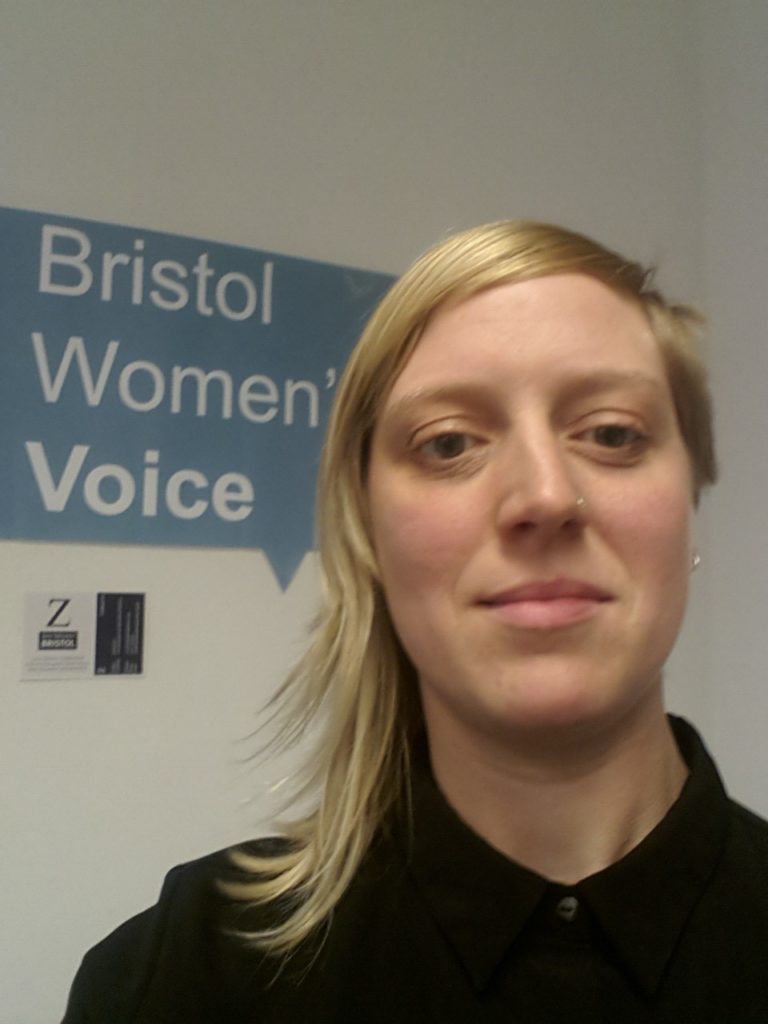
For the last in my series of blog posts speaking to activists in Bristol and the UK, I spoke to Charlotte Gage, Partnerships Officer at Bristol Zero Tolerance (BZT). This is an initiative that was set up by Bristol Women’s Commission in 2015, and its vision is to “make Bristol zero tolerance to all forms of gender-based violence, abuse, harassment and exploitation”.

BZT does not run frontline services but is working towards becoming an umbrella for all relevant services in the city, aiding coordination and collaboration. Gage works extensively with business, offering training and awareness-raising to create a safe culture and change attitudes and behaviour. BZT can also advocate for particular policy positions on gender-based abuse, something frontline organisations often don’t have time for. Local police and the local council, for example, have drawn up action plans in conjunction with BZT, who can then hold them to account.

So what’s happening specifically with street harassment? Gage recently started a street harassment campaign.  “Local women were talking about it, so I felt it was important”, she says. The campaign is in its infancy as yet, being launched in International Anti-Street Harassment Week this April. At present Gage is focusing on gathering data to get a better picture of street harassment in the city. She has a researcher collecting data via local networks and specific communities. BZT also have a filmmaker recording women’s stories of street harassment.

Where the campaign goes after that will depend on the outcomes, but de-normalising street harassment and empowering people to speak out, either as victims or bystanders, is key. Gage explained she has had discussions with the local Police and Crime Commissioner and local organisation SARI (Stand Against Racism and Inequality) about the best way to enable this. “The police always say that if it’s not reported there is no data, and therefore there’s no problem”, she says, but exactly how street harassment is recorded is not straightforward. Gender is a “protected characteristic” under the UK Equality Act 2010, but street harassment isn’t automatically recorded as a hate crime, as, for example, attacks on someone because of their race or a disability would be. Victims have to specifically request that the offence is logged by police as “other – gender”, and even that won’t tell the whole story, because gender could mean male or female, masking the fact we know the vast majority of street harassment is targeted at women.

Gage is considering if BZT might lobby Avon and Somerset police to follow Nottinghamshire police’s lead and add a hate crime category of misogyny (the #NotACompliment campaign calls for this to be rolled out by police forces nationally), but is also wary of completely relying on a criminal response. “Not everyone wants to report to police. We want to give women different options”. One of these options might be a toolkit for people experiencing harassment, and bystanders.

BZT is clearly doing incredible work, but it’s not easy. Apart from Gage, BZT has just one other paid member of staff, Gage’s assistant, and they are both part-time. The initiative is funded by Public Health as it is prevention work, but like many publicly funded services in the UK, money is running out. It’s obvious that her drive and commitment are essential to the ongoing survival and success of this important work. As we finish our chat, Gage is clear that the issue of street harassment, which nearly all women experience, is a good way into a broader understanding of violence and abuse against women. “We need to get the message out there – street harassment is part of a culture which normalises and condones gender-based violence”.

Annabel is involved in campaigns for human rights, mental health, environmental issues and social justice. She has an honours degree in Classical Studies, a diploma in counselling, and works in Higher Education.


Share

Filed Under: Activist Interviews, anti-street harassment week, correspondents, street harassment

USA: Stop Commenting on Women’s Bodies and Appearances

April 27, 2017 By Correspondent

Libby Allnatt, Phoenix, AZ, USA, SSH Blog Correspondent

Are you the kind of person who tells someone when they have something stuck in their teeth, or do you let it slide? What about toilet paper on their shoe?
Some things are okay to point out.

There are also areas where commentary is off-limits unless invited.

Other people’s bodies, and other aspects of an individual’s appearance, especially if they are a stranger, would be included in that list.

The motives behind street harassment are diverse. A harasser may even have no motive, simply a senseless act of disrespect or violence. But entitlement is surely an aspect – either entitlement to one’s body (as in the case of groping or physical violence, for instance), entitlement to one’s time or attention (as in the case of being followed or catcalled), or a mix a both.

It’s almost comical when street harassment crosses into the territory of feedback. What’s the point of hollering at a young girl what you like and don’t like about her appearance? Would you pass a man and yell, “It looks like you have a superiority complex and I think you should seek professional help for that”?

Some of the absurd things harassers say would be almost funny due to how stupid they make their speakers look if they weren’t so violating, degrading, threatening and downright terrifying.

After my age and young look, the most common topic of the catcalls and comments I receive center on my clothing or style.

Catcalls, sexual/sexist remarks, groping, leering, and assault. Street harassment limits people’s access to public spaces. #SAAM #stopSH pic.twitter.com/68ZZQ94TGi

— Anna M Bogdan (@AnnaMBogdan) April 2, 2017

And it’s not just the creepy perverts that lurk in alleys and on street corners. I’ve had guys I know (both well-meaning and blissfully ignorant) comment on everything from the amount of makeup I wear (too much or too little) to the appropriateness of my clothing (you’d think some men have never seen leggings before).

A male acquaintance even once asked me to grow my hair out because he “liked it better long.” Um, excuse? And I like your mouth better shut.

Don’t get me wrong. Compliments can be wonderful. I often tell women how much I love their dress or perfume. A nice comment can go a long way. But as has been discussed many times, street harassment isn’t a compliment, so catcalls from men across the street and mutters of profanity as I pass don’t fall into that category.

In addition to compliments, there’s also a huge difference between warranted feedback and unwarranted harassment. A female friend admitting she’s not a huge fan of my outfit choice when I’m picking out something to wear (and asking for her advice) is a far cry from a man shouting, “WHY DON’T YOU SHOW MORE LEG” from across the street.

I know I’m preaching to the choir. Chances are if you’re reading this, you’re someone who has either been a victim of street harassment (if you’re a woman, the chances are high) or someone genuinely trying to understand more about the issue. I doubt the men that holler at us on the street are going online to read about street harassment communities and how their actions impact others’ safety and well-being.

But there are ways we can all be aware of how our language impacts others. Laughing at someone’s outfit? Maybe they spent a lot of time picking it out and are really excited to express themselves. Hear a guy analyzing a woman’s every curve? Ask him why he thinks she would care.

If you’re a dude reading this, you need to be aware of the appropriate ways of interacting with women. Generally, commenting on her appearance won’t get you anywhere, even if you think you’re being nice. It may be “bullshit PC culture” to you. But for us, it’s survival.

I hate to break it to you, but she probably doesn’t care what you think. You might even be creeping her out. It’s not personal. But given the prevalence of street harassment and genuinely threatening experiences women have, she’s likely learned to keep her guard up for protection.

Fellas: If a girl is turned away from you, giving one-word responses, stop trying to talk to her. It’s not personal, it’s survival. #stopSH

— Libby Paige (@LibbyPaigeA) April 19, 2017

While certainly anyone can be harassed, being aware of the ways that women’s bodies are continually policed, degraded, mocked, violated and sexualized is an especially important part of the framework.

We are not zoo animals to be gawked at, or artwork to be absorbed with the eyes and critiqued.

We are people wanting to walk down the street.

Libby is a student at Arizona State University. Originally from Salt Lake City, Utah, she is majoring in journalism with a focus on print and she is minoring in psychology and women’s studies. You can follow her on Twitter @libbyallnattasu and Instagram @LibbyPaigeA.

Share

Filed Under: correspondents

Romania: International Anti-Street Harassment Week in Bucharest

April 22, 2017 By Correspondent

Simona-Maria Chirciu, Bucharest, Romania, SSH Blog Correspondent

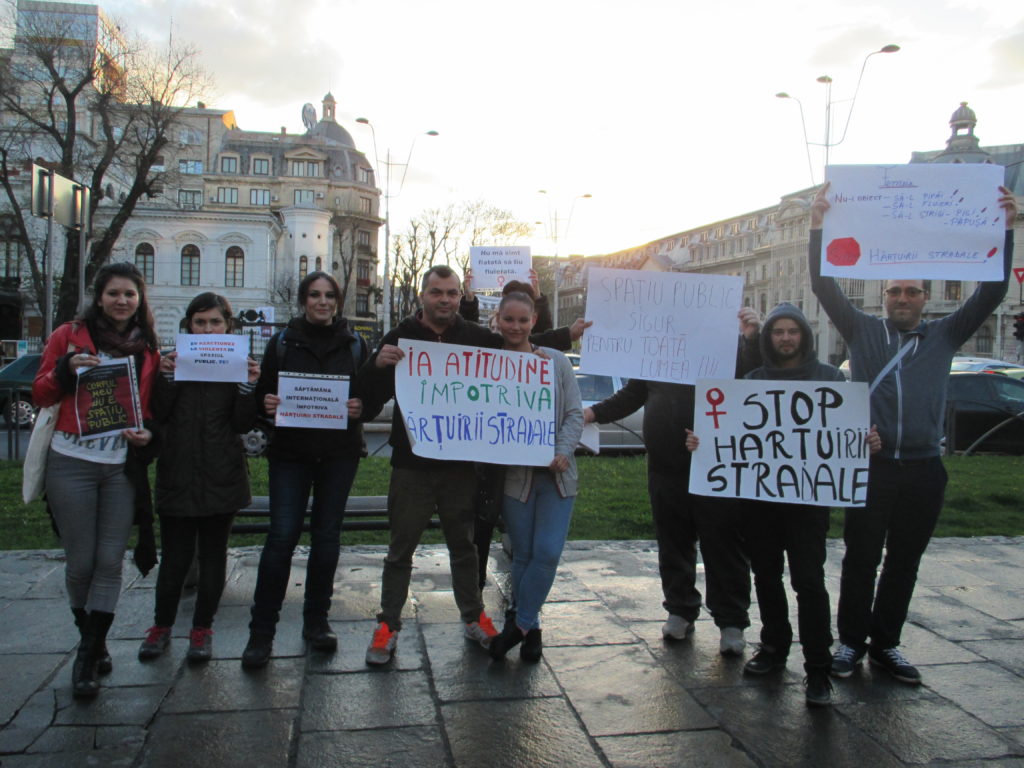
This year International Anti-Harassment Week in Bucharest was a full week! There were a couple of different activities which involved many people and targeted many different audiences.

First of all we had a meeting with a few young women who wanted to participate and we talked about street harassment that women bikers face on a daily basis in Bucharest. Maybe, in the summer time, we will do something about this, too.

Credit: Vasile Bianca

Then Hollaback! Romania organized a flash-mob in the center of the city of Bucharest. It was an example of intersectionality because the participants have different identities and personal experiences: 13 persons of different genders, different ethnicities, different sexual orientations. It was a good opportunity to get in touch with people interested in taking action and change something when it comes to the street harassment nightmare in Romania. Moreover, people stopped and gave us a nice feedback – “Good job, folks!”, “Yes, you are right, street harassment is a problem”!, “Congrats!” – while others wanted to take a photo with our protest signs.

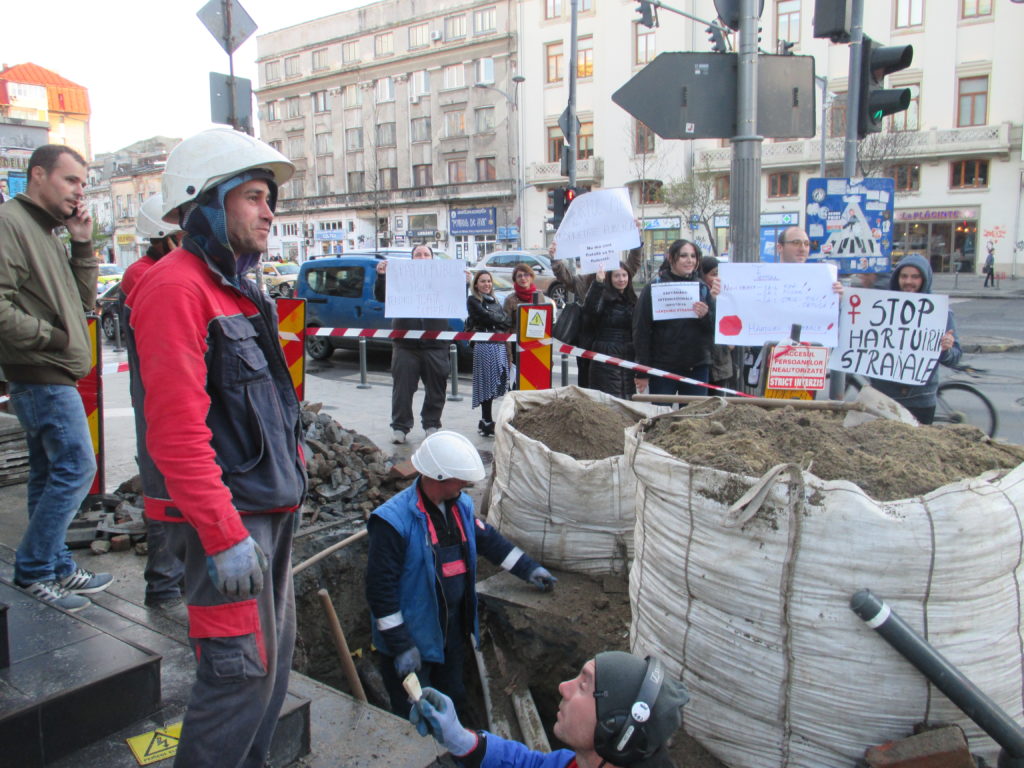
A nice moment was when we crossed a street and on our right side we saw a working site where were four workers, so we all laughed because this was a good encounter (everybody knows that many site workers harass women). We had a little chat with them about street harassment and they assured us they respect women and they never harass them.

Credit: Vasile Bianca

Another action that we organized was a complex online campaign. Hollaback! Romania is just a baby now but I am pretty sure it will grow up and become a great activist movement. We gained 300 new likes in just one week (2-8 April) and impacted 16.000 people for some of the posts on the Facebook page. This numbers are a good outcome but not the only one!

ANAIS Association and I collaborate with a group of Informatics students to develop an online application to address street harassment in Bucharest. Even though things are moving slowly I see that there are more and more people interested and willing to get involved. I really hope that the app will be well received by the people and be a real tool against street harassment.

For 2-8 April we had a great time in Bucharest sharing ideas and hopes for the future regarding our fight against this type of violence. I was surprised to receive lots of support! We – the Hollaback! Romania team – are so grateful for it! For example, regarding the online campaign, National Agency for Equal Opportunities between Women and Men – ANES (subordinated to the Ministry of Labor and Social Justice) shared our campaign. It’s a rare thing to have authorities involved in feminist activism in Romania!

A really cool metal music band – Trooper – made a video where a member of it spoke to his fans about the harm that street harassment produces to society and to women.

Also, two martial arts schools from Bucharest shared Hollaback! Romania’s message announcing the International Anti Street Harassment Week and spread information about how important is to speak up and react to street harassment.

Finally, a member of the Ecologist Romanian Party conducted an interview with me about  street harassment in Romania and their media press release had 8.000 people read it!

So yes, I am very glad that step by step (very little steps indeed) we starting to shake things up and grow the street harassment discussion in Bucharest. I try to convince people that we all have a role to play in preventing harassment in public spaces (in all its forms) and each stakeholder has a responsibility in defining and respecting his own role for creating safer and more welcoming public spaces. I am pleased to see that many of them get the message and step out of their comfort zone taking action.

We look forward for the International Anti Street Harassment Week in 2018 but we won’t wait that long to do other activities and campaigns against street harassment in Romania!

Simona-Marie is a Ph.D. Student in Political Sciences, working on a thesis on gender-based street harassment in Romania. She is an activist and organizes numerous public actions (marches, flash-mobs, protests) against sexual violence and street harassment against women. Now she is part of an working-group trying to improve by public policies the situation of young homeless people in Romania. You can find her on Facebook.

Share

Filed Under: anti-street harassment week, correspondents, street harassment

Northern Ireland: “There’s no Excuse to be Doing Nothing”

April 13, 2017 By Correspondent

Elaine Crory, Belfast, Northern Ireland, SSH Blog Correspondent

A striking image taken in the city of Birmingham, England, went viral this week; a young woman, Saffiyah Khan, facing down a man from the far-right, xenophobic English Defense League (EDL). In the photo we can glimpse at least two EDL members, their jaws set, chins tilted up, they appear to be speaking to – or shouting at – Khan. We can also see a Police Liaison Officer, speaking to one of the EDL members. The young woman, however, is smiling serenely at the enraged man who is addressing her.

The image captured imaginations, and the story behind it is one activists can learn much from. It transpires that Khan was a bystander who stepped up to defend another woman, young British Muslim Saira Zafar, who was surrounded by EDL members, shouting at her to go back to where she came from. Both Khan and Zafar, not coincidentally, were born and raised in Birmingham. Birmingham is a large and diverse city, an industrial giant in its time, exactly the sort of place that the EDL believe is theirs, given their stated aim to whip up tensions between the Muslim population and the white population. With a smile, Khan showed them how wrong they are.

Bystander intervention is one of those things that anti-street harassment activists have been advocating for a long time. In surveys, most people who have experienced public harassment have said that they wish someone had intervened on their behalf. It doesn’t happen much, though. It’s not hard to see why in a way, sometimes it seems dangerous, sometimes we’re in a hurry, the whole thing is more trouble than it’s worth. At the most basic level, though, I suspect it’s because we are raised in a world that puts individual before community always, or that sees community as something narrow and divisive, us’uns versus them’uns, in local Belfast parlance.

But things have shifted recently. After the Brexit vote in the UK, there was an immediate increase in hate crime incidents. After Donald Trump’s victory in the U.S. Presidential Election, sexist and xenophobic incidents increased, many citing Trump’s victory as evidence that “political correctness” had been defeated. One U.S. politician was arrested for grabbing a female colleague, pinching her genitals from behind, reminiscent of the president’s infamous “grab her by the pussy” comments. He did so after arguing with the woman in question and saying, “I love this new world. I no longer have to be politically correct”. The far right is on the march all across Europe, and while Geert Wilders was defeated in the Netherlands and Marine Le Pen looks likely to lose the French Presidential election, the levels of support they have found is worrying, and it is spreading.

In this new world where racists, xenophobes, homophobes and misogynists feel emboldened, we can no longer stand by when people get assaulted and harassed daily on the grounds of race, gender and LGBTQ+ status. This is this generation’s great activist moment; in the words of Saffiyah Khan, interviewed along with Saira Zafar a few days after the incident, “there’s no excuse to be doing nothing”.

We must educate ourselves about intersectionality, too, and understand that oppression often thrives where identities intersect, making a woman of colour more likely to be targeted than a white woman, for instance. When we speak of bystander intervention, we often urge male allies to be aware of their power to step in and divert harassment, and to speak to their peers about the sexist attitudes that underpin street harassment. This applies to all of us; we must be aware of how and where we wield power, when our actions might have most impact. And once we have armed our minds, we must be willing to act.

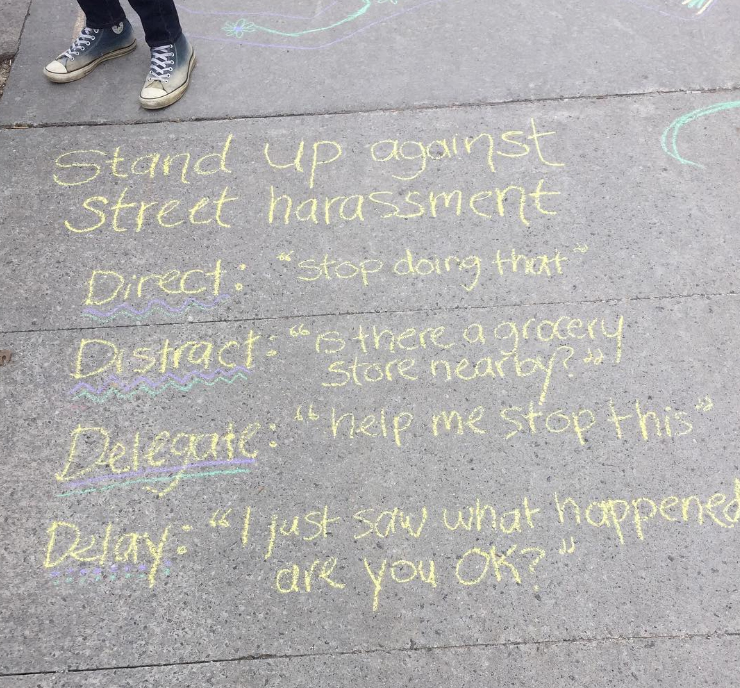
Hollaback! Ottawa chalking on April 9

Hollaback! is currently hosting online webinars on bystander intervention, and you can sign up here. They have also produced useful infographics that we can learn from and share in our networks, summarising briefly the basics of bystander intervention; the 5 D’s:

  1. Direct – directly confronting or addressing harassers, as Khan did, provided it’s safe to do so
  2. Distract – get in the way, ask for directions, speak to the victim about something other than what’s happening
  3. Delegate – ask for assistance from a third party, a security guard or transport worker for instance
  4. Delay – after an incident has happened, check in with the victim, ask if they need any help, etc
  5. Document – use your phone to photograph or video what is happening, and make sure you approach the victim with your record to see if or how they want to use it

This is necessarily brief, and the tip of the iceberg. During International Anti-Street Harassment Week, activists the world over shared inventive ways of tackling the problem. The goal now must be to spread the knowledge, widen the practice, and stand up against the tide of hatred which challenges the progress we have made as a society. Psychologists have long observed the “bystander effect”, whereby the probability of a victim being helped is inversely proportional to the number of people who witness the abuse or harassment. Saffiyah Khan bucked that trend, standing up to a gang of thugs in the midst of a large crowd with nothing but a smile and the power of being on the right side of history. We can, indeed must, learn a lot from her.

Elaine is a part-time politics lecturer and a mother of two. She is director of Hollaback! Belfast, co-organises the city’s annual Reclaim the Night march, and volunteers with Belfast Feminist Network and Alliance for Choice to campaign for a broad range of women’s issues.

Share

Filed Under: anti-street harassment week, correspondents, News stories, Resources Tagged With: bystander

USA: How Does Street Harassment Change Your Daily Behavior?

March 30, 2017 By Correspondent

Libby Allnatt, Phoenix, AZ, USA, SSH Blog Correspondent

There’s nothing quite like wearing an outfit again for the first time after you were catcalled while wearing it. While street harassment is obviously not about clothing (if it was then women wearing modest or traditionally “unsexy” clothing wouldn’t get harassed, and they do), it can be easy to attach feelings of violation and disgust to the shorts or a top or skirt or dress you were wearing when someone decided to encroach upon your safety and rights as a human.

It can also be difficult to return to places where one was once harassed. That street, that intersection, that park will always be filled with the voices of the ill-mannered, the sexist, and the violent that not-so-silently dot our neighborhoods.

According to Stop Street Harassment’s 2014 statistically significant national survey, street harassment caused 47 percent of women to constantly assess their surroundings. Four percent of all harassment victims made bigger decisions as a result of harassment, like moving neighborhoods or quitting a job.

An informal study by Cornell University and Hollaback! showed that 85 percent of women have taken a different route, 73 percent of women took different forms of transportation, and 70 percent avoid going out at night, all to avoid street harassment.

I’ve considered that *any* response can seem like encouragement for harassers to continue the interaction, to treat it like a game

— @PiaGlenn (@PiaGlenn) March 18, 2017

I personally know how taking public transportation in my city is more arduous than just buying a ticket and hopping on the train. I avoid it if I can, avoid taking it at night, and stare out the window in silence praying that no one speaks to me. I tug my skirt down to cover my legs and clutch my keys. I avoid the bus altogether because of what I’ve heard happen to my peers on there.

What makes me the saddest is the look of panic I see in others’ eyes when a girl says she’s walking home. “Text me as soon as you get there,” they plead, horrific possibilities on everyone’s minds but left unsaid.

“I wanted to go, but I also didn’t want to walk home that late,” is another frequent statement I commonly hear (and say myself) when women are discussing why they avoided a particular event or outing.

Male friends of mine have offered to walk me places at night if they know I’m going somewhere on my own. I always decline, and I’m both reassured by their willingness to help and sad because this is our reality.

Street harassment has emotional and psychological damage, as sexualization of girls and women can lead to depression, anxiety and eating disorders. It makes leaving our homes feel less safe.

Anyone who has been harassed and gone home shaking knows this feeling. Anyone who been harassed on the way to work or school and has to shake it off and act like they didn’t just feel scared for their lives knows this feeling.

Because it’s never just a catcall. It always has the potential to escalate to something much worse, because it has.

96% of participants experienced street harassment & 45% said over 15 times. Harassment is Never Okay @iHollaback @HollabackOttawa pic.twitter.com/zsQ7kKWSD6

— David Veshkini (@DVeshkini) March 30, 2017

My female friends and I adorn our keychains with colorful and sparkly pepper spray, as we try and pretend they’re accessories rather than self-defense weapons. Much to the dismay of my loved ones, I often leave my pepper spray at home. A part of me doesn’t want to admit that we need to be armed to move about in public spaces lest we become another victim, another statistic.

Surely many men often feel frightened at night as well. Many forms of crime, like robbery and assault, don’t discriminate based on gender. But the reality is that sexually-charged threats to bodily autonomy are a different animal to navigate, and usually reserved for women. I don’t know many men who tremble when they hear a shout on their walk home. I don’t know many men who grip their keys between their fingers, trying to determine if they would be capable of gashing out the eyes of someone twice their size if they had to. I don’t many men who alter their daily lives because catcalls, gropes, stalking, and rape are genuine possibilities.

While caution should not be thrown to the wind (I will continue to get the hell out a place where someone is making me feel uncomfortable, and perhaps I will swallow my pride and start carrying my pepper spray), I feel disgusted at a world where women have any burden to bear that men do not.

The other day, I returned to a spot where I was harassed that I had been avoiding for some time. I sat. I took up space. I enjoyed the world around me – the air, the sky, the birds, the city. I won’t let harassers keep me inside, and you shouldn’t either.

Libby is a student at Arizona State University. Originally from Salt Lake City, Utah, she is majoring in journalism with a focus on print and she is minoring in psychology and women’s studies. You can follow her on Twitter @libbyallnattasu and Instagram @LibbyPaigeA.

Share

Filed Under: correspondents, Stories, street harassment

« Previous Page
Next Page »

Share Your Story

Share your street harassment story for the blog. Donate Now

From the Blog

  • #MeToo 2024 Study Released Today
  • Join International Anti-Street Harassment Week 2022
  • Giving Tuesday – Fund the Hotline
  • Thank You – International Anti-Street Harassment Week 2021
  • Share Your Story – Safecity and Catcalls Collaboration

Buy the Book

  • Contact
  • Events
  • Join Us
  • Donate
  • Facebook
  • Instagram
  • Pinterest
  • Tumblr
  • Twitter
  • YouTube

Copyright © 2026 Stop Street Harassment · Website Design by Sarah Marie Lacy