• About Us
    • What Is Street Harassment?
    • Why Stopping Street Harassment Matters
    • Meet the Team
      • Board of Directors
      • Past Board Members
    • In The Media
  • Our Work
    • National Street Harassment Hotline
    • International Anti-Street Harassment Week
    • Blog Correspondents
      • Past SSH Correspondents
    • Safe Public Spaces Mentoring Program
    • Publications
    • National Studies
    • Campaigns against Companies
    • Washington, D.C. Activism
  • Our Books
  • Donate
  • Store

Stop Street Harassment

Making Public Spaces Safe and Welcoming

  • Facebook
  • Instagram
  • Pinterest
  • Tumblr
  • Twitter
  • YouTube
  • Home
  • Blog
    • Harassment Stories
    • Blog Correspondents
    • Street Respect Stories
  • Help & Advice
    • National Street Harassment Hotline
    • Dealing With Harassers
      • Assertive Responses
      • Reporting Harassers
      • Bystander Responses
      • Creative Responses
    • What to Do Before or After Harassment
    • Street Harassment and the Law
  • Resources
    • Definitions
    • Statistics
    • Articles & Books
    • Anti-Harassment Groups & Campaigns
    • Male Allies
      • Educating Boys & Men
      • How to Talk to Women
      • Bystander Tips
    • Video Clips
    • Images & Flyers
  • Take Community Action
  • Contact

USA: You Have the Power to Stop Street Harassment

January 24, 2013 By Contributor

By: Erin McKelle, SSH Correspondent

Once when I was at the mall with a friend, a random guy approached her and slapped her butt. She was a little shocked and so I said (loudly), “What’s your problem!? That’s so disgusting!” and he immediately walked away in the other direction.

Street harassment happens every single day in every single city. It’s one of the most common sources of personal violation that anyone (but women especially) have to deal with. A phone survey conducted by Penn, Schoen and Berland Associates concluded that “almost all women had experienced street harassment.” Because of this then, it is important that we stop harassment when we see it happening and let the harasser know that what they are doing is not okay. Taking action and empowering women in the street by confronting street harassment head on is essential to ending it.

This also means taking action and standing up for yourself as well. If you find yourself in a situation in which you are being harassed, take action and let the harasser know that their harassment will not be tolerated. A great example of this can be seen in the viral YouTube videotaped by a bystander when a woman being harassed on the NYC subway in 2010 humiliated her harasser. She refused to let it slide off her back and caused street harassment to be brought into the light by the media, as the story was featured by many popular news websites. Her courage and strength probably caused that man to never “take out his penis” ever again.

Now, sometimes taking action is easier said than done. We don’t intervene (especially if the situation isn’t happening to us and we are a bystander) because we don’t know how or we don’t think it’s our place. That is why having a plan of action already thought out is the key to taking that action. Don’t let the situation happen and then kick yourself for not doing anything. Think about what you will do to take action NOW instead of later. Then, you will be prepared and ready when it does happen.

I’ve composed a list of five actions that you can take to end street harassment as you see it happening to you or someone else. This list is by no means complete and is meant to get your mind churning to think about what else you could do or what actions feel most comfortable to you. Feel free to add in, throw out or modify these actions as needed!

And always remember to put your safety first! If you don’t feel safe taking action then by all means, don’t (but also note, fear of making a spectacle doesn’t count as putting your safety first. That’s just part of the equation).

1. Intervene: Tell the harasser exactly what they are doing is harassment. Try to separate the harasser from the victim (and try to separate yourself from said harasser if that person is you) and make sure everyone around knows exactly what is going on. Also, perhaps try to get police or law enforcement involved, if possible. Don’t use violence, but make your point in a firm, direct but respectful way.

2. Get the Victim Out of the Situation: If you feel less comfortable speaking outright, then try to engage the victim in some way that will distract from the harasser. Ask them for a pen, directions or pretend to even be with them (example: “hey, this is our stop.” And walk off the subway with them). Get said person out of the situation as quickly as possible. Then, ask them if they are okay, need help from the police or support in any way. Direct them to organizations like Stop Street Harassment and Hollaback! so they can share their story. Make sure they know there are outlets and options if they wish to take further action.

3. Take Picture/Video of the Harasser on your Cell Phone: This is one of the best ways to identify a harasser and document the incident, especially if you wish to take legal action or even create awareness! Especially if you are the one being harassed, this could be an option for you if you don’t feel safe speaking out (just pretend to be texting or making a call).

4. Draw Attention: If you don’t feel comfortable speaking to the actual harasser, you can still draw attention to the incident. Say something like, “Hey, do you see what is going on here? I am calling the police!” or something that will get people to notice. Make sure to express your anger and disgust with the situation. Or, if police are around, bring their attention to the scene. Make sure you act fast and empower fellow bystanders to act with you. There is power in numbers.

5. Distract: Try to draw the attention of the harasser away from their harassment. Even act oblivious; ask them an unrelated question or make some kind of statement such as, “Do you know where the nearest grocery store is?” or “Who makes your shoes? I’m looking to buy a birthday present for someone and I really like them.” Anything that will take their attention away from the situation. It may seem silly, but doing this can defuse the situation very quickly.

Make eye-contact with the harasser and engage them to where it would be uncomfortable for them to brush you off. Also, after you have distracted them, take the harassed person aside and make sure they are okay, ask if they need support, etc. Also, see if while you complete this step you can take picture or video as it happens, that way you can also have documented evidence.

Remember, you DO have the power to act! You can liberate those being harassed and give power back to them. You can be responsible for putting a stop to a situation that could cause great distress to a person’s life or well being. You can also make others more aware of street harassment that happens and empower them to take action! Create a chain reaction of empowerment by taking action!

Erin is an e-activist and blogger based in Ohio. You can find more of her work here and here.

Share

Filed Under: correspondents

USA: Surviving a Night Out as a Woman

January 23, 2013 By Contributor

By Natasha Vianna, SSH Correspondent

A few nights ago, I went to a club to meet friends. After a guy friend had a few drinks, he walked over to dance with me. I was happy to dance with him. It was fun, until he decided to slap my ass. Immediately, my heart sank and I turned to him in anger and that moment of fun was ruined. I was embarrassed, offended, and upset.

When I told him to keep his hands off me, he laughed and told me he was “just dancing”. Here I was, in a situation where I had to not only teach this guy to keep his hands to himself (something we learn in the first grade) but I also had to define for him what is dancing and that slapping me did not fall in that category.

Why? Why am I left with this responsibility?

Trying to explain how disrespected I felt is something I can’t put into words. If I want to shake my ass, if I want to wear a tight dress, if I want to wiggle around to my favorite music, I should be able to do so without worrying whether some guy will have enough self-control to respect my body. Unfortunately, I do have to worry. I have to worry that if I’m having too much fun, I’m sending some creep the nonexistent signal.

Once upon a time, I was eager to turn 21 so I could go to clubs, bars, and lounges. Having drinks with friends in cool places was something I looked forward to, and when I imagined having cocktails in my little black dress, I couldn’t wait for a giggly girls-night-out.

After I turned 21, I learned that a girls-night-out at a club was never really just that. While I started off planning what I would wear and what color lipstick to put on, when my first club experience included lots of tugging on the arm, boners on my back, and strange men giving me pet nicknames, I quickly realized there was much more planning involved in a night out that I ever imagined.

In the beginning, I assumed this was just how men behaved. Was this the norm? As a young woman, was this just how we were supposed to be approached?

From their behavior, I learned that whenever I decide to wear a dress and heels, I am instantly telling male strangers that:

  1. I am here for your visual pleasure.
  2. I want my arm tugged on until I turn my head.
  3. I need new pet nicknames.
  4. I enjoy stiff boners rubbing against my back.

Gosh. It’s sad that I now have to prepare how I will maneuver through crowds of men or plan witty responses for new nicknames or discover how to remove the erection from my spine.

I’ve been out to clubs many times in the past few years and I’ve learned what does and doesn’t work. Sadly, some men won’t take no as an answer and attempt to aggressively persuade you into giving them a chance. I’ve discovered that making them feel awkward without offending them is the safest method for me to remove myself from these situations. Yes, safest. So I resort to pretending I know them from long ago or I do strange things that make them lose interest.

If guys would respectfully approach women, accept “NO” when they hear it, and never put their hands on us unless we allowed it, I would be able to enjoy my nights without paranoia. Since this still isn’t a universal understanding amongst men, I decided to speak out and share my stories.

Natasha Vianna, a fearless activist and young feminist, is a freelance writer and blogger based out of Boston, MA. Follow her on twitter!

Share

Filed Under: correspondents, street harassment

USA: Not just an 8 on a Scale from 1 to 10

January 22, 2013 By Contributor

By Lauren Duhon, SSH Correspondent

Recently, it came to my attention that there is an unofficial blog at my university called “Greeks That Matter,” designed to rank the attractiveness of students from various sororities and a few fraternities.

Now, I don’t know who is behind the infamous blog, but to my understanding, it seems to be a bored freshman fraternity brother who has nothing better to do with his time. . My university’s student newspaper The Daily Reveille wrote an article and a column about the blog if you would like to read more

Needless to say, when I found out about the blog I was more than displeased. Not only did most of the young women not know that their photos were being displayed on a website seen by thousands of people, but countless guys saw it is as a joke. One of my co-workers looked at the photos and made comments like, “She is hot,“ or, “She’s alright.” I told him to stop, but he replied with, “What? Don’t tell me if your face was on this website that you wouldn’t think of it as a compliment.”

This is the typical response I hear when things like this arise. No thanks.

I kept thinking to myself, “I know these girls. I went to high school with some of them.” If I wouldn’t appreciate it, I knew they wouldn’t either. And, I was right. Countless young women spoke out against the website saying it was an invasion of privacy, but unfortunately nothing can be done. The university can’t stop it

Now, I know this isn’t the first time this has happened. Countless universities have had .similar situations in the past, and in fact, the idea behind Facebook began like this.  It is a shame that young women all over the country have been exposed online without their knowledge or consent as part of a sick joke to entertain students when they are bored

When will people understand that these rating websites objectify people? Every time a young woman is belittled and seen as just a number, it justifies someone’s actions of doing so in real life, not just online. Allowing this behavior tells people that it is okay to harass someone. It cultivates a society where men feel like they can pick apart women’s appearances and one where men feel like they can catcall and harass a woman because she is attractive and then make her think it was a compliment.

I was proud to hear about guys who spoke out against this website, including countless fraternity brothers and Chandler Rome, who wrote the column in the newspaper. These are the young men who can help shape a society where women are seen as equals and not just an 8 on a scale from 1 to 10.

Lauren Duhon is a student journalist from LSU in Baton Rouge, La.

Share

Filed Under: correspondents, street harassment

USA: ESPN Commentary About Alabama Player’s Girlfriend Unnecessary

January 8, 2013 By Contributor

By Lauren Duhon, Baton Rouge, La., Stop Street Harassment Correspondent

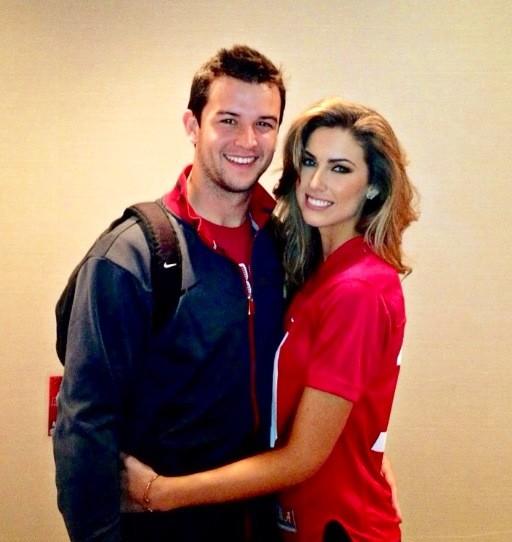
Image from Katherine Webb’s Twitter Account

As the nation watched the Bowl Championship Series National Championship game last night between the University of Notre Dame and University of Alabama, I’m sure fans only expected to watch a football game between the top two teams in the nation. What they also saw, however, was a continuous string of remarksby ESPN commentators about Alabama quarterback A.J. McCarron’s girlfriend Katherine Webb.

During the first quarter of the game, commentator Brent Musburger made remarks about Webb, who is also Miss Alabama, like she was a trophy. “You quarterbacks get all of the good looking women,” he said, as he urged young boys watching to play football in order to date attractive women.

Throughout the game, the camera did close up shots of Webb, bringing more and more attention to the Auburn University alumna.

I watched the game with some of my friends who contributed to the commentary while practically drooling every time she appeared on the screen. When I got angry and asked why they thought that was okay, they answered, “Because she is hot” numerous times.

I couldn’t understand their behavior. The unnecessary comments and explicit names they called her continued until the end of the game (ending in a victory for Alabama).

Then the sexist comments moved online. Webb’s Twitter account went viral in a matter of hours and gained nearly 170,000 followers and there were many creepy tweets directed at her.

Webb hasn’t made a comment about the coverage, but today ESPN released a statement:

“We always try to capture interesting storylines and the relationship between an Auburn grad who is Miss Alabama and the current Alabama quarterback certainly met that test. However, we apologize that the commentary in this instance went too far and Brent understands that.”

Despite the apology, this isn’t the first time Musburger has made inappropriate comments during a game, nor do I think it will be the last time that a sports commentator does so, especially since few people have spoken out against his behavior. On the contrary, I’ve read multiple comments on websites like Bleacher Report from people saying they love him for his antics.

So I am speaking out: no one should be gawked at on national television without their permission, including by ESPN commentators. No one should have to virtually be catcalled by teenage boys and middle-aged men online without their consent.

Our society needs to stop justifying these actions. They help shape a society in which many men think it’s okay to say disrespectful things to women on the streets, on television, and online without much consequence. If I were Webb, I would come out with a statement to discourage these men, because I wouldn’t want to be pinned as anyone’s prize.

Lauren Duhon is a student journalist from LSU in Baton Rouge, La.

Share

Filed Under: correspondents Tagged With: aj mccarron, brent musburger, ESPN, football, katherine webb

USA: New Year, New Challenges

January 7, 2013 By Contributor

By: Carla C. Avenia, Stop Street Harassment Correspondent and Social Media Volunteer

The year 2012 has been full of achievements for Stop Street Harassment and the anti-street harassment community.

But the new year is just a few days young, and women and activists have already had to do a lot of work.

Our first challenge arose as soon as the clock struck midnight on the 31st, when Republican politicians allowed for the Violence Against Women Act to expire, which means that domestic abuse survivors across the country will receive much less help until a new plan is in place.

The mass protests in India after a young woman was harassed and then brutally gang-raped and then died from her injuries are still ongoing. Although a most horrific case, she has not been the only victim of attackers trying to intimidate the anti-street harassment protesters. Another young protester was also gang-raped, and after police tried to convince her to drop the charges and marry one of her attackers, she committed suicide.

Back on our own soil, young men from Steubenville High were caught on camera mocking a rape victim. Parents and other responsible adults surrounding the culprits have engaged in a high-scale cover up operation rather than admit at their failings as parental and authority figures and prosecute these young men.

Just before the new year, the Department of Veterans Affairs published a study in which it is revealed that as many as 48.6% of women who served in war zones claim to have been sexually harassed, while 22.8% of them said they were sexually assaulted or raped.

As you can see from just the last seven days of news, sexual violence against women – whether on the streets, in the workplace, at school, even at home – is still endemic, everywhere. Women of all ages, social backgrounds, races, and religious beliefs are victimized every day.

We have a lot of work ahead of us this year. So what can you do?

Get involved. There are many ways to contribute to the cause!

* Submit your street harassment story and share your experience.

* Report harassers

* Learn how to take action.

* Raise awareness and participate in International Street Harassment Awareness Week, April 7-13, 2013. Go one step further and get your community or your local activist group involved.

Don’t forget to stay in touch with us via Twitter or Facebook!

Carla is a proud feminist originally from Texas, who strongly believes in creating safer spaces for women. She holds a Master’s in Local Development, and she runs her own translation company from France. She is also a travel blogger. You can find her on Twitter.

Her photo was taken by Norman Acosta.

________________________________________________________________________

El año 2012 estuvo repleto de éxitos por parte de nuestra organización, Stop Street Harassment, tales como los que Holly – nuestra intrépida coordinadora – ha detallado en nuestro blog hace unos pocos días.

Aunque el nuevo año recién ha empezado, ya se han presentado varios retos para el 2013 que tanto mujeres como activistas deberán sobrellevar.

Nuestro principal desafío se originó apenas las campanadas dieron la medianoche el 31 de Diciembre, cuando los políticos Republicanos permitieron que la Ley de la Violencia Contra la Mujer caducara, lo cual significa que las mujeres víctimas de maltrato familiar y violencia doméstica en Estados Unidos recibirán menos asistencia hasta que se instituya una nueva Ley para protegerlas.

En la India, protestas masivas han congelado el país luego que una joven fuera sometida a un ataque bestial en el cual fue torturada y violada en banda. Aunque éste ha sido uno de los ataques mas terroríficos, la joven en cuestión no ha sido la única víctima de agresores decididos a intimidar los y las manifestantes que denuncian el acoso sexual en las calles. Otra joven también ha sido victima de una violación en banda, y al ir a declarar los hechos y presentar cargos ante las autoridades, la policía misma intentó convencerla de retirar los cargos y contraer matrimonio con uno de sus agresores. Poco después, se suicidó.

Volviendo a nuestro propio territorio, jóvenes alumnos de Steubenville High fueron filmados burlándose de una joven, víctima de una violación. Los padres y funcionarios escolares dentro del entorno de los agresores intentado encubrir el hecho en vez de admitir públicamente sus falencias en sus respectivas funciones, y hacer lo correcto enjuiciando a los autores del crimen.

Asimismo, a fines del mes de Diciembre, el Departamento de Asuntos de Veteranos publicó un estudio en el cual se reveló que el 48,6% de las mujeres que han prestado servicios en zonas de guerra sostienen haber sido víctimas de acoso sexual, mientras que el 22,8% de ellas declaran haber sido agredidas sexualmente o violadas.

Como se puede deducir a través de las noticias de los últimos siete días, la violencia sexual contra  la mujer – sea en la calle, el entorno laboral, la escuela o hasta en el hogar – todavía es un problema endémico a nivel mundial. Mujeres de todas las edades, entornos sociales, razas y religiones siguen siendo víctimas de la violencia sexual día a día.

Tenemos mucho trabajo para hacer este año. Y seguro que te preguntas… “Y yo ¿qué puedo hacer?”.

Fácil: involúcrate. ¡Existen varias maneras en las que puedes contribuir a nuestra causa!

* Envíanos un relato de cualquier instancia de acoso sexual en las calle que hayas sufrido. Anímate a compartir tu experiencia.

* Denuncia a un acosador.

* Infórmate sobre como actuar frente a una instancia de acoso sexual en la calle.

* Únete a nuestra campaña de sensibilización y haz frente al acoso sexual: participa de nuestra Semana Internacional de Sensibilización Sobre el Acoso Sexual en la Calle, del 7 al 13 de Abril, 2013. Y ya que estás, ¿por qué no ir un poco más allá e involucrar a tu comunidad o a un grupo activista local?

Y claro está, puedes mantenerte al tanto de todas nuestras novedades a través de Twitter y Facebook.

Carla es una feminista Tejana, dedicada a la causa de crear espacios seguros para las mujeres. Obtuvo su Máster en Desarrollo Local, y es la dueña de su propia compañía de traducción basada en Francia. También relata sus aventuras internacionales en su blog de viajes. Síguela en Twitter.

Share

Filed Under: correspondents

« Previous Page
Next Page »

Share Your Story

Share your street harassment story for the blog. Donate Now

From the Blog

  • #MeToo 2024 Study Released Today
  • Join International Anti-Street Harassment Week 2022
  • Giving Tuesday – Fund the Hotline
  • Thank You – International Anti-Street Harassment Week 2021
  • Share Your Story – Safecity and Catcalls Collaboration

Buy the Book

  • Contact
  • Events
  • Join Us
  • Donate
  • Facebook
  • Instagram
  • Pinterest
  • Tumblr
  • Twitter
  • YouTube

Copyright © 2026 Stop Street Harassment · Website Design by Sarah Marie Lacy