• About Us
    • What Is Street Harassment?
    • Why Stopping Street Harassment Matters
    • Meet the Team
      • Board of Directors
      • Past Board Members
    • In The Media
  • Our Work
    • National Street Harassment Hotline
    • International Anti-Street Harassment Week
    • Blog Correspondents
      • Past SSH Correspondents
    • Safe Public Spaces Mentoring Program
    • Publications
    • National Studies
    • Campaigns against Companies
    • Washington, D.C. Activism
  • Our Books
  • Donate
  • Store

Stop Street Harassment

Making Public Spaces Safe and Welcoming

  • Facebook
  • Instagram
  • Pinterest
  • Tumblr
  • Twitter
  • YouTube
  • Home
  • Blog
    • Harassment Stories
    • Blog Correspondents
    • Street Respect Stories
  • Help & Advice
    • National Street Harassment Hotline
    • Dealing With Harassers
      • Assertive Responses
      • Reporting Harassers
      • Bystander Responses
      • Creative Responses
    • What to Do Before or After Harassment
    • Street Harassment and the Law
  • Resources
    • Definitions
    • Statistics
    • Articles & Books
    • Anti-Harassment Groups & Campaigns
    • Male Allies
      • Educating Boys & Men
      • How to Talk to Women
      • Bystander Tips
    • Video Clips
    • Images & Flyers
  • Take Community Action
  • Contact

Post-Election Map of Hate, Including Street Harassment

November 30, 2016 By HKearl

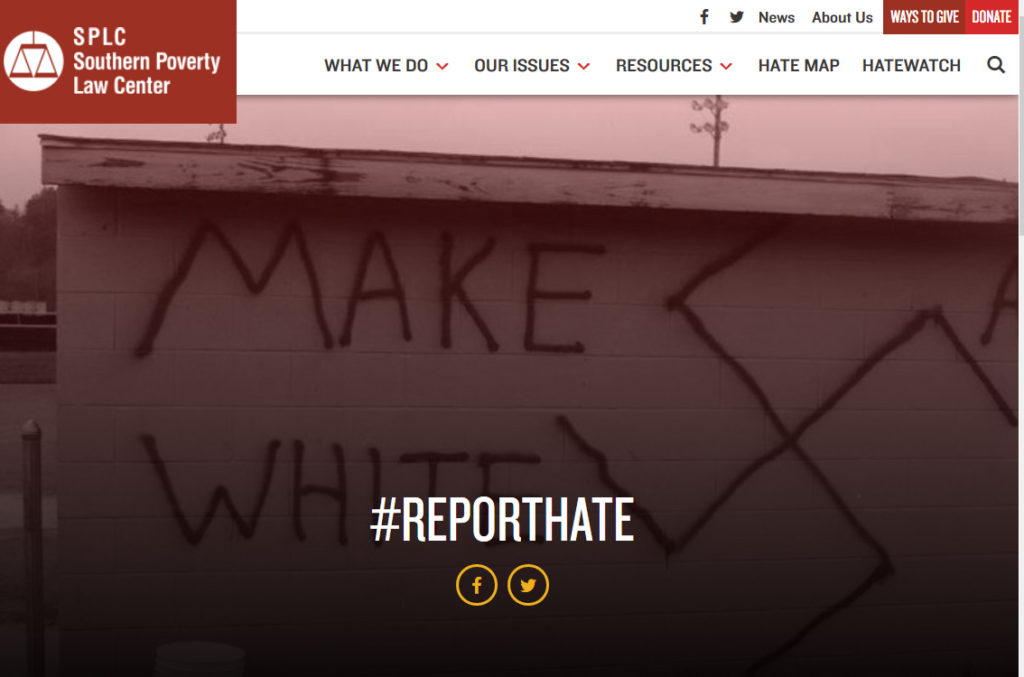
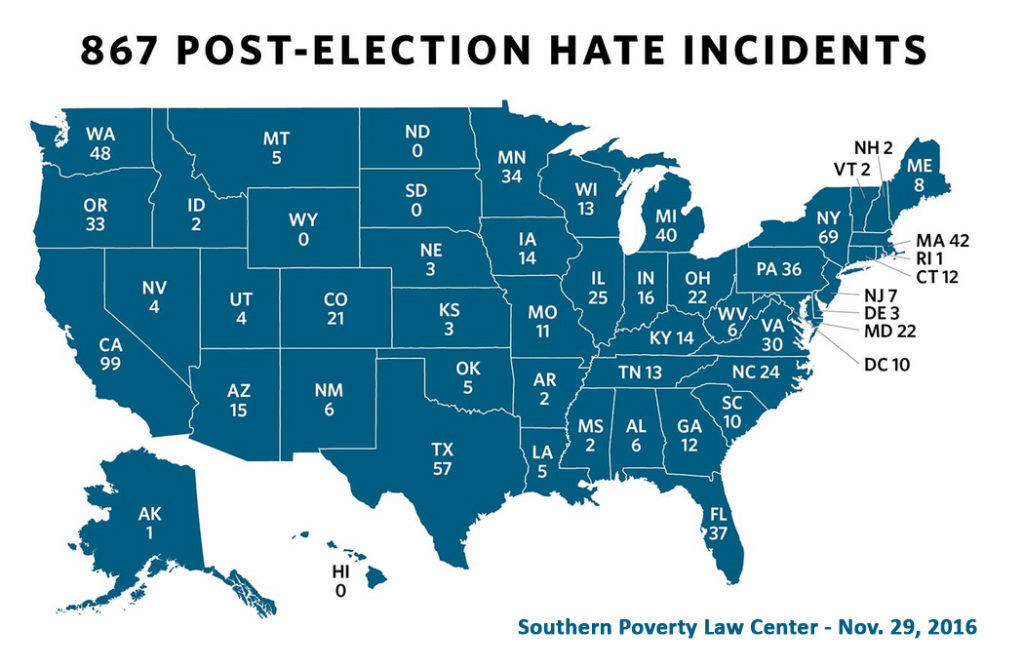
splcnov292016The Southern Poverty Law Center released a new report yesterday on the more than 860 post-presidential election hate incidents that have been reported so far in the United States. You can see the breakdown and learn more about the types of incidents they are tracking here:

  • Introduction
  • Anti-Immigrant Incidents
  • Anti-Black Incidents
  • Anti-Muslim Incidents
  • Anti-LGBT Incidents
  • Anti-Woman Incidents
  • Anti-Semitism
  • White Nationalism
  • Anti-Trump
  • PDF version

Here are examples of the Anti-Woman incidents, which they classify as street harassment.

“Since the election, the frequency and tone of street harassment of women seems to have changed. Women — about 5% of the total reports — reported that boys and men around the country are parroting the president-elect’s sexist and vulgar comments from the now-notorious 2005 audio tape.

In Minneapolis, middle-school boys leaned out of a school bus to yell, “Grab her by the pussy!” to a man walking with a female colleague.

A 50 year-old woman from Venice, California, reported that she had not been “catcalled” in over 20 years. The day after the election, three white men in a pickup truck bearing a Trump sticker shouted at her, “Do you want us to grab your pussy?”

In Arlington, Virginia, a woman crossing the street reported that two young white men yelled at her from their car: “You better be ready because with Trump, we can grab you by the pussy even if you don’t want it.”

In New York, a girl on her way to school reported that a man on the subway told her he was “allowed to grab my pussy because it’s legal now.”

A woman in Spokane, Washington, reported that she encountered young men who she described as being “‘liberated’ from normal behavior since the election.” They shouted “We’re going to rape you!” from a Jeep with the word “TRUMP” emblazoned on its side.

And in a Brooklyn, New York, restaurant, a woman who voiced her support for Hillary Clinton was punched in the face by a male patron.”

If you’ve experienced any of these types of harassment (e.g. anti-immigrant, anti-Black, anti-LGBT, anti-woman), you can report it via this URL or the hashtag #ReportHate.

Related, here is a Ms. Magazine article by Carly Lanning about how Trump is a “trigger” for sexual abuse survivors.

H/T our board member Patrick!

Share

Filed Under: LGBTQ, News stories, race, Resources, street harassment Tagged With: discrimination, election, hate, trump

Two Efforts to Document and Map Hateful Acts, Post-Election

November 18, 2016 By HKearl

Here is an update on places where you can report discriminatory harassment in the USA, since we know there has been an uptick since the Presidential election.

FIRST:

reporthatesplc

The Southern Poverty Law Center (SPLC) is collecting reports of hateful and harassing acts.

On November 18, they wrote:

“This is the second update from the Southern Poverty Law Center’s effort to collect reports of hateful incidents of harassment around the country. This report covers the full week (Wednesday Nov. 9 to Wednesday Nov. 16) since the presidential election.

The SPLC collected reports from news articles, social media, and direct submissions from the #ReportHate intake page. The SPLC made efforts to verify each report but many included in the count remain anecdotal.

While the total number of incidents has risen, the trend line points to a steady drop-off. Around 65 percent of the incidents collected occurred in the first three days following the election.


SECOND:

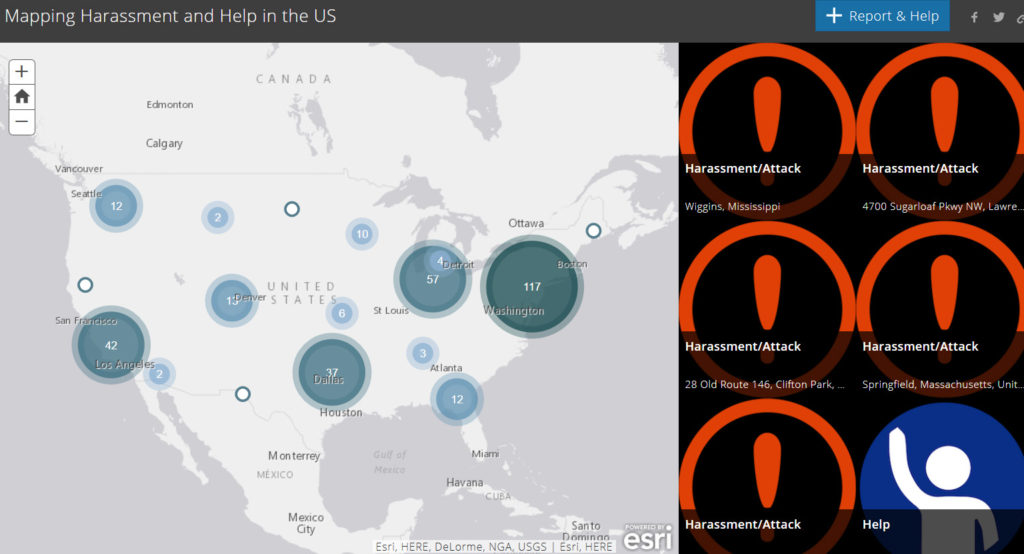
harassmentandhelp

“In the wake of the 2016 US elections reports of harassment and hate crimes directed at minority groups of all kinds have been widespread. The purpose of this multi-team effort is to collect and map reports of harassment and hate crimes against [discriminated against] communities. We also seek to collect and map reports of [discriminated against] communities being helped.

Important: This is not an emergency response system. If you are the victim (or an eyewitness) of harassment/attacks, please call 911.

This project is a collaboration between CrisisMappers, Harvard University, MIT and UCLA.
Contact: contact@harassmap.us”

Share

Filed Under: disabilities, LGBTQ, News stories, public harassment, race, Resources, Stories, street harassment

Late October 2016 News Round-Up

October 31, 2016 By HKearl

Here are some of the global news highlights from the past few weeks:

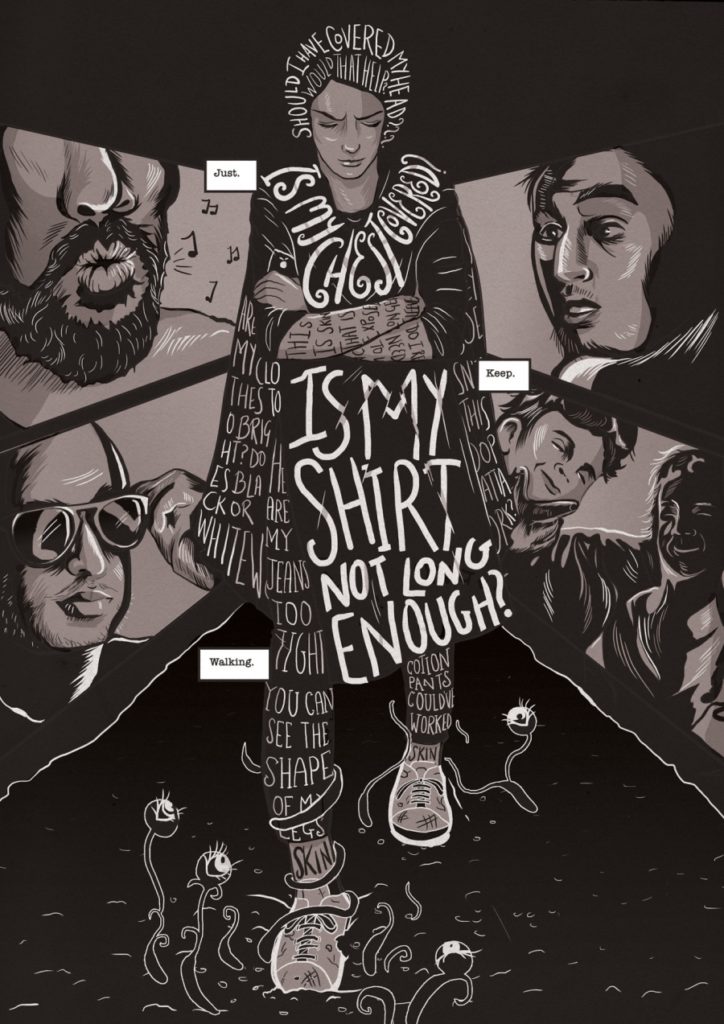
Illustration by Shehzil Malik

Tens of thousands of women marched in Argentina to protest violence against women.

“Respectful relationship” curriculum will be mandatory in all Victoria, Australia, schools next year and students will learn about social inequality, gender-based violence, and male privilege.

A video of a woman walking for two hours in San Jose, Costa Rica, garnered a lot of discussion about street harassment.

A French TV commentator kissed a young woman’s breasts without consent on live TV, sparking a national conversation about sexual abuse.

Thanks to SHE teams launched two years ago in Hyderabad, India, street harassment is down by 20%.

Half of all women in Ireland have faced some form of sexual harassment in their life.

An increase in non-consensual up-skirt recordings in tourist areas in Kyoto, Japan, has prompted more police patrolling.

Women in Morocco are standing up to street harassers.

Illustrator Shehzil Malik in Pakistan created a series of images she called #WomenInPublicSpaces.

A viral video of street harassment in Trinidad prompted the Office of the Prime Minister (Gender and Child Affairs) to state that such behavior is illegal.

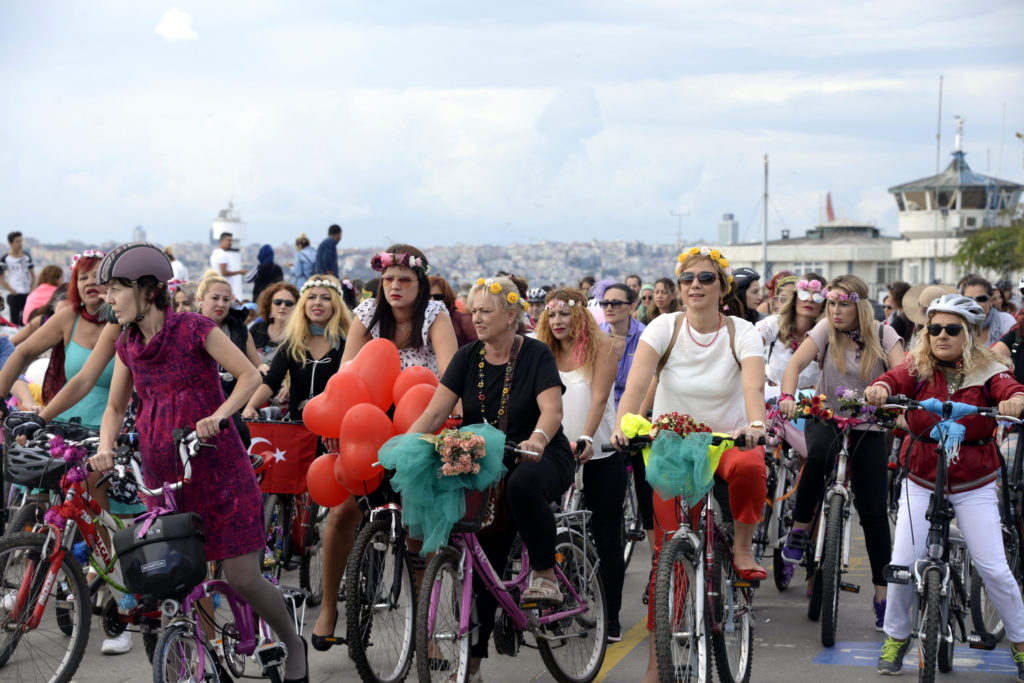
Thousands of women in Turkey dressed in their best and rode bicycles to claim their right to the streets.

fancywomenonbiketurkey2016
Turkey. Via NYT Live

Share

Filed Under: News stories, street harassment

Runner’s World Focuses on Street Harassment

October 27, 2016 By HKearl

I ran my first 5k when I was 8 years old and I began running long distances in middle school. In total, I have 25 years of running under my belt. I use running for stress relief, fitness, to enjoy nature, and to train for races. It’s also a great way to do sightseeing in a new place because you can see more than you can walking but you don’t go zipping by too fast like you might in a car. Sadly, street harassment has marred many of my runs. At least hundreds of men have verbally harassed me, a few have done worse. In my 20s, I realized this is not unusual for women runners. It’s just one more way that we lack safe and equal access to public spaces.

I am so grateful that Runner’s World tackled street harassment and runners by conducting a survey of 4,670 runners and writing a feature article for their December issue. In an unprecedented move, they released the survey results and article online last night. SSH supporter and journalist Michelle Hamilton is the author of the article.

Here is an excerpt, do read the full piece!

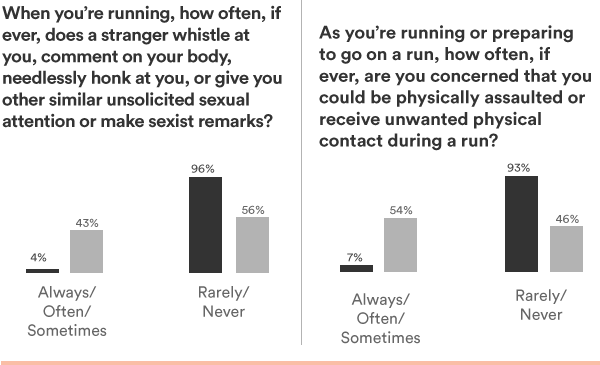
Two of the questions -- black is men, grey is women
Two of the survey questions — black is men’s response, grey is women’s response

“43 percent of women at least sometimes experience harassment on the run, according to a recent RW survey, compared with just 4 percent of men. In the vast majority of cases, it’s not life-threatening. But it is pervasive, and it’s upsetting, and it’s most likely happening to you or someone you know.

A man will look a woman up and down as she runs past. A driver will shout a come-on, laughing with his friends as they speed away. A person on a bike or in a car will follow a woman, and she might dart down a side street to escape. Even if nothing like this happens most days, knowing that it (or something worse) could happen causes stress. As the recent national dialogue surrounding Donald Trump’s sexist comments and alleged assaults brought to light, almost all women—runners or not—have endured unwanted sexual attention. And no matter how swift a woman’s pace, it’s impossible to outrun harassment….

There’s no immediate, easy solution, because sexual harassment is a complex societal problem. But open and honest conversations about the issue—ones that include men as well as women—are a step in the right direction. “Too often, street harassment is normalized and minimized,” Kearl says. “Listening to people’s stories with empathy is important because these actions signal that street harassment is a serious issue.” Kimmel encourages men to speak up when they witness sexist treatment. “If I say nothing, even though I don’t like the behavior,” he says, “other men assume I support it.” Even if female runners can’t be entirely spared of harassment, disrupting the status quo is a place to start.”

Share

Filed Under: News stories, Resources, street harassment Tagged With: runner, runners world, survey

Spain: Including Harassment and Sexual Abuse in Laws

October 24, 2016 By Correspondent

Alice C.R., Barcelona, Spain SSH Blog Correspondent

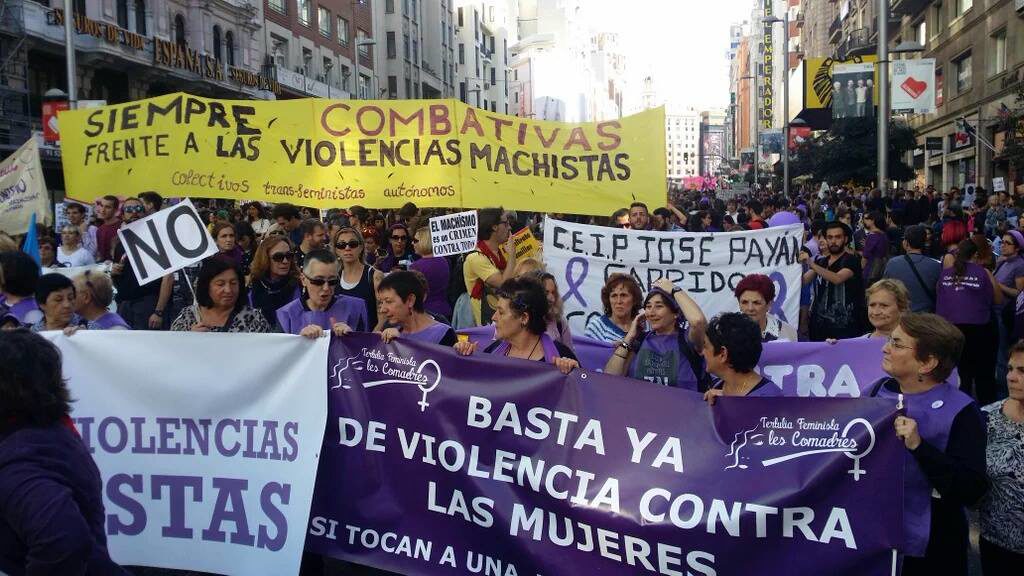
7n-manifestacionRecently, the Nottingham police in the UK decided to treat misogyny, ranging from street harassment to physical attack, as a hate crime. This marks a step forward in the fight against violence against women and stopping street harassment. Some initiatives had already been launched to tackle violence and harassment in public transportation in London in 2013. In Paris, street harassment is sadly common and considered as a “séduction à la française,” and a 2015 study shows that 100% of the women interviewed said they suffered at least one case of harassment. This “French lover” culture is so ingrained, accepted, valorized and glamorized that the decision to institute a plan of action has been virulently criticized and even rejected. Many voices, mainly male voices, raised against this plan arguing it was anti-male and even anti-social. In their arguments, the difference between harassment and even physical assault and an attempt to pick up is shockingly blurred and ignored.

This is especially alarming given how such harassment can escalate to violent crimes like physical assault and rape and even death. In December 2014, a woman was killed with a screwdriver for rejecting sexual advances in a Parisian street close to Bastille. There was also the case of a young woman being harassed, threaten and groped by a man in the Lille metro which has been widely commented on the media. The man admitted he hit on the woman. Cases like this are not unique at all and such frightening stories have been shared by women everywhere in France. Just have a look at Project Crocodiles for example.

Actually, I have to admit that my decision to leave France has been, among others reasons, motivated by the harassment I had to face on a daily basis from the age of 10. Harassment occurred by day, in crowded spaces and while I wrote large trousers and large shirts. Of course I am not saying that harassment is acceptable if we wear skirt or short or a bralette, I just want to emphasize that what we wear does not help to prevent harassment. I always carried a whistle, had my mobile phone ready for calling the police, and held my keys strongly between my fingers. At some point, it was so bad that I asked my boyfriend to come to pick me up at work. That was just unbelievable and such a restriction of movement which I never faced in others countries where I lived. I still feel very unsafe, uncomfortable and, somehow, scared when I have to travel there.

In Barcelona, I found a friendlier environment. I remember being positively surprised to see posters at the entrance of supermarkets indicating what to do in case of domestic violence, to walk down the street and discover new poster from a new public campaign, to get leaflets in the metro explaining how to recognize gendered violence and what to do. I never suffered the same level of harassment here as in France, even when alone at night and wearing a skirt.

I was not yet in Spain in 2004 when the organic law which integrated measures to prevent and fight violence against women was adopted, but I heard a lot about it as a model to follow. This law demonstrates a recognition and an awareness of the issue. But (unfortunately, there is always a “but”) it does not mean that everything is perfect here. It is not.

For too many people, gendered violence means physical domestic violence, but in reality, gendered violence is not limited only to this kind of violence, yet it seems that others violence are a bit excluded. As a matter of fact, if almost everyone agrees that it is not okay to hit someone, it seems that psychological violence, verbal harassment and sexual abuses do not provoke the same reaction. I say “almost” because some people still think it is okay to hit, especially women. This year so far, there have been 35 women killed by their intimate partner and there are 83 if we add women killed by non-intimate partner. And that is the point. A woman who is attacked by her partner is considered to be a victim of gendered violence. A woman who is attacked by a stranger is not and she won’t be allowed to benefit from some measure of protection.

Sexual violence and abuse neither. In fact, they are not included in the organic law of 2004 and associations and organizations like 7N, Stop Violencia Sexual and l’Aadas ask for its inclusion right now. The recent event of San Firmin rape case re-opened the debate.

This law is a good tool to fight violence against women but it needs to include all kind of form of violence. As long as something is not recognized, it is a bit like if it does not really exist or is not very serious. But we all know the impact of such kind of violence. And it is very serious.

Alice likes researching, analyzing and writing about Women’s Rights, gender bias, and intersectionalism with a special focus on sexual violence, rape, rape culture, the impact of street harassment and how the media deals with these issues. She is currently working on a new project focused on how some media participate in the revictimization of victims. Follow her and her projects on her Facebook page and via Twitter @Alyselily.

Share

Filed Under: correspondents, News stories, Street Respect Tagged With: france, law, spain, UK

« Previous Page
Next Page »

Share Your Story

Share your street harassment story for the blog. Donate Now

From the Blog

  • #MeToo 2024 Study Released Today
  • Join International Anti-Street Harassment Week 2022
  • Giving Tuesday – Fund the Hotline
  • Thank You – International Anti-Street Harassment Week 2021
  • Share Your Story – Safecity and Catcalls Collaboration

Buy the Book

  • Contact
  • Events
  • Join Us
  • Donate
  • Facebook
  • Instagram
  • Pinterest
  • Tumblr
  • Twitter
  • YouTube

Copyright © 2026 Stop Street Harassment · Website Design by Sarah Marie Lacy