• About Us
    • What Is Street Harassment?
    • Why Stopping Street Harassment Matters
    • Meet the Team
      • Board of Directors
      • Past Board Members
    • In The Media
  • Our Work
    • National Street Harassment Hotline
    • International Anti-Street Harassment Week
    • Blog Correspondents
      • Past SSH Correspondents
    • Safe Public Spaces Mentoring Program
    • Publications
    • National Studies
    • Campaigns against Companies
    • Washington, D.C. Activism
  • Our Books
  • Donate
  • Store

Stop Street Harassment

Making Public Spaces Safe and Welcoming

  • Facebook
  • Instagram
  • Pinterest
  • Tumblr
  • Twitter
  • YouTube
  • Home
  • Blog
    • Harassment Stories
    • Blog Correspondents
    • Street Respect Stories
  • Help & Advice
    • National Street Harassment Hotline
    • Dealing With Harassers
      • Assertive Responses
      • Reporting Harassers
      • Bystander Responses
      • Creative Responses
    • What to Do Before or After Harassment
    • Street Harassment and the Law
  • Resources
    • Definitions
    • Statistics
    • Articles & Books
    • Anti-Harassment Groups & Campaigns
    • Male Allies
      • Educating Boys & Men
      • How to Talk to Women
      • Bystander Tips
    • Video Clips
    • Images & Flyers
  • Take Community Action
  • Contact

Five Country Study on Women’s Safety in Cities

December 20, 2011 By HKearl

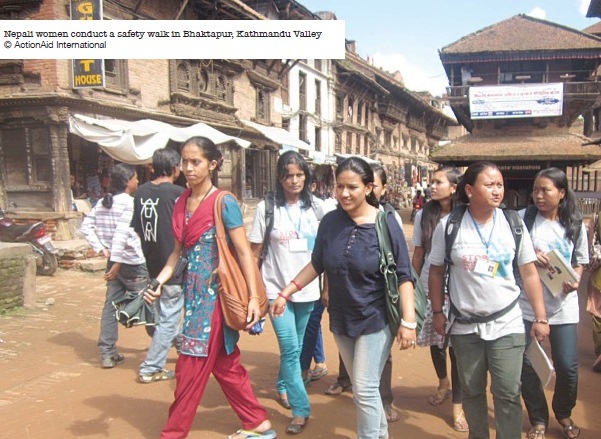
Nepali Women conduct a safety walk

“I carry safety pins with me while travelling. Whenever I feel that I am being harassed by someone around me, I poke him with my safety pin. It alerts the person who is conducting such violence on me. I was taught to do it by seniors in my college. I was hesitant to do it at first, but I found that when my friends did it, the person who harasses tends to back off. So that gave me confidence to use it by myself as well. .. ” – A college student in Nepal

“A woman I know felt safe in this community because of the [gangsters/traffickers] who took care of the community, who watched over everything that happened. But that only gives you security when they don’t have their eye on you [i.e., want to date you]…the man who watched over the entrance to the community one day decided he wanted to go out with her, and he told her to go get dressed up to go out the next day at 7 p.m. If she didn’t go out with him, he was going to kill her children and husband. She didn’t have a choice.” – A woman in Brazil

“When we [are] leaving factory, there are crowd[s] and gangsters often come to touch women’s bottoms and they laugh and feel it’s normal. There have also been instances where workers were sexually assaulted by gangsters during daylight hours.” – A garment factory worker in Cambodia

How safe are public places for women who work in factories in Cambodia, for university students in Liberia, for street vendors in Ethiopia, for women commuters in Nepal, and for women in Brazil?
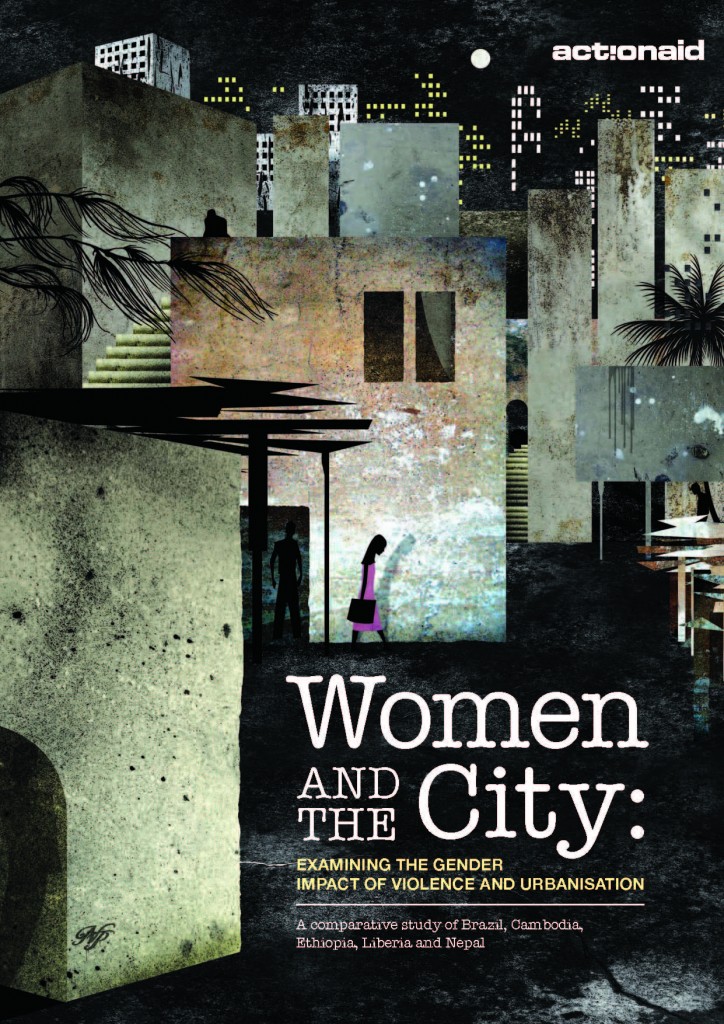
The NGO ActionAid conducted a participatory study to find out the answer. Through using safety audits, focus groups, and mapping, groups of women discussed and showed what about their cities make them feel insecure. Unsurprisingly, there were a lot of reasons why they felt unsafe, including personal experiences of harassment or assault, wariness of local drug traffickers, and poorly lit roads.

The findings from the study and the recommendations for making cities safer for women are available in the fascinating report Women and the City: Examining the gender impact of violence and urbanisation.

I highly recommend reading the report as it provides an in-depth slice of information about five demographics of women in five different countries and because the study was conducted and written in such a way that the women were able to share their stories and speak for themselves.

Through email correspondences, the report author Alice Taylor told me why she thinks the study is important:

“I think it’s crucial to look at issues of how cities are developed and are growing — in ways that are equal and unequal to their citizens — and violence against women together, to see how different kinds of risk factors intersect to influence women’s lives.”

She also spoke to its challenges:

“It was challenging to analyze and bring together such different contexts and approaches into one report, but it demonstrated how prevalent forms of insecurity are for women across urban settings.”

And she shared three findings that stuck out to her the most from her process of writing the report:

“First, the ways in which women constantly have to calculate and avoid routes in their own cities – that was universal.

Second, the finding about the popularity of mapping, which I think holds a lot of promise as a community-based and participatory approach as well as a powerful advocacy tool.

Third, I think there’s a lot to develop in the future in terms of ethics and “do no harm” when doing research on women’s urban safety, as well as monitoring and evaluation to understand what works.

After the five country profiles, the report concludes with six recommendations for making cities safer for women (starting on page 61):

1.      Raise awareness of the problem

2.      Build government commitment

3.      Change social norms for prevention

4.      Build institutional capacity to address the problem

5.      Strengthen networks for advocacy

6.      Conduct research for evidence-based programmes and policies.

Their recommendations aligned closely with the ones I wrote in my book (e.g. raising awareness, changing social norms, and conducting research).

In conclusion, Taylor offers her thoughts on where further research is necessary:

“I think a big question out there, is to further articulate gender analysis around urban safety: which types urban violence/ insecurity are particularly dangerous for women (i.e., poor men experience higher murder rates and are also greatly affected by poverty), why, and what interventions can be designed.”

Share

Filed Under: News stories, Stories, street harassment Tagged With: ActionAid, Alice Taylor, brazil, Cambodia, Ethiopia, Liberia, Nepal, report, street harassment

“Systematic sexual violence against women in Egypt”

December 19, 2011 By HKearl

12/20/11 update, from the New York Times:

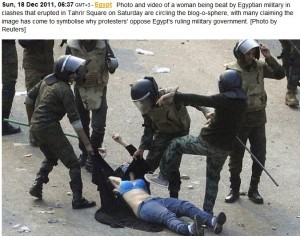
“Thousands of woman marched through downtown Cairo on Tuesday evening to call for the end of military rule in an extraordinary expression of anger over images of soldiers beating, stripping and kicking a female demonstrator on the pavement of Tahrir Square….

The event may have been the biggest women’s demonstration in Egypt’s history, and the most significant since a 1919 march led by pioneering Egyptian feminist Huda Shaarawi to protest British rule. The scale was stunning, and utterly unexpected in this strictly patriarchal society. Previous attempts to organize women’s events in Tahrir Square this year have either fizzled or, in at least one case, ended in the physical harassment of the handful of women who did turn out.”

Marvelous.

Image via Al-Jazeera

Visit the website HarassMap or follow the hashtag #EndSH on Twitter and you’ll find documentation of street harassment and sexual assault in Cairo, including Tahrir Square.

Journalist Mona Eltahawy is outspoken about this atrocity, and last month she brought attention to the sexual assault she and other female journalists experienced while covering protests at Tahrir Square.

Today on CNN, Eltahawy spoke about the brutality of the Egyptian military against protesters. She brought attention to the treatment of women in particular (especially the woman dubbed “Blue Bra Girl“):

“…I hope she survived…I hope she is able to recover… I cannot even begin to imagine what she went through…what this woman went through is incredible on so many levels. I salute her first of all for her courage in being there. And second of all, I think what she does, and especially this picture you are seeing right now, is it exposes once and for all and kills any denial about the Egyptian regime whether it was under Mubarak and now under the military and the use of systematic sexual violence against women in Egypt. It is a shame, it has been denied for too long and we must expose it at every level. And unfortunately, her tragic case has allowed us to do that very publicly…”

As many others have said before, there can be no true revolution until the sexual harassment and violence against women ends.

Update: Eltahawy just spoke to the BBC, too.

Share

Filed Under: News stories Tagged With: Blue Bra girl, Egypt, Mona Eltahawy, sexual assault, street harassment, Tahrir Square

Consequences for street harassers

December 19, 2011 By HKearl

One reason why street harassment is so pervasive is because street harassers rarely face consequences for their actions. But lately, more and more harassers ARE facing consequences, sometimes from the women they target and sometimes from the police.

1 – In Kuwait, after nine men sexually harassed young women at a shopping mall, the police shaved their heads and made them sign a pledge of good conduct in public.

2 – After a soldier groped her, a store clerk in India threw rocks at him on the street, cheered on by passers-by.

Boston groper, via the Boston Herald

3 – When a man groped her on the subway in Boston, a woman took his photo and reported him to the police. He was charged with indecent assault and battery on a person over the age of 14.

4 – A street harasser in Bellingham, Washington, approached two women on a street, making offensive slurs. After one of them said they didn’t want to talk to him, he caused $600 worth of damage to their car. One of the women tackled the man and held him down until a bouncer from a nearby bar came to help. The harasser was was arrested and taken to jail for investigation of malicious harassment, which is a hate crime.

5 – After groping a woman on the street in Romania, a street harasser was chased away by the woman.

YES!

Read 16 other memorable responses to street harassment from this year.

Hopefully each of these harassers will be deterred from harassing again because of the consequences they faced. There’s less incentive for them if they know they could have their head shaved or be chased or hit or jailed.

What kinds of consequences do you want to see street harassers face?

Share

Filed Under: News stories, street harassment Tagged With: consequences for gropers, groping, sexual assault, street harassers

Snapshot of Street Harassment Stories, News, & Tweets: December 18, 2011

December 18, 2011 By HKearl

Read stories, news articles, blog posts, and tweets about street harassment from the past week.

** Sign up to receive a monthly e-newsletter from Stop Street Harassment ***

Street Harassment Stories:

Share your story! You can read new street harassment stories on the Web from the past week at:

Stop Street Harassment Blog

HarassMap Egypt

Resist Harassment Lebanon

Many of the Hollaback sites

In the News, on the Blogs:

* Boston Herald, “Cellphone photo aids arrest in T groping“

* Seattle PI, “Police: man accused of slurs pinned to ground“

* Gulf News, “Kuwait: Nine men get hair shaved for harassing women“

* News Night 20-20, “Girl Beats Up Indian Soldier For Molesting Her“

* The Hindu, “Taking back the streets“

* L’Orient Le Jour, “Harcèlement au Liban : Dans la rue, les femmes inversent les rôles“

* UpTown, “The cloak of anonymity is about to be lifted“

* Notes from an Aspiring Humanitarian, “The People Who Inspire Series: Holly Kearl“

* Heather Hollywood, “Street Harassment: A Verbal Hollaback Call to a Few Good Men“

* The Nation, “Occupy the Holidays“

Announcements:

New:

* The 5th edition of the prestigious textbook Women: Images & Realities, A Multicultural Anthology is now available. For this printing, they included a few pages about street harassment! (see #143)

* Students living in Bangor, Gwynedd, Wales, are encouraged to take a new street harassment survey. The survey is organized by Cymdeithas Y Merched Bangor Women’s Society.

* Attention NYC-based organizations: “Cornell-ILR is partnering with Hollaback! on a research project that includes a survey of NYC-based organizations that seeks to measure the extent to which their clients and staff report street harassment; how they typically respond to reports of street harassment; and whether there’s a perceived need for the development of methods to counteract street harassment”

* Young Women for Change has a lecture and discussion session on street harassment of women on Thursday, December 22nd. More details will be available on their site soon.

Reminders:

* The Adventures of Salwa campaign launched a hotline for sexual harassment cases in Lebanon: 76-676862.

* In Bangalore, India, there is a new helpline for street harassment 080 – 22943225 / 22864023

* Find 6 ideas for holiday gifts that promote safe public spaces.

* You can purchase the Stop Street Harassment book for 50% off right now!

10 Tweets from the Week:

1. ramymamlouk I just stopped 2 OnTheRun employees from harrasing a woman with their eyes. #SayNo to sexual harrassement to #endsh

2. KaylinSnailin Spent the night dreaming about teaching street harassers why street harassment is wrong. I’m not feeling rested, just angry.

3. hipcrit I think the kind of street harassment I hate the most is getting honked at. It’s so startling and loud.

4. Hollaback_DSM Question for our beatifully inked followers: How often do you get #streetharassment based on your tattoos? xojane.com/relationships/…

5. mernathomas #endSH is a call from women to women to end sexual harassment. No one is going to hand u ur rights on a silver platter. #Egypt #womenrights

6. senorita_ex Audio: Shady Hawkins, “WRATH” It’s a song I wrote about street harassment. It’s only a demo, and I might add… tmblr.co/ZJ0yWyDEs0HV

7. KZiegs #streetharassment tally over 4 miles: 3 honks, 1 whistle, 1 8yo yelling “Nice ass, jogger. Don’t stop!” out a school bus. @HollabackBoston

8. nualacabral Just had a productive meeting with an inspiring & brave young woman photographer, Hannah Price: hannahcprice.com/cityofbrotherl… #streetharassment

9. HollabackOttawa Although the weather is getting colder, there seems to be no end in sight for #streetharassment in #ottcity….

10. maps4aid Dadar, Kurla & Andheri are Mumbai’s worst spots for women: Zero Tolerance & Maps4Aid Initial Survey ow.ly/7XMf7 #StreetHarassment

Share

Filed Under: hollaback, News stories, Stories, street harassment, weekly round up

Gender violence at epidemic levels in the USA

December 15, 2011 By HKearl

1 in 5 women in the U.S. is a survivor of rape or attempted rape, according to the National Intimate Partner and Sexual Violence Survey, a 2010 study released yesterday by Centers for Disease Control and Prevention. The first of its kind, the CDC study reveals the US to be a country where violence is rampant, especially against women, and especially against young women.

Via NPR News:

“As many as 29 million women say they have suffered severe and frightening physical violence from a boyfriend, spouse or other intimate partner. That includes being choked, beaten, stabbed, shot, punched, slammed against something or hurt by hair-pulling.

That number grows to 36 million if slapping, pushing and shoving are counted.

Almost half of the women who reported rape or attempted rape said it happened when they were 17 or younger.

As many as 1 in 3 women have experienced rape, physical violence or stalking by an intimate partner in their lifetimes, compared to about 1 in 10 men.

Both men and women who had been menaced or attacked in these ways reported more health problems. Female victims, in particular, had significantly higher rates of irritable bowel syndrome, asthma, frequent headaches and difficulty sleeping.

Certain states seemed to have higher reports of sexual violence than others. Alaska, Oregon and Nevada were among the highest in rapes and attempted rapes of women, and Virginia and Tennessee were among the lowest.”

The findings are not very shocking when you work on issues of gender violence every day. What I want to know is if issues of rape, domestic violence, and stalking will stop being treated as jokes and stop being viewed as non-priorities compared to “real problems,” private matters, and the fault of the victim/survivor. I want to see these issues treated as a national crisis. Because that’s what they are.

Prevention must become mandatory in homes and schools nationwide.

Also, while this didn’t come out in the published study, thanks to input from Shannon Lynberg, co-founder of Holla Back DC!, the survey included questions about street harassment as a form of violence. Holla Back DC! will be interviewing some of the study’s authors to get the data on the prevalence of street harassment. This will be the first time we have national data on street harassment so stay tuned.

About 9,000 women and 7,400 men selected at random took the CDC survey. The CDC plans to conduct this same study annually.

If you are a survivor of sexual assault (woman or man), you can find help at the Rape, Abuse, and Incest National Network‘s online hotline or phone hotline. It’s never too late to seek help, even if the abuse happened decades ago. There’s always time to start or continue your healing process.

Share

Filed Under: News stories Tagged With: CDC study, domestic violence, gender violence, intimiate partner violence, RAINN, sexual assault, stalking, survivor help

« Previous Page
Next Page »

Share Your Story

Share your street harassment story for the blog. Donate Now

From the Blog

  • #MeToo 2024 Study Released Today
  • Join International Anti-Street Harassment Week 2022
  • Giving Tuesday – Fund the Hotline
  • Thank You – International Anti-Street Harassment Week 2021
  • Share Your Story – Safecity and Catcalls Collaboration

Buy the Book

  • Contact
  • Events
  • Join Us
  • Donate
  • Facebook
  • Instagram
  • Pinterest
  • Tumblr
  • Twitter
  • YouTube

Copyright © 2026 Stop Street Harassment · Website Design by Sarah Marie Lacy