• About Us
    • What Is Street Harassment?
    • Why Stopping Street Harassment Matters
    • Meet the Team
      • Board of Directors
      • Past Board Members
    • In The Media
  • Our Work
    • National Street Harassment Hotline
    • International Anti-Street Harassment Week
    • Blog Correspondents
      • Past SSH Correspondents
    • Safe Public Spaces Mentoring Program
    • Publications
    • National Studies
    • Campaigns against Companies
    • Washington, D.C. Activism
  • Our Books
  • Donate
  • Store

Stop Street Harassment

Making Public Spaces Safe and Welcoming

  • Facebook
  • Instagram
  • Pinterest
  • Tumblr
  • Twitter
  • YouTube
  • Home
  • Blog
    • Harassment Stories
    • Blog Correspondents
    • Street Respect Stories
  • Help & Advice
    • National Street Harassment Hotline
    • Dealing With Harassers
      • Assertive Responses
      • Reporting Harassers
      • Bystander Responses
      • Creative Responses
    • What to Do Before or After Harassment
    • Street Harassment and the Law
  • Resources
    • Definitions
    • Statistics
    • Articles & Books
    • Anti-Harassment Groups & Campaigns
    • Male Allies
      • Educating Boys & Men
      • How to Talk to Women
      • Bystander Tips
    • Video Clips
    • Images & Flyers
  • Take Community Action
  • Contact

Street harassment in inner-city communities

September 22, 2011 By HKearl

Street harassment is a normalized experience. Even though it negatively affects our lives, it’s seen as no big deal and the way things are. This normalization is even greater in poor inner-city communities, according to researchers Susan Popkin and Robin Smith, and the negative effect it has on girls is chilling.

On the Urban Institute blog they write:

“People living in poor inner-city communities have to cope daily with levels of violence and drug trafficking that most of us in more affluent neighborhoods can barely imagine. The families we interviewed in Chicago and Los Angeles this past summer who live in public housing or rent with Housing Choice (Section 8 ) Vouchers in poor neighborhoods readily talked about shootings and fights and boys they knew who had been shot and died. But getting them to talk about the sexual violence and harassment that girls experience was harder—not because it was a sensitive subject, but because it was so ordinary.

Dating violence is so common and so visible that the people we interviewed no longer find it shocking. And men and boys in their communities commonly make sexual comments to girls, try to grab them, and pressure them for sex. Girls aren’t safe at school either, where they risk being called “cold” or “gay” if they ignore the teasing or  “fast” or a “ho” if they respond.

Living with daily harassment, coercion, and dating violence takes a toll on girls growing up in these communities and may contribute to the high rates of depression and other health problems there. Our earlier research found that girls whose families used special vouchers to move to less poor neighborhoods were less depressed and anxious than those who stayed behind. When we asked some what was different in the new environment, they talked about how much better they felt getting away from the sexual pressure and harassment…

But not every girl can move to escape sexual torment.  Most poor families can’t afford to live in a better, safer place. Given that, we need to treat sexual coercion and harassment of girls as seriously as more visible gun violence and drug trafficking. For both, we need to come up with both criminal justice and community-building solutions that will help improve the lives of our most vulnerable youth.  If we don’t, chances are these young girls and their children will face the same limited prospects that their mothers have.”

YES. It must be taken seriously and I would love if it was addressed at the same level as gun violence and drug trafficking!

I know there are people who don’t feel comfortable addressing the violence committed by marginalized groups of men against women in their community, but that does a disservice to the women they harass and hurt. They don’t deserve that treatment. Addressing the harassment and violence may require a different approach than harassment and violence committed by non-marginalized me, but it still needs to be addressed.

To expand on that, what I’ve noticed through my research is that men who are marginalized may harass women as a way to exert power when they feel powerless in other arenas of their life. Men who are not marginalized may harass women out of their sense of entitlement. The outcome for women is the same, but again, since some of the reasoning differs, the approach to stop the harassment may need to differ, too. Differences in relationships with police and structural power, as well as possible language or cultural differences have to be taken into account as well.

For more on this topic, check out Jody Miller’s book Getting Played: African American Girls, Urban Inequality, and Gendered Violence. She similarly talks about how sexual violence in dating relationships and by men on the streets is so common for girls and young women and so normalized in their community that bystanders see it happen and don’t blink twice (although the silence of bystanders is frequent no matter the neighborhood). Compared to gang violence and drive-by-shootings boys/men cause and experience, the harassment and violence girls/women face at the hands of boys/men  is dismissed as an issue. She also highlights the negative effect it has on the lives of girls, women, and then the community at large. It’s an important read.

Share

Filed Under: News stories Tagged With: drive by, getting played, Jody Miller, Robin Smith, sexual harassment, shootings, street harassment, Susan Popkin, the hood

Burqa Ban Increases Street Harassment

September 21, 2011 By HKearl

France’s new ban on women wearing burqas and niqab is causing an increase in street harassment for the women who continue to wear them for religious/personal reasons.

Via the Guardian:

“In April, France introduced a law against covering your face in public. Muslim women in full-face veils, or niqab, are now banned from any public activity including walking down the street, taking a bus, going to the shops or collecting their children from school. French politicians in favour of the ban said they were acting to protect the “gender equality” and “dignity” of women. But five months after the law was introduced, the result is a mixture of confusion and apathy. Muslim groups report a worrying increase in discrimination and verbal and physical violence against women in veils. There have been instances of people in the street taking the law into their hands and trying to rip off full-face veils, of bus drivers refusing to carry women in niqab or of shop-owners trying to bar entry. A few women have taken to wearing bird-flu-style medical masks to keep their face covered; some describe a climate of divisiveness, mistrust and fear.

Ahmas, 32, French, a divorced single mother of a three-year-old daughter, puts her handbag on the table and takes out a pepper spray and attack alarm. She doesn’t live on the high-rise estates but on a quiet street of semi-detached houses. The last time she was attacked in the street a man and woman punched her in front of her daughter, called her a whore and told her to go back to Afghanistan.

‘My quality of life has seriously deteriorated since the ban. In my head, I have to prepare for war every time I step outside, prepare to come up against people who want to put a bullet in my head. The politicians claimed they were liberating us; what they’ve done is to exclude us from the social sphere. Before this law, I never asked myself whether I’d be able to make it to a cafe or collect documents from a town hall. One politician in favour of the ban said niqabs were ‘walking prisons’. Well, that’s exactly where we’ve been stuck by this law’….

Only the French police can confront a woman in niqab. They can’t remove her veil but must refer the case to a local judge, who can hand out a ¤150 (£130) fine, a citizenship course, or both….

Kenza Drider, a 32-year-old mother of three, was famously bold enough to appear on French television to oppose the law before it came into force. She refuses to take off her niqab – “My husband doesn’t dictate what I do, much less the government” – but she says she now lives in fear of attack. “I still go out in my car, on foot, to the shops, to collect my kids. I’m insulted about three to four times a day,” she says. Most say, “Go home”; some say, “We’ll kill you.” One said: “We’ll do to you what we did to the Jews.” In the worst attack, before the law came in, a man tried to run her down in his car.”

Ridiculous. This is religious persecution and the ban is being used as an excuse by too many to violently harass women.

I am not in favor of countries that either require women to cover their faces or require that they do not. There are so many complex reasons why women would choose to wear (or not wear) a veil and it’s not right for people who do not wear a veil to put their standards and beliefs on those who do. As long as it harms no one else, women should be free to choose what to wear. And they certainly shouldn’t receive death threats or beatings over that choice!

The article noted that many of the harassers in France are older people, and to me it sounds like they may be afraid of change and don’t like to see the growing diversity in France. But every country is becoming more diverse and that is something old and young need to get used to, not fight with persecution.

Belgium and regions of northern Italy have similar laws banning face veils, while legislators in Denmark, Austria, the Netherlands, and Switzerland are pushing for a ban too. Is it because they are afraid of more diversity in their countries? I seriously wonder because if they really care about gender equality, there are more effective and inclusive measures they could undertake than a burqa ban.

What if each of these countries focused the time/energy/anger they are spending on banning a few hundred women from wearing burqas (and most women are ignoring the ban anyway) on ending the gender wage gap, fostering more women leaders, prosecuting rapists, and making public places safe for all women, no matter what they wear!!

That would be something I’d support.

Share

Filed Under: News stories Tagged With: burka ban, france, muslim women and street harassment, street harassment

Victim-blaming in Indonesia sparks protest

September 19, 2011 By HKearl

“”Wear sensible clothes, don’t wear ‘inviting’ clothes. You can imagine, if [a woman] wears short skirt and sits next to the driver, it could be ‘inviting.'”

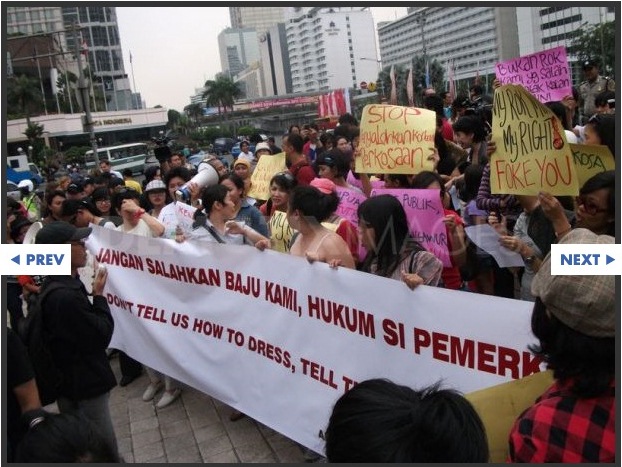
Protestors -- Image via Demotix

This is what Fauzi Wibowo, the governor of Jakarta, Indonesia, said on Friday after a bus driver raped a female passenger late at night this month and after another bus driver and unidentified perpetrators gang-raped and killed a university student.

He has since apologized for the comment.

On Sunday more than 50 people in Jakarta protested the victim-blaming comment and many women wore mini-skirts, something unusual in the most populous Muslim-majority country in the world.

They held signs that read, “Don’t tell us how to dress, tell them not to rape” and “My miniskirt is my right.”

Via the Jakarta Globe:

“‘We are here to express our anger. Instead of giving heavy punishment to the rapists, the governor blamed it on women’s dress. This is discrimination,’ protest coordinator Chika Noya told AFP.

‘Rape is a serious crime against humanity,’ Noya said, adding that the governor should guarantee women’s safety on public transport.

Protester Dhyta Caturani, dressed in a miniskirt and revealing top, said: “The way women dress is not the cause of sexual violence.”

Last year the head of Aceh Barat district stated that women who don’t wear Islamic women clothing are ‘asking to be raped.’ This statement was then rejected by Indonesian Council of Ulema (MUI).”

It is sick that a political leader like a governor would say something so harmful and wrong. Well done to the protesters in Jakarta for not letting his comment slide and for bringing international attention to the victim-blaming taking place in their country.

The protest was inspired by the SlutWalk in Toronto, held in April in response to a victim-blaming comment made by a police officer. Dozens of SlutWalks have taken place around the world to similarly speak out against the all-too-common response of blaming the victim for sexual assault or sexual harassment rather than the perpetrator.

Victim-blaming must end!

(Thanks to The Pixel Project for the story tip)

Share

Filed Under: News stories Tagged With: indonesia, Jakarta, protest, sexual harassment, slutwalk, street harassment, victim blaming

Snapshot of Street Harassment Stories, News, Tweets: September 18, 2011

September 18, 2011 By HKearl

Read stories, news articles, blog posts, and tweets about street harassment from the past week and find relevant announcements and upcoming street harassment events.

Street Harassment Stories:

Share your story! You can read new street harassment stories on the Web from the past week at:

Stop Street Harassment Blog

How Many Women Find Street Harassment Flattering?

Hollaback

Hollaback Baltimore

Hollaback Berlin

Hollaback Birmingham

Hollaback Chandigarh

Hollaback Chicago

Hollaback Columbia, MO

Holla Back DC!

Hollaback Delhi

Hollaback France

Hollaback Houston

Hollaback Israel

Hollaback NYC

Hollaback Ottawa

Hollaback Philly

Hollaback Portland

Hollaback Puerto Rico

Hollaback Queretaro

Hollaback Richmond

Hollaback Tegus (Honduras)

In the News, on the Blogs:

* The Telegraph (Calcutta), “High Court prod to stop eve-teasing“

* Racialicious, “Stanley Kubrick, Chopsticks, and Other Ways to Harass an Asian American Girl“

* HR Daily Advisor Compliance Corner, “Street Harassment”

* Thought Catalog, “Grabbing A Man’s Butt Is Sexual Harassment, Too“

* Flurt! Your source for your life, “Cat Calling: Stopping The Social Norm – ft. Experiment“

* Bronxnet Today’s Verdict, “Harassment and Victims Rights”

* No More Ms. Nice Girl, “Don’t call me sweetheart- My experience with street harassment“

* Feministing, “A trans woman found dead in DC: What is causing this increase in violence?“

* Forbes.com, “3 Reasons Why It Pays to Not Let Sexist Comments Slide“

* Unlimited Bravado, “Episode 1: The Fear of Passion!“

* Feministing, “An Innocent Comment“

* More Magazine, “Get Angry. Go Viral. Use Social Media for Change!“

* Women’s Interests, “Some Thoughts On Street Harassment”

Announcements:

New:

* If you are in the Washington, DC-area, participate in a week of street harassment logging, Sept. 26 – Oct. 2! Info.

* The White House launched a 1 is 2 Many anti-sexual violence/harassment campaign

Reminders:

* Call for men to share views/stories about street harassment

* Sign Mend the Gap’s petition to address subway harassment in Delhi, India

* Are you in Egypt? Use HarassMap to report your street harassers

* Have an iPhone? Download the Hollaback iPhone app that lets you report street harassers

15 Tweets from the Week:

1. pedestrienne Impressed Launceston Pizza Pub staff took seriously & promised to immediately act on complaint of #streetharassment coming from patrons.

2. RukayahSarumi Street harassment is not ok, its not flattering, its not funny or endearing. Oft times its scary and leaves women feeling violated #M4CWomen

3. FionaSavage #streetharassment. Should have said something to the car full of guys on Danforth Ave Toronto 2:30 pm today. Woo hoo yelled at us! WTF!!!!

4. DrtyLttlSecret Do I look like Krispy Kreme? RT @IAmDrTiller “Are you hot and ready baby?” fuck you, asshole. #streetharassment @iHollaback

5. noralambert Was going to ask one of the dudes jogging down the street to walk with me for a bit, but it felt Unfeminist, so I stomped on. #harassment

6. Izbella Seriously like there isn’t enough filth in the street #harassment

7. yashar I’m listening 2 Billy Ocean’s “Get out of the street, get into my car” as an adult, its creepy. #streetharassment cc: @iHollaback @hkearl

8. MT @JBDoubleU man at the bus stop heckled, “I like da way you eat dat banana!” I guess potassium is a turn on. #streetharassment

9. unfortunatalie Then a “whit-t-woo” whistle from a lad on a corner & an “evening gorgeous” from a binman. 5 in one street! #streetharassment

10. MediaCupid Oh, kissing noises. That’s original. #streetharassment

11. muteddragon street harassment needs to stop. I get that I’m a girl and Asian. But that isn’t an open invitation to call me baby or point out the “china”

12. ashcampaign: PLS RT @mayoroflondon Hi Boris, @ken4london supports our campaign against street harassment, do you?

13. DyannaLynn Why can’t I walk home in peace? Street harassment is so real out here.

14. chaele_n_ashley No matter what time it is, what a person wears or whatever other bs reasons people give, street harassment is NEVER warranted or deserved

15. gabbybean I’m so damn sick of street harassment. It’s disgusting. I should be able to walk down the street in peace without being whistled at..

16. FinerFeminist Loving Boston! Walking to work today, two people commented on my earrings. Such a nice reprieve from street harassment. Talking to you PHL

17. wunderkind87 “Street harassment seems to be a method of punishing women/girls for daring to leave the house without a male chaperone.” THIS. #DCLiving

18. hpyhpyjoyjoy Giraffe print trench + busy street = sexual harassment

19. SigourneyRae @puella_absurd There was an interesting correlation with higher rates of street sexual harassment when I was blonde.

20. arikia Great album for coping with street harassment: open.spotify.com/album/1c4fH0GP…

Share

Filed Under: Events, hollaback, News stories, Stories, weekly round up

Biden is right! 1 is 2 many

September 13, 2011 By HKearl

On the 17th anniversary of the Violence Against Women Act, VP Joe Biden (a co-author of the law) announced a new white house initiative called “1 is 2 Many” that focuses on ending violence against teens and young women ages 16-24 because they are the most vulnerable to sexual harassment, sexual assault, and dating violence.

I applaud these efforts and love the campaign name. One assault IS too many. It is unacceptable that anyone should perpetrate such hate and harm. We are a culture and country that prides itself on freedom, liberty, justice, and the pursuit of happiness, but when most girls face harassment and assault simply because they are female, where is their freedom, their liberty, their justice when they report it? How they can fully pursue happiness?

They cannot.

Our country will never be great until teens and young women stop facing sexual harassment and assault everywhere they go:

*from sexual harassment in schools (more than 8 in 10)
*and sexual assault in college (1 in 5)
* to harassment on the streets (nearly 90% of women face this by age 19)
* and in dating relationships (1 in 10).

    Most alarmingly, too many teens also experience the worst betrayal of trust: incest and abuse within their own homes, something I heard about all too often during my 2.5 years as an online hotline counselor for the Rape, Abuse & Incest National Network.

    These are very depressing statistics, especially considering the efforts of many organizations, people, and pieces of government legislation aimed at ending the violence.

    Focusing on prevention is still relatively new and I really appreciate that the white house campaign is focusing on prevention in their campaign. That is the only thing that will create sustainable change. The campaign page states:

    “By targeting the importance of changing attitudes that lead to violence and educating the public on the realities of abuse, the Vice President is leading the way in an effort to stop violence against women before it begins.”

    To start, they are soliciting ideas. They say:

    “As teens and young women across the country head back to school this month, tell us how you think we can make campuses safer for all students and share your ideas for preventing dating violence and sexual assault. From September 13th – the 17th anniversary of the passage of the Violence Against Women Act – to September 27th, use the form to submit your ideas, or use the hashtag #1is2many to share on Twitter.”

    So, share YOUR voice and ideas with the white house. Let us brainstorm and work together to figure out how we can make our society one where girls and women truly can be free and fully pursue happiness.

    Share

    Filed Under: News stories Tagged With: 1is2many, joe biden, sexual assault, VAW, violence against women

    « Previous Page
    Next Page »

    Share Your Story

    Share your street harassment story for the blog. Donate Now

    From the Blog

    • #MeToo 2024 Study Released Today
    • Join International Anti-Street Harassment Week 2022
    • Giving Tuesday – Fund the Hotline
    • Thank You – International Anti-Street Harassment Week 2021
    • Share Your Story – Safecity and Catcalls Collaboration

    Buy the Book

    • Contact
    • Events
    • Join Us
    • Donate
    • Facebook
    • Instagram
    • Pinterest
    • Tumblr
    • Twitter
    • YouTube

    Copyright © 2026 Stop Street Harassment · Website Design by Sarah Marie Lacy