• About Us
    • What Is Street Harassment?
    • Why Stopping Street Harassment Matters
    • Meet the Team
      • Board of Directors
      • Past Board Members
    • In The Media
  • Our Work
    • National Street Harassment Hotline
    • International Anti-Street Harassment Week
    • Blog Correspondents
      • Past SSH Correspondents
    • Safe Public Spaces Mentoring Program
    • Publications
    • National Studies
    • Campaigns against Companies
    • Washington, D.C. Activism
  • Our Books
  • Donate
  • Store

Stop Street Harassment

Making Public Spaces Safe and Welcoming

  • Facebook
  • Instagram
  • Pinterest
  • Tumblr
  • Twitter
  • YouTube
  • Home
  • Blog
    • Harassment Stories
    • Blog Correspondents
    • Street Respect Stories
  • Help & Advice
    • National Street Harassment Hotline
    • Dealing With Harassers
      • Assertive Responses
      • Reporting Harassers
      • Bystander Responses
      • Creative Responses
    • What to Do Before or After Harassment
    • Street Harassment and the Law
  • Resources
    • Definitions
    • Statistics
    • Articles & Books
    • Anti-Harassment Groups & Campaigns
    • Male Allies
      • Educating Boys & Men
      • How to Talk to Women
      • Bystander Tips
    • Video Clips
    • Images & Flyers
  • Take Community Action
  • Contact

Women’s Equality Day Wish: No Street Harassment

August 26, 2011 By HKearl

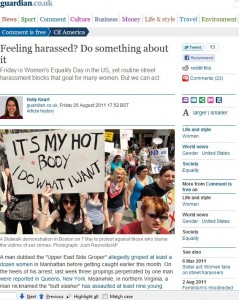
The Guardian just published  an op-ed I wrote for today’s Women’s Equality Day! Check it out and consider leaving a comment.

(By the way, a dozen op-eds and articles I’ve written have been published since I did The Op-Ed Project training last year. I highly recommend it!!)

A man dubbed the “Upper East Side Groper” allegedly groped at least a dozen women in Manhattan before getting caught earlier this month. On the heels of his arrest, last week three gropings perpetrated by one man were reported in Queens, New York. Meanwhile, in northern Virginia, a man nicknamed the “butt slasher” has assaulted at least nine young women in shopping malls across the past few months. He has not been caught.

Aren’t these just unfortunate, isolated, random incidents, you may ask. No.

The news stories simply bring to light experiences that happen to too many women. Recently, when a woman in Astoria, New York, blogged about a man groping her, 45 women emailed her with similar stories. More than half of 800 female survey respondents of a 2008 study said they had been groped or sexually touched in public. The majority of the respondents were only in their teens and twenties. When I was 18 years old, a man groped me on a street near my college campus, making me part of that percentage.

Today is Women’s Equality Day in the United States. But equality is more of a wish than our reality when so many inequalities exist – including women’s unequal access to public places because of gender-based street harassment, including gropings and slashings.

Street harassment comprises actions and comments between strangers in public that are disrespectful, creeping, threatening and unwanted. It ranges from whistling and sexist or sexual comments to flashing, stalking, groping and assault. It primarily impacts women, including more than 80% of women worldwide, and it directly limits their access to public spaces.

The milder forms of harassment like whistling and comments are often dismissed as a compliment – something women “ask for” – or a harmless annoyance. The reality is, they cause harm; and their accumulation can make women feel wary in public and even “choose” not to go places unaccompanied.

For Psychology Today, Dr Kathryn Stamoulis recently wrote about how a teenage girl she counsels confided that she did not want to run errands for her parents or go to school unaccompanied because adult men sexually harass her. Many harassed individuals are like her: teenage girls whose perception of self, of men, and of their place in the world, is negatively impacted by the sexual harassment they face on the streets.

Women who face lots of mild forms of harassment, or just one serious form like groping or stalking, may feel obliged to change commuting routes, only go places accompanied, or even move neighbourhoods, change jobs or quit hobbies to avoid further victimisation. Street harassment genuinely impedes women’s equality by limiting women’s access to public places; it denies them the liberty they should have of being able to walk freely in public without harassment.

Thankfully, more and more people are recognising that street harassment is a barrier to equality and a denial of liberties – and they’re taking action. Ever since New York City councilwoman Julissa Ferreras found out that teenage girls in her district face street harassment on their way to and from school, she has made the issue a priority. Last week, she took to the streets to raise awareness about the rampant groping in Queens, and last fall, she broke new ground by organising the first-ever city council hearing on street harassment.

A college student at Stanford University with whom I’ve corresponded is currently organising a coalition of people and groups in the California Bay Area to advocate for anti-street harassment measures. This summer, she worked with transit authorities to add sexual harassment information to their brochures and website and possibly to start an awareness ad campaign.

In Washington, DC this past spring, 50 volunteers, just ordinary residents of the city, participated in a community safety audit, organised by Holla Back DC! and me. On designated dates, they fanned out across the city to analyse what the streets looked like during the day, and at night, and then made recommendations for how to make the city safer. During the last week of September, we will be encouraging interested persons to keep a “street harassment log” for a week using a log we provide. Because street harassment is under-documented and researched, the goals of these projects are to start documenting harassment better – and to add to the growing number of stories being collected online – so we can then work on solutions.

What can you do to ensure women have equal access to public spaces? Your role can be as simple as sharing a story, talking about boundaries and consent, or helping out when you see harassment occurring. Every action helps and every action can bring us closer to Women’s Equality Day being a reality, not just a wish.

Share

Filed Under: News stories, Stories, street harassment Tagged With: groper, slasher, street harassment, upper east side groper, women's equality day

45 women report gropes on the street in Astoria, NY

August 23, 2011 By HKearl

On the heels of the arrest of the alleged Upper East Side Manhattan groper, the problem of men groping women in public is back in the news after a series of groping reports in Queens, New York.

From the Queens Chronicle:

“If you have breasts, you get hit on. That’s how this neighborhood is,” said Nicolle Loayza, 26. She was talking about Jackson Heights, where she was born and raised. A man accused of groping three women in the neighborhood on two different occasions last July is still at large, said Councilman Danny Dromm (D-Jackson Heights) this week.

On the heels of these attacks and a spate of separate groping incidents reported in Astoria and the Upper East Side, council members Julissa Ferreras (D-Corona) and Dromm stood on the corner of 90th Street and Roosevelt Avenue to pass out fliers with the police drawing of the Jackson Heights groper last week.

In Astoria, various groups, including the New York Anti Crime Agency and the office of Councilman Peter Vallone (D-Astoria), have mobilized to make community members more aware of the problem and help women in the neighborhood.

At least two different men accused of groping Astoria women have been arrested, according to Vallone’s office. Published reports have identified these two men as Miguel Hermenegildo, 33, and Dennis Bryan, 22. A different Queens man, Jose Alfredo Perez Hernandez, 18, has been arrested in connection with gropings on the Upper East Side.

The issue first came to attention last July because of Kate Salute, an Astoria woman who blogged about being groped on “Why Leave Astoria?” prompting an outpouring of similar stories from other women. Salute wrote in an email that some 45 women have since come forward…

In Jackson Heights, Loayza pointed to the spot on Roosevelt Avenue where she said men often wait just to look up women’s skirts when they climb the stairs to the 90th St. 7 train.

She described the time a man grabbed her crotch a few blocks away when she was just 12 years old, and said men often follow her home from the train, catcalling her along the way. However, she has never reported a single incident.

“I’ve learned to deal with it,” she said. “You just walk around the block and try to lose them.”

But Ferreras thinks this is precisely the problem.

“It’s not just about shrugging it off or avoiding a corner,” Ferreras said.

Dromm, Ferreras and Vallone are encouraging women in their districts to continue coming forward.”

At what point does this constitute a hate crime?! 45 women have been groped in one area just for being female in public. What the hell.

I’m glad local leaders are taking action and working to fix the problem and that there was an awareness rally last week. Ladies of Astoria, keep sharing your story!

I’m not surprised Ferreras is one of the individuals speaking out; she called the first-ever street harassment city council hearing in NYC last year. She’s a great advocate for ending street harassment.

Now, the outcry needs to continue until the groping ends.

Share

Filed Under: News stories, street harassment Tagged With: Astoria groper, Julissa Ferreras, street harassment

Street Harassment Snapshot: August 21, 2011

August 21, 2011 By HKearl

Read stories, news articles, blog posts, and tweets about street harassment from the past week and find relevant announcements and upcoming street harassment events.

Street Harassment Stories:

Share your story! You can read new street harassment stories on the Web from the past week at:

Stop Street Harassment Blog

How Many Women Find Street Harassment Flattering?

Hollaback

Hollaback Berlin

Hollaback Birmingham

Hollaback Buenos Aires

Hollaback Chandigarh

Hollaback Czech Republic

Holla Back DC!

Hollaback Des Moines

Hollaback Dortmund

Hollaback Israel

Hollaback Istanbul

Hollaback NYC

Hollaback Philly

Hollaback Queretaro

Hollaback SoCal

Hollaback West Yorkshire

Street Harassment in the News, on the Blogs:

* Psychology Today, “‘Hey Baby’ Hurts“

* Essence, “Real Talk: Protecting Our Girls From Predators“

* NPR, “‘Holla Back DC!’ Calls Out Street Harassment“

* Bell Bajao, “Don’t Call Me, ‘Eve’”

* Richmond.com, “Hollaback! Network Comes To Richmond“

* The Third Estate, “Walk this way?“

* Te Waha Nui, “Women harrassed in the street start to holler back“

* Queens Chronicle, “A different groper in Jackson Heights” and YourNabe.com, “Lawmakers warn residents of E. Elmhurst groper“

* Jezebel, “Woman-Only Earphones are Strong Enough for Him But Made Just for Suckers“

* Yahoo News, “American girl in Italy: 60 years later” and my response on Stop Street Harassment, “‘American Girl in Italy’ DOES Depict Street Harassment“

* Groundswell Voices, “Jonell on Sexual Harassment, Street Harassment and “Hey Shorty!””

* Tip of a Tongue, “Open Letter #2.“

Announcements:

New:

* Are you in Baltimore, MD? A Goucher College student is looking for focus group participants to talk about street harassment as part of her thesis research. Details.

Reminders/On-Going:

* Do you have a stare that can turn #streetharassers to stone? Then participate in the Medusa Gaze Project! http://tinyurl.com/6fhh3tz

* Sign Mend the Gap’s petition to address subway harassment in Delhi, India

* Are you in Egypt? Use HarassMap to report your street harassers

* Have an iPhone? Download the Hollaback iPhone app that lets you report street harassers

10 Tweets from the Week:

1. shani_o: No, old guy on the street that I do not know, I would not like to go to lunch with you

2. wardasahra @e_Chill I speak as a girl, and those street ‘flirts’ never make me smile or grin. They are never welcome and I view it as harassment.

3. sydmosley Despite the fact that #streetharassment sucks, there is a sisterhood, comraderie, mutuality in shared experience that is empowering.

4. femmeniste “Man, I need to get me a white girl,” says guy on the street while pointing at me. #Subtle #streetharassment #comeahhhhhhn

5. clairesgould Thursday night with a side of #streetharassment. Ugh. Come on, DC. The count is getting a bit high for August.

6. sallyzohney Been told harassment verbal n physical in #hussein skyrocketing in ramadan,almost no tourists around,street beggars all around. Sad!@EngyG

7. Salencita Still can’t describe how sad, yet comforted, I am that this tumblr exists howmanywomen.tumblr.com Street Harassment Sucks.

8. FeistyFeminist1 Don’t stare at me until I’m uncomfortable, say “Hey, Baby”, and then chuckle as I scoff & walk away. Asshole. #streetharassment

9. CharriseRenee It’s definitely not polite to beep your horn incessantly or catcall a young lady… #NoBueno

10. evachen212 Just heard a guy catcall a girl (not me, thank god) by shrieking “hey, sugar booger”. men, please note: that is not at all appealing

Share

Filed Under: Events, hollaback, News stories, Stories, street harassment, weekly round up

“Hey Baby” Hurts | Psychology Today

August 20, 2011 By HKearl

Dr. Kathryn Stamoulis writes a column for Psychology Today and yesterday she poignantly wrote about why addressing street harassment matters:

“Leers and derogatory comments are familiar to many women, especially those who live or work in an urban environment. Blasé attitudes towards cat calls, with reactions such as, “it’s no big deal” or “take it as a compliment” act to downplay what is in actuality a form of sexual harassment. Recently I was confronted with the story of a young teenager whose experience reminded me of the serious psychological implications of street harassment.

14 year-old Sarah* was brought to my counseling office by her concerned parents who were worried that she wasn’t exhibiting enough independence for her age. Sarah, they said, was often hesitant to run errands on her own and wanted to be escorted when she walked to and from school. I met with Sarah one-on-one to get her reaction to her parents concerns, and after a few minutes she blurted out “I don’t like old men saying things to me”.

Sarah had been keeping a secret from her parents. On an almost daily basis, men were making sexual comments to her when she was on the street or taking public transportation. These comments ranged from “hey baby” to explicit remarks about her body. To cope with the harassment she had developed strategies such as wearing headphones or pretending to talk on the phone. Despite her resourcefulness, Sarah was forced to become aware of the sexual way in which some men viewed her, when she just wanted to go to her friend’s house or walk to school…..

The frequency of this form of harassment is both shocking and serious in its implications. In Sarah’s case, she was restricting her behavior and fearful of being alone. At a critical stage of development, this fear was hindering her ability to gain confidence by completing tasks independently. She even turned down a job offer to walk her neighbor’s dog, something that could have increased her sense of responsibility and self-esteem.

Aside from its effects on her independence, this harassment could also have an effect on how she views her own body. A study in the Journal of Social Justice Research found that street harassment was related to self-objectification. Self-objectification is a process by which girls learn to think about their own bodies as objects of other people’s desires. Instead of appreciating the body for its abilities, its strengths or its pleasures, a person sees it as something for other people’s enjoyment. Multiple studies have linked self-objectification with an increase in rates of depression, anxiety and eating disorders as well as lower academic achievement.

Harassment and self-objectification are linked to lower academic achievement because they rob a person of valuable cognitive resources. For example, the time Sarah spent being vigilant and pretending to talk on her cell phone was time not spent processing the events of the day at school or mentally preparing for an exam.

Aside from all the negative effects of harassment noted above, most simply the harassment Sarah faced made her enjoy her time less, and that alone is a tragedy….”

(Read the full article)

When I began researching street harassment for a book, it was when I realized just how much street harassment negatively effects women’s and girls’ lives that I decided to channel my passion for equality into this issue. It really is a big deal, especially when we think about its impact on teenage girls.

It’s time to change things.

Share

Filed Under: News stories Tagged With: kathryn stamoulis, psychology today, street harassment

“American girl in Italy” DOES depict street harassment

August 19, 2011 By HKearl

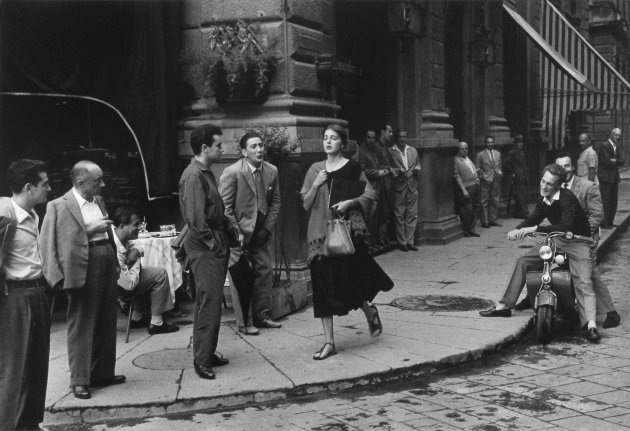
It’s the 60 year anniversary of the famous photograph “American girl in Italy” and the subject of the photo is speaking out.

Via Yahoo News

Last year, I discovered the photo when I saw it at a restaurant. I looked it up and blogged about it. To me, it looked like a very upsetting street harassment experience, especially based on the look on the woman’s face. A few weeks ago the woman in the photograph, Ninalee Craig, commented on my blog post and I was surprised by what she wrote. She said,

“I was that young woman in the photograph. I was 23 years old. It was taken at 10:30 in the morning. It was not set up, or posed. I was walking with confidence in Florence, a city I knew and loved. Yes, it was a corner filled with men, but not for one moment did any of them “harass” or disturb. It was an instant in which I was Beatrice, and among the men, might be a Dante. It was, and remains a delightful memory of an Italy that was. And, still is. Ninalee.”

I thought it was a prankster until someone sent me a link to a Globe and Mail article where Ms. Craig made a similar comment about the photo. Today someone tweeted to me a Yahoo article about it and the article quotes Ms. Craig’s recent appearance on the “Today” show:

“In her “Today” appearance, Craig spoke about how, despite what some might say, the photo isn’t a “symbol of harassment.” Craig insists that the image is “a symbol of a woman having an absolutely wonderful time.”

(I wonder what facial expression she makes when she’s having a miserable time because her “wonderful time” face looks like most people’s “miserable time” face!!)

Her comments beg the question: Does the photograph depict street harassment or not?

I believe that it does. Those men do not know her (she says it was not staged) and in a public place they are grabbing crotches and making faces that suggest they are uttering sexually objectifying comments and sounds. That is street harassment.

Ironically, the photograph was part of a series the photographer Ruth Orkin titled Don’t Be Afraid to Travel Alone, based on their joint experience as women traveling alone in Europe in the 1950s. Orkin photographed Craig shopping in the markets, crossing traffic, riding a carriage and flirting at a cafe. In my interpretation of it, that photo shows discomfort and maybe even fear. It would not entice me, as woman, to want to travel alone through Italy.

And in fact, in college, I originally wanted to study abroad in Italy, but I chose not to after I heard some terrible street harassment experiences from women who had been there (including a shop owner groping a family friend when she was in line to buy food). Italy has a misogynistic culture and street harassment is rampant. Consequently, Italy was one of three countries I highlighted in my book as being street harassment hot zones.

Ms. Craig, however, disagrees with my interpretation and feels it was not harassment and unproblematic.

Women don’t all agree with what is harassment and I’m glad she didn’t feel harassed. I’m glad she has fond memories of it.

I also know that when this photograph was taken, it was a different era. Back then no one knew the term street harassment or even sexual harassment and it was acceptable and expected behavior that women had to deal with. And she dealt with it and continued to have a good time in Italy.  Wonderful.

But I can’t let it go at that. The behavior captured in the photograph IS problematic! It is street harassment even if the subject didn’t feel harassed. If someone is paid less for the same job as someone else because of their race and/or gender that is pay discrimination even if that person doesn’t feel discriminated against!

Street harassment is how some men exert male dominance and ownership over the streets and ensure that women who may not have the fortitude of Ms. Craig choose not to be in public alone, or feel discomfort when they are there. Do you see any other women on the street? No. That is a problem!

The men’s behavior contributes to the lack of gender equality in our society: it keeps women from having the same access to public spaces as men. Even if it doesn’t bother one individual, it bothers most women and contributes to a misogynistic culture.

Your thoughts?

Share

Filed Under: News stories Tagged With: American Girl in Italy, Ninalee Craig, street harassment

« Previous Page
Next Page »

Share Your Story

Share your street harassment story for the blog. Donate Now

From the Blog

  • #MeToo 2024 Study Released Today
  • Join International Anti-Street Harassment Week 2022
  • Giving Tuesday – Fund the Hotline
  • Thank You – International Anti-Street Harassment Week 2021
  • Share Your Story – Safecity and Catcalls Collaboration

Buy the Book

  • Contact
  • Events
  • Join Us
  • Donate
  • Facebook
  • Instagram
  • Pinterest
  • Tumblr
  • Twitter
  • YouTube

Copyright © 2026 Stop Street Harassment · Website Design by Sarah Marie Lacy