• About Us
    • What Is Street Harassment?
    • Why Stopping Street Harassment Matters
    • Meet the Team
      • Board of Directors
      • Past Board Members
    • In The Media
  • Our Work
    • National Street Harassment Hotline
    • International Anti-Street Harassment Week
    • Blog Correspondents
      • Past SSH Correspondents
    • Safe Public Spaces Mentoring Program
    • Publications
    • National Studies
    • Campaigns against Companies
    • Washington, D.C. Activism
  • Our Books
  • Donate
  • Store

Stop Street Harassment

Making Public Spaces Safe and Welcoming

  • Facebook
  • Instagram
  • Pinterest
  • Tumblr
  • Twitter
  • YouTube
  • Home
  • Blog
    • Harassment Stories
    • Blog Correspondents
    • Street Respect Stories
  • Help & Advice
    • National Street Harassment Hotline
    • Dealing With Harassers
      • Assertive Responses
      • Reporting Harassers
      • Bystander Responses
      • Creative Responses
    • What to Do Before or After Harassment
    • Street Harassment and the Law
  • Resources
    • Definitions
    • Statistics
    • Articles & Books
    • Anti-Harassment Groups & Campaigns
    • Male Allies
      • Educating Boys & Men
      • How to Talk to Women
      • Bystander Tips
    • Video Clips
    • Images & Flyers
  • Take Community Action
  • Contact

Bus stop cameras in India, more on eve teasing in Bangladesh

July 15, 2010 By HKearl

As of last month, all bus stops in Central Jakarta, India have sex segregated lines to curb sexual harassment and other crimes. To further curb and address the widespread problem of the sexual harassment of women waiting in line, the Transjakarta public service agency has installed closed-circuit tv’s at all bus stops. The agency is encouraging passengers to report any crime and the cameras can be monitored via the agency’s website. They’ve also started posting female officers at every bus stop. Soon there will be 54 officers at 27 stops.  It’s to see the the issue of harassment taken seriously and I hope these new measures will deter harassers.

In other news for that region of the world, AFP reports about eve teasing in Bangladesh, the spike in suicides among girls who’ve been eve teased by boys and men, why there are so many reports about eve teasing, and what needs to happen for it to end. Here’s an excerpt:

“Some girls even chose suicide as they feel so unsafe. The parents don’t listen to their daughters. Instead they accuse her of being responsible for the harassment,” she told AFP.

Even if parents do listen, they may not be able to help, with ASK evidence pointing to men who try to intervene and prevent bullying often being attacked themselves.

The father of one bullying victim committed suicide and another recently had a stroke — allegedly because he was terrified his daughter’s suicide would be reported in newspapers, ASK said.

Bangladesh, a Muslim-majority nation of 146 million, remains a deeply patriarchal society, and Women’s Minister Chaudhury said the balance of responsibility between the genders had to change.

“I think there is a gradual change in this, and girls are now coming out — they’re raising their voices against it and this is a good thing,” she said.

For Chaudhury, this year’s spike in reported instances of female sexual harassment or bullying is, to some extent, a sign of how successful Bangladesh has been at getting girls into schools and women into the workforce.

“Our females are in school and they are employed, so when they are facing this problem they are coming out with it. Eve-teasing has always happened, but it was not reported as much before,” she said.

But a fundamental transformation in how men treat women looks a distant dream.

At the moment, “perpetrators are being released too easily. If a perpetrator is arrested and the next day he gets bail, the girl is again unsafe and the family is also in danger,” said ASK’s Goswami….

“Bangladeshi girls get little respect in many families, and often boys grow up believing girls are not human beings but sexual objects,” said Dhaka-based psychology professor Mehtab Khanom.

“Traditional attitudes and new technology like mobile phones have combined to change how young people interact and leaving victims, parents and the authorities struggling to respond,” she said.

I hope the government, educators, policy makers, and regular people can work together to overcome this problem. Already the Bangladeshi government has taken action like prosecuting harassers and declaring an Eve Teasing Protection Day.

The US and other countries can learn from these tactics, by first of all acknowledging public harassment to be a problem. Let’s hope it doesn’t take suicides, as it did in Bangladesh, before more people pay attention to the damage street harassment causes.


Share

Filed Under: News stories Tagged With: eve teasing, sexual harassment, street harassment

Stop Commuter Harassment

July 13, 2010 By HKearl

“Imagine you are heading to work on a Monday morning. Over the next 20 minutes you use your commuting time to catch up on e-mail and mentally run through a list of meetings and deadlines. You feel confident as you prepare for your day.

Suddenly a man interrupts you mid-thought to whisper, “Smile for me,” or “Hot bod.” Or gropes you on a crowded subway or follows you in his car. Now you feel angry, offended, possibly scared.

Worse than breaking your train of thought, however, is how you will carry those feelings with you to work. They affect your performance. And if this is the 20th or 100th time a man has harassed you during your commute, you might even consider changing your route, time of commute or even your job to avoid it.”

Read the rest of my article about commuter harassment at Forbes.com, complete with ideas for what employers can do to help keep their employees safe.

Are you harassed during your commute? If so, does it impact your work performance? Have you ever considered changing jobs because of it?

Share

Filed Under: News stories, street harassment Tagged With: commuter harassmsent, Forbes, sexual harassment, street harassment

Weekly Round Up: July 11, 2010

July 11, 2010 By HKearl

Story Submissions Recap:

I accept street harassment submissions from anywhere in the world. Share your story!

  • Stop Street Harassment Blog: There were 8 stories from women in Michigan, North Carolina, Toronto, Washington,  Spain, New York,  Connecticut, and “everywhere.”
  • Hollaback DC!: 8 new stories

Poems:

  • Check out two great anti-street harassment poems on HollaBack NYC!

In the News:

  • A new UN report shows that 2 in 3 women in Delhi, India, faced public sexual harassment 2-5 times in the past year.
  • The Observer covers street harassment, the new LASH campaign in England, and mentions the Stop Street Harassment blog!
  • Op-ed in the NY Daily News about HollaBack’s new iphone app and the grossness of subway harassers, also coverage of the iphone app on The Frisky and Feministe

10 Street Harassment Tweets of the Week:

  • jennifercwang: I am so terrible and vicious to men who sexually harass me on the street. Stop using your tiny dick for a brain and I’ll stop stomping on it
  • beleidy: And if women could walk in the street free of fear of harassment, they wouldn’t take transportation everywhere, even for very short distances
  • JeanGrae: Men, it’s 2010. You still haven’t let go of the “deflating balloon/I have a secret 2 tell you aka PSST” catcall? #dobetter
  • iHollaback: @monasosh Every time I see a baby girl, it reminds me of my 10 yr plan: create a world where they never have to experience #streetharassment
  • praymurray: An amazing, outspoken and fearless initiative 2 deal w/street sexual harassment on the streets of India http://bit.ly/ct9Qy4
  • komurphy: Keep thinking about ystrdy, 1st time I feared 4 my safety due 2 #streetharassment. It was impossible 2 ignore.
  • tekniklr: Dug: “Street harassment puts women in an impossible position. When we do nothing or say nothing, it…” http://bit.ly/aaEnWv
  • alaina_love: The @CatCall-ing has been incessant today. “I like your glasses” & “You look nice but you got a stanky attitude” (my fave).
  • icebergha: If you want to tell a woman she’s pretty, TELL HER! Don’t be disrespectful & catcall, that won’t get you anywhere!!
  • stopstharassmnt: Safe Delhi Campaign PSA shows how the community can play a critical role in making the city safer for wmen & grls http://tinyurl.com/28bwz5g

Announcements:

  • Blank Noise in India is asking for contributions defining Action Heroes in the context of street harassment.
  • Stop Street Harassment: Making Public Places Safe & Welcoming for Women is available Aug. 30. Pre-order your copy today!

Resource of the Week:

Real Men Don’t Holla

Share

Filed Under: hollaback, News stories, Stories, street harassment Tagged With: delhi harassment study, hollaback iphone app, street harassment

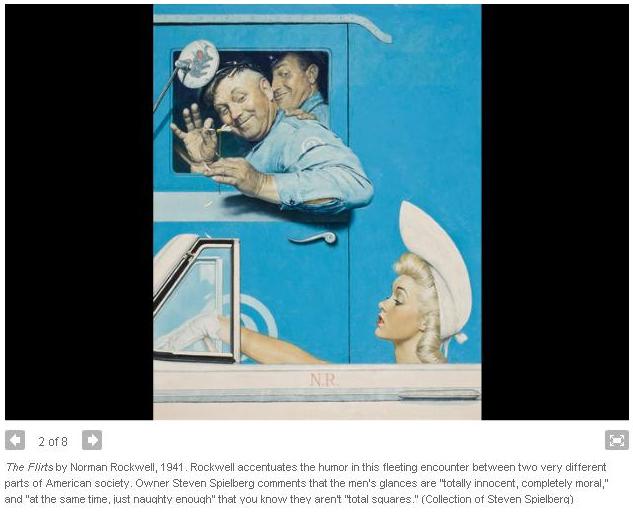
Rockwell’s painting “The Flirts” should be titled “The Harassers”

July 9, 2010 By HKearl

From NPR

Anyone who believes street harassment is a recent occurrence can check out this Norman Rockwell painting “The Flirts” from 1941.

The photo caption, in part, reads:

“Owner Steven Spielberg comments that the men’s glances are ‘totally innocent, completely moral,’ and ‘at the same time, just naughty enough’ that you know they aren’t ‘total squares.'”

Wow. Spielberg and I have different definitions of “innocent” and “moral.” I guess reading hundreds of women’s stories about how much they hate street harassment and studies that show how much it impedes their mobility and comfort in public has left me with zero tolerance for ANY street harassment. Where he sees innocence, I see men purposefully, or at least uncaring-ly, making a woman feel uncomfortable. Where he sees morality, I see male bonding at the expense of a woman.

He also rates them on their performance of masculinity. They’re red-blooded men, a little bit naughty, not squares, so of course they’re going to leer at a woman! Am I right? It’s all in good fun… for the men, that is. Not for women who simply want to go about their day and are barraged by harassing men leering, catcalling, whistling, honking, stalking, and groping them. We are human beings, not objects to ogle and rate!

This painting is part of a new exhibit called, “Telling Stories: Norman Rockwell from the Collections of George Lucas and Steven Spielberg” launching this month at the Smithsonian American Art Museum in Washington, D.C.

To celebrate the exhibit launch, NPR talked with George Lucas and Steven Spielberg and their collections. I’m horrified by quotes from the radio show regarding the above painting, which I think clearly depicts gender-based street harassment.

“Another Rockwell painting is also movielike. In the 1941 Saturday Evening Post magazine cover The Flirts, a pretty blond in a convertible waits at a stoplight. Next to her, hanging out of the window of an immense turquoise truck, a beefy driver picks the petals off a daisy as if to say, “she loves me, she loves me not.”

“He looks at her with a nice smile on his face,” says “Telling Stories” curator Virginia Mecklenburg. “He’s not leery. He’s just being a guy.”

But the pretty blond stares snootily straight ahead and won’t give the driver the time of day. It’s funny in a gentle way — a Rockwell way.

The scene is reminiscent of something out of Lucas’ 1973 film American Graffiti — although the painting is part of Spielberg’s Rockwell collection.

“That certainly could be Richard Dreyfuss looking at Suzanne Somers down there — although she didn’t have a convertible,” he says.

Wow. I have several immediate responses to this discussion.

1. Insulting to men: It is insulting to men to say that the harassers are “just being guys.” Respectful men do not lean out of vehicle windows to leer (I disagree with Ms. Mecklenburg and say that is definite leering) at women in the car next to them. There’s nothing wrong with looking for a second or two at someone nearby, but there is something presumptuous and disrespectful about invading a person’s space by having a laugh with your buddy and pulling off daisy petals in a “she loves me, she loves me not” way while staring at her when she clearly doesn’t want to be bothered.

2. The snooty argument: Calling her “snooty” because she doesn’t want to engage with her harasser is old. How many women have been called “bitch,” “ugly,” “stuck up,” “racist,” and so forth just because they refused to engage in dialogue with a harasser or act thankful over his “compliment?” We are not snooty, we just want to be treated respectfully. I guess in a patriarchal society those mean the same thing.

3. Responses to harassers: If she did respond in a “positive” way to the harassers, would they have increased their attention? Would she be considered a woman with “loose morals” for flirting with strangers in public? I guess she’d still be “snooty” if she had demanded they treat her with respect. Women are damned if they do, damned if they don’t when it comes to dealing with street harassers.

4. What she’s really thinking: How many times have we as women been in the same position as the woman in the painting? Sitting or standing there thinking to ourselves, “Please let the light change…act like you don’t hear them… I wonder if they will follow me? Where is the closest police station I can drive/run to if they do?” We don’t know what men who harass intend to do and so being harassed can be scary, no matter how “innocent” it seems. Especially for rape survivors.

5. Class: This painting emphasizes the stereotype that street harassment is only instigated by lower/working class men toward beautiful, well-dressed women. There are men of all races and classes who harass women, so stereotyping is inaccurate and impedes finding a solution to ending street harassment if it’s dismissed as a class issue. There are women of all appearances, backgrounds, and classes that men harass. In fact, women without cars tend to get harassed the most because they must rely on foot, bike, or public transportation to get around and encounter many more men than someone in a car might and they can be seen as more vulnerable than someone in a car.

6. Humor: I see none. It’s not funny to me that “lower class” men are daring to harass a wealthier woman. I see, hear about, and even experience it (i have class privilege) often. No matter the class, women are still “less” than men, so men of any class can feel free to harass women of any class. And they do – men of all classes harass women of all classes. Where’s the humor? Also, the scene in the painting is not funny for the woman and for me as a woman, it’s not funny to look at her discomfort.

7. American Graffiti reference: Suzanne Somers did not appear to dislike the attention of Richard Dreyfuss. This woman does. It’s been a while since I’ve seen American Graffiti but I don’t remember Dreyfuss’s character acting disrespectful (correct me if I’m wrong). The context for their encounter was different. All of the teenagers in town drove around and tried to find their friends and find someone to hook up with. In contrast, in this scene it’s daytime and the men are on the job and she is heading somewhere and does not want to be bothered. Why is it so hard for people to understand the difference between mutual flirting and men straight up disrespectfully harassing women who want to be left alone?!

I shouldn’t be surprised about the dialogue around this painting of gender-based street harassment when it seems like most people dismiss such harassment as harmless, but I’m still sitting here seething!!

What are your thoughts?

(Also, a big thanks to my wonderful partner who heard this story and immediately recognized it as street harassment and called me up to tell me to check it out.)

Share

Filed Under: News stories Tagged With: George Lucas, Normal Rockwell, NPR, Smithsonian American Art Museum, Spielberg, Telling Stories: Norman Rockwell from the Collections of George Lucas and Steven Spielberg, The Flirt

In Delhi, 2 out of 3 women experience harassment

July 9, 2010 By HKearl

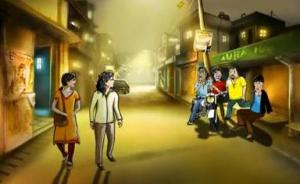
Safe Delhi PSA

Two out of three women in Delhi suffered sexual harassment at least 2-5 times during the last year. Via the BBC:

“Women in the national capital feel unsafe in many public spaces, and at all times of the day and night,” the survey says.

Public transport, buses and roadsides are reported as spaces where women and girls face high levels of sexual harassment.

Most women who were surveyed said buses were the most unsafe form of transport.

Many said the Metro system, which used to be safer earlier, is now equally crowded and unsafe.

The report says the most common forms of harassment are “verbal (passing lewd comments), visual (staring and leering) and physical (touching or groping or leaning over)”.

Women of all classes have to put up with harassment in their daily lives, but students between 15 and 19 years old and women employed in the informal sector are specially vulnerable, the survey says.

The findings come from a “Safe Cities Baseline Survey” of more than 5,000 people who were interviewed during Jan – March of this year, and the survey was commissioned by the NGO Jagori/Safe Delhi, the United Nations Development Fund for Women, and UN Habitat.

The report findings are unsurprising since a study conducted last fall showed that 96 percent of women surveyed in Delhi are afraid to be in public alone because of the high rates of harassment and risk of assault (view a newsclip about the study).

Also,  another survey of women in Delhi from earlier this year tracked their experiences in specific areas of the city and found that 1/3 of the women faced verbal harassment and half of the women felt unsafe there. Several recommendations came out of that survey, including traffic monitoring.

Like most big cities, men’s harassment of women in public places is clearly a huge problem and one that impedes women’s mobility and equality with men. Thankfully, groups like the UN and Jagori/Safe Delhi are addressing this reality.

In addition to surveying people and writing reports, Jagori/Safe Delhi is doing great ground work to make the city safer for women.

  • In June they held trainings on sexual harassment for bus authorities, who are now training the bus driver staff.
  • They’re holding trainings for women about safety measures in August.
  • They’re co-hosting the Third International Conference on Women’s Safety: Building Inclusive Cities, November 22 – 24, 2010 in New Delhi.

Also, check out some of their humorous anti-sexual harassment PSAs on YouTube.

Share

Filed Under: News stories Tagged With: eve teasing, inclusive cities, Jagori, Safe Delhi, sexual harassment, UN Habitat, UNIFEM, women's safety

« Previous Page
Next Page »

Share Your Story

Share your street harassment story for the blog. Donate Now

From the Blog

  • #MeToo 2024 Study Released Today
  • Join International Anti-Street Harassment Week 2022
  • Giving Tuesday – Fund the Hotline
  • Thank You – International Anti-Street Harassment Week 2021
  • Share Your Story – Safecity and Catcalls Collaboration

Buy the Book

  • Contact
  • Events
  • Join Us
  • Donate
  • Facebook
  • Instagram
  • Pinterest
  • Tumblr
  • Twitter
  • YouTube

Copyright © 2026 Stop Street Harassment · Website Design by Sarah Marie Lacy