• About Us
    • What Is Street Harassment?
    • Why Stopping Street Harassment Matters
    • Meet the Team
      • Board of Directors
      • Past Board Members
    • In The Media
  • Our Work
    • National Street Harassment Hotline
    • International Anti-Street Harassment Week
    • Blog Correspondents
      • Past SSH Correspondents
    • Safe Public Spaces Mentoring Program
    • Publications
    • National Studies
    • Campaigns against Companies
    • Washington, D.C. Activism
  • Our Books
  • Donate
  • Store

Stop Street Harassment

Making Public Spaces Safe and Welcoming

  • Facebook
  • Instagram
  • Pinterest
  • Tumblr
  • Twitter
  • YouTube
  • Home
  • Blog
    • Harassment Stories
    • Blog Correspondents
    • Street Respect Stories
  • Help & Advice
    • National Street Harassment Hotline
    • Dealing With Harassers
      • Assertive Responses
      • Reporting Harassers
      • Bystander Responses
      • Creative Responses
    • What to Do Before or After Harassment
    • Street Harassment and the Law
  • Resources
    • Definitions
    • Statistics
    • Articles & Books
    • Anti-Harassment Groups & Campaigns
    • Male Allies
      • Educating Boys & Men
      • How to Talk to Women
      • Bystander Tips
    • Video Clips
    • Images & Flyers
  • Take Community Action
  • Contact

More Women-Only Cars in India

September 16, 2009 By HKearl

from NYTimes
from NYTimes

The NYTimes reports that in India, gender-based street harassment (or eve teasing) is so bad that the government has instituted a pilot program for eight new commuter trains exclusively for female passengers in India’s four largest cities: New Delhi, Mumbai, Chennai and Calcutta. They are called “Ladies Specials” and offer women relief from harassing men. (view a slideshow from NYTimes)

Gender-based harassment of women on public transportation is widespread. There are many countries that have instituted women-only subway or train cars, buses, or taxi cab services because so many girls and women are groped and harassed by men.

For example, some cities in Thailand, Mexico, Bangladesh, Indonesia, Pakistan, and UAE have women-only buses.

Japan, Brazil, Egypt, Iran, Mexico, and South Korea are examples of countries with women-only subway cars in their major cities.

In some places in England, Russia, Australia, Lebanon, Iran, India, and the UAE, there are women-only taxi cabs with women drivers.

In the U.S., transit systems in NYC, Boston and Chicago are all struggling to deal with high rates of harassment. Both NYC and Boston have anti-harassment PSAs on some of their subway cars.

Women-only cars are only a band aid fix that does not fix the overall problem of men harassing women.  Men will still harass them on the platform, in mixed car trains, on streets, in parks, etc.  Separate cars can make women who can’t access women-only cars seem like fair game for harassing men.  In Tokyo, which has women-only subway cars, there were 2,000 groping cases reported last year, 30% were of teenage girls. The crime is underreported, so imagine how much higher the figure may be.  Again, Tokyo HAS women-only cars.  This is not a solution.

Men must be taught to respect women and not see them as available for comment, touching, following, and assault when they are in public simply because they are female. Check out what Blank Noise is doing to address eve teasing in India (they aren’t advocating for separate train cars for women and men).

Share

Filed Under: News stories, street harassment Tagged With: Blank Noise, eve teasing, India, ladies special, new york times, public transportation, segregation, street harassment, train

Harassed on the way to school

September 14, 2009 By HKearl

As the news reminds us almost daily with abduction stories like Jaycee Dugard’s, most Americans realize children are at some risk for abduction from strangers and, as a result, fewer parents allow their young children to go to school alone (though the figure of abductions is smaller than people may realize: 112 children are kidnapped by strangers per year).  I don’t think people realize, however, how many girls and young women are followed, verbally harassed, and touched by boys and men as they wait for a school bus, walk, or ride the subway to and from school, particularly once they reach puberty.

Last fall I conducted an informal online survey about people’s experiences with street harassment and over 900 people responded.  In an open-ended question where people could share a story, many females mentioned the harassment they had or do receive en route to or from school.

“When I was a freshman in high school a girlfriend and I were followed home by a car of teenage boys who shouted remarks and the occasional lewd comment. We veered off our route and onto the campus of the elementary school where we went to a former teacher’s classroom and asked her if we could stay for a while, until we felt sure those guys were gone.”  – 20 -29 year old Anglo American young woman in Murfreesboro, Tennessee

“One day in 8th grade (when I was 13), I was running late. The train was crowded, but I had to get on. As I shoved myself in, a fat man suddenly came out of nowhere and wedged himself in behind me… He started rubbing his crotch against my leg and panting. I was so scared, I didn’t know what to do or say. When the train reached the next stop and a lot of people got off, I tried to get away from him. He followed me and continued rubbing his crotch against my leg … He didn’t stop until more people got off and I finally found a seat.” – 13-19 year old Asian American young woman in New York City

Of the 811 females who took my survey, 22 percent said they were first harassed by men in public when they were ages 0-12, 40 percent said ages 13-15 and 25 percent said ages 16-19.

Unfortunately, harassment of girls on the way to and from school is a global problem, from England to Italy to Brazil to Mexico to Egypt to Mauritius to India to Japan to Canada.

For example, in large cities in Japan, men groping women on the subway is a huge problem. According to a recent article in The Japan Times, last year in Tokyo alone there were 2,000 reported groping cases (and it’s a vastly underreported crime). Most of the attacks occurred during morning rush hour and almost half of the women targeted were in their 20s and more than 30 percent were teenagers.  To combat this problem, there are women-only subway cars and PSAs telling men to stop groping.

Another example is in rural areas throughout African. A recent news story detailed how only an estimated 20 percent of children who enter primary school in rural Zambia complete Grade 12, in large part because of the long distances that they must travel (up to 13 miles) which is tiresome and also places them, particularly girls, at risk of assault and rape. To enable more school attendance, Chicago-based World Bicycle Relief is donating bicycles to children in Africa to help them stay safe as they travel to school.

In the U.S., to combat parents’ fear of child abductions, SafeRoutes works to enable children to more safely travel to school by foot or on bus in an effort to reduce traffic congestion, etc.

I think, however, people need to pay more attention to how boys and men are treating older girls going to and from school.  My research has shown that street harassment impacts females of all ages but, the harassment of teenage girls upsets me the most because I believe they are the most vulnerable to believing this is how women are supposed to be treated and the least likely to know how to respond or protect themselves.

And it should not be girls’ responsibilities to have to protect themselves; boys and men must stop preying upon and harassing young women.  I’m currently writing a book on this topic which will explore ways to accomplish this goal.  In the meantime, here are suggested strategies to share with the young women in your life about dealing with harassers and, if you are a parent or in a position to mentor youth, please especially note #7 for ways to help stop harassment overall.

(cross-posted at AAUW’s blog)

Share

Filed Under: News stories, street harassment Tagged With: jacyee dugard, japan, research, saferoutes, school, street harassment, teenagers, world bicycle relief, zambia

Quick News Cap

September 7, 2009 By HKearl

I’ve been working hard on my street harassment book and took a two day vacation over the weekend, so my posts have been lax the last week – sorry! Here’s a recap of three relevant news stories for the past week or so.

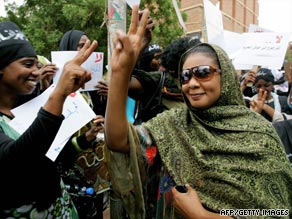
First, today journalist Lubna Ahmed al-Hussein goes on trial again in Sudan. Her crime is wearing pants in public. Rather than take lashings as other women who were arrested did or rather than take immunity from her job with the United Nations she is electing to go through a public trial in an effort to change the laws saying women cannot wear pants in public. Her original trial was scheduled for August but it got rescheduled to today. Best of luck to her!

Second, it’s been one year since the Egyptian Centre for Women’s Rights released its report on the high rate of public sexual harassment in Egypt. Bikya Masr writes about how little things have changed for women since then.

“The government and police have done little to enforce the laws in place, which call for up to one-year in prison and a hefty fine for perpetrators.

“The police chief told another man ‘what if this were to happen to a foreigner or even an ambassador’s wife? Then we would have a problem.’ I felt as if I was being demeaned because I was Egyptian,” said an Egyptian woman who recently took an incident to a local police office. She argued that the police do not seem to put much weight when it comes to average Egyptians complaining of harassment.

And it is Egyptian women who face the brunt of harassment on a daily basis. ECWR agrees, saying that “not addressing this problem leads to total injustice, especially since victims often hesitate to report incidents for lack of confidence in the legal system or fear of being blamed herself.”

Third (and lastly), there is an interesting article in the Yemen Times about street harassment. In January 2009, a survey revealed that most women experience street harassment and for many of them this causes fear and anxiety about going into public spaces. The article from last week covers the role of Sana’a’s police patrol who monitor the street for crimes like street harassment, the low report rate of harassment, and the impact of Sheikhs on negative attitudes about women being in public (punish women who are not modest and not cloistered etc). Educators suggest the importance of teaching both boys and girls not to harass each other and to report people who do.

Share your street harassment story today and help raise awareness about the problem. Include your location and it will be added to the Street Harassment Map.

Share

Filed Under: News stories, street harassment Tagged With: Egypt, Egyptian Centre for Women's Rights, flogging for wearing pants, Lubna Hussein, sexual harassment, street harassment, Sudan, Yemen

Serial groper along "the View"

September 2, 2009 By HKearl

Via WorldWidePhotoWalk
Echo Park, via WorldWidePhotoWalk

In separate incidents, police say an unidentified man grabbed three young girls from behind and groped them as they walked on streets around Belmont and Bellevue streets (“the View”), overlooking Echo Park in Los Angeles, CA. In two of the incidents a lone girl was walking to school along a pedestrian walkway. In a third incident, he groped a 12-year-old girl walking with her mother. Chances are he’s groped other girls who haven’t reported him.

From ABC News in Los Angeles, CA:

“The suspect is described as a Hispanic man with a dark complexion, between 18 and 30-years-old, about 5’4″ tall, around 150 pounds.  He has short black hair, a mustache, and acne.  Anyone with any information is asked to call Rampart Division detectives at (213) 484-3624.”

Share

Filed Under: News stories, street harassment Tagged With: belmont and bellevue streets, california, echo park, los angeles, serial groper, sexual assault, the view

Serial groper along “the View”

September 2, 2009 By HKearl

Via WorldWidePhotoWalk
Echo Park, via WorldWidePhotoWalk

In separate incidents, police say an unidentified man grabbed three young girls from behind and groped them as they walked on streets around Belmont and Bellevue streets (“the View”), overlooking Echo Park in Los Angeles, CA. In two of the incidents a lone girl was walking to school along a pedestrian walkway. In a third incident, he groped a 12-year-old girl walking with her mother. Chances are he’s groped other girls who haven’t reported him.

From ABC News in Los Angeles, CA:

“The suspect is described as a Hispanic man with a dark complexion, between 18 and 30-years-old, about 5’4″ tall, around 150 pounds.  He has short black hair, a mustache, and acne.  Anyone with any information is asked to call Rampart Division detectives at (213) 484-3624.”

Share

Filed Under: News stories, street harassment Tagged With: belmont and bellevue streets, california, echo park, los angeles, serial groper, sexual assault, the view

« Previous Page
Next Page »

Share Your Story

Share your street harassment story for the blog. Donate Now

From the Blog

  • #MeToo 2024 Study Released Today
  • Join International Anti-Street Harassment Week 2022
  • Giving Tuesday – Fund the Hotline
  • Thank You – International Anti-Street Harassment Week 2021
  • Share Your Story – Safecity and Catcalls Collaboration

Buy the Book

  • Contact
  • Events
  • Join Us
  • Donate
  • Facebook
  • Instagram
  • Pinterest
  • Tumblr
  • Twitter
  • YouTube

Copyright © 2026 Stop Street Harassment · Website Design by Sarah Marie Lacy