• About Us
    • What Is Street Harassment?
    • Why Stopping Street Harassment Matters
    • Meet the Team
      • Board of Directors
      • Past Board Members
    • In The Media
  • Our Work
    • National Street Harassment Hotline
    • International Anti-Street Harassment Week
    • Blog Correspondents
      • Past SSH Correspondents
    • Safe Public Spaces Mentoring Program
    • Publications
    • National Studies
    • Campaigns against Companies
    • Washington, D.C. Activism
  • Our Books
  • Donate
  • Store

Stop Street Harassment

Making Public Spaces Safe and Welcoming

  • Facebook
  • Instagram
  • Pinterest
  • Tumblr
  • Twitter
  • YouTube
  • Home
  • Blog
    • Harassment Stories
    • Blog Correspondents
    • Street Respect Stories
  • Help & Advice
    • National Street Harassment Hotline
    • Dealing With Harassers
      • Assertive Responses
      • Reporting Harassers
      • Bystander Responses
      • Creative Responses
    • What to Do Before or After Harassment
    • Street Harassment and the Law
  • Resources
    • Definitions
    • Statistics
    • Articles & Books
    • Anti-Harassment Groups & Campaigns
    • Male Allies
      • Educating Boys & Men
      • How to Talk to Women
      • Bystander Tips
    • Video Clips
    • Images & Flyers
  • Take Community Action
  • Contact

#SafeCitiesBecause

May 20, 2016 By HKearl

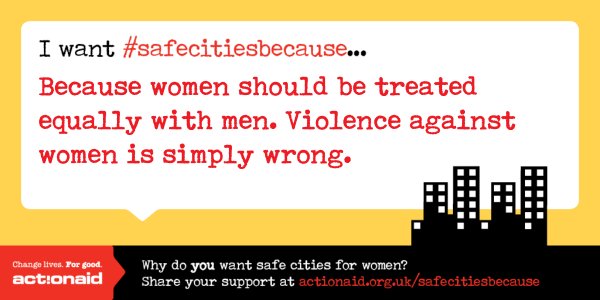
SafeCitiesBecause ActionAid May 2016May 20 marks one year since ActionAid launched their Global Safe Cities campaign. This year, 17 countries are joining part in speaking out against street harassment and other forms of sexual violence in public spaces. They’ll be doing wall painting, radio broadcast and online action. Here’s how you can join in online:

Using the hashtag #safecitiesbecause
1. Add a badge to your FACEBOOK and/or TWITTER photo
i. Go to this link https://twibbon.com/Support/safe-cities-for-women
ii. Click “add to Facebook” or Twitter
iii. Click “Add Twibbon to Facebook”
iv. When you see your profile photo with the badge, please click “Make Profile Picture”
2. Join the 1-Day Tweetathon and commit to tweeting for at least an hour continuously on Safe Cities Day
3. Share and re-share, tweet and retweet. Monitor and watch-out for posts about the Safe Cities day from the ActionAid social media channels and the accounts of the countries participating.

Share

Filed Under: News stories, street harassment Tagged With: ActionAid, safe cities

3-Year-Old Girl in Critical Condition

May 17, 2016 By HKearl

Trigger Warning – Violence escalation

Via Jezebel:

“On Sunday night, a Memphis man opened fire on a woman and her three year-old daughter after she refused his advances. The girl was hit multiple times, and is now in the hospital in “extremely critical condition.”

The gunman, who is still on the run, had had a confrontation with the girl’s mother. Local Memphis reports that, after the woman rejected him, he flew into a rage and fired into the car.”

Sending many positive thoughts out to the mother and daughter with every hope that the three-year-old recovers.

#Streetharassment is a serious issue. Male entitlement is deadly. We must address and end this!

H/T to our board member Laura S. Logan

Share

Filed Under: News stories Tagged With: escalation, girl, killing, memphis

Mid-May 2016 News Round-Up

May 17, 2016 By HKearl

First Post, “Rainbows abound: How the world is celebrating International Day against Homophobia“

“They say there’s a pot of gold waiting at the end of every rainbow. As the world observes International Day against Homophobia, Transphobia and Biphobia (IDAHOT) on 17 May, the LGBTQ community stands unified, doused in rainbow colours, still waiting for its pot of gold.

While 30 countries have legalised same sex conduct, 75 countries still criminalise same sex relationships, 10 out of which condemn same sex relationships as punishable by death, according to Human Rights Campaign, which is a civil rights organisation working for LGBTQ rights in the US. Under such conditions, it becomes imperative that the world shows solidarity by acknowledging the violence and the discrimination that the LGBTQ community still faces, as well as celebrating the advancements.”

BBC, “French female ministers decry sexual harassment“

“Seventeen women who have served as ministers in France say they will no longer be silent about sexual harassment in politics.

All 17 signatories to the declaration are current or former ministers.

Among them is Christine Lagarde, the head of the International Monetary Fund and France’s former finance minister.

On Monday, the deputy speaker of the National Assembly, Denis Baupin, resigned over sexual harassment claims, which he denies.

In the declaration, the women call for a toughening of the law against sexual harassment, as well as specialist desks set up in police stations to deal with such complaints….

Women must be allowed to work, be out in the street, take transport without having to be subject to comments or wandering hands. We shouldn’t have to say it again and again. We shouldn’t have to write this declaration.”

Huffington Post, “Making it Easier to Report Sexual Harassment Isn’t Enough“

“After construction workers sexually harassed women passersby at a 22-acre site in Prospect Heights, New York, the four companies employing them have taken an unusual step. The employees will each wear a different colored hard hat to coincide with their company and they have new badges and hard-hat stickers to make it easier for harassed persons to identify and report their perpetrator.

It is encouraging to see a company take street harassment seriously. But one of the downsides to this plan is that it places the onus on the harassed person alone; they have to take time and use emotional energy to pay attention to what was said or done and by whom and file a report and deal with whatever happens once a report is made.

Making it easier for a harassed person to report is very important, but in general, companies need to do more, especially if they know that some of their employees are harassers.

It’s been 25 years since professor Anita Hill’s testimony during the confirmation hearings of Supreme Court Justice Clarence Thomas made workplace sexual harassment more visible, but sexual harassment is still widespread, including in astronomy, the National Park Service and Hollywood.

While 98 percent of companies have a sexual harassment policy and many hold employee trainings, new research shows that policies and training videos may be doing more harm than good. For example, in one study, men who took sexual harassment training were more likely to blame the victim of sexual harassment and less likely to identify certain inappropriate behaviors as sexual harassment. In another study, employees were more confused about what sexual harassment entailed after the training than before. Gender perceptions of sexual harassment and how it is defined by a company’s policy can play a role in its effectiveness, too.”

DCist, “Sexual Harassment In Bars Is Pervasive, But A New Project Offers Help“

“A new project will help bar patrons figure out which establishments have trained their staffers to intervene in instances of sexual harassment and assault.

Safe Bars has been two years in the making, and is a collaboration between Defend Yourself and Collective Action for Safe Spaces.

“You can just see why bars are the perfect place to intervene,” says Lauren Taylor, co-director of Safe Bars and founder of Defend Yourself. “It’s such an important nexus for dealing with unwanted sexual touching, harassment, or assault.”

Many people, especially women, have had the experience of feeling uncomfortable or even scared at a bar. But it’s not because aggressors are too drunk to know better. Studies have found that people target others who have been drinking. The research concluded that “Prevention needs to focus on addressing masculinity norms of male patrons and staff who support sexual aggression and better management of the highly sexualized and sexist environments of most bars.””

Ahram Online, “Art Alert: Matigi exhibition explores street harassment at Darb 1718“

“Darb 1718 is displaying work by Sayed Arafat, titled Matigi (Won’t you come) and opening on 17 May, where he explores gender roles in Egypt’s patriarchal society and street harassment women are exposed to through his series of monoprints.

The term “matigi” is a suggestive invitation, though it holds many unwelcome connotations on the streets when used as a catcall.

Inspired by personal experiences of the artist’s female friends, the work “captures how women find themselves the objects of gawking, whistles and cat calls from random males in the streets of Cairo,” according to Darb 1718’s description.”

Daily Life, “We need to talk about ‘fatcalling’ – not just catcalling“

“I have been ‘fatcalled’ several times. ‘Fatcalling’ is a term I came up with to describe the abuse fat people, typically women, have hurled at them on the street. In my experience, the mainstream feminist narrative surrounding catcalling doesn’t allow much room for experiences like mine. Instances where I haven’t been objectified because the harasser considers me physically attractive, but instead where I’ve been denigrated because the harasser has decided I am not. Instead of “hey sexy”, I usually get “hey Jabba” (as in Jabba the Hutt, who is the boss of everyone so thanks for saying I’m powerful!!!) or “you’re a whale/hippo”, both of which are extremely cute animals that could crush a human being if they wanted to.

Like many other women, I’ve been dealing with this from a young age, right after I started puberty. Where other women learnt that men saw their bodies as objects of desire, I learnt that men found mine repulsive. Both catcalling and fatcalling are most definitely street harassment, but I’ve found that fatcalling has been discussed less in feminist circles, perhaps because it’s less about sexualising women and more about stripping them of any sexuality whatsoever.”

Las Vegas Informer, “I’m not your shorty“

“More important than criminalizing catcalling, however, is changing the way men are taught to view and talk about women. We need to teach young men that hollering at women just isn’t OK. That a genuine compliment is always nice, but a litany of adjectives to describe women’s anatomy shouted from across the road is not. That they might feel quite cute when they compete with each other to offer up new harangues, but that women do not find them at all witty for doing so.  We need to teach young men that true power isn’t about making women fear you. Such conversations need to happen in homes, schools, churches, and other institutions.  And they need to happen often, starting at a young age.  It’s time we put some more focus on the daily microaggressions that women must endure, rather than treating them as if they’re an inevitable fact of life if you were born with a vagina.”

VICE News, “Women in Mexico City Are Fighting Back Against Rampant Public Sexual Harassment“

“Last month the capital’s authorities decided it was time to show they care about stopping rampant sexual harassment against female commuters in the Mexican capital by flooding the subway system with 1,200 police officers dressed in pink vests. The city government said the force is being deployed at stations throughout the network during the morning and evening rush hours.

“Groping usually takes place during peak times,” said a spokesman at Mexico City’s Public Security Secretary. “Our aim is to stop these uncomfortable situations for women from taking place.”

The new special anti-groping force on the subway was announced after thousands of women took to the streets on April 24 to demand an end to gendered violence of all kinds.

Many wore purple, some carried pink crosses, and others wore clothes with simulated blood stains. The main slogan was “We want to stay alive.” Banners proclaiming “No means no,” and “If one of us gets armed, all of us will respond,” were common.”

My News LA, “Sex hassle on Metro train or bus? Crackdown works“

“The percentage of Metro transit riders reporting sexual harassment on buses and trains continues to decline, Metro reported in releasing the results of the latest survey of transit passengers.

Of the 15,000 customers surveyed in March, 88 percent said they were satisfied or very satisfied with Metro service, while 85 percent said they felt safe while waiting for transit and 88 percent felt safe while riding. The number of passengers who said they had experienced sexual harassment was 18 percent, down from 19 percent in October and from 22 percent in fall 2014.

“Safety is Metro’s highest priority and it is gratifying to see the results of our heightened efforts to train, educate and engage law enforcement and passengers on how we all must do our part to improve the safety of the system,” Metro board chairman and county Supervisor Mark Ridley-Thomas said. “We will not rest on our laurels, but instead redouble our efforts to enhance the positive experience for our riders.””

Fembot Magazine, “How I went from being a catcall apologist, to an anti-harassment activist“

“Internalizations are one of the strongest factors when it comes to street harassment – but they are completely understandable. It is so much easier to accept the hegemonic story that, “nice tits baby!” is a harmless comment rather than something darker, or something that could even get us killed over if we dare protest against. Even harder is confronting your own problematic behaviours. Forgiving yourself for continuing objectification because its comfortable.

I’m thankful for all the fish swimming upstream against public harassment because it gives women and other gender (non)identifying folk a reason to speak up and learn about the deeper causes of catcalling without playing the blame game. It unites us in talking about something that happens on a daily basis.

We only believe the colour purple is purple because we wake up everyday told that’s the way it is. We only believe catcalling is a compliment because, every damn day, we’re told that’s how it is. But, not anymore.”

Revelist, “A disturbing history of getting catcalled as a mixed woman in front of my white mother”

“When puberty hit, I suddenly became an object for sale with various bidders letting me know of my best — and, upon rejection, worst — attributes.

As a woman, my mom wasn’t surprised that my sister and I were being catcalled. But as a white woman (who is also short, very petite, pale and freckled, with green eyes and blond hair) with biracial children (I’m average height and curvy, with dark hair and eyes and light-brown skin), she was unprepared for a new reality — one in which her kid is constantly catcalled in front of her, because people don’t realize I’m her kid at all.”

Tyburn Mail, “Anger at ‘sexist’ ad of woman’s rear“

“The huge ad features a close up of a woman’s rear with the text: “We’re getting ready to reveal our fabulous new rear..! (entrance)… Pert and perfect by June.”
University lecturer Charlotte Barlow says: “This type of campaign objectifies and sexualises women, encouraging them to be viewed as sex objects, and should not be tolerated.

“The fact that the model’s ‘rear’ is the only part of her body that we can see reinforces the status of women’s bodies as objects for the male gaze.”
Dr Barlow lectures in Criminology at Birmingham City University. “Campaigns like this arguably perpetuate street harassment and sexual harassment”, added Dr Barlow.

“Street harassment is a daily reality for many women and this objectification of women’s bodies reinforces the idea that this is acceptable, when such behaviour should not be tolerated and rather viewed as part of a wider continuum of sexual harassment and ‘everyday sexism’.”

“I recognise that there is also a male ‘rear’ that is featured as part of the campaign, but as there is only one such image and four images of women, the sexualisation of the female body is clearly the key focus of this campaign.””

Legal Solutions Blog, “Is Street Harassment A Crime?“

“Amid this increasing focus on women’s rights, the debate surrounding the criminalization of street harassment is unlikely to dissipate.  As women continue to suffer indignity and disrespect (and death), and as foreign nations continue to pass new laws, there will be increased pressure on the U.S. to legislate against what is tantamount to gender hate speech.  It appears Washington, D.C. is already on the right path.”

Timeline, “The panic over potty politics didn’t start with the transgender issue“

“Centuries later in London, no one thought to build public bathrooms for women because no one really expected women to be in public all that much. When women did venture outside the home, it was usually for a short enough time, that they were expected to just hold it. (Molotch calls this sociological phenomenon the “urinary leash.” ) But in case they couldn’t, Sheila L. Cavanagh writes in Queering Bathrooms, adventuresome London ladies of the 1700s carried around “urinettes” made of glass, leather, or ceramic — essentially portable chamber pots. Urinals for men, however, were conveniently located throughout the city.

“One way of dealing with the issue of women’s elimination was to just not acknowledge that women had a public life,” he said.

Gender scholars call this the “separate-spheres ideology.” In early 19th century America, for example, trains included one car for women — it was always the last car so that if the train crashed, they stood the best chance at survival. When public libraries opened in the mid-1800s, women had separate reading rooms. Hotel lobbies were built to include women’s resting rooms.”

Quartz, “The “bystander effect” keeps catcalling alive. Let’s train ourselves to take action“

“In sum, research suggests that bystander intervention is one of the most promising ways to combat street harassment and the sense of powerlessness that it cultivates in communities.

“When street harassment is common, all women will be on edge, worried, and wondering if they’ll be next,” Fairchild says. “The mental energy spent on vigilantly looking out for possible harassment and steeling oneself to ignore it takes away from our creativity and drive. Active bystanders can be wonderful allies to help make the streets more welcoming.”

The Conversation, “We want men to stop honking their horn at women because they respect them, not for fear of punishment“

“Ensuring street harassment is included within government policy and prevention efforts addressing gender-based violence could help to shift perceptions of this behaviour as “not serious” and actively locate it as a form of harm.

Given many of my participants’ experiences were inflected with elements of homophobia, transphobia, racism and ableism (discrimination against people with disability), this suggests that we need to look beyond gender-based inequality if we are to prevent all forms of street harassment.

We know from other violence prevention and anti-bullying work that a whole-of-community approach works best in shifting cultural attitudes and behaviours. While efforts such as the London campaign and hotline are a good start, these types of actions cannot occur in isolation if they are to be effective.”

Share

Filed Under: News stories, street harassment Tagged With: Australia, bystander, Egypt, fat-calling, france, laws, mexico, offensive ads, subway, transit, UK, usa

Woman Chases Creep in Florida

May 4, 2016 By HKearl

A major creeper/harasser in Florida was caught after he harassed Candice Spivey in the same way twice. This time, she chased him out of the store (see video) and he’s been arrested.

Via Daily Mail:

candice
Image via NY Daily News

“He starts out his conversation with the same punch line he uses here in the very beginning of this video saying: “Hey there I don’t mean to bother you but I just bought this maxi dress for my wife at Ross and I was kinda worried about the sheerness of it,”‘ she said.

From the innocent opening line, she said the questions soon got ‘extremely inappropriate.’

‘For instance he starts asking his wife should wear the maxi dress with no panties, and if she should shave “down there” trying to make it seem very innocent in the way he’s asking. He then asks if you’re wearing panties, etc.

‘Whiles he’s asking these questions he’s filming you with his cell phone, and I knew he was by the way he was holding his phone.’…

The suspect had jumped in his vehicle and sped away – directly in front of a police car responding to the incident at the store, she added.

After a short police chase, he was pulled over and arrested for reckless driving….

Police confirmed Polizzi has previously been charged with video voyeurism and issued an appeal last week for any other potential victims to come forward.

Since then, scores of women have complained that they were approached by the man in similar scenarios.

Nassau County Sheriff’s Office posted: ‘Omg, so many! Please contact Det. Kelley, we want to keep a record. We appreciate it if you do.'”

Good for her!

Share

Filed Under: News stories, street harassment

End of April 2016 News

April 30, 2016 By HKearl

More recent news:

USA Today, “China introduces female-only bus service“

“A female-only bus service aimed at protecting women from sexual harassment launched this week in China, drawing praise and criticism.

The Zhengzhou 3rd bus company introduced the service on a popular route in the central city of Zhengzhou. It will run during busy commuting hours until early August.

“During the summer, women usually wear thinner clothes, making it easier for them to be harassed in crowded buses. … The all-female service will increase their convenience and safety,” said Kong Chaoping, the firm’s chairman, according to the Beijing Youth Daily newspaper.

The buses are recognizable by their big red signs that read, “Female-only.” They have stuffed animals and other kids’ toys suspended from the ceiling.

Sexual harassment is a common yet largely ignored problem on China’s public transportation system. More than 50% of women have experienced inappropriate touching or body contact while using the country’s trains and buses, a survey by the China Youth Daily newspaper found last year.

In 2014, the Women’s Federation of Guangzhou, a state-affiliated group, found that 85% of all sexual assaults in Guangzhou, a city in southern China, occurred while victims used the city’s public transportation network.”

Quartz, “Thousands of Mexican women are talking about sexual harassment for the first time“

“Rarely publicly acknowledged in Mexico, sexual harassment is being surfaced via Twitter hashtag #MiPrimerAcoso, or #MyFirstHarassment, by women posting their first experiences with male bullying and by others wanting to have an open discussion. Hundreds of thousands of posts have circulated in the last three days.

The drive, started by a Colombian columnist (link in Spanish) on Saturday, is reinforcing the issue after demonstrations Sunday (April 24) in Mexico City and other major cities attracted thousands of women. The Twitter record, a poignant collection of heartfelt confidences, will probably prove more powerful…

#MiPrimerAcoso reveals that many women first experienced harassment as girls, as young as five and six years old. The perpetrators of the abuse span a wide range, from relatives—older cousins and uncles are mentioned frequently—to policemen, to random strangers, and in one case, a therapist.”

Waging Nonviolence, “Mexican feminists declare a ‘violet spring’ on nationwide day of action“

“Tens of thousands of feminists protested across Mexico on Sunday, amid what they say is an epidemic of violence against women.

“We’re sick of suffering all kinds of abuse when we just walk in the street,” said Mari, a protester in the central Mexican city of Puebla, who was joined by hundreds of activists in Puebla’s city center, demanding justice for victims of femicide.

When the march reached the state government offices, activists accused local authorities of failing to bring perpetrators of violence to justice. One masked protester shouted, “The government here in Puebla lets them get away with impunity,” adding, “This isn’t just in Puebla, but all of Mexico.”

Declaring a “violet spring,” protesters called on women across Mexico to take a stand against sexism. One of the largest protests took place in Mexico City, where organizers railed against Mexico’s traditionally machista, or sexist, culture.

“It is evident that we need social re-education — to teach men not to harass, not violate, not hit, not threaten, not enslave, not abuse and not kill women and girls,” organizers said in a statement.”

The Verge, “India mandates panic button on all phones to help keep women safe“

“All mobile phones sold in India will be required to have a panic button as of next year, the country’s telecommunications ministry announced this week, as part of an effort to enhance safety for women. As Bloomberg reports, the order requires handset makers to implement an emergency feature that could be activated by holding down the numbers 5 or 9 on a keypad. The function will be mandatory on all phones by January 1st, 2017, while GPS navigation systems will be mandatory on all devices by 2018.

Women’s safety in India has drawn worldwide attention following reports of gang rapes and other forms of violence. There were more than 330,000 reported cases of violence against women in 2014, according to government statistics, up 9 percent from the previous year. The issue has spurred some companies to develop apps and services that make it easier for women to contact emergency services. India’s minister for women and child development, Maneka Gandhi, pushed for mandated panic buttons last year.”

‘Technology is solely meant to make human life better and what better than using it for the security of women,’ Communications Minister Ravi Shankar Prasad said in a statement.”

attn: “This Man’s Attempt to Take Upskirt Photos Just Backfired in an Extreme Way“

“A shocking piece of footage, in which a man eats his camera’s memory card after being caught allegedly filming upskirt videos, is gaining international attention.

According to the Chinese Publication People’s Daily, the video was filmed by a woman caught the alleged Peeping Tom in the act while riding the subway. The woman who shot the footage goes by the name Xiao Cha Cha A, Daily Mail reports. She posted the video on the Chinese social media service Weibo, with a caption reading, “I had tried to block his view a few times but he kept on taking them. I must expose him!”

In the video, the Xiao Cha Cha A is seen tugging at the man’s bag, and yelling, “delete the pictures, delete them. Look everybody, here is a pervert who takes upskirt pictures of women,” Daily Mail reports.

The man then eats his SD card. It is unclear if the woman forces him to do so, or if he eats the card voluntarily to destroy the evidence. In the final seconds of the 1:01-long video, the man can be seen fleeing the subway car.”

The Source, “[Los Angeles] Metro’s new anti-sexual harassment video“

“Metro launched its “Off Limits” campaign last spring in an effort to reduce sexual harassment on buses and trains. The campaign was a direct response to riders identifying this as an issue in Metro’s customer surveys.”

Share

Filed Under: News stories Tagged With: china, India, los angeles, mexico, phone app, public transit

« Previous Page
Next Page »

Share Your Story

Share your street harassment story for the blog. Donate Now

From the Blog

  • #MeToo 2024 Study Released Today
  • Join International Anti-Street Harassment Week 2022
  • Giving Tuesday – Fund the Hotline
  • Thank You – International Anti-Street Harassment Week 2021
  • Share Your Story – Safecity and Catcalls Collaboration

Buy the Book

  • Contact
  • Events
  • Join Us
  • Donate
  • Facebook
  • Instagram
  • Pinterest
  • Tumblr
  • Twitter
  • YouTube

Copyright © 2026 Stop Street Harassment · Website Design by Sarah Marie Lacy