• About Us
    • What Is Street Harassment?
    • Why Stopping Street Harassment Matters
    • Meet the Team
      • Board of Directors
      • Past Board Members
    • In The Media
  • Our Work
    • National Street Harassment Hotline
    • International Anti-Street Harassment Week
    • Blog Correspondents
      • Past SSH Correspondents
    • Safe Public Spaces Mentoring Program
    • Publications
    • National Studies
    • Campaigns against Companies
    • Washington, D.C. Activism
  • Our Books
  • Donate
  • Store

Stop Street Harassment

Making Public Spaces Safe and Welcoming

  • Facebook
  • Instagram
  • Pinterest
  • Tumblr
  • Twitter
  • YouTube
  • Home
  • Blog
    • Harassment Stories
    • Blog Correspondents
    • Street Respect Stories
  • Help & Advice
    • National Street Harassment Hotline
    • Dealing With Harassers
      • Assertive Responses
      • Reporting Harassers
      • Bystander Responses
      • Creative Responses
    • What to Do Before or After Harassment
    • Street Harassment and the Law
  • Resources
    • Definitions
    • Statistics
    • Articles & Books
    • Anti-Harassment Groups & Campaigns
    • Male Allies
      • Educating Boys & Men
      • How to Talk to Women
      • Bystander Tips
    • Video Clips
    • Images & Flyers
  • Take Community Action
  • Contact

Lakers Players Street Harass Advocate

March 23, 2016 By HKearl

Alexis Jones via her personal website

On Instagram this week, Alexis Jones posted photos of four men who street harassed her and her 68-year-old mother in Hollywood, California. The men were in a vehicle next to theirs and made “vulgar, sexual gestures”, causing the women fear and her mother to cry. Later they learned that two of the men were Lakers players Nick Young and Jordan Clarkson.

Ironically, Jones works to address sexual abuse in athletics. Lakers spokesman John Black told ESPN that the team takes this matter “very seriously” and she was invited to speak to the players. I applaud Jones for sharing her story publicly and Lakers leadership for their response.

I also see the incident as a teachable moment for people everywhere since the story connects to several important points about street harassment.

For instance, it’s not uncommon for people to tell harassed persons to not go places alone if they don’t want to be harassed. But even when one is not alone — Jones and her mother were together — street harassment can occur. On the extreme end, this month, two Argentinian women, María Coni and Marina Menegazzo, were killed by men while backpacking in Ecuador together. Telling women to travel in pairs or groups is not only often impractical and a far cry from equality, but it won’t necessarily achieve the objective.

Some people may also tell harassed persons, “If you don’t like it, then drive.” It’s true that for those with the means to access a car, driving may reduce the amount of street harassment they face, but clearly from Jones’ story, it does not stop it. As part of the research for a 2014 national study on street harassment, I conducted a focus group in Los Angeles, California, and the participants concurred that street harassment is a problem in car cultures. It happens at red lights, in parking lots, and even while driving down the freeway at 70 miles per hour. No mode of transportation is completely free from harassment.

While street harassment is seen by some as “a minor annoyance” or “no big deal,” a growing body of research proves it is serious. Street harassment negatively impacts women emotionally, just as this incident was upsetting to both Jones and her mother. It can be traumatic for women, especially for survivors of sexual abuse. It restricts women’s mobility, and thus their equality with men, a reality the United Nations recognized in 2013.

Further, “mild” street harassment can escalate into physical harassment without warning. This year there have been two cases where street harassment escalated into death. One incident was in Texas where a man in a vehicle shot into another vehicle, killing one of the woman, after her male friend told the men in the other vehicle to stop harassing his female friends.

As the laughing faces of the men Jones and her mother say harassed them suggest, often men — who are the main street harassers of both women and men — treat street harassment as a game or as a bonding experience. The limited research on street harassers, including in the documentary War Zone, shows that harassers usually are either trying to intimidate or humiliate their targets, or they don’t consider how the persons they harass feel, period.

Fortunately, sexual harassment is learned behavior and so it can be unlearned.

Share

Filed Under: News stories, street harassment Tagged With: Alexis jones, Lakers

Mumbi Police Tackle Holi Harassment

March 23, 2016 By HKearl

Image via Wonderful Mumbai

The Mumbai police are taking action to help ensure women can have a safe and enjoyable Holi celebration.

Via Vagabomb:

“If you’re dreading the creeps who use Holi as an excuse to do disgusting things like throwing semen-filled balloons, condoms, eggs, forcibly applying colour on people, or simply groping them, the Mumbai Police has decided to do something very smart this year.

People who throw water balloons or colour at women on the streets can be booked for crimes against women by the Mumbai Police, which will take the strictest action against the perpetrators.

Victims of such assaults can simply take a picture of the location of the assault, and if possible, the perpetrator, and upload them to the Mumbai Police’s Twitter handle, @MumbaiPolice. They should also mention their own names. When the complaint is received, the police will deploy personnel to the location and book the person accused…

The police is afraid of people misusing the initiative and lodging false complaints, which is why they will be verifying the authenticity of each complaint, and the victim will be required to go to the police station.

This is a terrific initiative, and we request everyone in Mumbai not to misuse it. At the same time, please do not hesitate to lodge a complaint if you actually feel harassed. “Bura na maano Holi hai” is a regressive excuse to get away with harassing people.”

Share

Filed Under: News stories Tagged With: festival, Holi, India, mumbai, police

Women Traveling – Recent News

March 22, 2016 By HKearl

María José Coni y Marina Menegazzo. Imagen difundida en Twitter por diversas cuentas.

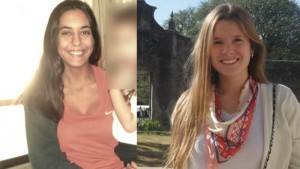
Recently, two young Argentinian women, María Coni and Marina Menegazzo, were killed while backpacking in Ecuador. In response to the horrific victim-blaming that followed, the phrase #viajosola (I travel alone) trended on Twitter, with more than 5,000 women using the hashtag to discuss their experiences.

Here’s mine. I have visited 19 countries and all 50 U.S. states (more than 40 of them at least twice) and have traveled alone for many of the trips. I began running alone in public spaces in middle school and I first flew on a plane solo as a teenager. Thus, combined, I have spent a lot of time alone in public spaces locally and while traveling. And yes, I have faced a lot of street harassment. I’m 33 now and I’m sure the figure is in the thousands.

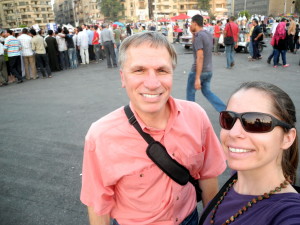
In addition to the scary experiences I’ve had in the U.S. of being grabbed, followed and chased, my worst experiences have been in the UK, Ethiopia, and India. Men made explicit comments to me, followed me, hounded me. I traveled with my dad in Egypt and if I ever left his side for a second in a public space, men would start in with catcalls. I specifically traveled with my dad to try to stay safe, especially as there were still mob attacks happening against women at Tahrir Square.

But I’ve had really wonderful solo travel experiences too, with my best experiences happening in Ireland, Iceland, Norway and Sweden (likely there’s no coincidence that they are countries with some of the highest gender equality rates in the world… it probably also helped that I didn’t look out of place as a white woman in those countries).

I was hesitant the first time I traveled completely alone in Ireland at age 21 while studying abroad. I stayed in hostels full of strangers, had to figure out bus schedules and debated ever eating in restaurants or just picking up snacks at a grocery store and eating on a park bench or hostel room bed. But overall it was a lovely trip. I saw major historic sites and national parks from coast to coast. I even kissed the Blarney Stone. Everyone I encountered was so nice and helpful. In my six days of solo travel I wasn’t harassed once. And I had the freedom to do what I wanted. I determined every aspect of my schedule. I could eat when I wanted, leave when I wanted, go to bed when I wanted, etc.

I wish every person — every woman — could have the experience to travel and to travel safely. To see the world, to meet its diverse people, and to expand their mind. But street harassment and the fear of it escalating to sexual assault and even murder puts a damper on things.

Going back to the two Argentinian women and the victim-blaming, here are excerpts from two excellent articles on the Guardian and NPR:

Guardian:

“The restriction of women’s solo travel remains a curiously acceptable form of victim-blaming. When Sierra was killed, for example, one headline read: “American’s death in Turkey puts focus on solo travel”. Compare this with a headline about the death of Harry Devert, a 32-year-old US citizen killed while travelling alone in Mexico: “The untimely death of world traveler Harry Devert.” When Australian Lee Hudswell died after an accident while tubing down a river in Laos, the press reported: “Fatal end to Lee’s overseas adventure”.

Female travellers have long been subjected to restrictions and double standards, with their gender emphasised over their capability and strength. Female travellers are much more likely to be categorised into reductive stereotypes – such as the glamorous adventuress – than their male counterparts. Think HG Wells in ‘Warehouse 13’, sexy Lara Croft, or the film portrayal of Adèle Blanc-Sec versus that of Tintin. When men travel in films, they are usually just travelling, but when women do, they are often running away from (or towards) a male romantic partner. (Compare The Holiday, Wild, Under the Tuscan Sun, Eat Pray Love, to The Motorcycle Diaries or Into the Wild.) There are, of course, welcome exceptions (take a bow, Dora the Explorer).

Travel has historically been, and to an extent still is, seen as a natural, bold activity for men, and a risky or frivolous pursuit for women. And as with so many other forms of low-level sexism, the knock-on impact is enormous. At a local level, curtailment of travel can prevent women from accessing healthcare, visiting family or taking job opportunities. When we restrict women’s wider freedom, we also curtail their ability to broaden their horizons and acquire valuable language skills. The impact on women’s careers can be clearly seen in the responses to female journalists who experience assaults while reporting abroad and face not only immense victim-blaming but also the curtailment of foreign assignments as a result.”

NPR:

“By the time I read about Marina Menegazzo and María José Coni, their bodies have already been found. They’d been missing for nearly a week and were discovered on Feb. 28, wrapped in plastic bags and dumped near a beach in Ecuador. One had her skull bashed in, the other had stab wounds and had bled to death. The two Argentine tourists, 22 and 23, had been vacationing in Ecuador. Their murder wasn’t reported much in English language media.

As is often the case with crime in Latin America, there’s been an array of versions of what happened shrouded in a cloud of doubt. Initially, Ecuadoran authorities detained two suspects and said one had confessed that he and his friend were drunk. One of them tried to touch one of the girls and she resisted. He then hit her on the head with a stick; the blow killed her. The suspect says her friend panicked, and the other murder suspect stabbed her.The families of the victims publicly questioned this version — they think both suspects might have had nothing to do with the murders and were being forced by authorities to confess.

In recent days another version of the story has surfaced: One of the suspects has linked the murders to a group of Colombian, Ecuadoran and Venezuelan drug traffickers, one of whom was arrested this week. Coni’s father has publicly speculated that “perhaps they kidnapped the girls to traffic them and killed them.” The Argentine Consul in Guayaquil, Ecuador, has said he does not discount that hypothesis.

Justicia por Marina Menegazzo y María José Coni!! pic.twitter.com/neUkxWYjFD

— Milagros Portioli (@Mili_Portioli) March 3, 2016

One thing is for sure: The murders have sparked outrage in Latin America, where there is a widespread crisis of femicide (the deliberate killing of women) and sexual violence. Central America has some of the highest rates. The 2012 Small Arms Survey, often cited by United Nations, surveyed murders of women around the world in the years 2004-2009. At a rate of 12 per 100,000, El Salvador is the country with the highest femicide rate, followed by Jamaica (10.9), Guatemala (9.7) and South Africa (9.6). Many of the deaths are related to gang violence that rages throughout much of Central America: In a recent series, NPR investigated the brutal effect gang violence has on young women, who are seen as sexual trophies and are targeted in sexual attacks.

Central American women who choose to leave the region and head north to the U.S. face a grim reality. Amnesty International estimates that 60 percent will be assaulted on the way. Activists report that many take birth control before the dangerous journey, in preparation for possible sexual assault.

And it’s a problem that extends far south. According to Argentine NGO “La Casa Del Encuentro” in 2014 nearly 300 murders in Argentina were considered hate crimes against women. All of this has led to a growing women’s rights movement, with the hashtag campaign #niunamenos (#notoneless) protesting the killing of women. It’s also led to femicide laws in several Latin American countries, including in Brazil, where the U.N. estimates that an average of 15 women a day are murdered in acts of gender violence. The new Brazilian law imposes jail sentences of up to 30 years for convicted offenders and longer sentences for criminals who attack girls under 14, women over 60 and pregnant women.

The outrage over the fate of the Argentine tourists goes beyond the killing itself. News articles about the murders are filled with reader comments like this one: “It’s terrible, what happened to them, but how irresponsible of their parents to let them travel alone, backpacking.” Another commenter writes: “the world is tough and their parents clearly didn’t teach them well … What did they expect?”

That line of questioning has launched a twitter hasthag #yoviajosola (#Itravelalone).”

There SHOULD be outrage. No woman should be killed simply for being female in public. Or for simply being female. (And ideally, no one should be murdered, period!).

Tahrir Square in Cairo with my dad, July 2012

When people have warned me to not travel someplace because it’s unsafe, I weigh the facts. I’ve never not gone somewhere, but twice I did adjust my plans. When I went to Egypt, I decided I’d feel safer with my dad. When I went to India for a conference and sightseeing, I decided I’d feel safer going with a friend than alone.

But generally, I realize that I have just as much chance of being street harassed near home (as I was earlier this month) as I do abroad or in other states. And it’s more likely that I’ll be hurt in a car accident here at home than that I’ll be raped while traveling.

So yes, harassment and worse are considerations, but they won’t stop me from traveling for work, for activism, and for my own education of the world.

We should not blame women who are traveling alone or with other women for the harassment or violence they face. We should instead do everything that we can to ensure that everyone can have the freedom to navigate our world safely, in their own communities and abroad.

Share

Filed Under: News stories, street harassment Tagged With: Argentina, ecuador, María Coni, Marina Menegazzo, travel alone, viajosola, victim blaming

Obama Talks about Online and Offline Public Sexual Harassment

March 17, 2016 By HKearl

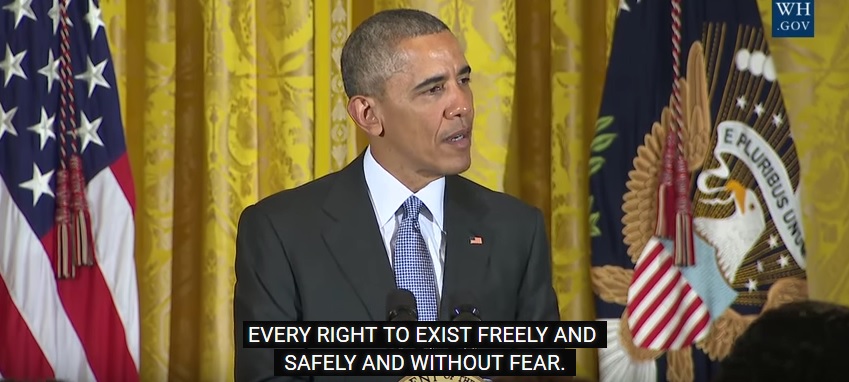
Yesterday, President Barack Obama talked about both online & offline sexual harassment in public spaces!! I believe this is the first time he has publicly done so regarding street harassment, so this is big.

ObamaSHMarch2016

Here is a short excerpt, but to read or watch more, jump to around minute 40 of the video (for online harassment) and 50 (for offline harassment).

“…’Obviously, this is not unique to the Internet,’ Obama added. ‘Women have been up against this kind of nonsense since the beginning of time. As long as women have dared to enter the public space — whether they’re fighting for their rights or simply walking the streets, there have been times where they’ve been harassed by those who apparently see the mere presence of women as a threat.’

Obama said that while it’s important for women to continue to speak up about online harassment, it’s also integral that men join in. ‘This is not just the role for women,’ he said. ‘It’s about men speaking up and demanding better of themselves and their peers, their sons, their friends, their coworkers. Because we’re all in this together.'”

Thank you so much, Obama!!

Share

Filed Under: male perspective, News stories, online harassment, public harassment Tagged With: Barack Obama, male allies, offline harassment, online harassment

Mid-March 2016 News Roundup

March 17, 2016 By HKearl

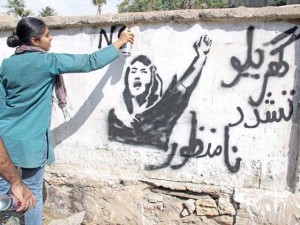
Young men and women took to street art and painted slogans and images against domestic violence, street harassment, identity crisis, stereotypes and rape in Gulshan-e-Iqbal, North Nazimabad, Saddar, Tower, II Chundrigarh Road, Karachi Press Club and Numaish. PHOTOS: AYESHA MIR/EXPRESS
PHOTOS: AYESHA MIR/EXPRESS

Pakistan Tribune, “NSF seeks to empower women via ‘Draw for Feminism’ campaign”

“Around 20 young men and women took to street art and painted slogans and images against domestic violence, street harassment, identity crisis, stereotypes and rape. Employing stencils and paints, the group went about raising their voice through graffiti in Gulshan-e-Iqbal, North Nazimabad, Saddar, Tower, II Chundrigarh Road, Karachi Press Club and Numaish. Talking about what drove them to initiate the campaign, NSF Karachi organiser Muzammal Afzal said until women of our society are not freed, the society cannot exist as a free entity.”

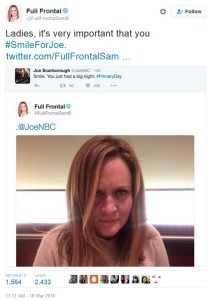
SmileForJoe-March2016Mic, “Samantha Bee Starts #SmileForJoe Twitter Campaign Against MSNBC Host Joe Scarborough”

“While Democratic frontrunner Hillary Clinton had a successful Tuesday with the five states voting in the primaries, there was one issue with her victory speech, according to male pundits: She didn’t smile enough. MSNBC anchor Joe Scarborough was the headlined instigator, directing in a tweet that the former Secretary of State “smile” after her “big night.”

Samantha Bee — host of the new TBS late night show Full Frontal — didn’t agree with Scarborough’s slight. In response, the comedian has started a ‪#‎SmileForJoe‬ campaign on Full Frontal’s Twitter, beginning with a photo of herself frowning, coupled with the caption: “Ladies, it’s very important that you #SmileForJoe.””

iSchool Guide, “California Becomes First State To Make Sexual Consent Lessons Mandatory In High Schools Beginning Next Year”

“California Governor Jerry Brown’s office announced Thursday that the state will require all high schools statewide to teach students about sexual consent. Brown’s approval of the measure made California the first U.S. state to take such move..

The new law mandates all school districts that have made health a graduation requirement to lecture students about sexual violence prevention and affirmative consent starting next year. It also urges state education officials to include those topics to their high school health curriculum.”

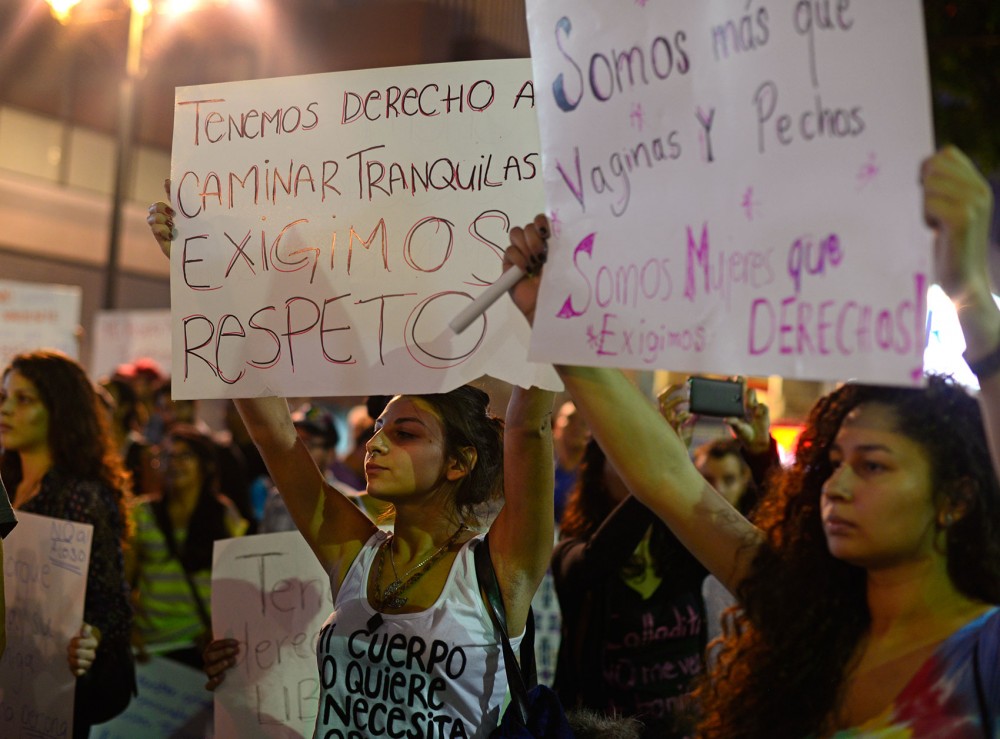
The Tico Times, “Costa Rica march demands end to street harassment”

“Over 100 people on Tuesday evening marched along San José’s Central Avenue to protest the persistent sexual harassment of women – and sometimes men – in public places, including streets, sidewalks, parks and the workplace.

Dubbed “Las calles también son nuestras” – “The streets are ours, too” – the demonstration was convened by the National Women’s Institute (INAMU) as part of International Women’s Day….

Members of several human rights and LGBT groups joined the protest.

Costa Rican President Luis Guillermo Solís, first lady Mercedes Peñas and the couple’s daughters joined demonstrators, along with Vice President Ana Helena Chacón and Women’s Issues Minister and INAMU President Alejandra Mora.

“I’m here to demand that women can walk and work peacefully in public spaces,” President Solís said. “We cannot tolerate more aggression. Violence is unacceptable.”

ticoTimesCostaRicaIWDmarch2016

MSN, “Bus No. 8 conductor sacked for alleged sexual harassment of female passenger”

“A conductor of the bus was fired yesterday after a female passenger accused him of sexually harassing her during a ride from MRT Ladprao on Saturday night.

The Bangkok Mass Transit Authority (BMTA) instructed the bus operator to fire the conductor, identified only as “Pai,” yesterday following a complaint by a woman who claimed Pai was being a total creep by touching her and then following her when she got off the bus.”

Women 24, “Does Zuma Approve Catcalling?”

“…Speaking to a group of female journalists on Saturday, [South African president Jacob Zuma] said that ‘when men compliment [women] innocently, you say it’s harassment. You will miss out on good men and marriage.'”

There are countless resources available on why street harassment is not flattering, and I encourage you to do some research. For now, let me explain in a nutshell why catcalls and wolf whistles from strangers are not compliments.

Commenting on a woman’s appearance immediately reduces her to an object. To you, she is nothing more than her looks. Saying ‘Hey cutie’ or ‘Looking good, baby!’ or ‘I’d like to bury my face in that ass’ — yeah, don’t do that.

It also implies that women exist for men’s viewing pleasure. She did not ask for your thoughts on her appearance; believing you have the right to give it — or that she should be grateful for your unsolicited opinion — is presumptuous…..”

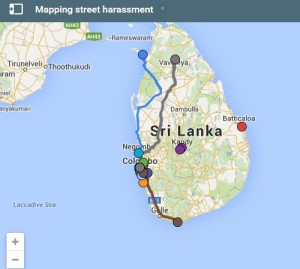
SriLankaMappingSHMarch2016Ground View, “Mapping Street Harassment [in Sri Lanka] This Women’s Day”

“March 8 marks International Women’s Day, and this year Groundviews decided to highlight the widespread nature of street harassment, by mapping it. Each marker tells a story – a story of a woman trying to go home, to work, or just about her day – only to be made to feel uncomfortable, or even unsafe. View the map directly here.”

Mic, “A Reporter Was Slut Shamed After a Man Pulled Her Underwear Down on the Street”

“In the CCTV footage, Noel is seen walking down the street [in Mexico] while an unidentified man creeps up behind her. The man lifts her skirt up, pulls down her underwear and runs away, while Noel is left sprawled in the streets.

“If anyone recognizes this imbecile, please identify him,” Noel wrote in her tweet, in Spanish. “Women should be able to walk safely. ‪#‎FelizDiaDeLaMujer‬ [translation: Happy Women’s Day].”

For the most part, Noel’s tweet garnered an outpouring of support, as well as nearly 4,000 retweets in the span of only a few days. Yet a small number of literal demons felt it was appropriate to blame Noel for the assault, attributing it to, among other things, her blonde hair and the way she was dressed.”

Esquire, “12 Things About Being A Woman That Women Won’t Tell You”

“#6: Fear. We’re scared. We don’t want to mention it, because it’s kind of a bummer, chat-wise, and we’d really like to talk about stuff that makes us happy, like look at our daughters — and we can’t help but think, “Which one of us? And when?” We walk down the street at night with our keys clutched between our fingers, as a weapon. We move in packs — because it’s safer. We talk to each other for hours on the phone — to share knowledge. But we don’t want to go on about it to you, because that would be morbid. We just feel anxious. We’re scared. Given the figures, we can’t sometimes help but feel we’re just… waiting for the bad thing to come. Because that would be a realistic thing to think, and we like to be prepared. Awfully, horribly, fearfully prepared.”

Khaama Press, “Afghan Women to Use Technology to Stop Street Harassment”

“As part of ongoing celebrations of Women’s History Month, USAID’s Promote Women in the Economy (WIE) program recognized three women who developed the best concepts for a mobile device application to help women confront street harassment in Afghanistan.

The applications, developed as part of USAID WIE’s first Code Challenge competition, will allow women to report harassment in real time as it occurs and identify problem areas, or to send a message to friends, family members, or other nearby users to ask for assistance.”

National Post, “In a Canadian first, survivors of sexual violence will get free legal advice in Ontario pilot program”

“Anyone who has experienced a sexual assault in Toronto, Ottawa and Thunder Bay — the host cities for the pilot — will be offered access to four hours of free legal advice.

“It’s not representation in court but to help these women to make an informed decision: what are their options, what are the services offered to them,” Ontario Attorney General Madeleine Meilleur said. “At the end they will make their decision: do I go forward, what do I do?”

While some advocates have called for sexual assault complainants to get equal standing in criminal trials to defendants, that’s a federal matter and one that would challenge centuries of common law. This move is meant to empower and inform these individuals of their legal rights and options without upending the justice system.”

U.S. News & World Report, “Is Egypt Doing Enough to Counter Widespread Sexual Harassment?“
“An Egyptian TV talk show host who slammed a sexual assault survivor, blaming her for provoking the attack by “dressing immodestly,” has been sentenced to one year in prison. Reham Saeed’s conviction is a milestone ruling in a country where sexual harassment and assault is so commonplace that it has been described by rights groups as “endemic” and where, for decades, survivors have been stigmatized and blamed for provoking the assaults. Rights activists believe the recent court decision is the result of social media pressure after thousands of activists launched a relentless online campaign using Arabic hashtags that translate to #dieReham and #prosecuteRehamSaeed.”

Guardian Series, “‘We have a growing problem of sexual harassment in Walthamstow’ – MP speaks out as activists organise march”

“Stella Creasy MP [in the UK] has spoken out about the fear women have of sexual harassment on the streets of Walthamstow as she invites people to a day of action to celebrate International Women’s Day.

The Walthamstow Labour MP will take part in a march to tackle street harassment and she has also organised a “feminist bootcamp” to develop the leadership skills of women on Saturday (March 5).”

The Irish Times, “Street harassment: Feeling intimidated familiar for women”

“As women speak up more and call out harassment and violence as simply unacceptable, men need to get involved too. Men need to call out unacceptable behaviour by their friends. They need to stand up for women. They need to know that being drunk isn’t an excuse to act like a thug. They need to realise that women live in a world where the violence perpetrated against them is very often gendered, a violence and harassment that emerges from a culture of misogyny and a desire – however subconscious – to keep women in their place and to exert a sort of power over them that reminds them of who rules.

The threat that hangs in the air at night when a woman is walking past a group of men is not made up, it is not fantasy or an unfounded fear. The sense of threat is real because the outcome of that sense is often very real too. It’s not ok, it’s never ok, and we all have a duty to stand up against it and end it.”

al-Monitor, “How a new website is helping Lebanese women avoid sexual harassment”

“Nour confided how she had experienced shame after being touched by a stranger in a service when she was 19. She remembered, “I told no one what happened that day, not even my parents. I was feeling so shameful. Later on, I understood that the shame was not mine to feel, but his. It was not my fault.” Allowing women to express what happened to them anonymously is one of the purposes of HarassTracker as well as applying words to the act of harassment.

“It is empowering to say that happened and that was sexual harassment,” Mir, the website’s designer, told Al-Monitor. “Even if there is a doubt, nuances, you can at least make other people understand. At least we can change things a bit to make people start talking. People don’t go to our website only to denounce a harassment, they visit too. So it’s always positive, even though it’s not going to make the situation evolve right away,” said Mir.”

Raw Story, “SXSW panel: Sexual harassment and bullying in gaming cannot be dismissed just because it’s online”

“Online harassment and sexism is demeaning women and can no longer be brushed aside as an ugly side of social media and the gaming industry if they are to thrive, panelists on Saturday said at the South By Southwest (SXSW) tech meeting in Austin.

The gaming summit at one of the premier events on the global tech calendar had faced threats of violence, prompting organizers in October to initially suspend two panels on the subject. After facing a flood of criticism from online media firms, SXSW organizers reversed course and set up a full day of discussions on the subject.

Bustle, “I Confronted My Street Harassers, And Reclaimed My Power In The Process”

“The fear of experiencing violence at the hands of a man is all too real for women, but the alternative is living my life in fear of what may happen. I don’t know how I’m going to die, but I do know how I don’t want to live.

Street harassment is not inevitable. I have seen the impact responding to someone can have. If, in my mission to reclaim my personhood, I’ve deterred one man from harassing another woman on the street, then I’ve been more successful than I could ever imagine. Our bodies belong to us. We are not public property, and no one has the right to make us feel otherwise.”

The Michigan Daily, “Melissa Scholke: We must share our stories”

“I write this acknowledging that street harassment, or cat-calling, is a societal problem with no easy, immediate solution. My encounters with this issue began around the age of 18 and will most likely continue for many more years to come. For others from different races, religions and communities, their experiences may differ vastly in severity and frequency. Regardless, these experiences need to be recounted and retold as frequently as they occur.

Over break, I read essays by Rebecca Solnit, and one section of her essay, “Pandora’s Box and the Volunteer Police Force,” stood out to me. She writes, “Saying that everything is fine or that it will never get any better are ways of going nowhere or of making it impossible to go anywhere.”

When my friend first suggested I write about street harassment, I thought it was redundant and wouldn’t make anything better. However, it’s the insistent act of continually writing and making voices heard that leads to significant change.”

The Piolog, “Students of color face foreign ideas of race abroad”

“Race and identity play out differently around the world forcing students of color to face the ways in which their identity is interpreted in other cultures.

For Karissa Tom ’16, the shouts of “China,” “Japan,” and “Korea,” became the form of harassment she had to navigate on a daily basis while studying abroad in Morocco in the Spring of 2015…

For women participating in study abroad programs,  sexual harassment can often be a scary reality. The scariness of this reality can be intensified for female students of color because of the intersections between the sexualization and racialization of their bodies…

I also studied abroad in Morocco, but my blackness invited different forms of racialization.  Street harassment for me was always racialized due to stereotypes about black women and sexualitiy. “Black pussy,” “I like the black girls,” and other comments with the same sentiment were yelled at me and only me.”

Refinery 29, “Superman Actor Says Women Have A Double Standard On Catcalling”

“Do women do that, too? Yes, absolutely, and it’s equally gross and unacceptable. Women shouldn’t catcall, either — but not because they aren’t as threatening: because it’s wrong to volunteer an assessment of a stranger’s physicality without having been expressly asked for it. That is an intimate move. It disregards a right to privacy, and it doesn’t matter where you fall on the gender spectrum: It’s not cool to approach someone you don’t know with comments about his or her looks. “

Share

Filed Under: News stories Tagged With: art, Costa Rica, Egypt, ireland, lebanon, mexico, Pakistan, south africa, sri lanka, thailand, UK, usa, victim blaming

« Previous Page
Next Page »

Share Your Story

Share your street harassment story for the blog. Donate Now

From the Blog

  • #MeToo 2024 Study Released Today
  • Join International Anti-Street Harassment Week 2022
  • Giving Tuesday – Fund the Hotline
  • Thank You – International Anti-Street Harassment Week 2021
  • Share Your Story – Safecity and Catcalls Collaboration

Buy the Book

  • Contact
  • Events
  • Join Us
  • Donate
  • Facebook
  • Instagram
  • Pinterest
  • Tumblr
  • Twitter
  • YouTube

Copyright © 2026 Stop Street Harassment · Website Design by Sarah Marie Lacy