• About Us
    • What Is Street Harassment?
    • Why Stopping Street Harassment Matters
    • Meet the Team
      • Board of Directors
      • Past Board Members
    • In The Media
  • Our Work
    • National Street Harassment Hotline
    • International Anti-Street Harassment Week
    • Blog Correspondents
      • Past SSH Correspondents
    • Safe Public Spaces Mentoring Program
    • Publications
    • National Studies
    • Campaigns against Companies
    • Washington, D.C. Activism
  • Our Books
  • Donate
  • Store

Stop Street Harassment

Making Public Spaces Safe and Welcoming

  • Facebook
  • Instagram
  • Pinterest
  • Tumblr
  • Twitter
  • YouTube
  • Home
  • Blog
    • Harassment Stories
    • Blog Correspondents
    • Street Respect Stories
  • Help & Advice
    • National Street Harassment Hotline
    • Dealing With Harassers
      • Assertive Responses
      • Reporting Harassers
      • Bystander Responses
      • Creative Responses
    • What to Do Before or After Harassment
    • Street Harassment and the Law
  • Resources
    • Definitions
    • Statistics
    • Articles & Books
    • Anti-Harassment Groups & Campaigns
    • Male Allies
      • Educating Boys & Men
      • How to Talk to Women
      • Bystander Tips
    • Video Clips
    • Images & Flyers
  • Take Community Action
  • Contact

Our Latest Research is Out Now!

April 30, 2019 By HKearl

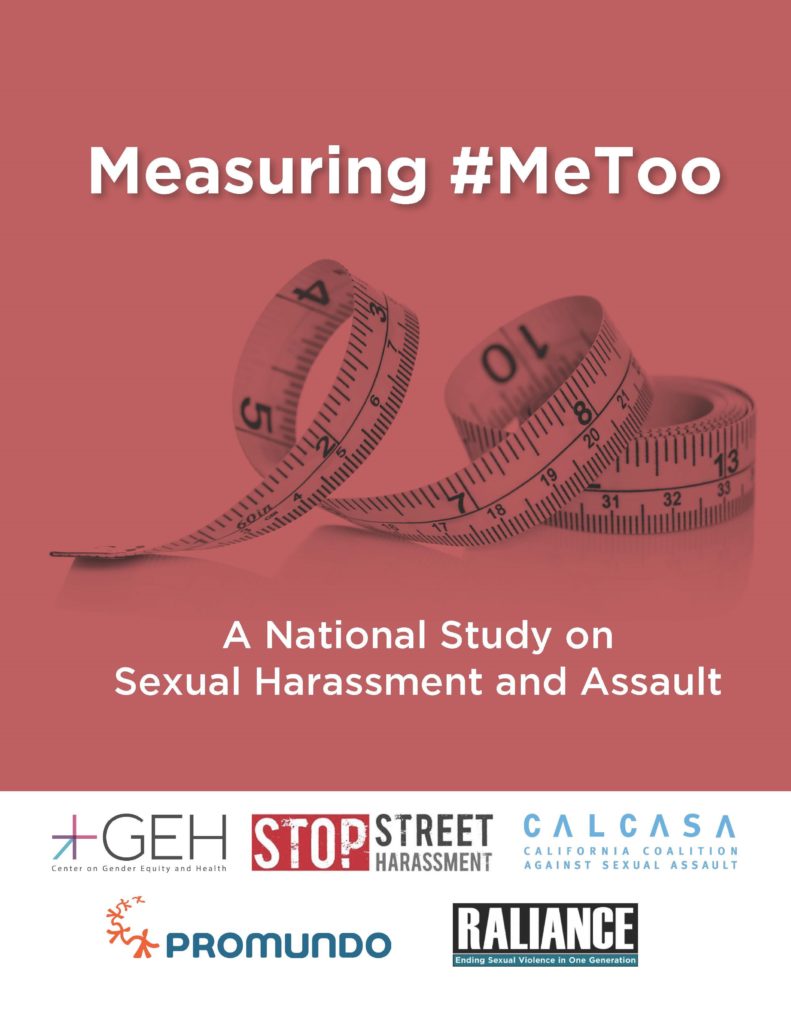
To close out Sexual Assault Awareness Month, on April 30, 2019, SSH, UCSD Center on Gender Equity and Health (GEH), RALIANCE, CALCASA and Promundo released a new joint national study.

NORC at the University of Chicago conducted the nationally representative survey of 1,182 women and 1,037 men across February – March 2019. They used the using the AmeriSpeak Panel. UCSD’s GEH did the data analysis.

READ: Full Report | Two-Page Executive Summary | Press Release | Survey Questions | Street Harassment Factsheet

Our findings include:

  • 81% of women and 43% of men reported experiencing some form of sexual harassment and/or assault in their lifetime. This graph shows the breakdown of the main categories:
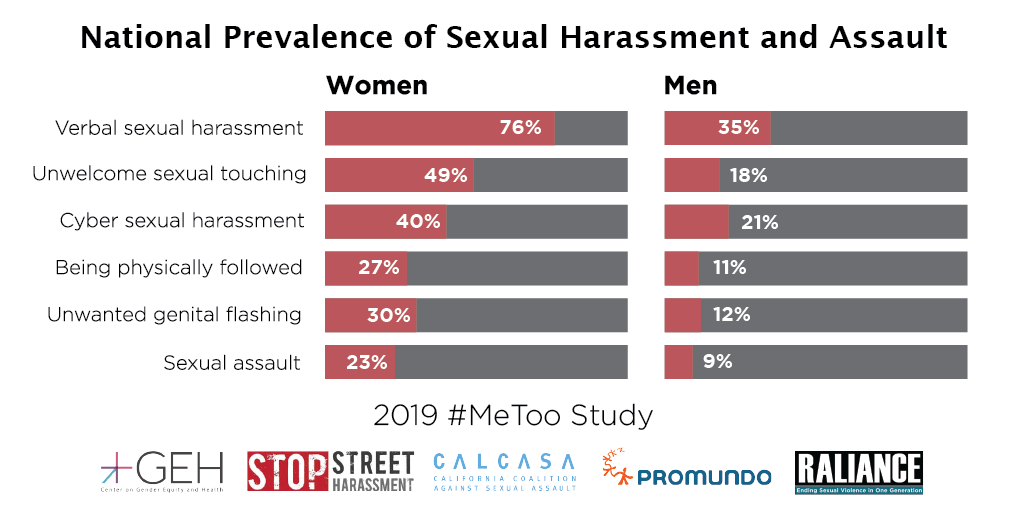
  • The most frequently was listed location for sexual harassment is a public space, while most sexual assault takes place in private homes or residences.
    • 68% of women and 23% of men experienced sexual harassment at a public place like a street, store, park or restaurant. When you include mass transit and nightlife venues, that statistic rises to 71% women and 28% men. In other words, nearly all women who had experienced sexual harassment and/or assault had experienced it in public spaces (as well as perhaps other locations).
  • Sexual harassment and assault cause people, especially women, to feel anxiety or depression and prompt them to change their route or regular routine.
  • While experiences of sexual harassment and assault are highly prevalent, accusations of sexual harassment and assault are very rare.
  • Most people who said they committed sexual harassment also said they had experienced sexual harassment.

While we repeated a few questions from our 2018 survey, we chose to add new questions around false accusations this year in light of the Kavanaugh hearing and Betsy DeVos’s efforts to change Title IX guidelines.

We broke down differences by demographics and included the findings that were statistically significant. For instance:

  • 35% of Black women had experienced sexual harassment in the previous six months.
  • 35% of women with disabilities experienced sexual assault in their lifetime.
  • 95% of lesbian/bisexual women experienced some form of sexual harassment in their lifetime.

Check out the full report!

Thank you to all of our donors who made this report possible!

Share

Filed Under: disabilities, LGBTQ, national study, News stories, online harassment, public harassment, race, SSH programs, street harassment Tagged With: metoo, national study, research

January 2019 Street Harassment News

February 1, 2019 By HKearl

Nigerian market protest against harassment

Here is a sampling of news that caught my eye relating to street harassment:

Global: An ActionAid study of 2,560 young people aged 14-21 in the UK, India, Brazil and Kenya found that 65% of girls had faced sexual harassment in the last six months and 20% worry about sexual harassment every single day.

Australia: The country has a long ways to go to stop sexism and street harassment.

Egypt: The country’s #MeToo Movement targets street harassment.

Egypt: A man was stabbed to death while standing up to street harassers.

France: A new film was released called “Prey,” or “La Proie.”

France: Sexism in humor remains a problem in society

India: A documentary about our partners Safecity.

India: Women are taking on sexual harassment.

Kenya: A study of a No Means No programme in Nairobi shows it’s effective.

“A study of adolescent girls in one of these settlements [in Nairobi], published in the Journal of Adolescent Health, found that a 12-hour No Means No programme more than halved incidences of sexual assault – a statistic that has been replicated across the programme’s reach. Ten months after completing the course, more than half of female participants reported that they had used their new skills to avert sexual assault.

Three-quarters of boys trained by No Means No have successfully intervened in a violent or sexual assault on a woman. And there has been a 46% decrease in school dropouts due to teen pregnancy where the programme is active.”

Lebanon: Women across the Arab world, including Lebanon, have launched anti-SH campaigns like #NotYourAshta

Netherlands: The first conviction under Rotterdam’s street harassment law was made.

Nigeria: How women in the market put a stop to street harassment.

Pakistan: There’s no perfect way to deal with street harassment.

Palestine: In Ramallah and beyond, women are using their clothing to respond to street harassment, ­wearing jackets and T-shirts ­emblazoned with the words “Not your habibti”.

Philippines: The House of Representative approved a law against street harassment.

Sri Lanka: 90% of women have faced sexual harassment on public transport.

Turkey: Syrian girls and young women who are refugees in Turkey face street harassment there.

UK: After an 18-month campaign, upskirting will be illegal in England and Wales.

UK: Five teenagers talk about their lives, including street harassment.

USA: “Surviving R Kelly” documentary aired and has led to some cities banning the musician.

USA: Coachella will combat sexual harassment with “safety ambassadors” this year.

USA: Harassment on Lyft vs Uber.

Share

Filed Under: News stories, street harassment, weekly round up

SSH stands with Terry Crews

January 29, 2019 By HKearl

All survivors of sexual assault and harassment deserve support and respect. 

Photo by Gage Skidmore

In October of 2017, actor Terry Crews courageously added his voice to a growing wave of survivors breaking their silence about sexual harassment and assault on a global scale.

This week, Terry Crews’ status as a survivor is making headlines again, but for all the wrong reasons, as Crews endures victim-blaming, skepticism, and other forms of revictimization following several celebrities’ mockery of Crews’ sexual assault.

Stop Street Harassment stands with all survivors of sexual harassment and assault, and we know all too well that Terry Crews is not alone in his experience. Our most recent survey research confirms that all genders experience harassment or assault: forty-three percent of men surveyed in 2018 said they’d experienced sexual harassment or assault. Twenty-six percent of men reported experiencing some form of physical sexual harassment. 17 percent said they’d experienced unwanted sexual touching, and 7 percent said they’d been sexually assaulted.

There is no “right” way for a person to act when they are disrespected, sexually objectified, made to feel unsafe, or touched without their consent. When someone comes forward and courageously shares a story of harassment or assault, the last thing they deserve is to have others speculate on what they could have or should have done, either in the moment or in the weeks, months, or years that follow.

Stop Street Harassment remains committed to ending gender-based public sexual harassment, and part of that work is uplifting survivors of any kind of harassment or assault. Thank you again to Terry Crews for adding his story and his support to a movement we hope will continue making the world a safer place for all survivors.

–Stop Street Harassment Board of Directors

Share

Filed Under: male perspective, national study, News stories

16 Days – Day 7: A Job for a Woman

December 1, 2018 By HKearl

Each day across the 16 Days of Activism Against Gender-Based Violence, we will highlight a 2018 activism effort undertaken to stop street harassment or a personal story about stopping harassers!

Day #7: A Job for a Woman

Image via BBC

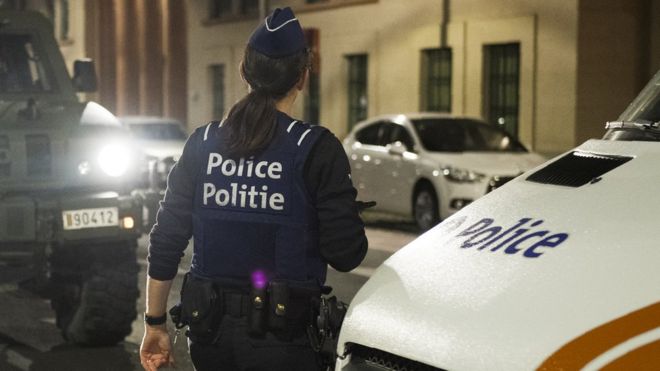
In Belgium, sexism in public places is illegal under a law passed in 2014. This year, the first charge was made using the law. A female police officer questioned a man after he jaywalked, and he said in response to her, “Shut your mouth, I don’t talk to women, being a police officer is not a job for women.” Apparently it IS a job for women (more than 30 percent of Belgium’s 40,000 police officers are women), and she arrested him. He was fined 3,000 euros.

Sexism, according to the law, is defined as “every gesture or deed” that is “clearly meant to express contempt of a person based on sex,” or considers a person inferior based on sex, or reduces a person solely to a sexual dimension, and which “gravely affects the dignity of that person as a result.”

Share

Filed Under: 16 days, News stories, Stories, street harassment Tagged With: belgium, laws, police officer

16 Days – Day 5: Indian Motorcycle Police Unit

November 29, 2018 By HKearl

Each day across the 16 Days of Activism Against Gender-Based Violence, we will highlight a 2018 activism effort undertaken to stop street harassment or a personal story about stopping harassers!

Day 5: Indian Motorcycle Police Unit

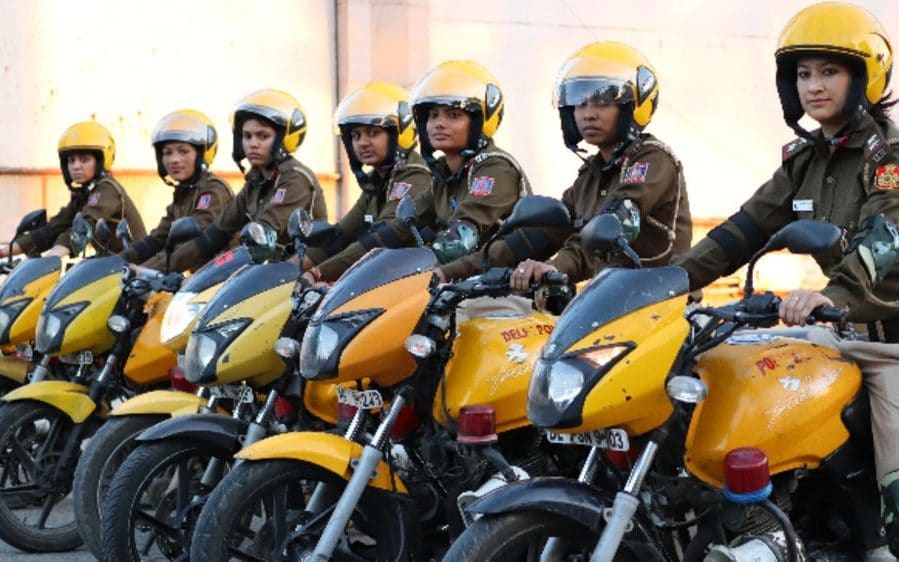
A 40-person, all-female motorcycle police unit in Delhi, India, has reduced the incidents of street harassment by 30 percent, according to the police in the city. The women have intervened in many street harassment cases during 24-hour patrols.

“We keep an eye on girls in distress. In several cases, members of the woman squad have nabbed stalkers. They rescue girls and also ensure they reach their destination safely,” said Vijayanta Arya, Deputy Commissioner of Police.

Share

Filed Under: 16 days, News stories, street harassment Tagged With: delhi, India, police unit

« Previous Page
Next Page »

Share Your Story

Share your street harassment story for the blog. Donate Now

From the Blog

  • #MeToo 2024 Study Released Today
  • Join International Anti-Street Harassment Week 2022
  • Giving Tuesday – Fund the Hotline
  • Thank You – International Anti-Street Harassment Week 2021
  • Share Your Story – Safecity and Catcalls Collaboration

Buy the Book

  • Contact
  • Events
  • Join Us
  • Donate
  • Facebook
  • Instagram
  • Pinterest
  • Tumblr
  • Twitter
  • YouTube

Copyright © 2026 Stop Street Harassment · Website Design by Sarah Marie Lacy